
Daylight Saving Time Ends 2026: When Do Clocks Go Back in the US and UK?
Daylight saving time ends November 1 in most of the US and October 25 in the UK. See exact clock-change times, exceptions, time differences and device settings.
Contents
- When does daylight saving time end in 2026?
- What happens at 2 a.m. when the clocks go back?
- Which U.S. states and territories do not change their clocks?
- Why the UK and US have different clock-change dates
- How to prevent missed meetings, flights and deadlines
- How to check automatic time changes on iPhone
- How to check time settings on Android
- How to check Windows and Mac computers
- Does changing the clock affect sleep and health?
- Practical sleep tips for the fall clock change
- What about daylight saving time in 2027?
- A quick checklist for October and November 2026
- Official sources and further reading
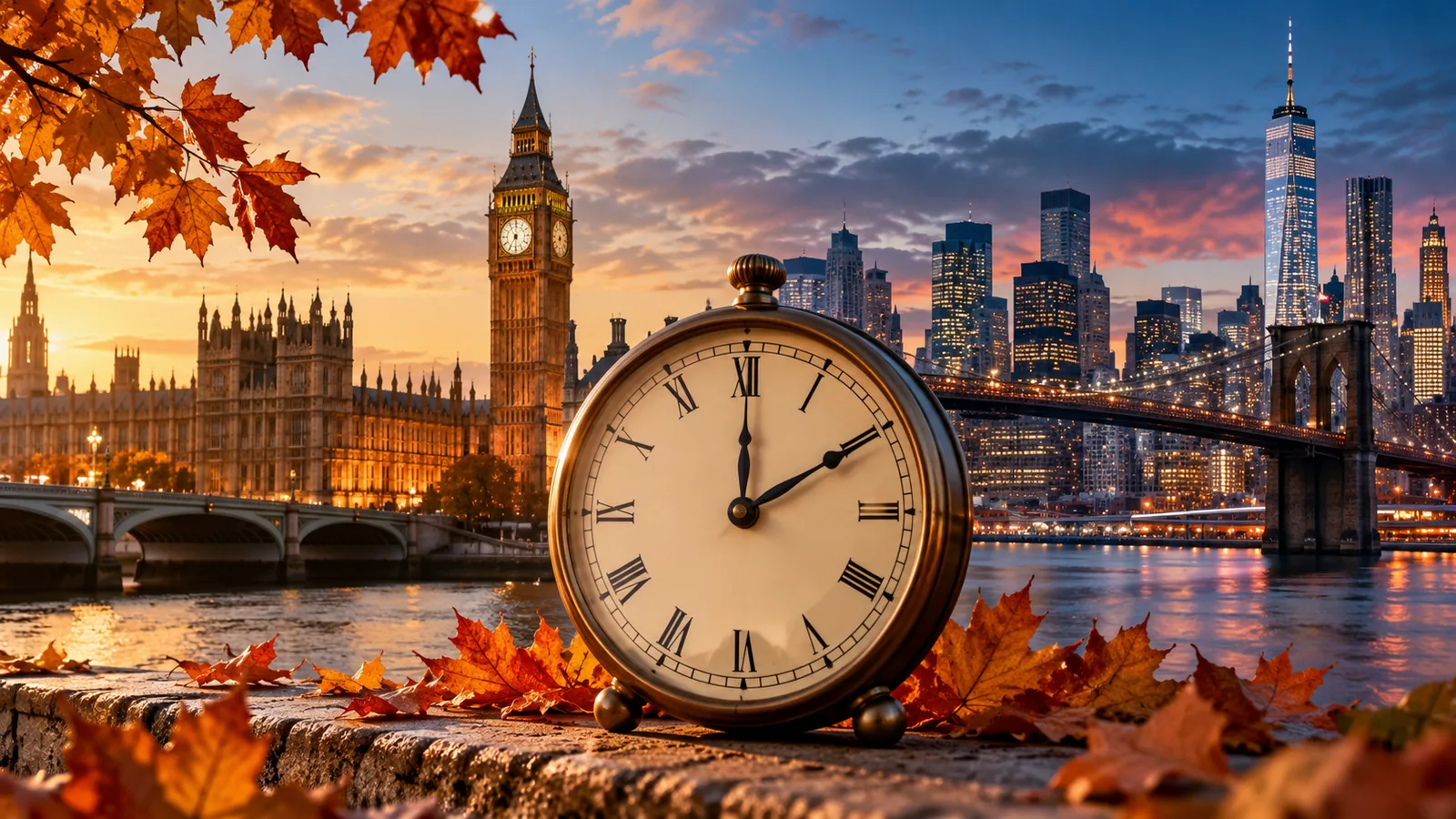
Updated October 17, 2026. Daylight saving time ends on Sunday, November 1, 2026 in most of the United States, but the United Kingdom moves its clocks back a week earlier, on Sunday, October 25, 2026. In places observing the change, 2:00 a.m. becomes 1:00 a.m., creating an extra hour on the clock. The difference between the two dates matters for international meetings, flight connections, work shifts, and time-sensitive appointments.
This practical guide explains the precise changeover times, U.S. exceptions, why the UK–U.S. time difference temporarily shifts, and how to check phones and computers. It also separates the official calendar rules from health and technology advice that may vary by individual or device.
When does daylight saving time end in 2026?
| Location | Date | Local change | What happens |
|---|---|---|---|
| Most of the United States | Sunday, November 1 | 2:00 a.m. → 1:00 a.m. | Daylight time becomes standard time |
| United Kingdom | Sunday, October 25 | 2:00 a.m. BST → 1:00 a.m. GMT | British Summer Time ends |
| Most EU countries | Sunday, October 25 | 03:00 CEST → 02:00 CET, or equivalent | Summer time ends |
| Arizona (most areas) and Hawaii | No autumn change | Not applicable | Standard time year-round |
The U.S. Naval Observatory calendar for 2026 lists November 1 as the end date. The UK government clock-change calendar lists October 25. The dates are not interchangeable: they follow different statutory schedules.
What happens at 2 a.m. when the clocks go back?
In an area observing the autumn transition, the clock repeats the hour from 1:00 to 1:59 a.m. In the United States, local daylight time reaches 2:00 a.m. and immediately returns to 1:00 a.m. standard time. In the UK, 2:00 a.m. BST returns to 1:00 a.m. GMT. The calendar day effectively contains 25 local clock-hours, but you do not gain an extra hour of sunlight: daylight is simply displayed at an earlier clock time.
- Morning: sunrise appears about an hour earlier by the clock immediately after the change.
- Evening: sunset appears about an hour earlier by the clock.
- Overnight schedules: a time such as 1:30 a.m. may occur twice; confirm whether it means the first or second occurrence.
- Pay and transport: overnight shift arrangements, train timetables and airline schedules depend on the employer or operator; never assume the extra hour is handled identically.
Which U.S. states and territories do not change their clocks?
Under current federal daylight saving time rules, Hawaii and most of Arizona do not observe the seasonal clock change. The Navajo Nation, including its Arizona territory, does observe daylight saving time. Puerto Rico, Guam, American Samoa, the U.S. Virgin Islands and the Northern Mariana Islands do not follow the standard mainland clock-change schedule. Check local jurisdiction rules if you live near tribal or state boundaries.
The National Institute of Standards and Technology (NIST) explains the federal schedule and key exceptions. States that observe daylight saving time do not get to choose a different changeover date independently under the usual federal framework.
Why the UK and US have different clock-change dates
The United Kingdom ends British Summer Time on the last Sunday in October. Most of the United States ends daylight saving time on the first Sunday in November. In 2026, those Sundays are October 25 and November 1. For the intervening week, transatlantic time differences are typically one hour smaller than usual for locations that change clocks on both sides.
| Period | London vs New York | London vs Chicago | London vs Los Angeles |
|---|---|---|---|
| Before UK change (through Oct 24) | London +5 hours | London +6 hours | London +8 hours |
| Oct 25–31, 2026 | London +4 hours | London +5 hours | London +7 hours |
| From Nov 1, 2026 | London +5 hours | London +6 hours | London +8 hours |
Example: A London meeting scheduled at 3:00 p.m. on October 28 corresponds to 11:00 a.m. in New York, not the usual 10:00 a.m. A meeting at 3:00 p.m. London time on November 4 is back to 10:00 a.m. New York time. The example assumes each city follows its local time zone and that no other schedule changes apply.
A meeting time written only as “10 a.m.” is ambiguous around a clock change. Include the date and an IANA time-zone name, such as Europe/London or America/New_York.
How to prevent missed meetings, flights and deadlines
- Use a calendar event with a named time zone rather than typing an informal offset such as “GMT-5” all year.
- For recurring meetings, check both the week of October 25 and the week of November 1; a fixed local time in one country can shift for participants in another.
- Verify departure and arrival times on the airline or rail operator’s official booking page. Tickets normally show local airport or station times.
- For overnight work, payroll and medical appointments, confirm how the repeated 1 a.m. hour is labeled.
- Set two reminders for critical international calls: one the day before and another shortly before the meeting.
How to check automatic time changes on iPhone
On a recent iPhone, open Settings → General → Date & Time and check that Set Automatically is enabled. The setting may depend on device restrictions, mobile network information or location services. If the displayed time is wrong, restart the phone, update iOS, verify the selected time zone, and consult Apple’s official time-setting instructions. Do not manually force the clock back a week early just because the UK and U.S. dates differ.
How to check time settings on Android
On many Android phones, open Settings → System → Date & time and enable automatic date/time and automatic time zone. Samsung and other manufacturers may place these controls under General management or another menu. Search Settings for “date and time” if the menu differs. Confirm that the selected city or region is correct; a device configured for the wrong zone can display the wrong local time even when automatic updates are on.
How to check Windows and Mac computers
- Windows 11: open Settings → Time & language → Date & time. Turn on automatic time and confirm the time zone. Use “Sync now” if the displayed clock is incorrect.
- Mac: open System Settings → General → Date & Time. Enable automatic time and check the time-zone setting, especially after travel.
- Other devices: smartwatches, networked clocks and some car systems usually update automatically; ovens, wall clocks and older car dashboards often need manual adjustment.
For technical troubleshooting, use the official Microsoft Windows support and Apple Mac help pages. Interface labels can change with operating-system versions.
Does changing the clock affect sleep and health?
A one-hour change can temporarily affect sleep timing, alertness and daily routines, although the autumn transition is generally easier for many people than the spring loss of an hour. Research findings vary across populations, and an extra hour on the clock does not guarantee an extra hour of restorative sleep. The CDC’s sleep guidance emphasizes consistent sleep schedules and adequate sleep duration.
Practical sleep tips for the fall clock change
- Keep a reasonably consistent bedtime and wake-up time over the days surrounding the change.
- Seek natural morning light when possible; it helps align the body clock with local daytime.
- Avoid relying on the extra hour to compensate for chronic sleep deprivation.
- Reduce late-night caffeine and bright-screen exposure if they interfere with your sleep.
- Allow extra attention for children, shift workers and anyone managing a sleep disorder; seek individualized clinical advice when needed.
The UK House of Commons Library’s 2026 briefing notes that health evidence around clock changes is mixed and that research often focuses on short-term transition effects. Avoid treating a specific health outcome as inevitable for everyone.
What about daylight saving time in 2027?
| Region | Clocks go forward in 2027 | Clocks go back in 2027 |
|---|---|---|
| United States (participating areas) | March 14, 2027 | November 7, 2027 |
| United Kingdom | March 28, 2027 | October 31, 2027 |
These dates follow the current U.S. and UK statutory rules. Proposals to abolish seasonal clock changes have been debated in both countries, but do not plan around a proposed change unless the relevant government actually enacts it. Check official calendars again when arranging long-range travel or contracts.
A quick checklist for October and November 2026
- UK residents: check clocks and alarms on Sunday, October 25.
- U.S. residents in participating areas: check clocks and alarms on Sunday, November 1.
- International teams: review cross-border meetings scheduled between October 25 and November 1.
- Travelers: verify the time zone printed on bookings and check local transport notices.
- Anyone using manual clocks: adjust kitchen appliances, wall clocks and older car dashboards.
Official sources and further reading
You may also like
 Technology & How-To
USB Works on PC but Not on TV? How to Find the Cause
Diagnose a USB drive that works on a computer but not a TV. Separate detection, missing files and…
 Technology & How-To
WhatsApp “Waiting for This Message”: Fixes for iPhone, Android and Web
Fix WhatsApp’s waiting-message notice by comparing your phone and linked devices, checking updates and protecting existing chat data.
 Technology & How-To
WhatsApp iOS 15.5 Requirement: What Changes on November 30, 2026?
WhatsApp raises its iPhone minimum to iOS 15.5 on November 30, 2026. Check your version, older iPhone eligibility…