
Why Your Boiler Pressure Keeps Dropping: A Safe UK Diagnosis Guide
Boiler pressure dropping overnight or after topping up? Compare cold and hot readings, spot leak clues, and know when to call a UK Gas Safe engineer.
Contents
- Quick answer: what your pressure pattern may mean
- First, identify which pressure you are reading
- The safe 24-hour pressure log: a practical test that does not require tools
- Seven causes of boiler pressure loss, ranked by what you can observe
- 1. Water leaks at radiator valves, joints or visible pipework
- 2. Water discharged by the pressure-relief valve
- 3. Expansion-vessel pressure-control fault
- 4. Recent radiator bleeding or other maintenance
- 5. A filling loop that has not been fully closed
- 6. Hidden leaks under floors or inside walls
- 7. A faulty gauge, sensor or another internal component
- How to distinguish a normal hot-pressure rise from a problem
- Can you safely repressurise a boiler yourself?
- What not to do: six common internet mistakes
- Three practical scenarios: how to decide what happens next
- Scenario A: pressure fell after you bled upstairs radiators
- Scenario B: pressure looks fine at night but is low by morning
- Scenario C: pressure rises sharply when heating, then falls below normal
- When to stop and call a professional
- A useful handover checklist for your heating engineer
- Boiler pressure versus other heating problems
- The bottom line
- Sources and technical references
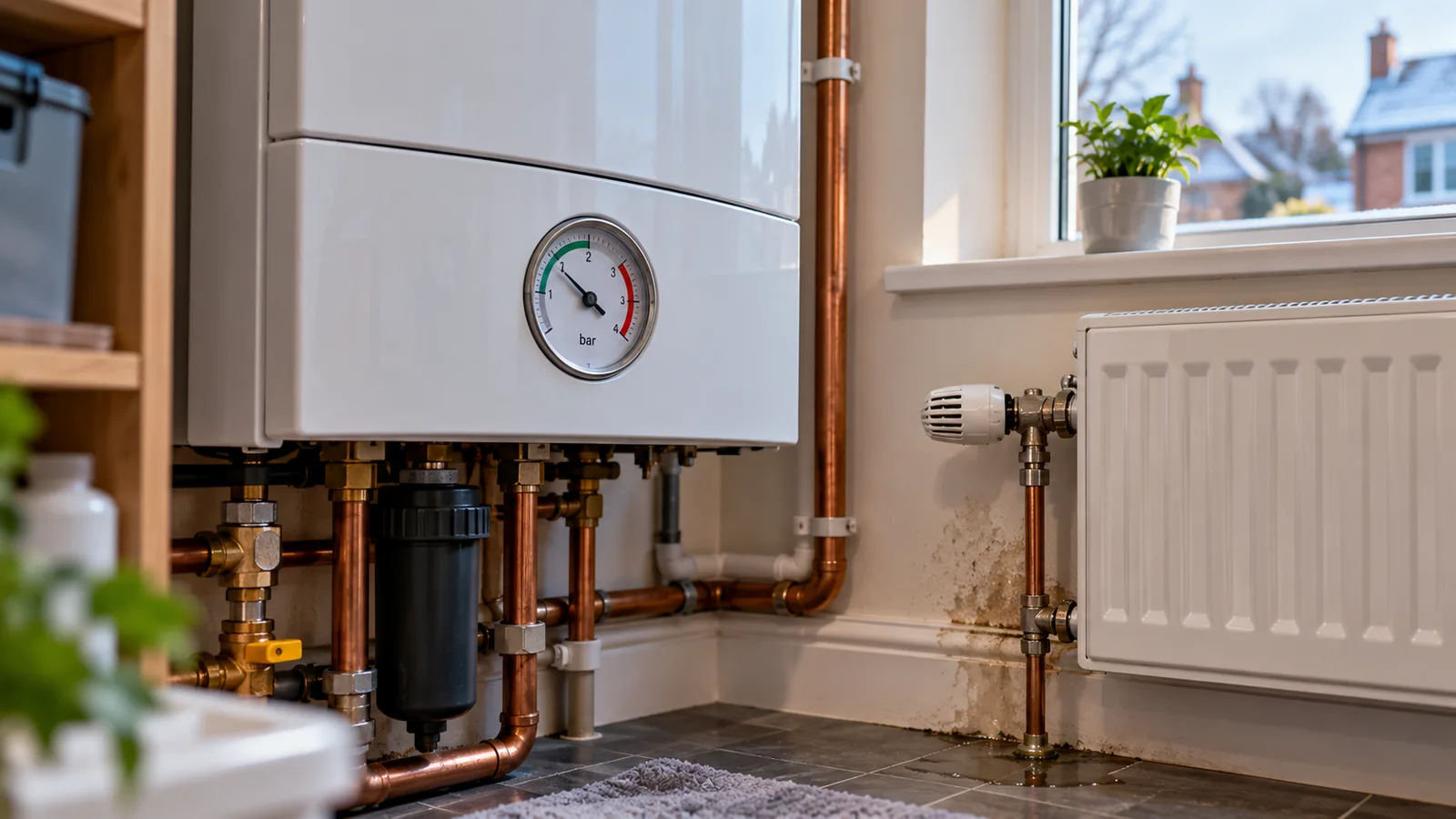
If your boiler pressure keeps dropping after you top it up, do not keep adding water indefinitely. In a sealed central-heating system, repeated loss usually means a leak, water discharged through a safety valve, or a fault affecting pressure control. A one-off fall after bleeding radiators is different from a gauge that drops every night. The most useful next step is to record when the pressure changes—not just how low it gets.
This UK-focused guide shows you how to compare cold and hot readings, identify clues you can inspect without opening the boiler, and prepare a useful record for a Gas Safe registered engineer. It also explains what common internet advice gets wrong: a single pressure reading cannot diagnose an expansion vessel, and repeatedly repressurising is not a repair.
Quick answer: what your pressure pattern may mean
| Pressure fell once after bleeding a radiator | Air released; system water pressure needs checking | Follow the model-specific user manual for a single top-up if permitted |
|---|---|---|
| Cold pressure falls over days or overnight | Possible small system leak or water escaping at a valve | Record cold readings; inspect accessible radiator valves and pipe joints |
| Pressure climbs unusually high when heating, then drops after cooling | Possible expansion-vessel or pressure-relief problem | Stop repeated top-ups; book professional diagnosis |
| External safety discharge pipe is wet or dripping | Possible pressure-relief valve discharge | Do not block the pipe; arrange engineer inspection |
| Gauge stays stable cold but heating does not work | Fault may not be pressure-related | Check fault code and controls; use manufacturer guidance |
First, identify which pressure you are reading
The gauge on a typical sealed combi or system boiler measures the pressure in the central-heating water circuit. It is not the pressure at your kitchen tap, the gas supply pressure, or necessarily the domestic hot-water pressure. A home can have excellent tap flow and still have a low boiler heating-circuit reading.
On many domestic sealed systems, the normal cold reading is around 1.0–1.5 bar, but the correct range depends on the boiler model, installation height and manufacturer. Some systems operate differently. Use the printed gauge markings and your own manual rather than treating any generic number as universal. British Gas provides the 1–1.5 bar guidance for many common boilers: boiler pressure guidance.
The safe 24-hour pressure log: a practical test that does not require tools
A useful addition to a standard checklist is a like-for-like cold reading log. Pressure naturally changes as water heats and cools, so comparing a hot gauge at night with a cold gauge the next morning can create a false impression of a leak. This is an observation exercise, not a pressure test and not a substitute for an engineer.
- Find the gauge or digital pressure display. Do not remove a casing or open a sealed panel.
- With the heating off and the system cooled to a comparable state, photograph the gauge and note the time, pressure, room temperature if available, and any displayed fault code.
- Repeat at roughly the same cold condition the next day. Avoid adding water during the observation period unless the manufacturer instructs you to restore operation; if the boiler is in a fault condition, prioritise safety and professional help.
- Separately, if the boiler is operating normally, note its pressure while the heating is warm, then compare it with the next cold reading. Do not touch hot pipework.
- Record whether you recently bled a radiator, had a repair, noticed damp patches, or saw water at an external discharge pipe.
| Cold, heating off | 1.3 bar | 1.3 bar | No measurable cold drop over this interval |
|---|---|---|---|
| Warm during heating | 1.7 bar | 1.7 bar | A rise with heat can be expected |
| Cold after a night | 1.3 bar | 0.8 bar | A genuine cold-to-cold decrease warrants investigation |
A small difference may reflect gauge resolution, different temperatures or measurement timing. Do not use this log to decide that a boiler is safe to operate against a fault warning. If the pressure drops quickly, the boiler locks out repeatedly, or water is escaping, stop experimenting and contact a professional.
Seven causes of boiler pressure loss, ranked by what you can observe
1. Water leaks at radiator valves, joints or visible pipework
Slow leaks can be hard to see because a small amount of water may evaporate on warm metal. Inspect accessible radiator tails, bleed screws, towel rails, exposed joints, and the floor directly beneath them. Look for staining, crusty deposits, corrosion, damp skirting or fresh droplets. Do not tighten or dismantle fittings as a diagnostic experiment; a corroded joint can fail when disturbed. An engineer can test concealed pipework if visible inspection reveals nothing.
2. Water discharged by the pressure-relief valve
Many boilers have a pressure-relief valve (PRV) designed to discharge water if the heating circuit becomes excessively pressurised. The discharge route may end at an external copper pipe, depending on the installation. If you can identify it safely from the ground, check for fresh wetness or staining; do not touch, cap, obstruct or redirect it. A PRV can discharge after a high-pressure event, and a valve that no longer seals properly may keep leaking. HomeServe explains this mechanism in its boiler leak guide.
3. Expansion-vessel pressure-control fault
Heating water expands as it warms. In a sealed system, an expansion vessel accommodates that change. If it cannot do so effectively, pressure may rise much more than expected during heating; a relief valve may then discharge water, leaving the system low after it cools. This hot-high, cold-low pattern is a clue, not proof: gauge errors, filling-loop problems and other faults can look similar. Testing or recharging a vessel is a professional task, not a homeowner DIY step.
4. Recent radiator bleeding or other maintenance
Releasing trapped air can reduce the indicated pressure, particularly if water also escapes. If the reading fell once immediately after bleeding and remains stable afterward, the pattern differs from a recurring unexplained loss. Follow the boiler manual before repressurising. British Gas lists radiator bleeding as a common reason for a one-off pressure drop in its repressurising guide.
5. A filling loop that has not been fully closed
A filling loop adds mains water to the sealed heating circuit. If left open, it may cause rising pressure rather than straightforward falling pressure; later discharge through a relief valve can produce confusing swings. Check only that the user-accessible controls are in the position specified by your manufacturer. Do not force valves or modify pipework.
6. Hidden leaks under floors or inside walls
A concealed leak may leave no obvious puddle near the boiler. Warning signs include new damp marks, discoloured ceilings, warped flooring or persistent musty smells near heating pipes. Avoid lifting floors or drilling near suspected pipe routes. Document where the signs appear and request professional leak tracing. Remember that a damp patch can also come from plumbing, condensation or building fabric; it does not prove a heating-circuit leak.
7. A faulty gauge, sensor or another internal component
An analogue gauge can stick, or a digital pressure sensor can misreport. If the displayed reading behaves inconsistently with the boiler fault code or other evidence, ask an engineer to verify it. Do not assume a sensor fault merely because you cannot find a leak.
How to distinguish a normal hot-pressure rise from a problem
The key comparison is cold-to-cold over time, alongside the separate size of the hot-pressure rise. A modest rise during heating can be normal; a rapid climb towards the appliance’s upper limit or a repeated discharge event needs professional investigation. Exact acceptable readings vary by model and installation. Avoid universal rules such as “any rise over 0.5 bar proves a failed expansion vessel”—it does not.
| Cold stable, warm higher, cold returns to baseline | Thermal expansion may be behaving normally | Continue ordinary checks and service schedule |
|---|---|---|
| Cold gradually decreases on successive days | Possible loss from sealed circuit | Inspect accessible areas and book repair |
| Warm pressure rises towards red zone; cold pressure later falls | Pressure-control or discharge issue possible | Arrange engineer; do not keep refilling |
| Low reading immediately after bleeding; then stable | Maintenance-related loss possible | Use manual for a one-off correction |
| Displayed pressure fluctuates abruptly without obvious heating changes | Sensor, gauge or system issue possible | Provide readings and fault codes to engineer |
Can you safely repressurise a boiler yourself?
Many UK manufacturers allow the user to repressurise some models using a clearly identified filling loop. But procedures differ between external loops, integrated filling keys and automatic filling systems. Only do it if the manual explicitly covers your model, you can identify the correct controls, and there is no visible leak or other safety concern. If in doubt, ask the manufacturer or a Gas Safe registered engineer.
- Turn the heating off and let the system cool, as directed in your manual.
- Read the manual’s cold-pressure target and locate the exact user-operated filling control shown in its diagram.
- If the instructions permit, admit water slowly while watching the gauge; stop at the manufacturer’s target rather than chasing an arbitrary higher number.
- Close the filling controls fully in the prescribed order. Do not leave the loop open.
- Recheck for dripping and record the cold reading. If pressure falls again, book an inspection instead of repeatedly topping up.
Repeated topping-up adds fresh water and can introduce oxygen and minerals into the circuit, potentially aggravating corrosion or deposits over time. It can also mask an ongoing leak. If you do not know which valves belong to the filling loop, do not guess.
What not to do: six common internet mistakes
- Do not open the boiler casing. Internal repairs and gas-related work require the appropriate competent professional.
- Do not block a discharge pipe. It is part of a safety system.
- Do not keep topping up daily. This conceals a fault rather than fixing it.
- Do not drain water or operate a pressure-relief valve just to lower pressure. Hot water can cause serious scalds, and safety components can be damaged.
- Do not assume a new boiler cannot leak. Recently installed joints and components still need checking if symptoms appear.
- Do not compare a hot reading with a cold reading as if conditions were identical. Make comparable observations.
Three practical scenarios: how to decide what happens next
Scenario A: pressure fell after you bled upstairs radiators
You release air from two radiators and later see a lower cold reading. There are no visible leaks, the gauge stays stable over the next day, and the boiler manual permits user filling. This pattern is consistent with maintenance-related pressure loss. Correct it once according to the manual; if it drops again, investigate.
Scenario B: pressure looks fine at night but is low by morning
The night reading was taken while heating was running, but the morning reading was cold. That alone does not establish a leak. Compare two readings taken with the system cooled to similar conditions. If those cold readings keep falling, record the pattern and contact an engineer.
Scenario C: pressure rises sharply when heating, then falls below normal
This pattern can suggest a pressure-control issue or relief-valve discharge. Do not attempt to recharge the expansion vessel or test the PRV yourself. Note the maximum observed reading, any fault code, and whether the external discharge pipe is wet; pass that information to the engineer.
When to stop and call a professional
Contact a qualified heating engineer promptly if pressure drops again soon after one correct top-up, you find an active leak, the boiler repeatedly locks out, water appears at the discharge pipe, or hot pressure approaches the manufacturer’s maximum. In the UK, work on gas appliances that constitutes gas work must be done by someone legally qualified and Gas Safe registered. You can verify registration through Gas Safe Register. For an active gas smell or suspected gas leak, follow the UK gas emergency advice and call the National Gas Emergency Service on 0800 111 999 from a safe location; do not operate electrical switches or attempt boiler repairs.
A useful handover checklist for your heating engineer
- Boiler make, model, approximate age and any error code
- Photographs of cold readings taken at comparable times, plus a warm reading if safely observed
- Date and amount of each recent top-up or radiator bleed
- Whether water is visible at radiator valves, pipes or the outside discharge
- Any recent installation, servicing or plumbing work
- Location of damp patches and whether the boiler loses pressure when heating is off
This evidence does not replace an inspection. It simply helps the engineer distinguish an intermittent problem from a one-off event and may reduce wasted troubleshooting time.
Boiler pressure versus other heating problems
A radiator that is cold at the top may contain air; a radiator cold at the bottom may have circulation or sludge-related problems. Neither pattern, on its own, proves that your boiler has lost water pressure. Likewise, low tap pressure and a blocked condensate pipe are different diagnostic problems. Treat each symptom on its own evidence instead of assuming every heating fault comes from the gauge.
The bottom line
If the pressure drops once after radiator maintenance, the model-specific instructions may provide a straightforward correction. If it keeps falling, stop treating the gauge as the problem. Record comparable cold readings, look for safe-to-observe clues, and have the cause professionally identified. The most useful question is not “How many times can I top it up?” but “Where is the pressure going, and under what conditions?”
Sources and technical references
- British Gas — How to re-pressurise your boiler: common pressure ranges, bleeding and filling-loop procedure.
- British Gas — What pressure should my boiler be set at?: cold readings and pressure loss.
- HomeServe — Common boiler problems: leaks, pressure loss and internal components.
- HomeServe — Why is my boiler leaking?: pressure-relief valve and discharge risks.
- Gas Safe Register: check the credentials of gas engineers.
You may also like
 Technology & How-To
NHS App Prescription Not Showing? Check GP Approval, Pharmacy Status and Tracking
Find out why a prescription or medicine is missing from the NHS App in England. Separate repeat requests,…
 Technology & How-To
Google Wallet Not Working After Switching Phones? Fix Card Setup and Tap to Pay
Google Wallet transferred but tap to pay fails? Separate card verification, bank approval, NFC, screen lock and device…
 Technology & How-To
iCloud Family Sharing Not Working? Why You Still See 5GB and How to Fix It
Still seeing 5GB after joining an iCloud family plan? Check the account, invitation, sharing settings, personal plan and…