
Boiler Pressure Keeps Dropping? Causes, Safe Checks and When to Call an Engineer
A practical UK guide to recurring boiler pressure loss: safe owner checks, cold-vs-hot pressure patterns and when professional repair is needed.
Contents
- What pressure should your boiler show when cold?
- First: tell the difference between a one-off drop and a recurring fault
- Why a cold-versus-hot record is more useful than one number
- Cause 1: tiny leaks around radiators, valves and visible pipework
- Cause 2: pressure relief valve losing water
- Cause 3: expansion vessel that no longer accommodates heating expansion
- Cause 4: water loss after bleeding a radiator or servicing
- Cause 5: a hidden leak under floors or in walls
- How to check boiler pressure safely: an owner-level checklist
- Should you repressurise the boiler yourself?
- A comparison that can prevent needless visits and repeat refills
- When to book an engineer and what to tell them
- Red flags that mean stop troubleshooting immediately
- How to stop the fault returning once it has been repaired
- Myth check: three statements to avoid believing
- Official and technical references
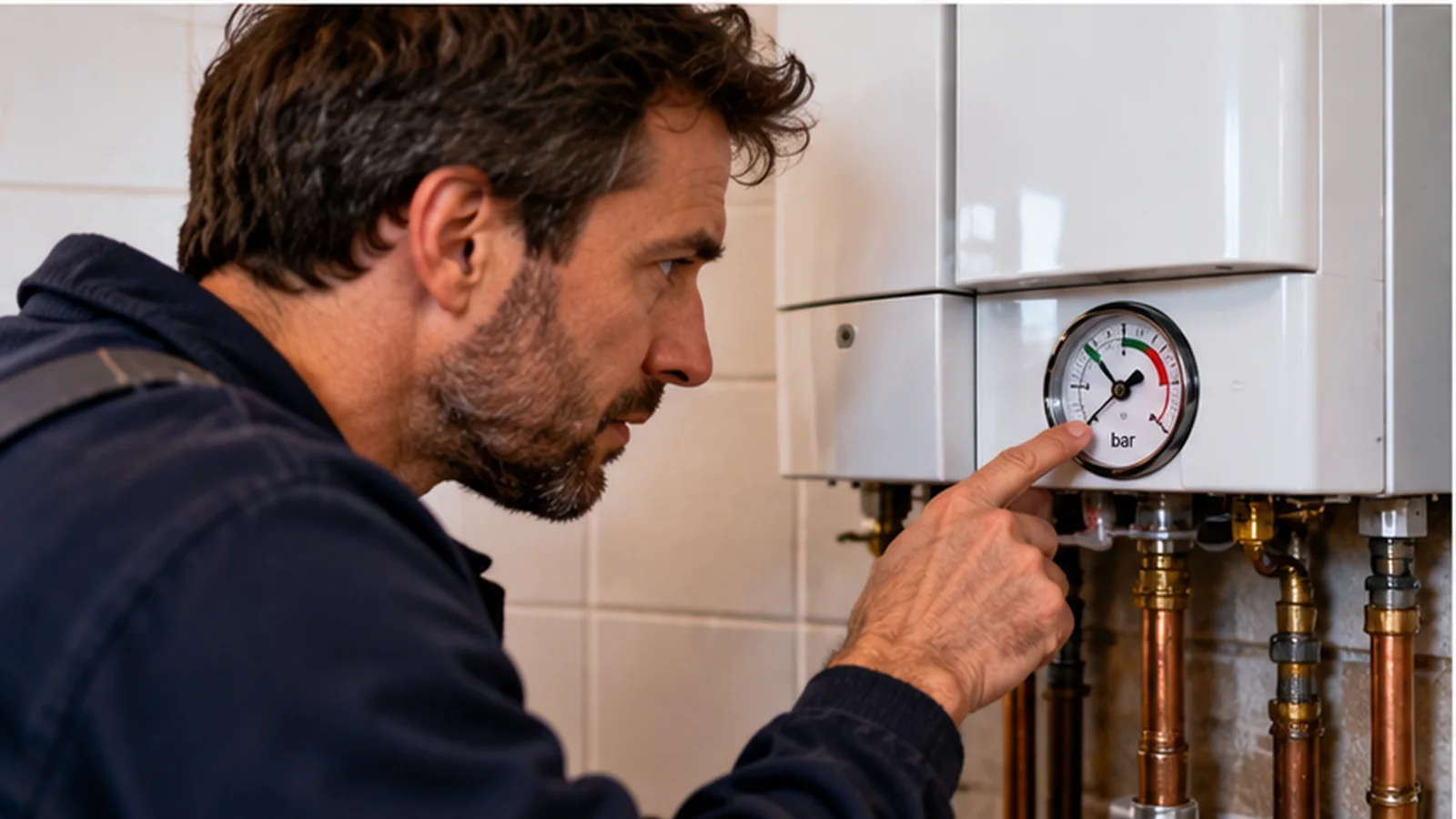
You top up your boiler pressure, the heating works again—and two days later the gauge is back near zero. Is the boiler faulty, or is the problem hidden elsewhere in your central-heating system? Repeated pressure loss is a symptom, not a diagnosis. The cause could be a small radiator leak, water released while bleeding a radiator, a faulty pressure-relief valve, an expansion-vessel issue, or a leak concealed below flooring. The pattern of the pressure change often offers better clues than a single reading.
This practical UK-focused guide explains what a homeowner can observe without removing a boiler cover, working on gas components or touching electrics. It also shows how to record useful evidence before contacting an engineer, and why repeatedly refilling a sealed system is not a durable repair. For advice about servicing, see Energy Saving Trust’s boiler service guide.
Safety first: If you smell gas, suspect carbon monoxide, see water entering electrical parts, or the boiler appears unsafe, do not continue a DIY test. Leave the area where appropriate and contact the relevant emergency service. In the UK, gas-boiler work on gas-related components must be handled by a suitably qualified Gas Safe registered engineer; find one via the Gas Safe Register.
What pressure should your boiler show when cold?
A commonly cited cold-system target is approximately 1.0–1.5 bar, but the manufacturer’s manual and your heating system’s specific design are the authority. Pressure normally rises to some extent while the system heats up because water expands. A cold reading of 0.9 bar could be acceptable in one model and trigger a low-pressure warning in another. A gauge value alone is not permission to turn valves or dismantle components.
| Gauge pattern | What it may suggest | Sensible next action |
|---|---|---|
| Cold reading within the manual’s recommended band | System pressure may be normal | Record it; compare after heating. |
| Low after recent radiator bleeding | Water was deliberately released | Follow the model-specific topping-up instructions if safe and permitted. |
| Falls a little each day even when heating is off | Possible leak or pressure-control issue | Check visible joints and log readings; arrange assessment. |
| Rises sharply when hot, then drops after cooling | Expansion-vessel or relief-valve issue is possible | Stop repeated topping up and contact an engineer. |
| Water is visibly leaking from the boiler | Active fault; potential electrical hazard | Switch off safely if instructed and call an engineer. |
| Gauge says zero or boiler repeatedly locks out | System may not be able to operate correctly | Avoid repeated resets; obtain proper diagnosis. |
There is no universally correct “top up to exactly 1.5 bar” instruction. The desired pressure depends on system design, whether the water is cold, where the gauge is fitted, and the manufacturer’s limits. For a conventional sealed domestic boiler, use the pressure indicator and user manual rather than a social-media photograph of someone else’s model.
First: tell the difference between a one-off drop and a recurring fault
Pressure can fall after bleeding radiators because you release a small amount of water as trapped air escapes. That is not the same as an unexplained recurring pressure drop. Likewise, a system that has just been professionally drained and refilled may need an initial correction as air works out. But a boiler that needs topping up every day or every few days should not be accepted as normal operation.
Keep a short record for two or three days only if the boiler is operating safely. Take the first reading when the heating is off and the system is cool. Record the reading when the heating has been running, then again after it cools. Note any visible drips, strange noises or shutdown codes. Do not try to “stress test” a defective boiler by forcing it to run with dangerously low pressure.
Why a cold-versus-hot record is more useful than one number
Suppose your system reads 1.2 bar cold, reaches 1.6 bar during heating, then returns close to 1.2. That could be ordinary thermal variation, subject to the model’s instructions. If it instead goes from 1.2 to near a high-pressure fault threshold, releases water, and later sits at 0.4, the pattern suggests something worth mentioning to an engineer, including a potential problem with expansion control or the relief-valve circuit. These are illustrative readings, not a diagnostic threshold for every boiler.
Cause 1: tiny leaks around radiators, valves and visible pipework
A sealed heating loop is intended to retain its water. A leak that only leaves a faint stain can gradually reduce pressure. Look for moisture at radiator valves, pipe joints you can see, accessible exposed pipework, and the floor or wall beneath them. Using a dry tissue to check an already accessible radiator joint can help reveal a slow external drip; do not open boiler panels or pull protective covers off electrical equipment.
Be aware that rust stains or wet floors do not always prove the cause. Condensation, ordinary plumbing leaks and spilled water can look similar. An engineer may need to isolate circuits, inspect the boiler internally or use non-invasive leak-detection methods. Never inject sealant, disconnect pipework or blindly tighten a pressurised joint as a first step: doing so can damage a fitting or hide the original problem.
Cause 2: pressure relief valve losing water
A pressure relief valve (PRV) is part of a boiler’s safety system. It opens under specified overpressure conditions and should not be altered or capped. If water repeatedly escapes via a discharge pipe outside the property or into a safe drain point, the engineer should investigate why, which may include excessive pressure, a valve that does not reseat correctly or problems elsewhere in the system.
Homeowners can safely observe whether an external discharge appears damp after heating has run, from a normal accessible location. Do not obstruct the pipe, put your hands into a hot discharge, or make any changes to the valve. Be careful: rain and condensation may make an outdoor pipe look wet, so a single observation is only a clue.
Cause 3: expansion vessel that no longer accommodates heating expansion
Water expands as it warms. In many sealed heating systems an expansion vessel allows pressure to rise and fall within an appropriate range. If the vessel’s gas charge is incorrect, its diaphragm fails or the installation has another expansion problem, pressure can rise excessively when hot. The safety valve may then release water and, after cooling, the pressure may be low.
You cannot confirm this from a gauge snapshot. Pressurising the vessel, disconnecting pipework or testing safety components may require isolating and draining parts of the system and belongs to a qualified engineer. The useful homeowner contribution is a cold-to-hot-to-cold sequence, plus notes about water discharge or error codes.
Cause 4: water loss after bleeding a radiator or servicing
When a technician bleeds a radiator, some water leaves the sealed loop along with trapped air. The pressure may need correcting afterwards, consistent with the manual. If you have just bled radiators and the boiler now shows a low-pressure warning, check the manufacturer’s user guidance before doing anything. Energy Saving Trust also notes that pressure typically needs checking after bleeding radiators.
But if a radiator repeatedly fills with air or you must repeatedly release water and refill the system, discuss it with an engineer. Persistent air can point to a broader issue such as a leak or an installation problem rather than a normal weekly maintenance routine.
Cause 5: a hidden leak under floors or in walls
The most frustrating scenario is no visible drip but pressure steadily drops. Hidden pipework can be buried in walls, within floor screed or below finishes. A failure does not always cause an obvious puddle immediately; nearby materials can absorb moisture, and a slow leak may show as a discoloration or warped floor only later.
Check for new damp marks, swelling skirting boards, stained ceilings beneath bathrooms or radiators, and unusual wet patches. These observations do not establish a heating-pipe leak by themselves. If you suspect water near wiring, avoid touching exposed electrics and seek qualified help. An engineer can determine whether the pressure loss originates within the boiler or the wider heating circuit using appropriate methods.
How to check boiler pressure safely: an owner-level checklist
- Find the model and read its user manual. Boiler controls and filling arrangements differ among Worcester Bosch, Vaillant, Ideal, Baxi and others.
- Read the gauge with the system cool. Note the time and whether heating/hot water was recently used.
- Inspect only accessible external areas. Look at radiator valves, visible pipe joints and obvious patches of damp without removing covers.
- Record the hot reading if the boiler operates normally. Do not override low-pressure lockouts to get a number.
- Check for a recent cause. Was a radiator bled or any heating repair performed recently?
- Observe any water coming from an accessible discharge pipe without touching or blocking it.
- Share your log with a professional. Include pressure, timing, outside temperature if relevant, boiler model and any error code.
These steps are observation, not repair. Avoid opening the combustion chamber or the boiler case. Repairs to gas appliances in the UK require appropriately registered professionals.
Should you repressurise the boiler yourself?
Some manufacturers provide user-facing instructions for restoring a low sealed-system pressure using a designed filling loop or filling key. Whether this is suitable depends on the model, correct cold pressure, system arrangement and the user’s ability to follow the instructions. The safe editorial recommendation is not to give one universal valve sequence that could be wrong for a particular appliance.
If the manual specifically permits owner repressurisation, follow it exactly, use a cold-system reading and ensure the designated filling valve is closed again as instructed. If you cannot identify the components with certainty, if the pressure rises too high, if a pipe is leaking, or if the system repeatedly loses pressure, stop and call an engineer. Never defeat an overpressure mechanism to keep the heating on.
A comparison that can prevent needless visits and repeat refills
| Situation | Why it differs | Better response |
|---|---|---|
| Pressure fell once after bleeding | Water intentionally removed | Correct only if manual directs; monitor. |
| Drops from normal to low every night | Repeated loss unexplained | Arrange diagnosis; do not establish a daily refilling routine. |
| Sharp rise while hot, then low when cold | Possible expansion/PRV problem | Record readings; engineer investigation. |
| Boiler stops and there is a damp patch nearby | Possible active leak | Limit use and seek qualified assistance. |
| Heating works, but displayed pressure varies modestly | Some variation is expected | Compare with the manufacturer’s normal range. |
When to book an engineer and what to tell them
Book a qualified engineer when pressure keeps falling, external leaks persist, the boiler repeatedly locks out, or you suspect a PRV or expansion-vessel fault. Use the official Gas Safe Register to verify an engineer’s registration and the types of gas work they are qualified to perform. If the issue is purely within accessible water-side components, the appropriate trade still depends on the installation and job; do not assume any handyman is qualified to open a gas boiler.
Give the engineer the following short description instead of “it doesn’t work”: “Combi boiler [model], 1.3 bar when cool Monday, 1.9 when heating, 0.5 by Tuesday morning, one radiator valve damp, error code [code]. No covers removed or valves altered.” This is an example report—not a claimed real repair—and gives them useful evidence about timing and potential sources.
Red flags that mean stop troubleshooting immediately
- A smell of gas, an activated carbon monoxide alarm, symptoms consistent with possible CO exposure, or a suspected combustion problem.
- Water flowing onto electrical wiring, sockets or controls.
- Steam, severe overheating, unusual banging with a fault condition, or an active high-pressure safety discharge.
- An unsafe location that requires climbing, removing covers or accessing internal gas equipment.
For a suspected gas leak in Great Britain, follow the National Gas Emergency Service instructions; call 0800 111 999 from a safe location. Carbon monoxide concerns require fresh air, urgent help and avoiding further appliance use.
How to stop the fault returning once it has been repaired
The long-term fix depends on the actual cause. Replacing a failed seal or radiator valve solves one problem; servicing an expansion vessel or pressure relief valve solves another. There is no credible universal “boiler pressure miracle product.” Ask the engineer to explain where water was leaving or why system pressure was excessive, how the fault was tested and what pressure changes you should expect after the repair.
A yearly service can detect maintenance issues but does not guarantee that concealed pipes will never leak. If the heating system repeatedly needs fresh water, ask whether corrosion protection, air ingress, component condition or the overall installation needs review. Routine refilling can dilute corrosion inhibitor and make a long-term problem more likely; an engineer can advise on water treatment and system health.
Myth check: three statements to avoid believing
“If the boiler still heats the radiators, it cannot be leaking.” Small leaks may allow it to work temporarily before pressure falls below its operating range. “Every low-pressure message means you need a new boiler.” Many pressure problems originate in repairable pipework or components. “Turn the filling loop on whenever pressure falls.” Recurring pressure loss is a fault to diagnose, not an invitation to keep adding water indefinitely.
Official and technical references
Reviewed 19 October 2026. Sources: Energy Saving Trust — boiler servicing and pressure; Gas Safe Register — find a registered engineer; Cadent Gas — national gas emergency number. For manufacturer-specific instructions, use the document supplied with your boiler or the model’s official support site, not a generic diagram found online. Additional context was compared with engineering articles about recurring pressure loss, which commonly identify leaks, pressure-relief valves and expansion-vessel faults but cannot diagnose a specific home remotely.
Bottom line: A one-off pressure correction after bleeding a radiator is different from a boiler losing water day after day. Observe cold and warm readings, check only accessible external areas, follow your actual model’s guidance and bring in a qualified professional for repeated loss or any safety concern.
You may also like
 Technology & How-To
Android Auto Keeps Disconnecting? How to Fix USB and Wireless Dropouts
Android Auto keeps disconnecting? Separate USB, wireless and app failures, check Galaxy USB mode, compare connection methods and…
 Technology & How-To
Netflix Says Your TV Isn’t Part of the Household? How to Fix It
Fix a Netflix household warning by separating home verification, permanent household updates and temporary travel access, with genuine…
 Technology & How-To
Google Photos Stopped Backing Up from Your PC? What Changed and How to Fix It
Google Photos stopped backing up your computer folders? Understand the Drive for desktop change, configure browser folder backup…