
Apple HomeView vs Amazon Echo Show: Which Smart Display Should You Buy?
Apple HomeView vs Amazon Echo Show: compare Siri AI, Alexa, smart-home compatibility, privacy, prices, FaceTime and total costs before buying.
Contents
- Apple HomeView at a Glance: Confirmed Specifications
- Apple HomeView vs Amazon Echo Show: The Main Differences
- Design and Display: Is Seven Inches Enough?
- Tabletop vs Wall-Mounted HomeView
- Siri AI vs Alexa: What Changes in Daily Use?
- Example: Coordinating a Busy Household
- Face Recognition, Profiles and Shared Privacy
- Smart Home Compatibility: Check Your Devices Before Buying
- Doorbells and Security Cameras
- Video Calling, Entertainment and Audio
- Price and Total Cost of Ownership
- Where and When Can You Buy Apple HomeView?
- Who Should Choose Apple HomeView?
- Who Should Choose an Amazon Echo Show?
- A Practical Buying Decision: Five Real-World Scenarios
- Scenario 1: An iPhone Household With Shared Calendars
- Scenario 2: A Home Already Using Alexa Routines
- Scenario 3: A Wall-Mounted Hallway Dashboard
- Scenario 4: A Budget-Conscious Buyer
- Scenario 5: A Home With Multiple Security Cameras
- What We Still Need to Test After Launch
- Final Verdict: Apple HomeView or Amazon Echo Show?
- Sources and Verification
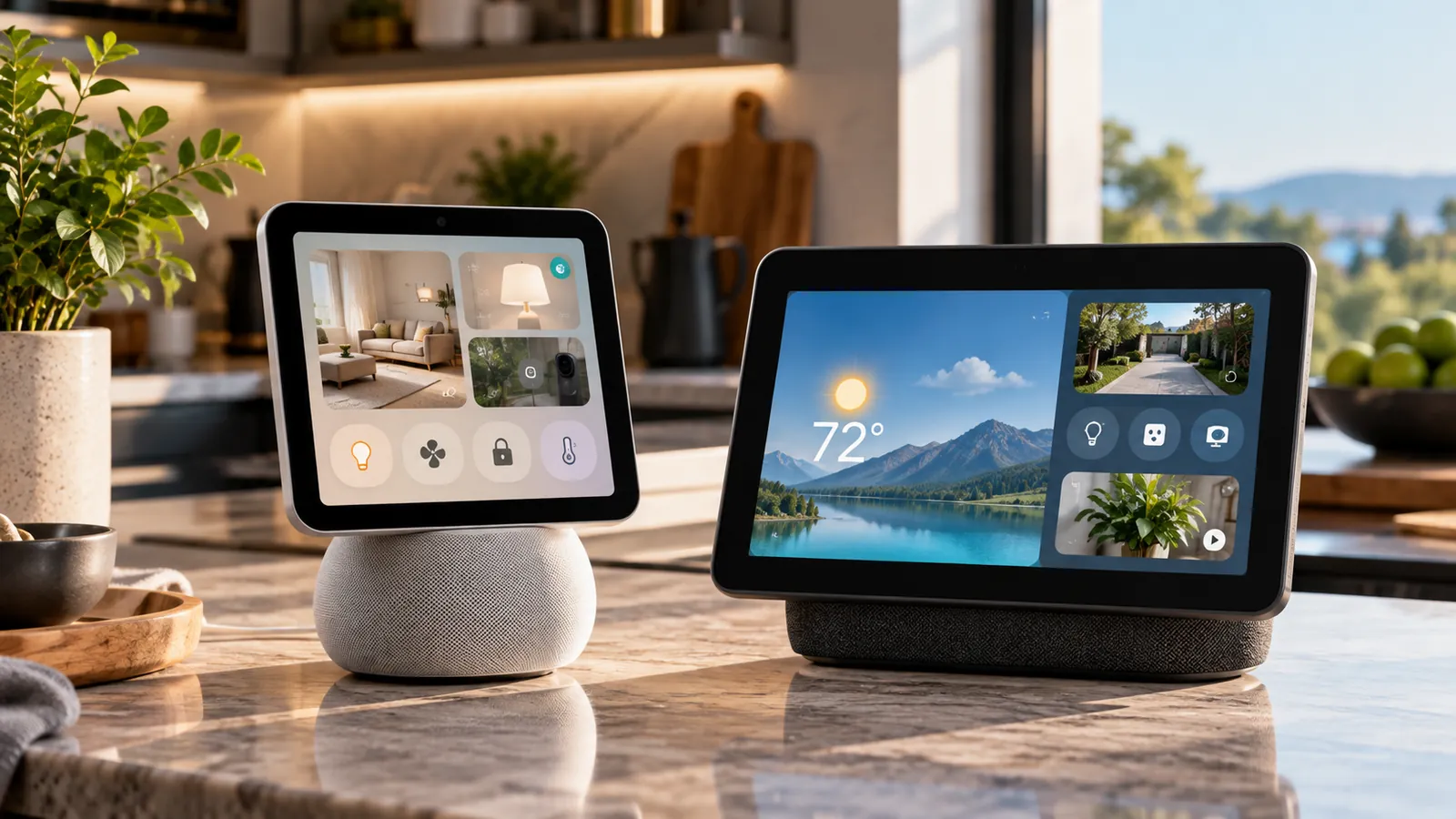
Apple has officially entered the dedicated smart-display market with HomeView, a $299 device announced on October 13, 2026. Amazon Echo Show already offers several display sizes, established Alexa features and a broader range of price points. Which approach makes more sense for your home? This in-depth guide compares what Apple has actually announced with the established Echo Show platform, without treating marketing promises as independent performance tests.
Bottom line: Apple HomeView looks particularly compelling for households already using iPhones, FaceTime, Apple Home and Apple Intelligence. Echo Show is worth considering for people who prioritize Alexa, a choice of display sizes, or lower-cost entry options. The better purchase depends on device compatibility, privacy preferences, mounting costs, and what you want the screen to do every day.
Apple HomeView at a Glance: Confirmed Specifications
Apple introduced HomeView on October 13, 2026. It has a 7-inch Liquid Retina LCD display, an A18 chip, a camera, microphones, integrated speakers and Siri AI. The interface changes with viewing distance and recognizes up to six household members for personalized experiences. Apple offers a tabletop version with a tilting display and speaker base, and a separate wall-mounted version.
Both HomeView versions start at $299 in the United States and £299 in the United Kingdom. Preorders began October 13 in initial launch markets, with general availability scheduled for November 13, 2026. These are announced launch details, not results from long-term ownership testing. Apple announcement.
Apple HomeView vs Amazon Echo Show: The Main Differences
- Platform: HomeView centers on Apple Home, Siri AI and personal context from compatible Apple devices; Echo Show centers on Alexa and Amazon-connected services.
- Display: HomeView is a 7-inch device; Echo Show is a family of products with different screen sizes and capabilities, so an exact comparison requires a specific Echo Show model.
- Household personalization: Apple advertises recognition for up to six users and personal screens; Alexa offers household and profile functionality that varies by device and region.
- Calling: HomeView emphasizes FaceTime; Echo Show emphasizes Alexa calling and other supported communication options.
- Price: HomeView starts at $299, while Echo Show prices vary widely by model, promotions and market.
- Availability: HomeView begins shipping November 13, 2026, while multiple Echo Show products are already on sale.
This is a platform-level comparison rather than a laboratory head-to-head review. Screen brightness, audio quality, response speed, camera quality and reliability should be compared through independent testing after HomeView ships.
Design and Display: Is Seven Inches Enough?
HomeView’s compact 7-inch display is intended to remain visible on a countertop, desk, bedside table or wall. Apple says the screen adjusts its presentation as people move closer, displaying glanceable information from a distance and richer controls at short range. A stainless-steel hinge allows the tabletop display to tilt.
For quick tasks such as viewing a doorbell camera, checking a shopping list or adjusting lights, a compact screen can be practical. For following recipes from across a large kitchen or watching video at a distance, a larger Echo Show may be more comfortable. Screen size alone does not establish readability: brightness, interface scaling, viewing angles and placement also matter.
Tabletop vs Wall-Mounted HomeView
The two HomeView designs are distinct products. The tabletop version has a speaker base and comes in silver, starlight, rose pink and space gray. The wall-mounted version comes in silver and space gray and requires an appropriate mounting and power solution. Apple lists separately sold Schneider Home mounts: U.S. starting prices are $59.95 for USB-C wall connection and $79.95 for AC wired mounting, with a PoE option planned for early 2027 at $129.95. That makes the real installed cost of a wall model higher than its $299 sticker price. Apple pricing and availability.
Siri AI vs Alexa: What Changes in Daily Use?
Apple’s headline feature is a more conversational Siri AI assistant. Apple says it can answer general questions, support music discovery and use onscreen context. When paired with an Apple Intelligence-enabled iPhone or iPad, it can also draw on permitted personal context from Messages, Calendar and other apps to help with requests. Users without a compatible personal device still get general Siri AI capabilities, but not the same level of personalized integration.
Alexa has long been built around voice commands, timers, routines, smart-home controls, music and information. Amazon continues to develop its assistant and supported features differ among devices, countries, subscriptions and software versions. Neither assistant should be declared categorically more intelligent without controlled tests using the same requests and current software.
Example: Coordinating a Busy Household
Imagine asking a kitchen display to find a recipe sent by a family member, add missing ingredients to a list and turn on compatible lights. Apple is positioning HomeView around such cross-app requests for recognized household members. The exact behavior depends on a compatible Apple device, permissions, supported apps and Siri AI availability. With Echo Show, a comparable routine may rely on Alexa lists, skills, routines and integrations rather than Apple Messages.
Face Recognition, Profiles and Shared Privacy
HomeView recognizes up to six people and can display different home screens, apps and widgets. This is particularly relevant for a shared kitchen or hallway, where a family wants convenient access without exposing one person’s messages or calendar to everyone. Apple describes local processing and Private Cloud Compute protections for supported Siri requests.
However, facial recognition is not a substitute for examining settings. Buyers should review whether recognition is enabled, what information appears when a person is not recognized, who can manage the device, and which data is shared with connected services. Echo Show households should likewise inspect Alexa voice profiles, camera settings, communications, activity history and any available privacy controls.
Privacy comparisons should distinguish published policies from independently audited behavior. Apple’s and Amazon’s different business models may influence user preference, but a blanket claim that one product is completely private or that the other constantly records conversations would be unjustified.
Smart Home Compatibility: Check Your Devices Before Buying
HomeView is designed as an Apple Home control center. Apple highlights Matter-compatible devices, lights, locks, thermostats, blinds and cameras. The key buying question is not whether a gadget says “smart,” but whether its particular model and features work with your chosen ecosystem.
Matter can improve cross-platform compatibility, but it does not guarantee that every advanced manufacturer-specific feature will work in every app. Thread support, border-router requirements, bridges, camera protocols, regional restrictions and firmware versions may still matter. Before buying either display, list your existing devices and check the manufacturer’s official compatibility documentation.
Doorbells and Security Cameras
Apple says HomeView can display up to nine camera feeds simultaneously and supports HomeKit Secure Video features with compatible cameras and an eligible iCloud+ plan. The experience and supported detection categories depend on compatible hardware and subscriptions. Echo Show can display supported camera feeds through Alexa integrations, but features differ by camera brand and device model.
For a home with several cameras, confirm whether your exact doorbell, indoor cameras and outdoor cameras support live view, two-way audio, event notifications and recordings. Do not assume that seeing a live feed automatically means you can store or review video without an additional service.
Video Calling, Entertainment and Audio
HomeView includes FaceTime, which makes it appealing for families that already communicate through Apple services. Apple also promotes music playback and a speaker system tuned for the tabletop design. The wall-mounted version has different physical acoustics, so it should not be assumed to sound identical.
Echo Show models commonly support Alexa communication and media features, but the available apps and streaming integrations vary by model and region. Before choosing a device mainly for Netflix, YouTube, Spotify or a specific video service, verify native app availability and supported playback methods. Apple’s initial announcement does not establish universal support for every streaming platform.
For serious movie watching, neither a small kitchen display nor a smart-home hub automatically replaces a television or tablet. For background music, hands-free calls and quick information, both approaches may be convenient.
Price and Total Cost of Ownership
The advertised HomeView entry price is $299 in the U.S. and £299 in the UK. A wall-mounted installation can cost more because the required mount is sold separately. Camera recording features may require iCloud+, while certain Siri AI personal-context features require a compatible iPhone or iPad. These dependencies should be included in a realistic budget.
Echo Show pricing cannot be summarized by one number because Amazon sells several models and frequently changes offers. Compare the exact model, local list price, available discounts and any paid service you expect to use. A discounted Echo Show may cost much less than HomeView, while a premium larger model may narrow the gap.
- Check the purchase price in your own country, including tax.
- Add mounts, wiring or accessories required for the intended installation.
- Include subscriptions needed for camera history or other premium services.
- Consider whether you already own a compatible iPhone or iPad.
- Account for return policies and warranty support.
Where and When Can You Buy Apple HomeView?
Apple opened preorders on October 13, 2026, in the United States, United Kingdom, Australia, Canada, India and New Zealand. Singapore preorders are scheduled for October 15. General availability is set for November 13 in the initial markets, with South African distribution through authorized resellers. Apple says HomeView is not currently available for sale in the European Union because Siri AI is not yet available on iOS there; no EU release date has been confirmed.
Siri AI on HomeView initially supports English in the named launch markets, with Canadian French planned for a later update. Availability and feature support can change, so consult the local Apple Store before ordering.
Who Should Choose Apple HomeView?
HomeView is a particularly sensible candidate for an Apple-centric household that wants FaceTime, Apple Home controls and household-specific Siri experiences on a permanent shared screen. It is also worth considering when compact design and personal data integration matter more than a very large display or the lowest possible price.
It is a less obvious fit for people who use Android as their primary phone, depend on Alexa-specific routines, want a much larger screen, or need services not yet confirmed for HomeView. The device is new, and buyers should also consider waiting for independent reviews of real-world audio, camera performance and software stability.
Who Should Choose an Amazon Echo Show?
Echo Show is worth exploring when you already use Alexa, want several screen-size options, need a budget-friendly model or have smart-home products and routines built around Amazon’s ecosystem. It may also be easier to evaluate today because several models have an established ownership history.
That does not mean every Echo Show is the better value. Hardware, camera capabilities, interface behavior, sound quality and availability vary significantly across the family. Choose a specific model and compare it with HomeView on the tasks you actually perform.
A Practical Buying Decision: Five Real-World Scenarios
Scenario 1: An iPhone Household With Shared Calendars
HomeView has a clear conceptual advantage when each person wants their own calendar, messages-derived context and FaceTime access, provided the required Apple devices and permissions are in place. Evaluate privacy settings carefully in shared spaces.
Scenario 2: A Home Already Using Alexa Routines
Replacing an Echo Show may involve rebuilding routines, checking device compatibility and changing communication habits. If Alexa already controls the home reliably, switching solely for a new display may not justify the expense.
Scenario 3: A Wall-Mounted Hallway Dashboard
HomeView’s purpose-built wall version is appealing, but add the mount cost and plan power access. A visible power cable, unsuitable wall material or difficult wiring can matter more than small specification differences.
Scenario 4: A Budget-Conscious Buyer
Compare current Echo Show prices against the full $299 HomeView cost. A lower-cost Echo Show may handle timers, basic controls and video calls adequately without requiring Apple ecosystem investment.
Scenario 5: A Home With Multiple Security Cameras
Start with camera compatibility, recording subscriptions, multi-camera view support and notification behavior. A display’s advertised camera count is not proof that your exact existing cameras will work as expected.
What We Still Need to Test After Launch
Because HomeView was announced only on October 13, 2026, definitive product judgments require independent testing after retail availability. Important unanswered questions include real-world Siri accuracy, how quickly profiles switch, false recognitions, microphone performance in noisy kitchens, screen visibility in sunlight, audio quality, camera compatibility and reliability over time.
Battery life is not a meaningful head-to-head metric for these normally powered smart-home displays; placement, power connection and standby behavior are more relevant. Long-term software support and repairability also deserve attention.
Final Verdict: Apple HomeView or Amazon Echo Show?
Choose Apple HomeView if your household is deeply invested in Apple services and values personalized Siri AI, FaceTime and Apple Home integration enough to justify its $299 starting price. Consider an Echo Show if Alexa compatibility, model variety or price flexibility are your priorities. Neither choice is universally superior, and Apple’s newest claims should be reassessed once independent reviews are available.
The most useful decision is to list the three tasks you want a smart display to perform every day, confirm that each device supports them in your country, and calculate the full installed cost before buying.
Sources and Verification
- Apple Newsroom — Official HomeView announcement, October 13, 2026
- Apple UK Newsroom — UK price, availability and mounts
- Amazon — Echo Show product information and current model selection
- The Verge — Wall-mount costs and configuration, October 14, 2026
- Ars Technica — HomeView feature analysis, October 13, 2026
Editorial update: October 14, 2026. This is a research-based buying guide, not a hands-on review. Specifications, regional support, prices and services should be rechecked before purchase.
You may also like
 Technology & How-To
NHS App Prescription Not Showing? Check GP Approval, Pharmacy Status and Tracking
Find out why a prescription or medicine is missing from the NHS App in England. Separate repeat requests,…
 Technology & How-To
Google Wallet Not Working After Switching Phones? Fix Card Setup and Tap to Pay
Google Wallet transferred but tap to pay fails? Separate card verification, bank approval, NFC, screen lock and device…
 Technology & How-To
iCloud Family Sharing Not Working? Why You Still See 5GB and How to Fix It
Still seeing 5GB after joining an iCloud family plan? Check the account, invitation, sharing settings, personal plan and…