
Will AI Replace Entry-Level Jobs? What the IMF Warns and What the Evidence Shows
Will AI replace entry-level jobs? Explore IMF warnings, exposed tasks, graduate hiring risks, credible evidence and practical ways to prepare.
Contents
- The short answer: exposure is not the same as replacement
- Why entry-level positions are unusually important
- Which tasks are most exposed?
- Administrative and clerical work
- Customer support and sales operations
- Content, marketing and design
- Software development and data analysis
- Finance, legal and healthcare support
- What do major institutions actually say?
- What the numbers cannot prove
- Three plausible labor-market scenarios
- Scenario 1: augmentation
- Scenario 2: hiring compression
- Scenario 3: new roles and redesigned apprenticeships
- How students and graduates can respond
- A practical 30-day plan
- What employers and universities should change
- Implications for developing economies
- What to watch next
- Conclusion
- Sources and further reading
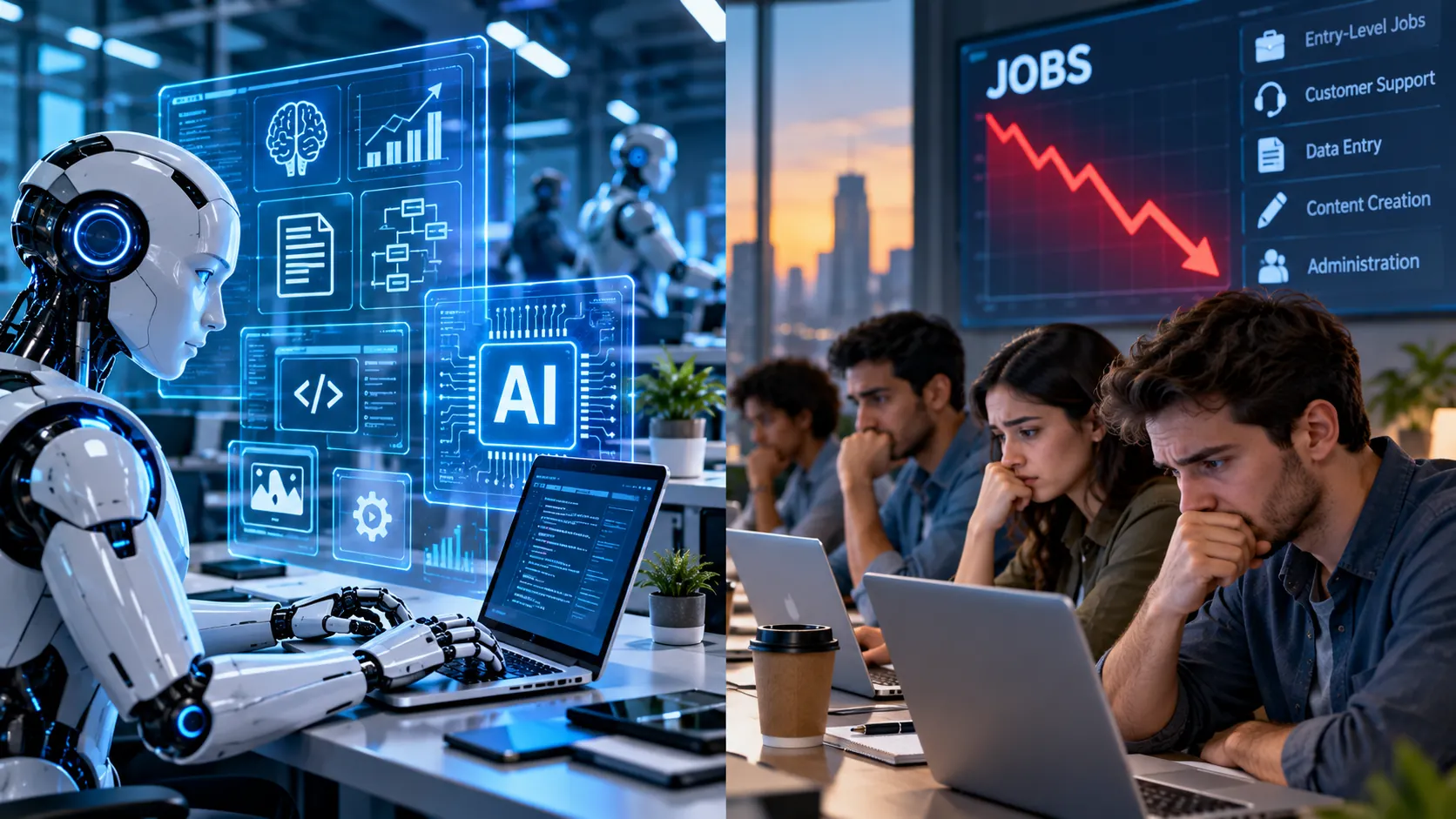
Artificial intelligence is changing the first rung of the career ladder. Tasks that once trained junior employees—drafting routine emails, summarizing documents, preparing basic reports, coding standard components and handling straightforward customer requests—can increasingly be assisted or completed by software. That does not mean all junior jobs are disappearing. It means employers may reorganize how beginners contribute, learn and get hired.
The short answer: exposure is not the same as replacement
The IMF estimated in January 2024 that almost 40% of employment worldwide is exposed to AI, with exposure around 60% in advanced economies. “Exposed” includes jobs whose productivity might improve as well as jobs whose tasks could be displaced. It is not a forecast that 40% of workers will lose employment. The IMF has also warned that benefits and risks are distributed unevenly, with potential consequences for inequality and new entrants.
Why entry-level positions are unusually important
Junior jobs are more than low-cost labor. They provide supervision, professional judgment, domain knowledge, feedback, networks and the experience required to become senior staff. If firms automate introductory tasks without replacing the learning opportunities, they may create a skills pipeline problem: fewer beginners become experienced practitioners later.
Which tasks are most exposed?
Administrative and clerical work
Scheduling, transcription, standardized data entry, form processing and basic correspondence are comparatively easy to codify. However, confidential records, exception handling, customer empathy and regulatory obligations still require oversight.
Customer support and sales operations
Chatbots can answer recurring questions and route tickets, but complicated complaints, accessibility needs, disputed charges and high-stakes conversations require escalation. A reduction in simple tickets does not prove that all support roles will vanish.
Content, marketing and design
Generative tools can produce first drafts, outlines, image concepts and variations quickly. Original reporting, fact checking, rights clearance, brand judgment, interviewing and performance analysis remain important. Publishing unverified AI copy can introduce errors and reputational risk.
Software development and data analysis
AI coding assistants can draft tests, explain errors and scaffold applications. Beginners still need to understand requirements, review security, trace failures, manage dependencies and test outputs. A generated solution is not equivalent to a maintained production system.
Finance, legal and healthcare support
Document review and classification may be accelerated, but regulated decisions need accountability, auditability, privacy safeguards and trained professionals. Organizations should distinguish automation of paperwork from delegation of responsibility.
What do major institutions actually say?
The IMF emphasizes labor-market exposure, differences between richer and poorer economies, and the need for social protection and education. The ILO’s research on generative AI and jobs highlights the likelihood of task transformation and particularly high exposure in clerical occupations. The World Economic Forum’s Future of Jobs Report 2025 surveys employers about anticipated job creation, displacement and changing skills through 2030; these are projections based on expectations, not measured job losses caused solely by AI.
What the numbers cannot prove
A vacancy decline can result from interest rates, weak demand, restructuring, outsourcing or a hiring freeze. A company using AI while reducing staff does not establish that AI caused every reduction. Credible research should compare similar firms or workers, separate junior from senior roles, identify time periods and account for economic conditions. Claims such as “half of all graduate jobs are gone” need unusually strong evidence.
Three plausible labor-market scenarios
Scenario 1: augmentation
A junior employee uses AI to handle repetitive work and spends more time on client interaction, analysis and quality checks. Productivity rises while the firm maintains hiring and develops staff.
Scenario 2: hiring compression
A team produces the same output with fewer new hires, leaving existing staff employed but making the first job harder to obtain. This is especially relevant to students and recent graduates.
Scenario 3: new roles and redesigned apprenticeships
Companies introduce AI evaluation, workflow design, data governance, cybersecurity and human-review roles. Whether those positions offset losses depends on local demand, wages, training and the speed of adoption.
How students and graduates can respond
Build demonstrable work rather than relying only on certificates. A useful portfolio explains the problem, data or sources used, decisions made, mistakes corrected and measurable outcome. Learn one domain deeply, then use AI tools to accelerate its routine steps. Practice verification, communication, spreadsheets, privacy and security. Show employers you can detect when a model is confidently wrong.
A practical 30-day plan
Week 1: identify ten job advertisements in your field and map recurring tasks and skills. Week 2: complete a small real-world project with an AI assistant, documenting your own checks. Week 3: ask a practitioner to review it and improve weak points. Week 4: publish a concise case study and apply to roles where you can demonstrate the skills required. Never upload confidential employer or client information to an unapproved tool.
What employers and universities should change
Employers can redesign internships around supervised judgment rather than copying and formatting. Keep junior hiring pathways, use structured evaluations and record whether AI actually improves quality. Universities can teach domain fundamentals, source verification, ethical tool use and project-based assessment. Governments can support reskilling, job-matching and protections for workers in transition.
Implications for developing economies
Effects differ where wages, connectivity, language coverage and the mix of occupations differ. Some regions may gain access to global services work using AI; others may face pressure on outsourced routine tasks. It is misleading to apply one US or European estimate directly to Egypt or another country without local labor data.
What to watch next
The most useful indicators are entry-level vacancy rates, graduate hiring, real wages, training budgets, task-level productivity and the percentage of junior employees promoted. These measures should be tracked across multiple quarters and compared with broader economic trends. Headlines about individual layoffs provide only partial evidence.
Conclusion
AI is likely to reshape the work beginners do, and in some occupations it may reduce demand for traditional entry-level tasks. The outcome is not predetermined: employers can use the technology to replace learning opportunities or to build better ones. The strongest response combines practical AI literacy with human judgment, demonstrable expertise and fair access to early-career experience.
Sources and further reading
IMF — Gen-AI: Artificial Intelligence and the Future of Work
IMF Blog — AI Will Transform the Global Economy
You may also like
 Technology & How-To
USB Works on PC but Not on TV? How to Find the Cause
Diagnose a USB drive that works on a computer but not a TV. Separate detection, missing files and…
 Technology & How-To
WhatsApp “Waiting for This Message”: Fixes for iPhone, Android and Web
Fix WhatsApp’s waiting-message notice by comparing your phone and linked devices, checking updates and protecting existing chat data.
 Technology & How-To
WhatsApp iOS 15.5 Requirement: What Changes on November 30, 2026?
WhatsApp raises its iPhone minimum to iOS 15.5 on November 30, 2026. Check your version, older iPhone eligibility…