
ACA Marketplace Open Enrollment 2027: Dates, Subsidies, State Deadlines and How to Apply
ACA Marketplace 2027 enrollment usually runs November 1–January 15. Check your state’s deadlines, learn about 2027 subsidies, and follow an application and troubleshooting guide.
Contents
- The 2027 enrollment calendar at a glance
- Important exceptions: 2027 enrollment dates by state
- Why some websites say enrollment ends December 15, 2026
- Who can enroll in an ACA Marketplace plan in 2027?
- How to apply or renew: a practical walkthrough
- 2027 premium tax credits: what changed, and what did not?
- Worked example: calculate an illustrative 2027 premium tax credit
- A 2027 immigration-related subsidy change many guides overlook
- How much will plans cost in 2027? Do not confuse proposed increases with your premium
- Bronze, Silver and Gold: how to compare the cost you might actually pay
- A 10-point checklist before you click Enroll
- If you already have a Marketplace plan: the renewal trap
- What paperwork should you prepare for your application?
- Official picture guide: how to upload Marketplace documents
- Troubleshooting: seven common enrollment problems and a safer next step
- Missed the deadline? Special Enrollment, Medicaid and CHIP
- ACA Marketplace is not the same as Medicare Open Enrollment
- Fraud protection when applying for 2027 coverage
- Action plan for the week before and after you enroll
- Bottom line: the safest 2027 enrollment strategy
- Official sources and fact-checking notes

ACA Marketplace Open Enrollment for 2027 coverage generally runs from November 1, 2026, through January 15, 2027 in states using HealthCare.gov. Enroll by December 15, 2026, if you need coverage to begin January 1, 2027; later selections generally begin February 1 after the first premium is paid. State-operated exchanges can open earlier, close later or have different January-start cutoffs. This guide explains how to check your exact deadline, estimate premium tax credits, compare real annual costs, resolve application problems and avoid a coverage gap.
The official federal schedule is published by HealthCare.gov. Details below were checked on October 27, 2026. Because individual Marketplace rules, enrollment notices, and state-specific timelines can change, verify your state exchange before relying on a deadline. This is consumer information, not personal insurance, tax or legal advice.
The 2027 enrollment calendar at a glance
| Date | What happens | What you should do |
|---|---|---|
| November 1, 2026 | Open Enrollment begins in federal-platform states | Apply, renew, compare plans, update your expected 2027 income. |
| December 15, 2026 | Typical cutoff for January 1 coverage | Select a plan by this date; pay the first premium by the insurer deadline. |
| January 1, 2027 | Coverage begins for timely selections | Confirm insurer payment and the actual effective date. |
| January 15, 2027 | Federal-platform Open Enrollment ends | Last standard chance to enroll or switch for February 1 coverage. |
| February 1, 2027 | Coverage begins for most December 16–January 15 selections | Check your insurer portal and provider network. |
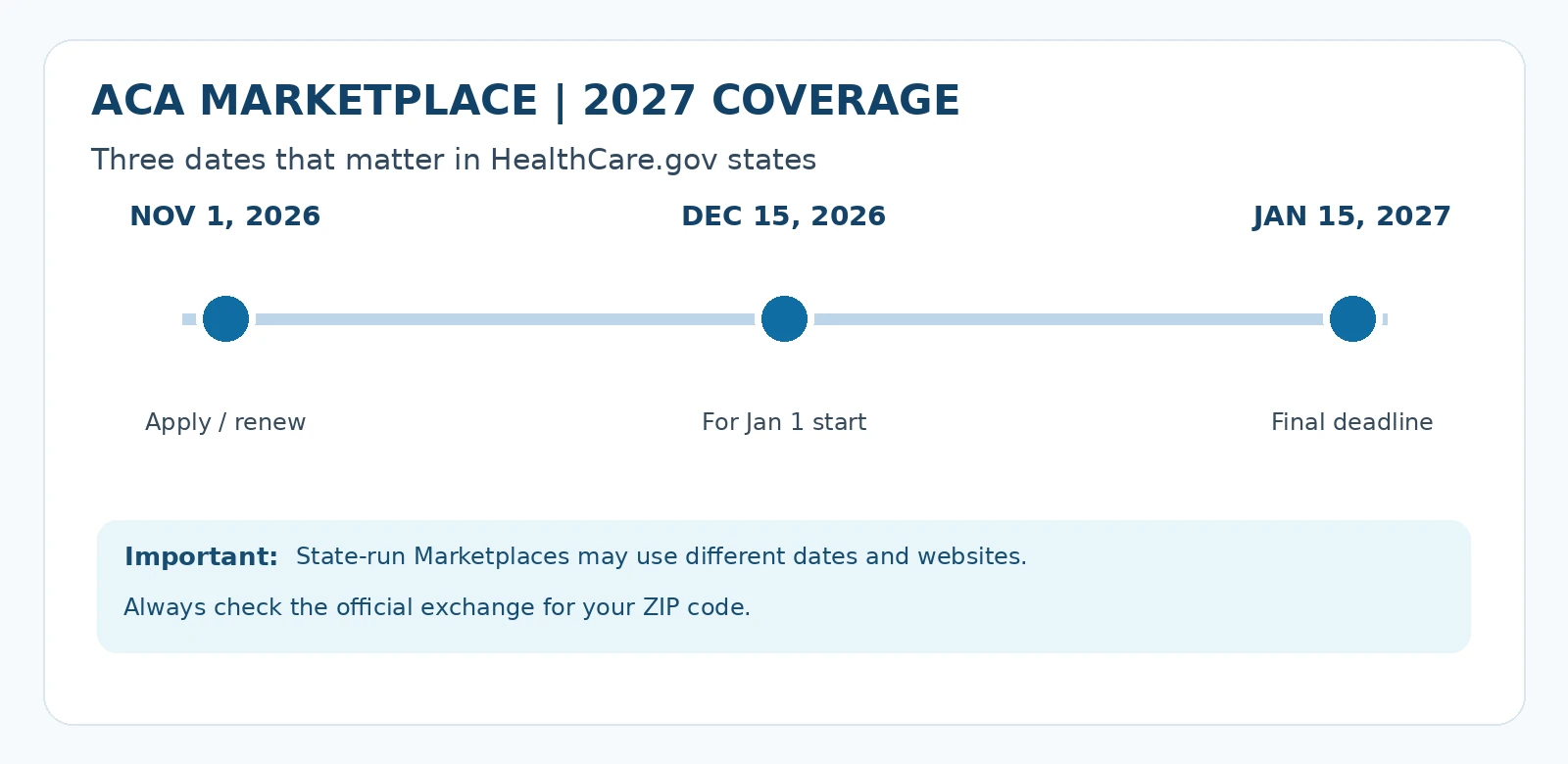
The difference between the last day to enroll and the deadline for January 1 coverage matters. A person applying on January 10 can still meet the federal general enrollment deadline but generally cannot expect coverage backdated to January 1. A December 15 selection without timely first-premium payment may also fail to activate. Always read the effective date in the final plan confirmation.
Important exceptions: 2027 enrollment dates by state
A nationwide guide cannot safely use a single calendar for everyone. The following examples come from official exchange or state announcements rather than a generic enrollment-date chart. The January 1 start deadline is also state-specific; it is not necessarily December 15 everywhere.
| Marketplace / location | 2027 application window | January 1 start: key deadline | Official source |
|---|---|---|---|
| HealthCare.gov states | Nov 1, 2026–Jan 15, 2027 | Dec 15, 2026 | HealthCare.gov |
| Idaho / Your Health Idaho | Oct 15–Dec 15, 2026 | Dec 15, 2026 | YourHealthIdaho.org |
| Connecticut / Access Health CT | Oct 23, 2026–Jan 15, 2027 | Dec 15, 2026 | AccessHealthCT.com |
| Massachusetts / Health Connector | Oct 23, 2026–Jan 23, 2027 | Dec 23, 2026 | Mass.gov |
| California / Covered California | Nov 1, 2026–Jan 31, 2027 | Dec 31, 2026 | CoveredCA.com |
| Oregon / Explore Health | Nov 1, 2026–Jan 15, 2027 | Dec 31, 2026 | OregonHealthCare.gov |
| Virginia / state Marketplace | Nov 1, 2026–Jan 29, 2027 | Check state portal for effective date | Marketplace.Virginia.gov |
| Vermont / Vermont Health Connect | Nov 1–Dec 28, 2026 | Dec 15, 2026 | HealthConnect.Vermont.gov |
Official state evidence: Idaho; Connecticut; Massachusetts; California; Oregon; Virginia; and Vermont. These are selected high-impact exceptions, not an exhaustive 50-state database.
Oregon change for 2027: Oregon residents should use the new Explore Health marketplace to enroll in 2027 coverage, not assume that an old HealthCare.gov account is the application path. Start with HealthCare.gov’s state locator or Oregon Explore Health. The federal site states the change explicitly.
Why some websites say enrollment ends December 15, 2026
You may find older ACA explainers claiming that all Marketplace enrollment for 2027 must end in December 2026. A 2025 federal rule had proposed a shortened window, but a federal court vacated the change in June 2026. CMS subsequently clarified the federal schedule. The current HealthCare.gov deadline page displays January 15 as the Open Enrollment end date. State exchanges publish their own notices. Do not confuse outdated rule summaries with the currently operating enrollment calendar.
For context, see the CMS regulations and litigation-update page and the legal timeline compiled by healthinsurance.org. The safest practice for consumers is to trust their official state Marketplace’s current enrollment page and save a screenshot of the displayed deadline.
Who can enroll in an ACA Marketplace plan in 2027?
The individual/family Marketplace is generally aimed at people who need health insurance outside of an employer plan, though eligibility to purchase coverage is separate from eligibility for financial assistance. In general, applicants must live in the United States, be U.S. citizens/nationals or meet qualifying lawful-presence rules, and not be incarcerated. Medicare coverage is a separate system: someone already on Medicare should not use ACA Marketplace enrollment to replace or supplement it. See official eligibility criteria.
Self-employed workers, freelancers, people leaving a job, early retirees not yet eligible for Medicare, and some people with employer offers may consider Marketplace coverage. Whether they qualify for tax credits depends on household income, affordable employer coverage, other qualifying public programs, tax filing rules and other factors. There is no universal income figure that guarantees a subsidy.
How to apply or renew: a practical walkthrough
- Locate your state’s official Marketplace. Go first to the federal state directory; choose your state instead of clicking a random search ad.
- Gather your information. Estimate total household income for 2027, household members and dependents, current plan details, Social Security or relevant immigration information where applicable, and employer-offered insurance information. Use the official preparation checklist.
- Create or sign in to the correct account. Existing HealthCare.gov enrollees should start with their current account where applicable. State-run marketplaces may have separate login systems.
- Start the 2027 application. Confirm the coverage year and home address, update changes, and provide your best estimate of household income. Apply accurately; guessing low income to lower monthly premiums can create repayment problems.
- Read the eligibility notice. It shows available financial help and may request verification documents. A provisional determination may change after records are checked.
- Compare multiple plans. Check covered medicines, each doctor and hospital, premiums, deductibles, copayments, out-of-pocket maximums and plan network. The lowest premium does not always mean the cheapest care.
- Finish enrollment and pay the insurer. Save the enrollment confirmation and pay the first premium by the plan’s deadline. A Marketplace application confirmation alone is not proof of activated coverage.
HealthCare.gov offers official online, phone and assisted enrollment options. If online access fails, use the official Marketplace Call Center or a listed local navigator. Help with the Marketplace application is free. The official federal Call Center number is 1-800-318-2596 (TTY 1-855-889-4325); state exchanges have different numbers.
2027 premium tax credits: what changed, and what did not?
The enhanced federal premium tax credits originally available from 2021 through 2025 expired at the end of 2025 and, as of this review, had not been extended. This does not mean all ACA financial help ended. Ordinary premium tax credits still exist for eligible applicants, but some households qualify for less help or no help than they would have received under the former enhancements. State-funded assistance can supplement the federal rules in some places. See the KFF explanation and the IRS 2027 percentage table.
For the standard 2027 premium tax-credit formula, the IRS lists an applicable household contribution percentage that varies by income relative to the federal poverty level. For eligible households at 300%–400% of the federal poverty level, the 2027 percentage is 10.22%. The formula relates to the benchmark second-lowest-cost Silver plan, not necessarily the plan you ultimately buy. The percentage is not a flat premium cap for everyone.
| Household income relative to FPL | 2027 applicable percentage |
|---|---|
| Below 133% FPL (where eligible) | 2.15% |
| 133% to less than 150% | 3.23%–4.30% |
| 150% to less than 200% | 4.30%–6.78% |
| 200% to less than 250% | 6.78%–8.66% |
| 250% to less than 300% | 8.66%–10.22% |
| 300% to 400% | 10.22% |
Do not read the table as an automatic subsidy guarantee. Medicaid eligibility and state coverage rules, citizenship/immigration status, tax filing, the cost of qualifying employer insurance, and the available benchmark plan still matter. Federal premium tax credits generally stop above 400% FPL under the post-enhancement framework. Some state assistance rules differ.
Worked example: calculate an illustrative 2027 premium tax credit
Suppose a single adult in the contiguous U.S. expects $50,000 in 2027 household income and has no disqualifying affordable employer or government coverage. The 2026 HHS poverty guideline for one person in the 48 contiguous states and Washington, DC is $15,960; $50,000 ÷ $15,960 ≈ 313% FPL. At that level, the 2027 IRS applicable contribution percentage is 10.22%, or about $5,110 annually / $425.83 monthly toward the benchmark Silver plan.
If a purely hypothetical benchmark Silver plan costs $800 a month before subsidies, the illustrative premium tax credit would be roughly $800 − $425.83 = $374.17 per month. If the household selected a $700 plan eligible for the same credit, its illustrative premium after credit would be about $325.83 per month. This is arithmetic to explain the formula, not a real 2027 quote or eligibility determination. Actual amounts depend on local premiums, age, household circumstances and official program decisions.
The income reference above is documented by HHS poverty guidelines. Alaska and Hawaii use higher FPL guidelines, and the reference income year for Marketplace subsidy calculations follows program rules. For a personalized amount, wait for the 2027 official application and view actual results instead of treating this illustration as an estimate from your ZIP code.
A 2027 immigration-related subsidy change many guides overlook
HealthCare.gov states that beginning January 1, 2027, only certain immigration categories can qualify for Marketplace savings: lawful permanent residents (green-card holders), Cuban or Haitian entrants, and Compact of Free Association migrants, in addition to eligible U.S. citizens/nationals. Other lawfully present people may still be able to buy Marketplace coverage but not receive federal financial help. The difference between being allowed to enroll and receiving a tax credit is essential; verify your individual status using HealthCare.gov’s status list.
How much will plans cost in 2027? Do not confuse proposed increases with your premium
KFF’s August 2026 analysis found a median proposed insurer premium increase of about 15% for 2027 across public rate filings. Proposed, finalized, age-adjusted and after-subsidy prices are different numbers. A 15% national median proposal does not mean your personal bill rises exactly 15%. One insurer may exit your county; another may offer a lower-cost network; your benchmark plan and credit could also change. See KFF’s rate-filing study.
There is no responsible one-size-fits-all national monthly premium figure. Your final Marketplace price depends on your ZIP code, ages, tobacco rules where applicable, selected insurer and metal level, household income, and financial assistance. HealthCare.gov’s plan-preview tool can give estimates; the application establishes the final eligibility and displayed plan prices.
Bronze, Silver and Gold: how to compare the cost you might actually pay
The category labels describe how covered costs are typically shared; they are not grades for doctor quality. Bronze often has lower premiums and higher cost sharing. Gold often has higher premiums and lower cost sharing. Silver is special for eligible buyers because cost-sharing reductions (CSR) that lower deductibles and copays generally require choosing a Silver plan. Confirm the plan’s Summary of Benefits and Coverage (SBC), prescription formulary and provider directory before choosing. Read the official plan categories and CSR rules.
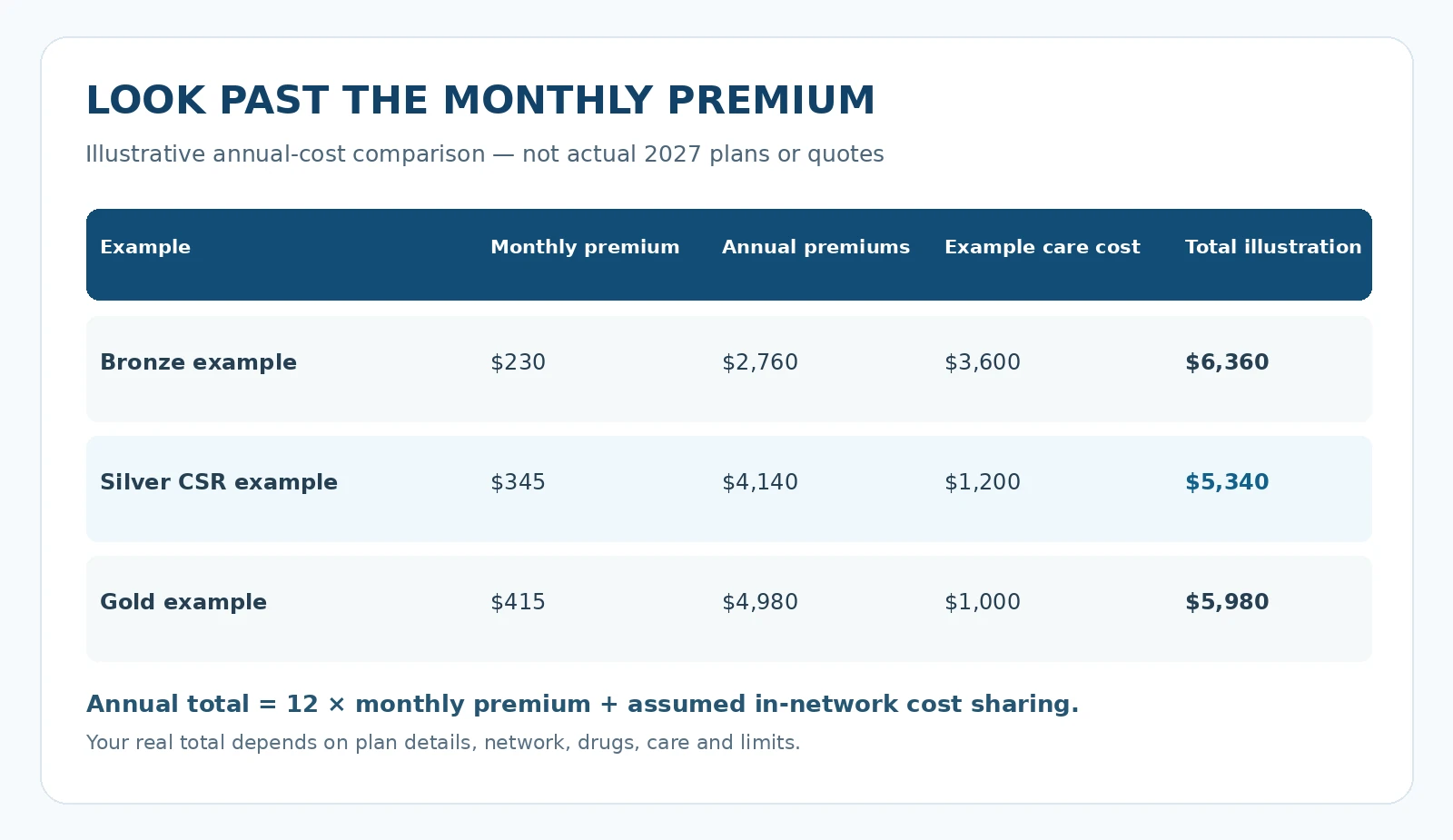
| Scenario | Net monthly premium | 12 months of premiums | Assumed annual in-network costs | Illustrative total |
|---|---|---|---|---|
| Bronze example | $230 | $2,760 | $3,600 | $6,360 |
| Silver with CSR example | $345 | $4,140 | $1,200 | $5,340 |
| Gold example | $415 | $4,980 | $1,000 | $5,980 |
In this fabricated comparison only, the Silver plan costs $115 more per month than Bronze. Over 12 months, that extra premium is $1,380. The assumed difference in annual cost sharing is $2,400, so Silver ends up $1,020 cheaper for that particular year and usage pattern. But a healthy year with little care, or out-of-network treatment, could reverse the choice. The example illustrates a break-even calculation, not a medical utilization prediction.
A stronger comparison method is to calculate at least three situations: low use (annual premiums plus predictable medications), expected use (annual premiums plus likely appointments and procedures) and high use (annual premiums plus the applicable in-network out-of-pocket maximum). Not all expenses count toward the out-of-pocket maximum; uncovered and out-of-network expenses may behave differently. HealthCare.gov also offers an estimated yearly cost comparison that can support this process.
A 10-point checklist before you click Enroll
- Your doctors and specialist offices are in-network for this exact 2027 plan name and network, not merely for the insurer.
- Your preferred hospital and urgent care locations participate in the same network.
- Your current medications appear on the plan formulary; check tiers, prior authorization and quantity limits.
- You understand the individual and family deductibles, copays, coinsurance and in-network out-of-pocket maximum.
- The displayed monthly premium is after the specific tax credit you qualify for; you have considered any tax repayment risk.
- You know whether a Silver CSR version is available and whether it changes your decision.
- You compared at least two insurers when possible, including their available counties and health systems.
- You checked the plan’s Summary of Benefits and Coverage and any referrals or authorization rules.
- You understand which date your coverage starts and when the first insurance-company bill is due.
- You saved the application confirmation, selected-plan summary and a record of your premium payment.
If you already have a Marketplace plan: the renewal trap
People with active federal Marketplace coverage may be automatically re-enrolled in the same plan or a similar replacement if they do not act. That is meant to reduce coverage gaps, but it is not a reason to ignore renewal. Your monthly subsidy can change when income, household size, benchmark premiums or eligibility rules change. Your insurer may withdraw an option or move you into another plan; a familiar brand name does not guarantee the same doctors, drugs or deductible.
Compare your 2026 renewal letter with the 2027 plan details. Review the insurer’s price and the Marketplace eligibility letter; update your expected 2027 income; look for a better alternative before the January 1 start cutoff. HealthCare.gov’s renewal guidance explains possible automatic selection and the ability to switch during Open Enrollment. If you are switching away from existing coverage, make sure there will be no unintended gap or overlap before canceling.
What paperwork should you prepare for your application?
Not every applicant has to upload documents at the start. The Marketplace can ask for specific proof later when information cannot be verified. As preparation, have a correct mailing address and ZIP code, expected household members for the coverage year, projected wages/self-employment income and any relevant immigration or eligibility documents available. If you receive an official document request, the notice itself defines the acceptable records and deadlines.
- Income: recent pay stubs, W-2s, tax records or self-employment records that make sense for your circumstances.
- Identity and eligibility: required personal information and any immigration/citizenship documentation requested by the exchange.
- Employer coverage: offer details and household affordability information if the application requests them.
- Coverage changes: documentation of lost insurance when requesting enrollment outside the annual window.
- Current coverage: insurer, plan name, member documents and renewal notices.
For exact approved evidence, use the official document-and-deadline page. The Marketplace says typical document-matching issues such as income have 90 days to resolve, citizenship/immigration issues 95 days, and certain loss-of-coverage SEP verification issues 30 days. Your individual notice takes precedence. Missing or rejected proof can affect your coverage or savings even after enrollment.
Official picture guide: how to upload Marketplace documents
HealthCare.gov provides a genuine federal screen-by-screen illustrated PDF showing the application list, “Application Details,” document-type selection, file upload and confirmation checks: open the official 4-page picture guide (PDF, CMS Product No. 12059, November 2025). The pictures in that agency handout are illustrative screen examples, not evidence that every 2027 portal screen looks identical. This article intentionally links to the primary document instead of presenting an unverified fabricated screenshot.
To use the documented upload path: sign in; select the application ID listed in your eligibility notice; open Application details; select Upload documents for the matching issue; choose the requested document type; select a file; and confirm the successful upload indicator. The official 2025 guide lists common upload formats such as PDF and JPEG and a file size below 10 MB. Check the live site’s current file requirements if an upload fails. Review the live uploading instructions as well.
Troubleshooting: seven common enrollment problems and a safer next step
| Problem | Likely explanation | Action |
|---|---|---|
| Cannot find 2027 plan prices | Preview for your location may not be fully available yet | Use the official state exchange; check again when 2027 browsing opens. |
| Website sends you to a state exchange | Your state operates its own Marketplace | Follow the state locator rather than using a federal application. |
| Two-factor security code missing | Old email/phone, message filtered, or expired code | Check registered methods, request a fresh code, then use official support. |
| Your premium looks unexpectedly high | Credit eligibility, income, age or benchmark price differs | Review 2027 household income and eligibility notice; compare plans. |
| Doctor disappears from plan network | 2027 network or plan identification changed | Confirm exact plan ID/network with insurer and doctor before enrolling. |
| Documents marked pending | Verification not finished | Check Application details/Messages; observe notice deadlines. |
| You enrolled but have no active coverage | First premium not received or effective date is later | Contact insurer, confirm payment and effective date immediately. |
The federal support resources explain login and security-code problems, what happens after document submission and first premium payments. If an uploaded document is not yet resolved, avoid sending duplicates without checking the status. If you receive a plan-change or termination notice, keep a copy and seek help promptly.
Missed the deadline? Special Enrollment, Medicaid and CHIP
Missing the end of the annual ACA Marketplace window usually means waiting until the next annual Open Enrollment period unless a qualifying life event creates a Special Enrollment Period (SEP). Common examples include loss of qualifying health coverage, moving, marriage or a new baby; each type has rules and proof requirements. Apply through the official outside-enrollment guide to see what applies. Medicaid and the Children’s Health Insurance Program (CHIP) accept applications year-round.
Do not assume that losing a coverage option or buying a plan after the deadline guarantees retroactive coverage. If an employer plan ends, compare the possible dates for COBRA or Marketplace enrollment and ask about any coverage gap. If you become Medicare eligible, follow Medicare’s own enrollment rules rather than this ACA Marketplace calendar.
ACA Marketplace is not the same as Medicare Open Enrollment
Both health-insurance topics are often called “open enrollment,” but their timelines and programs are different. Medicare’s usual annual election window is October 15–December 7; the federal ACA individual Marketplace typically uses November 1–January 15 for 2027 coverage. Medicare Advantage, Part D and Medigap are not sold through the ACA Marketplace. KFF explains this important separation in its Medicare-versus-Marketplace guide. For Medicare readers, see our separate 2027 Medicare enrollment walkthrough.
Fraud protection when applying for 2027 coverage
Apply through a trusted .gov Marketplace or an exchange listed by the federal government. Do not give your Social Security number, immigration documents, one-time account login code or complete credit-card details to an unsolicited caller who claims to “renew” your coverage. Certified helpers may be available, but you should verify their listing through the Marketplace and keep control of your application. Real plans and subsidy determinations come from the actual exchange and insurer, not from a social-media promise of a universally free 2027 policy.
If someone enrolled you without permission or changed your application, contact the official Marketplace directly and request assistance. Keep dates, confirmation numbers and copies of notices. If your application looks unfamiliar, secure your account and authentication methods before making further changes.
Action plan for the week before and after you enroll
| When | Action | What to save |
|---|---|---|
| Before your state portal opens | Prepare 2027 income and compare current doctors/medications | Budget, plan ID and provider notes |
| First week of Open Enrollment | Compare options and verify subsidy results | Plan estimates and eligibility notice |
| Before your January 1 cutoff | Submit selection and handle requested verification | Plan confirmation, date, document list |
| By insurer billing deadline | Pay first premium directly to insurer | Payment receipt and insurer confirmation |
| First day of coverage | Check that your policy is active and providers match | Member ID, effective date and insurer number |
| During 2027 after a life change | Report income/household/address changes promptly | Updated eligibility and plan correspondence |
Bottom line: the safest 2027 enrollment strategy
Use your official state Marketplace, not a generic deadline, and shop early enough to check your doctor network, prescription coverage and yearly out-of-pocket exposure. For HealthCare.gov states, November 1–January 15 is the general 2027 window and December 15 is the usual January 1 coverage cutoff. Idaho, Massachusetts, California, Oregon and others demonstrate why those dates should never be copied blindly to every state. Financial help still exists, but the expired enhancements, 2027 eligibility rules and your individual household facts change the calculation.
Start here: find your official Marketplace → gather the application materials → compare your possible yearly costs. Check your actual state portal immediately before submitting or making a deadline-sensitive decision.
Official sources and fact-checking notes
- HealthCare.gov — enrollment dates and effective dates.
- HealthCare.gov — state marketplace finder and Oregon 2027 notice.
- IRS — Revenue Procedure 2026-26, 2027 premium tax-credit applicable percentages.
- HHS — 2026 poverty guidelines.
- HealthCare.gov — 2027 immigration and eligibility for savings.
- HealthCare.gov — document requests and deadlines.
- HHS/CMS — official illustrated upload guide (November 2025).
- KFF — 2027 proposed premium increases (not personal quotes).
Editorial review date: October 27, 2026. Dates, premium policy and state programs are current only to the verification date. Examples are explicitly labeled illustrative. The site has no affiliation with HHS, CMS, HealthCare.gov or any insurance company.
You may also like
 Services & Guides
How to Freeze Your Credit for Free—and Temporarily Unfreeze It
Freeze your US credit reports for free at Equifax, Experian and TransUnion, then schedule a temporary lift when…
 Services & Guides
V5C Log Book Not Arrived? What to Check Before Applying Again
Still waiting for your V5C? Check the correct DVLA waiting period, your address and green slip before applying…
 Services & Guides
Royal Mail Missed Delivery? Redelivery and Collection Explained
Missed a Royal Mail delivery? Book a redelivery, find the right reference, prepare collection ID and check the…