
Abu Simbel Sun Alignment Explained: Dates, Science, Ramses II and How to Visit
Why sunlight reaches the sanctuary of Ramses II at Abu Simbel twice a year, what the October and February dates mean, and how travelers can experience the event.
Contents
- When does the Abu Simbel sun alignment happen?
- Where is Abu Simbel, and why is it famous?
- What exactly happens inside the temple?
- The astronomy: why only twice a year?
- A useful way to visualize the effect
- Was the alignment intentional?
- Why does Ptah remain in the dark?
- The remarkable rescue of Abu Simbel
- Did moving the temple change the dates?
- How to visit Abu Simbel for the sun festival
- A practical planning checklist
- What if you cannot visit on October 22?
- Abu Simbel versus other solar alignments in ancient Egypt
- Common misconceptions about the Abu Simbel alignment
- “The sun illuminates all four sanctuary statues.”
- “The dates prove the pharaoh’s birthday and coronation.”
- “The alignment is impossible without lost technology.”
- “The UNESCO relocation left everything completely unchanged.”
- How to photograph the event responsibly
- Why the event still matters
- Authoritative sources and further reading
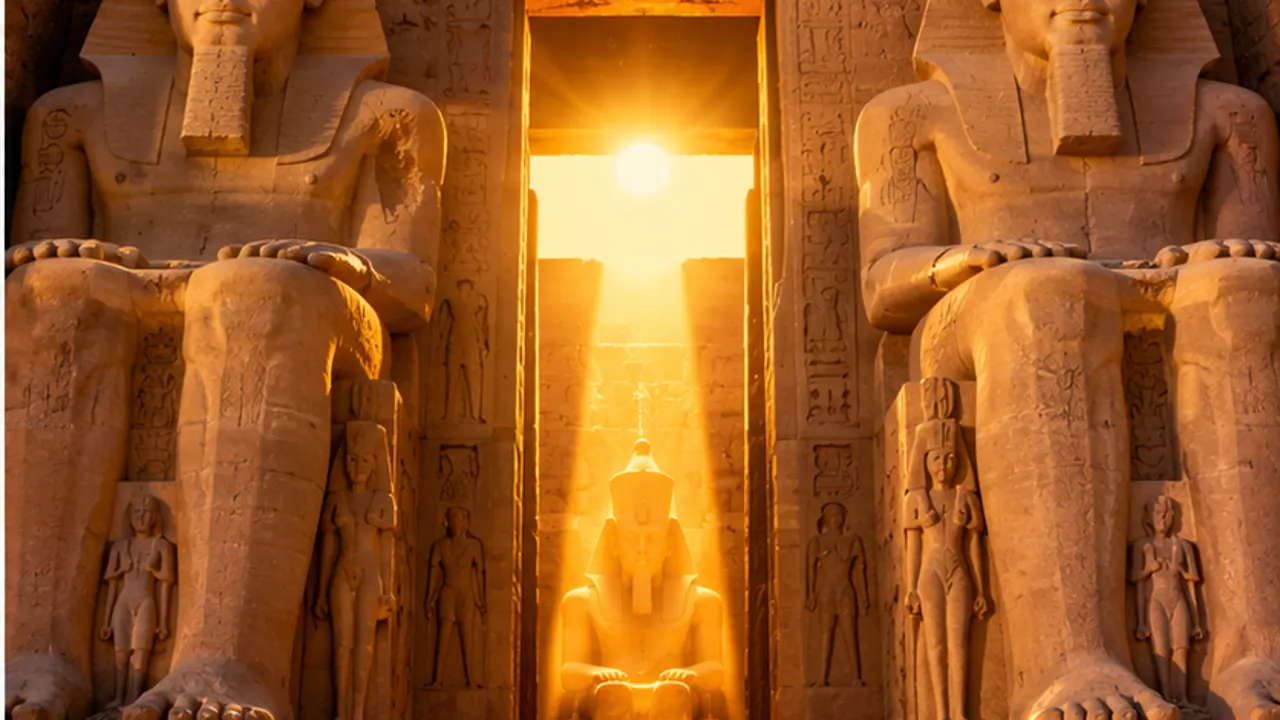
Twice a year, a shaft of morning sunlight travels through one of ancient Egypt’s most remarkable temples and reaches a chamber deep inside the rock. The phenomenon at Abu Simbel, associated with Pharaoh Ramesses II, is often described as a miracle of ancient engineering. It is also an extraordinary lesson in astronomy, geography, architectural planning and modern heritage conservation. Here is what visitors can actually expect, what researchers know, and which popular claims deserve caution.
When does the Abu Simbel sun alignment happen?
The event is traditionally observed on February 22 and October 22 each year. At sunrise, direct sunlight enters the Great Temple’s doorway and moves along its central axis toward the sanctuary. The spectacle attracts travelers, photographers, Egyptian visitors and cultural organizations. Actual visibility depends on weather, atmospheric conditions, access arrangements and the temple’s operating procedures; a calendar date alone cannot guarantee a clear view.
If you are planning to visit in October 2026, the customary observation date is Thursday, October 22, 2026. Confirm any festival program, opening arrangements and visitor restrictions with Egyptian tourism and antiquities authorities or your licensed local operator close to departure. The precise moments of illumination should not be treated as a guaranteed public viewing slot.
Where is Abu Simbel, and why is it famous?
Abu Simbel stands in southern Egypt’s Nubian region, near Lake Nasser and not far from the Sudanese border. Its monumental rock-cut temples were commissioned under Ramesses II, a ruler of Egypt’s Nineteenth Dynasty in the thirteenth century BCE. The complex includes the Great Temple and a smaller temple dedicated to the goddess Hathor and to Queen Nefertari. Together they form one of the most recognizable archaeological landscapes in Africa.
Four colossal seated statues of Ramesses II dominate the façade of the Great Temple. Behind them are halls with columns, carved scenes of royal and religious imagery, and a long sequence of rooms culminating in the inner sanctuary. This arrangement matters: the famous illumination is not simply sunlight falling on the entrance. It depends on the relationship between the building’s orientation, its deep interior and the sun’s position in the sky.
What exactly happens inside the temple?
The morning sun rises at a particular point on the eastern horizon. On the alignment dates, its rays travel through the temple entrance and successive spaces toward the sanctuary at the rear. Three of the four seated figures in the sanctuary are traditionally described as receiving illumination: Ra-Horakhty, the deified Ramesses II and Amun-Ra. The fourth, Ptah, is generally said to remain in shadow. This striking contrast is part of the event’s cultural significance, although descriptions of exactly how light moves across individual statues can vary by observation and interpretation.
The rays do not mean that the whole temple suddenly lights up. The effect is concentrated along a particular line of sight, and visitors may see changing patches of illumination over a short period. Camera exposures, crowds and the available viewing position can make the experience look different from highly edited photographs circulating online.
The astronomy: why only twice a year?
Earth’s axis is tilted relative to the plane of its orbit around the sun. As Earth travels around the sun, the position where the sun appears to rise shifts gradually north and south along the horizon. A fixed doorway and a long corridor therefore receive direct sunrise light along their central axis only when the solar direction closely matches the building’s orientation.
For many orientations between the sun’s northernmost and southernmost rising positions, the sun can occupy the same relevant rising direction on two dates in a solar year: once as its apparent path shifts in one direction and again as it shifts back. That broad geometry explains the two annual illumination windows. The actual dates depend on the temple axis, latitude, local horizon, atmospheric refraction and the definition of a visible alignment.
A useful way to visualize the effect
- Imagine a very long hallway with a narrow doorway facing the sunrise.
- On most mornings, the sun rises too far to one side for a beam to reach the back wall.
- Near two dates each year, the sunrise direction lines up with the doorway and the hallway.
- The deeper and narrower the corridor, the more selective the alignment can be.
The temple was not a modern observatory with digital precision. Nevertheless, ancient builders could observe the changing sunrise positions over many years and integrate those observations into sacred architecture. It is reasonable to discuss deliberate solar design while distinguishing the observable geometry from claims about the builders’ exact intentions.
Was the alignment intentional?
The monument’s monumental axis and sanctuary placement make deliberate design a plausible and widely discussed interpretation. Ancient Egyptian architecture often linked kingship, divine power, ritual and the movement of celestial bodies. However, a specific claim about what an architect meant to commemorate needs historical evidence, not just an impressive coincidence. There is a difference between establishing that sunlight reaches the sanctuary and proving the exact symbolic reason for choosing the dates.
In particular, many popular travel stories say February 22 marks Ramesses II’s birthday and October 22 his coronation—or reverse those explanations. These dates should not be presented as securely documented historical facts. There is no widely accepted contemporary birth certificate or coronation record establishing those exact modern calendar dates. The familiar story is part of modern popular interpretation rather than a settled archaeological conclusion.
Why does Ptah remain in the dark?
The fourth sanctuary figure is generally identified as Ptah, a major Egyptian deity associated with Memphis, craftsmanship and creation. Some modern explanations connect his position in shadow with symbolic associations, including the underworld. Such readings are interpretations rather than a simple statement proved by the beam of sunlight. The observable point is that the sanctuary’s illumination pattern treats the statues differently; what each contrast meant to the original builders is a more complex historical question.
The remarkable rescue of Abu Simbel
The modern story is nearly as extraordinary as the ancient one. In the twentieth century, construction of the Aswan High Dam threatened numerous Nubian monuments with flooding from the reservoir that became Lake Nasser. An international campaign coordinated through UNESCO helped rescue Abu Simbel and other sites. The temples were carefully cut into large blocks, moved to higher ground and reconstructed in an artificial setting designed to preserve their monumental appearance.
The relocation took place during the 1960s, with the main Abu Simbel project generally dated from 1964 to 1968. The monuments were raised by roughly 65 meters and moved about 200 meters from their original location, figures commonly cited in heritage accounts. The work required engineers, archaeologists, conservators and international funding, and it became a landmark of global cooperation in heritage protection.
Today the Nubian Monuments from Abu Simbel to Philae form part of a UNESCO World Heritage property. The inscription recognizes a landscape of extraordinary archaeological significance, not only the spectacular sunrise event.
Did moving the temple change the dates?
The common explanation is that the observed illumination dates shifted slightly after relocation. Some accounts describe a one-day change; others give different details depending on whether they discuss historical observations, the original structure or present-day festivities. Because the original alignment was not documented with the same precision as a modern astronomical survey, it is best to avoid declaring a perfectly verified before-and-after one-day difference as fact.
The central lesson is that the engineers attempted to preserve the temple’s orientation while moving it into a new landscape. Small differences in orientation, horizon profile and reconstruction geometry can influence exactly when and how light reaches a distant sanctuary. This is one reason a simple statement such as “the ancients designed it for October 22 exactly” should be treated carefully.
How to visit Abu Simbel for the sun festival
Abu Simbel is a major destination in Upper Egypt but is remote from Egypt’s best-known tourist centers. Many travelers arrive from Aswan by road, while some itineraries include flights or organized transfers when services are operating. The drive from Aswan is commonly described as several hours; actual travel time depends on route conditions, stops, security procedures and transport arrangements.
A practical planning checklist
- Book transport and accommodation early: festival dates can attract concentrated demand.
- Check official access information: confirm ticketing, opening hours and any special early-entry arrangements rather than relying on an old travel blog.
- Prepare for a very early start: the event concerns sunrise, not midday light.
- Allow time for the site: the smaller temple, façade details and surrounding landscape deserve attention beyond the alignment.
- Follow conservation rules: photography, tripods and restricted spaces may be regulated.
- Bring sun protection and water: the desert environment can be demanding even when mornings feel cool.
For current travel arrangements, use the Egyptian Ministry of Tourism and Antiquities’ monuments portal as a starting point and verify on-the-ground arrangements through authorized local channels. Never assume that a normal daytime ticket guarantees admission to a special sunrise viewing area.
What if you cannot visit on October 22?
The Great Temple remains an extraordinary destination throughout the year. Its giant façade, decorated interior and history of relocation can be appreciated without witnessing the alignment. A visit on an ordinary day may also allow more time for architectural details, interpretation and photographs, depending on seasonal crowds. The smaller temple honoring Hathor and Nefertari is equally important to understanding the broader site.
If the date is central to your trip, consider the other traditional alignment window in February. But remember that weather, transport schedules and visitor management can affect both occasions.
Abu Simbel versus other solar alignments in ancient Egypt
Abu Simbel is not the only Egyptian monument where sunlight has religious or architectural significance. Temples were built with carefully considered orientations, processional axes and relationships to landscapes and celestial events. The methods and purposes vary, and not every alignment is a proof of advanced predictive astronomy. Researchers study these questions through surveying, inscriptions, architectural history, computer modeling and observations rather than by repeating viral claims.
The fascination of Abu Simbel lies in how several stories meet: royal power under Ramesses II, the religious imagery of the New Kingdom, the predictable movement of the sun, and the modern engineering that saved a threatened monument. None of these dimensions requires exaggeration to be remarkable.
Common misconceptions about the Abu Simbel alignment
“The sun illuminates all four sanctuary statues.”
The best-known account describes illumination of three figures, with Ptah remaining largely in shadow. Photographs should be interpreted carefully because exposure and angle can change the appearance of the sanctuary.
“The dates prove the pharaoh’s birthday and coronation.”
These associations are popular but not established as precise historical dates in our modern calendar. Treat them as traditional explanations, not verified biographical data.
“The alignment is impossible without lost technology.”
The geometry is understandable through long-term observation of the sun, architectural orientation and careful construction. Ancient expertise was impressive without needing claims of supernatural or extraterrestrial intervention.
“The UNESCO relocation left everything completely unchanged.”
The rescue preserved an extraordinary amount of the site, but relocation necessarily involved major engineering intervention. The relationship between original and present-day alignment dates is more nuanced than a single slogan.
How to photograph the event responsibly
Strong photographs require planning and patience. A wide-angle lens can capture the monument’s façade and the morning setting, while interior photography may be restricted or difficult. Avoid flash where prohibited and do not block narrow passageways for other visitors. If sharing a dramatic image online, state whether it is a real photograph, composite, illustration or AI-generated reconstruction. This is especially important because some viral images depict physically impossible beams or alter the sanctuary arrangement.
Why the event still matters
For travelers, the sunrise alignment offers an unusually tangible way to experience an ancient building as more than stone sculpture. For scientists and historians, it raises questions about ancient observation, symbolic architecture and how much can be inferred from surviving evidence. For conservationists, it is a reminder that a monument’s orientation, light and landscape are part of its meaning—not just the blocks from which it was built.
The safest conclusion is also the most compelling: Abu Simbel is a genuine and extraordinary meeting point of ancient architecture and the sun’s seasonal movement. The exact interpretation of its dates remains more debatable than the phenomenon itself.
Authoritative sources and further reading
- UNESCO World Heritage Centre — Nubian Monuments from Abu Simbel to Philae: the heritage property and its significance.
- UNESCO — The rescue of the Abu Simbel temples: background on the international safeguarding campaign.
- Egyptian Ministry of Tourism and Antiquities — Monuments portal: official site information and visitor updates.
- NASA Solar System Exploration: accessible background on Earth–Sun geometry and seasonal solar movement.
You may also like
 History & Archaeology
 Ancient Egypt’s Mining Map: How Egyptians Charted Roads, Rocks and Gold
Explore the Turin Papyrus Map, the ancient Egyptian record of Wadi Hammamat, quarry routes, rocks and gold.
 History & Archaeology
 23,000-Year-Old Footprints at White Sands: New Evidence of Human Life and Climate Change During the Ice Age
New 2026 research dates the White Sands human footprints to 23,500–21,700 years ago and reveals an abrupt Ice…
 History & Archaeology
 A 75,000-Year-Old Neanderthal Spear Wound: What Shanidar Cave Reveals About Violence, Care and Burial
New Shanidar Cave research documents a probable fatal 15-mm spear wound in a 75,000-year-old Neanderthal, earlier facial trauma…