
Why Old Buildings Feel Unsettling: The Psychology of Abandoned Places
Explore why abandoned buildings feel eerie, what psychology studies actually show, and how memory, architectural anomalies and uncertainty shape our reactions.
Contents
- Why do abandoned buildings feel so unsettling?
- The strongest evidence: an uncanny valley for places
- Six mechanisms that can make a familiar building feel wrong
- 1. Broken expectations and spatial anomalies
- 2. Uncertainty about what is hidden
- 3. Silence and missing human activity
- 4. Decay as evidence of lost control
- 5. Memory, nostalgia and the passage of time
- 6. Stories shape interpretation
- Abandoned, liminal and haunted: three different ideas
- A practical comparison: what changes the feeling?
- Why some people love abandoned places
- What about ghosts, infrasound and electromagnetic fields?
- How to explore the subject safely
- The historical layer: what ruins can teach us
- What the research can and cannot tell us
- The takeaway
- Research and further reading
Why do abandoned buildings feel so unsettling?
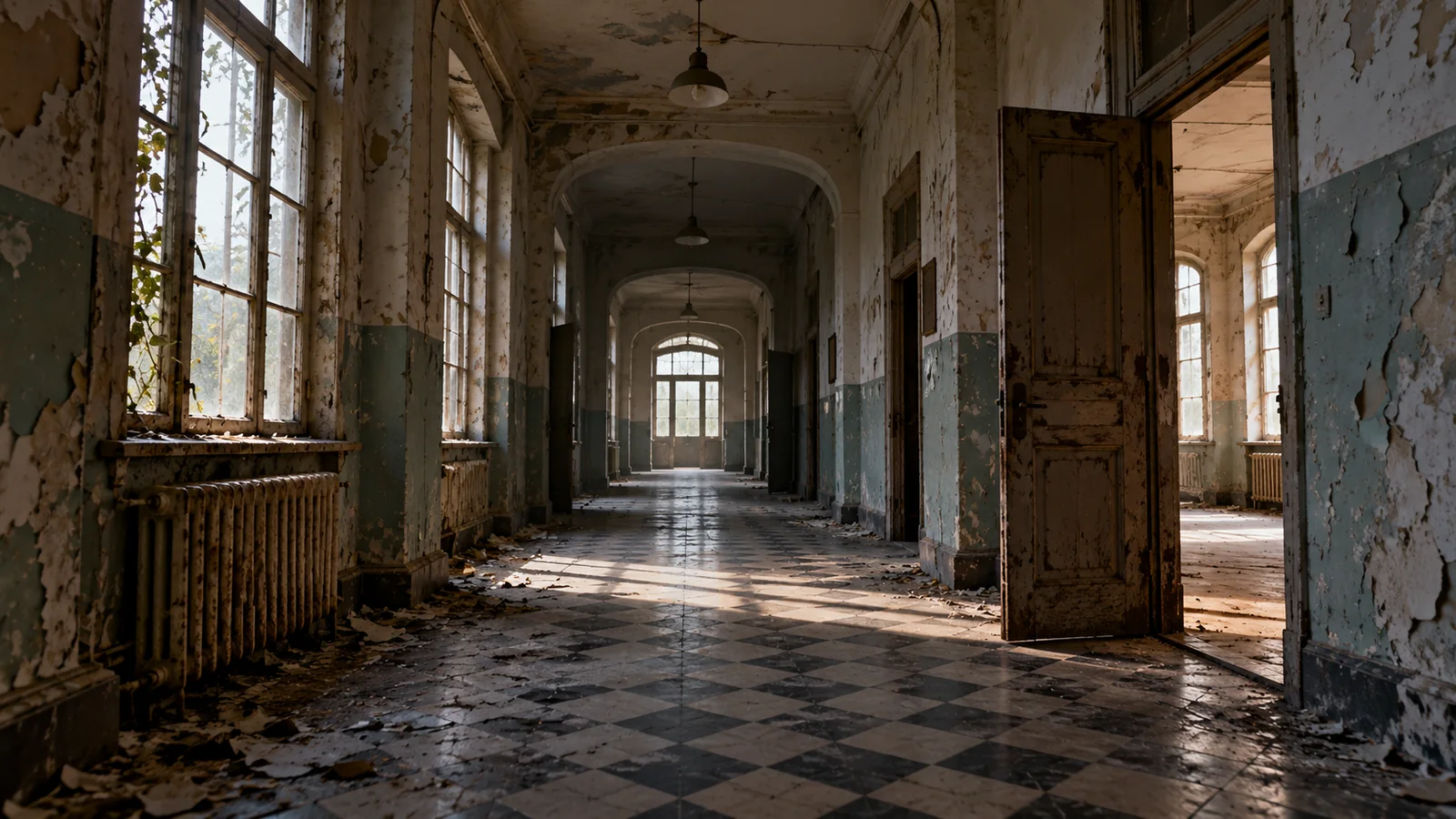
An empty hospital corridor can feel more disturbing than a dark forest. Its doors, windows and signs are familiar, yet the place no longer behaves as expected. There may be no people, no ordinary sounds and no clear indication of what lies beyond the next doorway. That mismatch helps explain why abandoned architecture can evoke unease even when nothing supernatural is happening.
The important distinction is that an unsettling impression is not proof of danger. It is a perception shaped by architecture, uncertainty, memory and context. And a genuinely derelict building can also present real structural and environmental hazards. This guide separates the psychology from the physical risks.
The strongest evidence: an uncanny valley for places
In a 2022 Journal of Environmental Psychology paper, Alexander Diel and Michael Lewis investigated how deviations from familiar architectural patterns affect perceived eeriness across three experiments. Their results linked unusual configurations and structural distortions with an uncanny response. Human presence also mattered differently depending on whether the space was public or private. Read the original study.
This is stronger evidence than the common claim that empty places are inherently frightening. The experiments suggest that how a place violates expectations can matter more than emptiness alone. The findings do not establish a universal response for every person, building or culture.
Six mechanisms that can make a familiar building feel wrong
1. Broken expectations and spatial anomalies
A school normally has children, bells and activity. A shopping mall has music, staff and shoppers. Remove those cues while leaving the architecture intact, and the brain must reconcile a familiar category with an unexpected scene. Repeated doorways, odd proportions, missing fixtures or unusual room layouts may intensify the effect. The 2022 experiments directly tested distortions in built environments; the broader explanation involving learned expectations is a reasonable interpretation, not a separate finding that every abandoned site was tested.
2. Uncertainty about what is hidden
A dark staircase or partly open door conceals information. You cannot immediately determine whether the next space is safe or occupied. Research on environmental perception describes “mystery” as the promise of additional information beyond what can currently be seen. Mystery may encourage exploration in some settings, but when paired with decay or isolation it can also feel threatening. See research on mystery in architectural preference.
3. Silence and missing human activity
In a working building, voices, footsteps and mechanical sounds help establish that the space is being used. Their absence can make the environment harder to interpret. But silence is not a proven stand-alone cause of fear: context, prior expectations and individual experiences influence the response.
4. Decay as evidence of lost control
Peeling paint, water damage, collapsed ceilings and vegetation growing indoors signal that routine maintenance has stopped. These cues can suggest uncertainty about safety and make time itself feel visible. They are also genuine reasons to keep away: unstable floors, exposed wiring, asbestos-containing materials and contaminated water are possible hazards in neglected properties.
5. Memory, nostalgia and the passage of time
An abandoned theater can invite the viewer to imagine the performances once staged there. A derelict school may evoke memories of childhood. That mix of presence and absence can produce sadness, curiosity, fascination or discomfort rather than fear alone. A 2024 qualitative study of the derelict Beelitz sanatorium found experiences ranging from irritation and eeriness to connection and wellbeing. Read the study.
6. Stories shape interpretation
A rumor that a house is haunted changes what visitors expect to notice. The same creaking door might be dismissed as ordinary in a familiar home but interpreted as alarming in a building with a frightening reputation. A 2020 review of research on supposedly haunted environments found that evidence for individual factors such as infrasound and electromagnetic fields was often weak, inconsistent or null. These factors should not be presented as proven explanations for every eerie experience. Read the review.
Abandoned, liminal and haunted: three different ideas
| Abandoned building | A property no longer regularly occupied or maintained | That it is haunted or automatically unsafe in every part |
|---|---|---|
| Liminal space | A transitional or strangely familiar environment, often depicted as empty | That it is abandoned in real life |
| Haunted place | A location associated with reports or stories of paranormal activity | That supernatural causes have been established |
An airport at night can be liminal without being abandoned. An abandoned factory may be visually ordinary rather than uncanny. And a reputedly haunted house can still be occupied. Keeping the categories separate makes the psychology clearer.
A practical comparison: what changes the feeling?
Try this at home with photographs, not by entering an unsafe property. Find two lawful, openly licensed photos of the same kind of interior: one normally occupied and one empty. Keep their viewing size similar. For each image, note whether you can see the exit, predict the room layout, identify its function and infer whether anyone is nearby. Then compare how uneasy you feel on a 1–5 scale.
- Record the setting and any prior stories you know about it before looking at the image.
- Rate uncertainty, perceived safety and eeriness separately; they are not identical.
- Repeat with a well-lit and dim version of a legally obtained image, without changing its architecture.
- If possible, ask another person to rate the same images without sharing your interpretation first.
- Do not treat these personal ratings as a scientific experiment or a diagnostic test.
This exercise adds a useful distinction: a scene can feel mysterious but attractive, visually distorted but harmless, or physically hazardous without looking eerie. Those outcomes should not be collapsed into one explanation.
Why some people love abandoned places
The appeal is not necessarily a taste for danger. Ruins offer visible traces of previous lives, unusual textures and an opportunity to imagine how a place changed over decades. Photographers may value symmetry, natural light and the contrast between human construction and returning vegetation. The Beelitz case study also documented positive responses alongside unease; reactions are not uniformly negative.
What about ghosts, infrasound and electromagnetic fields?
There is no reliable basis for claiming that abandoned buildings are eerie because they contain ghosts. Nor does current research justify a blanket claim that low-frequency sound, unusual electromagnetic fields or poor air quality automatically creates paranormal experiences. A review covering 66 studies found major methodological limitations and often weak or inconsistent findings for individual environmental variables. That does not mean poor air quality or structural hazards are harmless; it means the proposed psychological explanation needs stronger evidence.
How to explore the subject safely
- Use public photographs, virtual tours, archives and museums whenever possible.
- For in-person photography, visit only locations that are legally open to visitors and follow posted rules.
- Never cross fences, enter condemned structures or assume an open door grants permission.
- Avoid disturbing historic materials, wildlife, private property or personal belongings.
- If documenting a place, identify its history through archival or heritage sources rather than repeating ghost stories as fact.
The historical layer: what ruins can teach us
Abandoned architecture is also a historical source. A closed station may reveal changing transport routes; a disused factory can show shifts in industry and employment; an old hospital can document changing medical practices. The most useful stories ask when, why and how a place stopped being used, who worked or lived there, and what preservation decisions followed. Those questions are often more revealing than a sensational “most haunted” ranking.
What the research can and cannot tell us
| Unusual spatial layouts can increase uncanniness | Supported by experimental work on built environments | Architectural deviations can shape perceived eeriness |
|---|---|---|
| Every empty building is scary | Not established | Meaning and context matter |
| Infrasound explains haunted houses | Evidence inconsistent or weak in review literature | Do not use as a universal explanation |
| Ruins always cause fear | Contradicted by varied qualitative experiences | Responses can include curiosity and wellbeing |
The takeaway
Old buildings often feel unsettling because they combine familiar design with unexpected absence, concealed information, signs of decay and stories about the past. Experimental psychology supports a role for architectural anomalies; qualitative research shows that people can also experience fascination and connection. The most interesting question is not whether a building is “really haunted,” but which visual cues and expectations make it feel that way.
Research and further reading
You may also like
 Psychology
Mental Fatigue vs. Burnout: How to Tell the Difference and What Actually Helps
Mental fatigue or burnout? Compare symptoms, workplace causes and depression red flags with a practical, non-diagnostic guide grounded…
 Psychology
Can Mice Inherit Their Fathers’ Fear? The Odor Experiment Behind a Controversial Epigenetics Claim
A 2014 mouse experiment linked fathers’ odor–shock learning to odor sensitivity and sensory changes in descendants. Here is…
 Psychology
The Marshmallow Test Revisited: Can Waiting for a Treat Really Predict a Child’s Future?
Does the marshmallow test predict success? Compare original research with the 2013 trust experiment, 2018 replication, 2020 reanalysis…