
Why Are Native Kidneys Usually Left in Place During a Kidney Transplant?
Kidney transplant surgery usually leaves the recipient’s two original kidneys in place. Learn where the donor kidney goes, why nephrectomy is uncommon and when removal may be necessary.
Contents
- Where does the transplanted kidney go?
- Why do surgeons usually leave the original kidneys?
- 1. Avoiding a second operation and its risks
- 2. The pelvis offers a practical transplant site
- 3. Some patients retain limited native kidney function
- Does this mean a person has three kidneys after transplantation?
- When might the original kidneys need to be removed?
- What changes for people with polycystic kidney disease?
- How is the donor kidney connected?
- Will the transplanted kidney work straight away?
- What should patients monitor after a transplant?
- Frequently asked questions
- Do failed kidneys stay inside the body for life?
- Is having three kidneys dangerous?
- Can surgeons remove just one native kidney?
- Can transplant recipients stop immunosuppressants if their old kidneys remain?
- Does the graft replace one kidney in its original position?
- What if the transplanted kidney eventually stops working?
- Key takeaway
- Original medical sources and anatomical reference
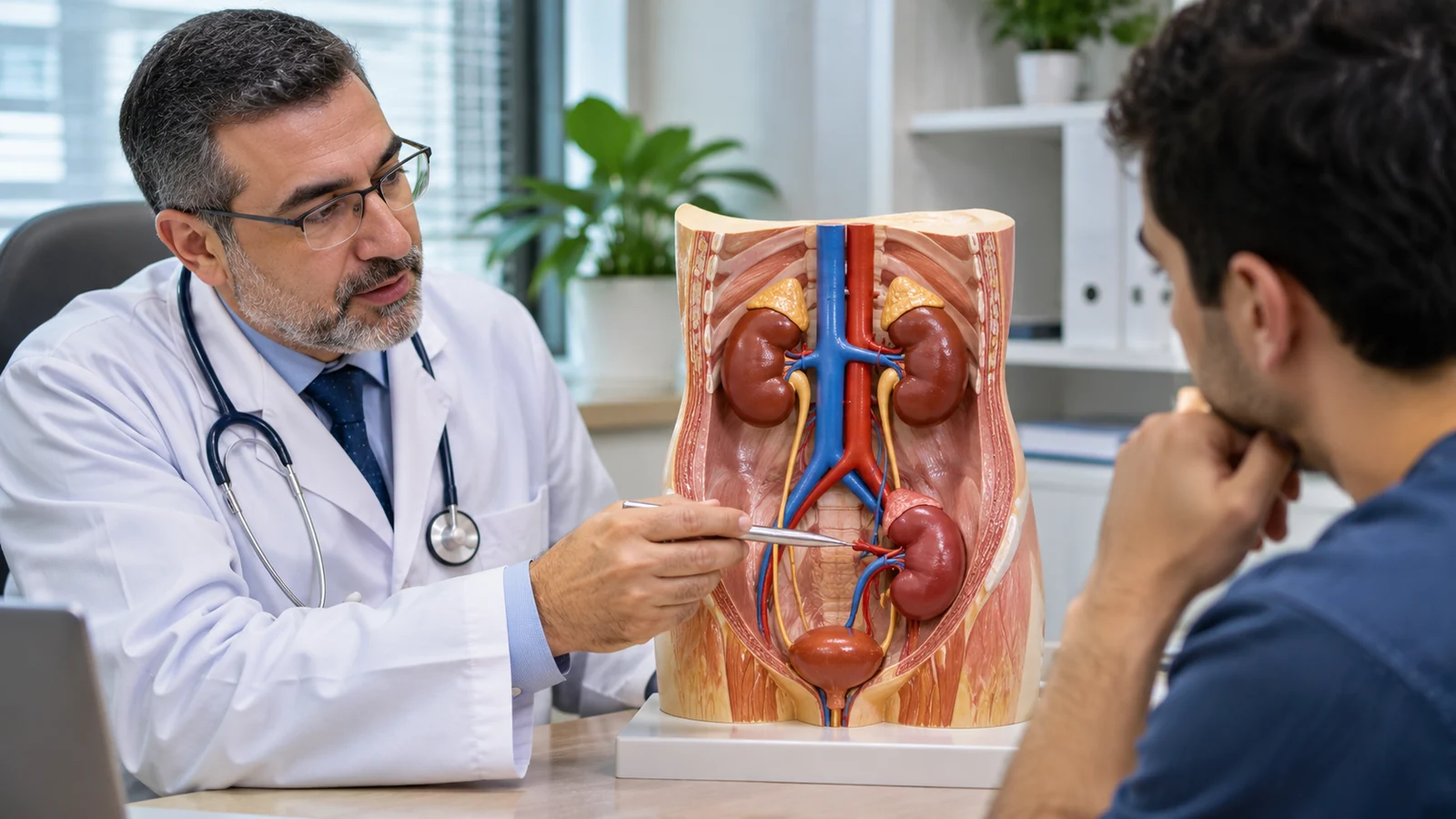
Surgeons usually leave a transplant recipient’s original kidneys in place because removing them is unnecessary unless they are causing a specific medical problem. Rather than replacing a kidney in its original location, the surgeon generally places the donor kidney in the lower abdomen, connects its blood vessels to vessels in the pelvis and connects its ureter to the bladder. Both native kidneys can therefore remain where they are—even if their filtering function is severely reduced.
This standard approach avoids a second, potentially risky operation and takes advantage of a convenient surgical location. The National Institute of Diabetes and Digestive and Kidney Diseases (NIDDK), NHS Blood and Transplant and Mayo Clinic all describe the donor kidney being placed in the lower abdomen while the native kidneys are usually retained.
Where does the transplanted kidney go?
Your original kidneys sit toward the back of the upper abdomen, on either side of the spine. A transplanted kidney is most commonly placed in the iliac fossa—the right or left lower abdomen near the pelvis. The operation is designed to provide the donor kidney with blood flow and a route for urine to reach the bladder without operating on the native kidneys unnecessarily.
- Blood supply: the transplant renal artery and vein are joined to suitable blood vessels in the pelvis, commonly iliac vessels.
- Urinary drainage: the donor kidney’s ureter is connected to the recipient’s bladder; a temporary ureteric stent may help the join heal.
- Native kidneys: the original kidneys are generally left in their upper-abdominal positions, unless there is a clinical indication for removing one or both.
For an anatomically accurate reference, see the original NIDDK/NIH kidney-transplant diagram. It depicts the two native kidneys and the donor kidney placed near the bladder. Image credit: National Institute of Diabetes and Digestive and Kidney Diseases, National Institutes of Health. This verified clinical diagram is separate from this article’s illustrative featured image.
Why do surgeons usually leave the original kidneys?
1. Avoiding a second operation and its risks
Nephrectomy—surgical removal of a kidney—has its own risks, including bleeding, infection and injury to surrounding structures. Removing two kidneys may further increase the scope of surgery. If failed kidneys are not causing symptoms or complications, the transplant itself does not require them to be removed. A nephrectomy may still be necessary for a clear clinical indication.
2. The pelvis offers a practical transplant site
The iliac vessels are accessible for vascular connections, and the nearby bladder makes the ureteric connection relatively straightforward. Placing the kidney here generally avoids the more extensive dissection needed to implant it at the native kidney’s original site. The exact approach depends on vascular anatomy, prior operations and individual surgical factors.
3. Some patients retain limited native kidney function
Even advanced kidney disease does not always eliminate all urine production or residual kidney activity. In selected cases, preserving that residual function may be relevant when deciding whether to remove the native kidneys. This is one consideration, not a universal justification: the leading reason remains that routine removal offers no automatic benefit when the kidneys are not causing harm.
Does this mean a person has three kidneys after transplantation?
Usually, yes—anatomically. Most recipients of a single donor kidney retain their two native kidneys, leaving three kidneys inside the body. That does not mean all three are functioning normally: the donor kidney may perform most of the filtration. There are exceptions, such as patients who require a native nephrectomy or selected situations involving dual-kidney transplantation.
When might the original kidneys need to be removed?
Native nephrectomy is considered when an original kidney is itself causing problems or preventing a safe transplant. These are potential indications rather than automatic reasons to operate; each case requires assessment by the transplant team.
| Potential indication | Why removal may be considered | Important limitation |
|---|---|---|
| Recurrent or serious kidney infection | The native kidney may remain a source of infection during immunosuppressive treatment | Treatability and source of infection must be assessed |
| Suspected or confirmed kidney cancer | A suspicious mass can require surgical management | Imaging and specialist evaluation determine the plan |
| Severe, difficult-to-control hypertension | A native kidney may contribute to persistent hypertension in selected patients | Most hypertension does not require nephrectomy |
| Very large polycystic kidneys | Severe pain, bleeding or insufficient space for the graft may be concerns | Enlargement alone is not always enough |
| Complex stones, bleeding or persistent pain | Some complications cannot be adequately managed conservatively | Risks and alternatives are reviewed individually |
What changes for people with polycystic kidney disease?
In autosomal dominant polycystic kidney disease (ADPKD), the native kidneys can become greatly enlarged, painful or susceptible to bleeding and infections. Even in this situation, nephrectomy is not routine. The 2025 KDIGO guideline recommends considering removal only for specific indications and when the anticipated benefit outweighs the risks, including problems with space for the graft, severe symptoms, recurrent infection, complicated stones or suspected malignancy.
The timing of surgery—before, during or after transplantation—and whether to remove one or both kidneys must be individualized. Such decisions can affect residual function, transfusion risk and transplant planning. Advice for ADPKD should not be applied indiscriminately to people with other causes of kidney failure.
How is the donor kidney connected?
- Before surgery, the team evaluates the recipient, donor kidney, blood vessels and immunological compatibility.
- Under general anesthesia, the surgeon makes an incision in one side of the lower abdomen.
- The donated kidney is positioned in the pelvis, and its artery and vein are joined to the recipient’s blood vessels.
- The ureter is connected to the bladder. A temporary stent is frequently used and later removed according to the centre’s protocol.
- Blood supply, urine output, blood tests and medications are monitored after surgery. Some grafts need more time than others to begin functioning well.
NHS Blood and Transplant notes that surgery typically takes around two to four hours, but duration and technique vary. Most recipients receive a single kidney, though dual-kidney transplants can be appropriate in selected cases.
Will the transplanted kidney work straight away?
A transplanted kidney may begin making urine promptly, particularly with some living-donor grafts. Other kidneys need days or longer before they function adequately. This is sometimes called delayed graft function and may require temporary dialysis. Delayed function is not automatically the same as immune rejection; the transplant team uses examination, laboratory findings and other assessments to determine the cause.
What should patients monitor after a transplant?
Keeping the original kidneys does not reduce the need for close care of the transplanted organ. Patients generally need prescribed immunosuppressive medications, frequent blood tests early on and follow-up with their transplant service. Medication doses should never be stopped or changed without advice from that team.
| Issue | Routine monitoring | When to seek urgent advice |
|---|---|---|
| Graft function | Creatinine, urine output and other tests ordered by the team | Very little or no urine, significant new illness |
| Infection | Symptoms and review of immunosuppressive treatment | Temperature of 38°C/100.4°F or higher, shaking chills |
| Rejection | Follow-up laboratory results and adherence to medication | New concerning symptoms or an abnormal result reported by the team |
| Surgical recovery | Wound condition, pain and swelling | Severe new pain, bleeding or acute deterioration |
Frequently asked questions
Do failed kidneys stay inside the body for life?
Often they do. A nonfunctioning kidney can remain in place indefinitely if it is not causing a problem that requires treatment. The team continues to assess it if symptoms or imaging findings change.
Is having three kidneys dangerous?
The number itself is not generally the problem. The new kidney is connected to the blood vessels and bladder so it can function, while the native kidneys remain where they are. The important questions are how well the graft is working and whether the native kidneys have complications.
Can surgeons remove just one native kidney?
Yes. A unilateral nephrectomy may be appropriate in selected circumstances, particularly when a problem affects one side or space is needed for transplantation. Removal of one versus both kidneys depends on the clinical indication.
Can transplant recipients stop immunosuppressants if their old kidneys remain?
No. Retaining native kidneys does not prevent the immune system from recognizing a donated organ as foreign. Immunosuppressive treatment and follow-up remain essential as directed by the transplant team.
Does the graft replace one kidney in its original position?
Usually not. A transplanted kidney is most often placed in the lower abdomen, near the pelvic blood vessels and bladder. Other techniques exist for unusual surgical circumstances.
What if the transplanted kidney eventually stops working?
Graft function can decline because of rejection, infection, recurrent disease or other causes. The transplant service evaluates treatment options. A failed transplant does not always need immediate surgical removal; the decision depends on symptoms and clinical risks.
Key takeaway
During a standard kidney transplant, the donor kidney is added in the lower abdomen and the two original kidneys are usually left alone. This avoids unnecessary surgery while providing access to blood vessels and the bladder. Native nephrectomy is reserved for cases where the original kidneys cause specific complications, and the decision is made by the transplant team.
Original medical sources and anatomical reference
- NIDDK / NIH — Kidney Transplant.
- NHS Blood and Transplant — Kidney transplant surgery.
- Leeds Teaching Hospitals — Do native kidneys need to be removed?
- KDIGO — 2025 ADPKD Clinical Practice Guideline.
- Mayo Clinic — Kidney transplant.
- NHS Blood and Transplant — Warning signs after kidney transplantation.
- NHS Blood and Transplant — Kidney transplant medicines.
- NIDDK Media Library — Original transplant anatomy diagram (credit: NIDDK/NIH).
You may also like
 HEALTH
Ebola Outbreak 2026: UK Risk and Vaccine Trials
What the 2026 Bundibugyo Ebola outbreak means for UK risk, how the virus spreads, and why new vaccine…
 HEALTH
Birth Control and Weight Gain: What Genetics and Research Really Show
Do implants, pills or injections cause weight gain? Understand the 2020 ESR1 genetics study, newer evidence, differences between…
 HEALTH
Plant-Based Milk vs Dairy: What the New UK Study Found
What the UK dairy-replacement study found, what it cannot prove, and how to check plant-based milk labels for…