
Why Do Drivers Get Road Rage? Causes and Safe Ways to Respond
Why does road rage happen? Explore psychological triggers, findings from 2025–2026 research and practical advice for managing anger and staying safe around aggressive drivers.
Contents
- Driving anger, aggressive driving and road rage: the difference
- Why do some people get so angry behind the wheel?
- 1. Traffic delays and lost control
- 2. Treating the car as personal territory
- 3. Assuming an insult was intentional
- 4. Anger regulation and attitudes toward aggression
- 5. Feeling anonymous inside a vehicle
- 6. The driving culture around us
- 7. Sleep disturbance and digital stress
- What do recent surveys tell us?
- Does road rage reveal a driver’s true personality?
- Everyday situations: safer alternatives
- How to manage your own driving anger
- What should you do when another driver becomes aggressive?
- Why honking back or recording with your phone may make things worse
- Frequently asked questions
- Is road rage a mental illness?
- Does heavy traffic cause road rage?
- Do bumper stickers make drivers aggressive?
- What if an angry driver follows my vehicle?
- Can anger-management skills improve driving?
- The bottom line
- Research and official sources
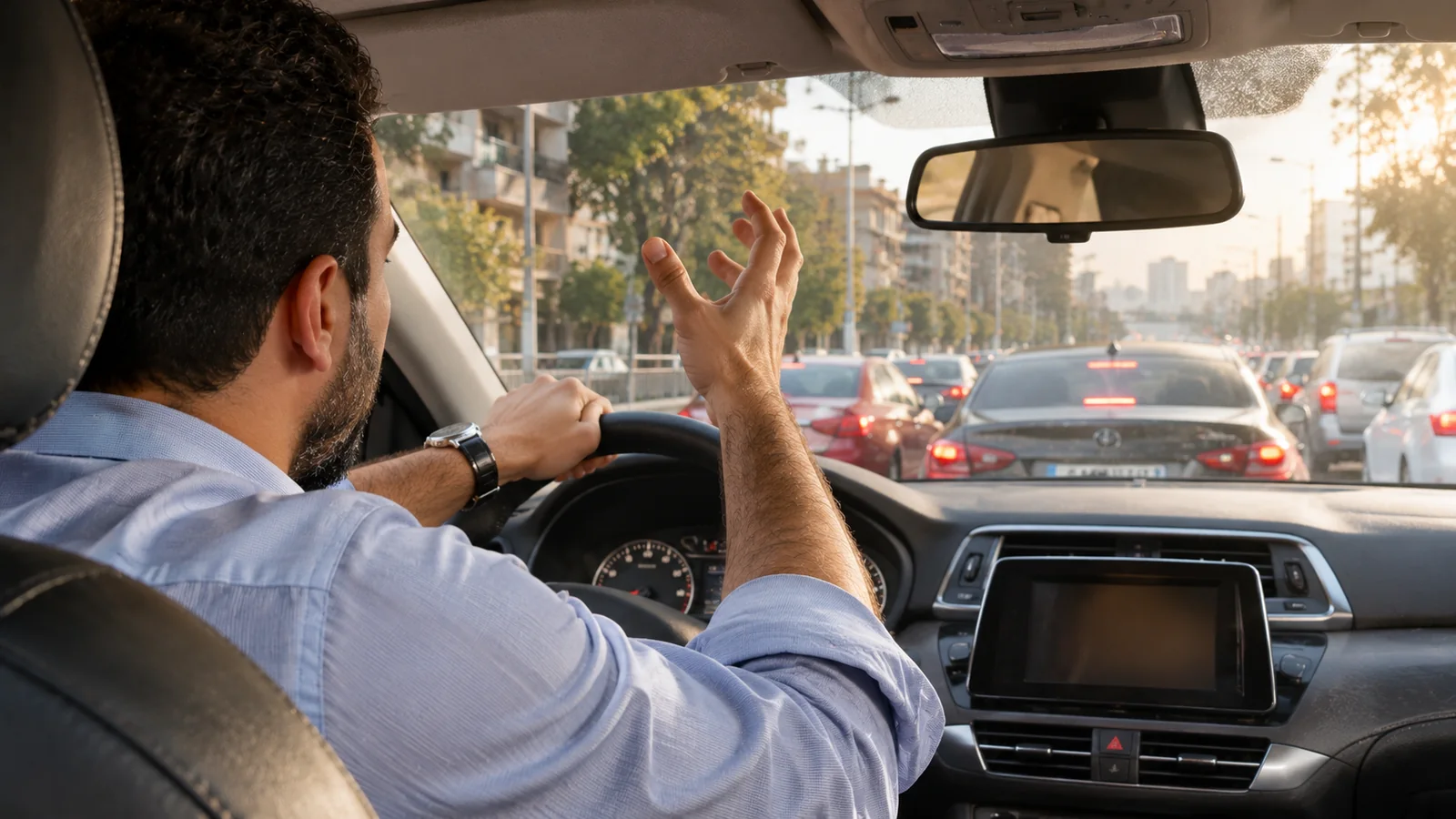
Road rage rarely has a single cause. A driver may interpret a delay, a sudden lane change or an unsafe maneuver as a threat, an insult or a loss of control. Stress, time pressure, emotion regulation, assumptions about other drivers and local driving norms can then turn an ordinary frustration into swearing, tailgating, retaliation or, in severe cases, violence.
A 2025 systematic review synthesized 148 studies linking aggressive driving to factors such as difficulty regulating anger, hostile attitudes and certain personality-related tendencies. These are associations, not a test that reveals anyone’s character. Here is what the evidence shows, how it has evolved since the original 2020 article and what to do if another driver becomes threatening.
Driving anger, aggressive driving and road rage: the difference
| Term | Meaning | Example |
|---|---|---|
| Driving anger | An emotional reaction that does not necessarily result in unsafe behavior | Feeling frustrated in a traffic jam while staying in your lane |
| Aggressive driving | Deliberately risky or intimidating conduct around other road users | Tailgating or cutting off someone to punish them |
| Road rage | A hostile escalation that can include threats, pursuit or violence | Chasing a driver or confronting them with threats |
Anger is not automatically aggression, and an unsafe maneuver is not necessarily deliberate. The safest response depends on what another driver is actually doing, not on guessing their intentions.
Why do some people get so angry behind the wheel?
1. Traffic delays and lost control
Traffic is an unusually frustrating environment because a driver cannot make a queue disappear by trying harder. When a person is late, every red light or slow vehicle can feel like a personal obstacle. That loss of control can amplify stress, particularly when the driver started the journey tired, worried or already under pressure.
Cleveland Clinic psychologist Susan Albers noted in August 2025 that road rage often reflects difficulties managing emotions in the moment rather than the traffic incident alone. Anxiety, hunger, fatigue and feeling rushed may all contribute; they do not inevitably lead to aggression.
2. Treating the car as personal territory
An older explanation, featured in the 2020 Horus Valley article, is territoriality: drivers may think of their vehicle as personal space and interpret a cut-in or close pass as an intrusion. A 2008 paper by William Szlemko and colleagues reported three studies associating personalized vehicle markers, such as stickers, with some expressions of driver aggression.
Crucially, the study did not prove that bumper stickers cause road rage. It also provides no basis for treating an individual driver with stickers as dangerous. Read the original research
3. Assuming an insult was intentional
When another vehicle merges abruptly, a driver may automatically think, “They did that to disrespect me.” Yet the maneuver might reflect a misjudgment, distraction or unfamiliarity with the road. Distinguishing a real hazard from an assumed personal attack can help prevent retaliation.
4. Anger regulation and attitudes toward aggression
The 2025 systematic review by Steven Love and Michelle Nicolls examined associations across 148 original studies. Difficulties with emotion regulation, favorable attitudes toward retaliatory behavior and certain maladaptive psychological patterns were linked to more aggressive driving. Better emotion-management skills and less tolerant attitudes toward aggression were generally associated with lower risk. Because measures and samples varied, these findings cannot predict how a particular person will drive.
5. Feeling anonymous inside a vehicle
Drivers are separated by windows and moving traffic. They often cannot hear explanations or see facial expressions, and they may feel less accountable because they do not expect to meet the other person again. That social distance may encourage behaviors they would avoid in a face-to-face conversation. It is a possible contributing factor, not proof that driving changes someone into a fundamentally different person.
6. The driving culture around us
If tailgating, hostile honking or refusing to let others merge seems common, drivers may start seeing these behaviors as normal. In a September 2025 AAA Foundation study, local norms about aggressive driving were among the strongest correlates of self-reported aggressive driving. The results describe American participants and should not be treated as worldwide or Egyptian prevalence estimates.
7. Sleep disturbance and digital stress
A July 2026 study surveyed 227 adults and found that problematic social media use was associated with greater driving anger; statistical analysis also identified a mediating role for disturbed sleep. This cross-sectional finding does not establish that social media causes road rage or that better sleep alone prevents crashes, but it supports paying attention to how you feel before starting a trip.
What do recent surveys tell us?
The AAA Foundation published a mixed-methods road-rage report in September 2025, including focus groups and a representative survey of 3,020 US drivers. It found that 96% reported at least one broadly defined aggressive-driving or road-rage behavior in the previous year, while 11% reported violent behavior. The 96% figure should not be misrepresented as the proportion who physically assaulted someone: the survey included a wide spectrum of behaviors.
A separate AAA safety-culture survey published in June 2026 found that 90% of respondents regarded aggressive driving as very or extremely dangerous. The contrast between perceived risk and unsafe behavior reminds us that knowing the rules does not always prevent an emotional response. These figures are specific to US surveys, not global prevalence.
Does road rage reveal a driver’s true personality?
Not necessarily. Some traits and persistent attitudes may raise the likelihood of aggression, but individual behavior also depends on fatigue, stress, learned habits, local norms and the immediate situation. A single angry reaction does not establish a mental disorder or provide a complete assessment of someone’s personality.
Everyday situations: safer alternatives
| Situation | Risky response | Safer alternative |
|---|---|---|
| Someone cuts in suddenly | Speeding after them or blocking their lane | Leave a safe gap and avoid assuming hostile intent |
| Another driver honks repeatedly | Swearing or making an offensive gesture | Keep your attention on the road and let them pass safely |
| A vehicle follows too closely | Brake-checking to punish the driver | Maintain smooth driving and create space when safe |
| Someone threatens or follows you | Stopping to confront them or driving home | Head to a safe, busy public place or police station and contact authorities |
How to manage your own driving anger
- Build in extra travel time. A realistic schedule reduces the pressure to recover every lost minute.
- Focus on your controllable decisions. You cannot remove a traffic jam, but you can maintain a safe following distance.
- Question your first interpretation. A mistake by another driver is not necessarily a deliberate insult.
- Recognize escalation. Gripping the wheel tightly, speeding up to retaliate and wanting to chase another car are signals to disengage.
- Stop safely if overwhelmed. Find a legal, safe place away from traffic and resume only when calm enough to focus.
- Seek support when needed. If anger repeatedly leads to threats or risky maneuvers, professional help with emotion regulation may be useful.
What should you do when another driver becomes aggressive?
- Do not retaliate. Avoid racing, pursuing, threatening, honking in anger or using offensive gestures.
- Create space. Give an erratic vehicle room and avoid blocking its path.
- Stay in the car when confrontation is likely. Keep doors locked and windows closed; do not get out to argue.
- If followed, do not drive home. Continue safely toward a staffed, busy public location or police station, and contact local emergency services when safe.
- Keep your hands on the task of driving. Do not film or use your phone while moving; stop safely before making a call or gathering information, subject to local laws.
AAA, the US National Highway Traffic Safety Administration (NHTSA) and Ontario’s official driver handbook all emphasize avoiding escalation and seeking a safe place if threatened. Proving who was right is never worth a dangerous confrontation.
Why honking back or recording with your phone may make things worse
A horn is a safety warning, not a way to punish another driver. Repeated blasts may be perceived as hostile. Holding a phone to record or chasing someone for footage can distract you and increase risk. If documentation is needed, prioritize safety, stop before using the device and follow local law.
Frequently asked questions
Is road rage a mental illness?
Anger on the road is not a diagnosis. Repeated threatening or dangerous behavior is serious, and someone who consistently struggles to control it may benefit from qualified professional support.
Does heavy traffic cause road rage?
Congestion can trigger frustration, but drivers respond differently. Time pressure, perceived threats, sleep, emotion regulation and social norms also matter.
Do bumper stickers make drivers aggressive?
A 2008 study found an association between personalized vehicle markers and some aggressive behaviors. It did not establish causation, so stickers cannot reliably identify a dangerous driver.
What if an angry driver follows my vehicle?
Do not lead the driver to your home or a secluded place. Drive safely toward a busy public location or police station and contact local authorities without using a handheld phone while driving.
Can anger-management skills improve driving?
Planning ahead, recognizing emotional triggers and pausing safely can help. Persistent road aggression may warrant structured professional support, especially if it puts others at risk.
The bottom line
Road rage is best understood as an interaction between personal tendencies, circumstances and the norms of the road. A frustrating incident is not proof of another driver’s intentions or moral character. Creating distance, declining confrontation and protecting everyone’s safety are more effective goals than winning an argument.
Research and official sources
- Love & Nicolls (2025): systematic review of 148 studies on aggressive-driving psychology.
- AAA Foundation (September 2025): Aggressive Driving and Road Rage report.
- AAA Foundation (June 2026): 2025 Traffic Safety Culture Index.
- Serrano & Williams (2026): problematic social media use, sleep and driving anger.
- Szlemko et al. (2008): Territorial Markings as a Predictor of Driver Aggression and Road Rage.
- Cleveland Clinic (2025): a psychologist explains road-rage triggers.
- AAA: preventing aggressive driving and responding to confrontation.
- NHTSA: dealing with speeding and aggressive drivers.
- Government of Ontario: official driver-handbook safety guidance.
You may also like
 Psychology
The Illusory Truth Effect: Why Repeated Claims Seem More Believable
Why does a repeated statement start to feel true? Explore the illusory truth effect, what 182 studies reveal,…
 Psychology
Why Do We Feel Nostalgic for a Time We Never Lived? The Psychology of Anemoia
Why do we miss decades we never experienced? Explore anemoia and historical nostalgia, the role of family stories…
 Psychology
What Happens When Actions Have No Consequences? Psychology Explained
Does a lack of punishment cause misconduct? Explore research on rule-following, accountability, behavior reinforcement and practical nonviolent boundaries.