
What Happens to Your Brain When You Stop Using Social Media for 30 Days?
What research actually says about a 30-day social media break, including mood, focus, sleep, mixed trial results and a practical tracking plan.
Contents
- The short answer: what research actually supports
- What could change in your brain—and what has not been proven
- 1. Attention may feel less fragmented
- 2. Mood and anxiety might improve—or remain unchanged
- 3. Sleep may benefit if late-night scrolling disappears
- 4. Reward and habit cues can become less automatic
- 5. Body image and social comparison may change
- What might happen across 30 days? A realistic timeline
- A 30-day social media break you can actually evaluate
- Step 1: define exactly what you are stopping
- Step 2: capture a three-to-seven-day baseline
- Step 3: reduce friction and protect relationships
- Step 4: choose replacement activities
- Step 5: record five measures each day
- Step 6: compare the final week with baseline
- Should you quit completely, limit time or curate your feed?
- Common claims that overstate the science
- "Your brain rewires itself in exactly 30 days"
- "A social media detox fixes ADHD or depression"
- "If you feel worse on day three, it means dopamine withdrawal"
- "Every minute of screen time is harmful"
- Why studies disagree—and why that is useful to know
- What if you need social media for work, school or community?
- When a break may not be enough
- How to return after day 30 without losing the benefits
- Bottom line: the goal is control, not a magical brain reset
- Original research and authoritative sources
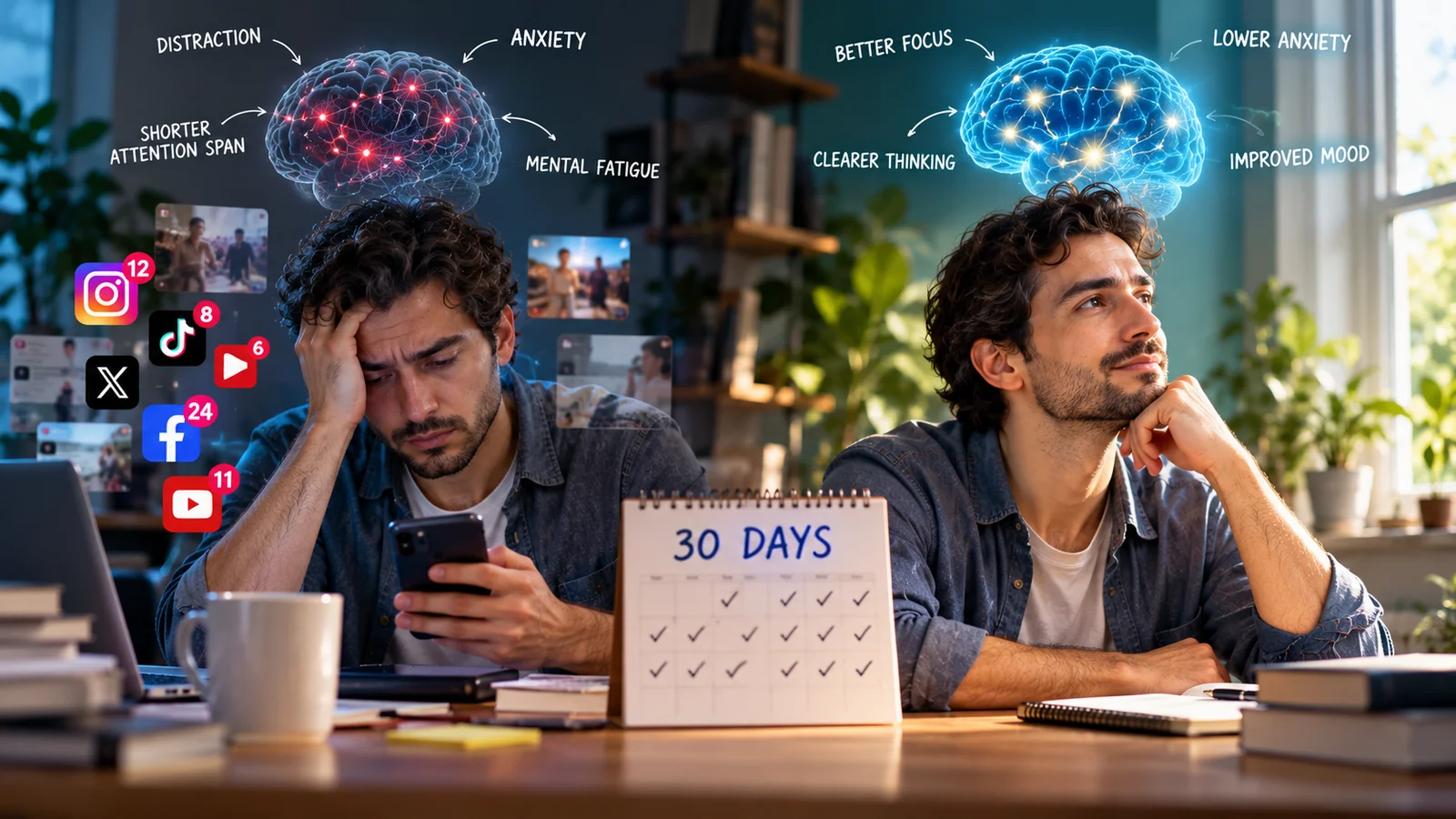
What happens to your brain if you stop using Instagram, TikTok, Facebook, X and other social platforms for 30 days? You might notice fewer interruptions, more time for other activities and a different relationship with your phone. You might also feel disconnected, bored or no better than before. There is no scientifically established 30-day brain reset, and research does not support promising that everyone will become happier, smarter or less anxious.
The more useful question is which parts of your digital routine are affecting you, and what changes when you remove them? This evidence-based guide explains the studies, the limits of brain-related claims, and a realistic 30-day experiment you can conduct without treating your experience as a medical diagnosis.
The short answer: what research actually supports
Some randomized studies find small improvements in well-being or symptoms after restricting social media. Others find no statistically reliable change in general life satisfaction or mood. A 2025 meta-analysis of 32 randomized-trial reports, including 5,544 people, reported a small, heterogeneous average benefit for subjective well-being (standardized effect approximately 0.17). That does not mean every participant benefited, or that abstinence permanently changed their brain.
A separate 2025 systematic review in Scientific Reports, covering ten studies and 4,674 participants, found no significant pooled effect of abstinence on positive affect, negative affect or life satisfaction. Different eligibility criteria, outcomes and intervention designs can produce different summaries. Both results matter; neither justifies a universal cure narrative. Sources: 2025 meta-analysis of randomized trials and 2025 systematic review in Scientific Reports.
What could change in your brain—and what has not been proven
1. Attention may feel less fragmented
Social feeds combine new content, notifications and opportunities to switch tasks. If you normally check an app whenever work becomes difficult, removing that shortcut can reduce interruptions. That is a behavioral explanation for improved focus, not proof that neural circuits regenerate after a fixed number of days. Your actual results depend on what replaces the scrolling: a video game or nonstop news browsing may recreate the same interruptions.
Measure whether you complete a 25-minute task without checking your phone, not whether your brain feels “detoxed.” A useful improvement is an observable change in concentration or task completion. Self-reported focus can also be influenced by expectations, so repeated measures are more informative than one good day.
2. Mood and anxiety might improve—or remain unchanged
A University of Bath randomized trial assigned 154 adults to a one-week social media break or usual use. The break group showed better average well-being and lower depression and anxiety symptom scores at follow-up. The study did not establish that everyone would experience the same result after 30 days, nor that a break treats clinical depression or anxiety. Read the original trial.
Other trials and pooled analyses are mixed. If social media is your main way to maintain supportive relationships, a total break may also remove positive social contact. The effect can differ depending on how you use platforms, what content you see, and the role they play in your daily life.
3. Sleep may benefit if late-night scrolling disappears
For some people, stopping evening scrolling removes delayed bedtimes, emotionally stimulating content and the temptation to stay awake for “one more video.” Better sleep can then support daytime alertness. But if you replace social media with streaming or work email until 2 a.m., quitting the apps alone may do little. A small UK pilot randomized study of adolescents published in 2026 reported tentative improvements in several sleep and well-being outcomes after a 21-day smartphone/social media break, but some changes did not persist at two months. Its small pilot design limits generalization to adults. See the adolescent pilot study.
4. Reward and habit cues can become less automatic
You may reach for your phone without a deliberate decision, especially during boredom, uncertainty or waiting. Social apps provide frequent unpredictable new content, which can reinforce repeated checking. Breaking a cue–response habit may make it easier to choose what to do next. However, claims that “dopamine receptors reset on day 30” or that a social media detox cures a “damaged dopamine system” go beyond what these abstinence studies establish.
Dopamine is involved in motivation and learning, not simply a toxin released by apps. You cannot infer neurotransmitter levels from how restless or productive you feel during a break. Brain-scan evidence should not be conflated with self-report outcomes in trials of social media restriction.
5. Body image and social comparison may change
A 2025 randomized study of 175 young women compared a seven-day Instagram/TikTok break, a 30-minute daily limit, a feed cleanup removing appearance-focused content, and usual use. Appearance satisfaction improved in the three intervention groups compared with the control group; the outcomes varied by strategy. This suggests curating your feed may sometimes be a more sustainable option than complete abstinence. It does not establish effects for all ages or genders. Source: Body Image randomized trial.
What might happen across 30 days? A realistic timeline
The timeline below is a planning framework, not a clinically validated biological sequence. There is no established day on which the brain “resets,” and you may not experience these changes in this order.
| Period | What you may notice | What to measure instead of guessing |
|---|---|---|
| Days 1–3 | Automatic checking, boredom, fear of missing out or relief | App pickups and urges; hours of sleep |
| Days 4–7 | A new evening routine, or difficulty replacing social contact | Bedtime, uninterrupted work blocks, connection with friends |
| Days 8–14 | Habits may feel less automatic; mood may or may not change | Consistent daily ratings rather than a single good day |
| Days 15–21 | More time for hobbies, or migration to other apps | Total recreational screen time and offline activity |
| Days 22–30 | A clearer idea of which platforms and uses you value | Compare baseline with the final week; decide what to keep |
A 30-day social media break you can actually evaluate
The most useful addition to a generic detox challenge is a simple before-and-after measurement plan. Without one, it is easy to attribute a better week to quitting social media when work pressure, sleep, illness or other factors changed at the same time. This is a personal observation exercise, not a randomized trial and not evidence of causation.
Step 1: define exactly what you are stopping
Decide whether you will stop algorithmic social feeds, all social networks, or only specific apps. Keep essential communication channels where needed. For example, you might remove Instagram, TikTok and X while retaining text messages and work messaging. Write the rules before day one so you do not redefine success afterward.
Step 2: capture a three-to-seven-day baseline
Use iPhone Screen Time or Android Digital Wellbeing to record daily app time and pickups, if available. Record bedtime and wake time, plus a brief 0–10 daily rating for concentration, mood and perceived stress. Keep the questions consistent. These ratings are personal tracking tools, not validated mental-health scales.
Step 3: reduce friction and protect relationships
- Remove the chosen apps or sign out; turn off nonessential notifications.
- Tell close contacts how to reach you through phone, text or another agreed channel.
- Save important event details, community notices or business contacts before the break.
- Avoid replacing social feeds with compulsive news, shopping or another infinite-scroll product.
- If your livelihood requires social media, consider scheduled access rather than an unrealistic total ban.
Step 4: choose replacement activities
Prepare alternatives for moments when you usually scroll: a ten-minute walk, a book, a short conversation, stretching, journaling, or completing one small task. Replacements matter because “more free time” is only beneficial if you can use it in a way that supports your goals. Keep at least one route to social support available.
Step 5: record five measures each day
| Measure | Simple recording method | Important limitation |
|---|---|---|
| Social app time | Minutes from device usage report | Some activity may shift to a browser |
| Sleep | Bedtime, wake time and self-rated restfulness | Self-report does not diagnose sleep disorders |
| Focus | Number of planned uninterrupted 25-minute sessions completed | Affected by work difficulty and motivation |
| Mood/stress | Same 0–10 ratings at the same time daily | Not a clinical assessment |
| Social connection | One sentence: connected, neutral or isolated | Quality matters more than message count |
Step 6: compare the final week with baseline
Average your daily numbers over several days rather than comparing your best and worst day. Example: if social-media time fell from 150 to 20 minutes per day, that is 130 minutes per day, or about 65 hours over 30 days at that average difference. This is an arithmetic illustration, not a measured research result. It also does not prove that those hours became productive.
Look for trade-offs. Did you sleep longer but feel more isolated? Did work focus improve but you miss important community information? Did anxiety ease without a total break, simply by unfollowing distressing accounts? A good outcome is a routine that fits your needs, not an impressive abstinence streak.
Should you quit completely, limit time or curate your feed?
| Approach | Best fit | Main drawback |
|---|---|---|
| Full 30-day break | People wanting to test whether a platform is useful to them | Can interrupt social support, work or community access |
| Daily time limit | People who need the platform but want less automatic scrolling | Easy to bypass; time alone misses content quality |
| Notification shutdown | People mainly disrupted by alerts | Does not address voluntary checking |
| Feed cleanup | People distressed by specific content or comparisons | Algorithms may reintroduce similar material |
| No social media before bed | People whose scrolling pushes bedtime later | Does not address daytime overuse |
Research supports avoiding simplistic “all-or-nothing” claims. A 2025 meta-analysis found small overall benefits from restriction, while another found no reliable average improvement in general affect and life satisfaction. A 2025 randomized study suggests that a time cap or feed cleanup can be worth testing, especially when the concern is appearance-focused content. See the meta-analysis of 20 randomized trials and the comparison of detox strategies.
Common claims that overstate the science
“Your brain rewires itself in exactly 30 days”
The brain is adaptable, and repeated behavior can influence habits, but the reviewed intervention studies do not demonstrate a universal 30-day neurological transformation. A change in self-reported anxiety or phone use is not direct proof of a structural brain change.
“A social media detox fixes ADHD or depression”
No. Restricting social media is not a proven replacement for evidence-based treatment of ADHD, depression or anxiety disorders. If you are struggling with persistent symptoms, consider a qualified healthcare professional. Do not stop prescribed treatment because a detox challenge promises a cure.
“If you feel worse on day three, it means dopamine withdrawal”
Restlessness, boredom or missing friends may occur, but those feelings do not identify a specific neurotransmitter mechanism. Some people feel immediate relief; others feel lonely or frustrated. Neither response confirms a biological detox process.
“Every minute of screen time is harmful”
Context matters. Messaging family, accessing disability communities, learning a skill and endlessly comparing yourself with idealized images are not the same activity. The quality, timing and purpose of use can matter as much as the total minutes.
Why studies disagree—and why that is useful to know
Research groups define social media differently, restrict different apps, study different age groups and measure outcomes ranging from anxiety symptoms to life satisfaction. Some trials rely on participants reporting their own use; others collect passive device data. Studies also differ in how long they follow participants after the intervention. These differences limit how confidently results can be combined.
For example, the 2025 Scientific Reports review pooled ten studies with no significant average change in affect or life satisfaction, while the 2025 SSM – Mental Health review pooled a larger set of randomized trials and found a small benefit. A reader should not select only the review with the most exciting conclusion. The responsible takeaway is that effects are variable and usually modest on average.
What if you need social media for work, school or community?
A strict break is not necessary to test healthier habits. Create scheduled windows for posting and replies, use desktop tools instead of phone notifications, and separate professional accounts from recreational feeds. If a community is a key source of emotional support, identify another way to stay connected before removing access. Accessibility needs and caregiving responsibilities may make some “digital detox” rules impractical.
For students and younger users, a parent or educator should consider safety, school requirements and access to friends rather than impose a universal ban. Evidence from adults cannot automatically be generalized to adolescents. The small 2026 UK pilot offers tentative findings, not a definitive prescription for young people.
When a break may not be enough
If low mood, panic, severe insomnia, loss of interest or impaired daily functioning persists, do not assume the solution is simply another week offline. Seek individualized support. If you feel unsafe or are considering self-harm, contact local emergency services or an appropriate crisis support service immediately. Social media use can interact with mental health, but it is rarely the only factor worth assessing.
How to return after day 30 without losing the benefits
- Keep only the platforms that serve a clear purpose.
- Set notification defaults to off and enable only essential alerts.
- Choose one or two short check-in windows rather than constant access.
- Unfollow accounts that repeatedly leave you distressed or comparing yourself negatively.
- Protect the hour before bed if that improved your sleep.
- Review your screen-time and well-being notes after two weeks of reintroduction.
- If a full break increased loneliness, prioritize deliberate communication over passive browsing.
Bottom line: the goal is control, not a magical brain reset
Thirty days without social media can be a useful experiment. It may reduce interruptions, change your sleep routine and help you discover which digital habits add value. But current evidence does not establish a predictable sequence of brain changes, and average psychological benefits are small or absent in different reviews. Measure your own experience carefully, preserve important relationships and choose the least restrictive strategy that actually helps.
Original research and authoritative sources
- Lambert et al. (2022): one-week randomized social media break
- Lemahieu et al. (2025): systematic review and meta-analysis
- 2025 meta-analysis: restriction and subjective well-being
- Liu et al. (2025): meta-analysis of 20 randomized trials
- Seekis et al. (2025): break, time cap and feed cleanup trial
- de Hesselle and Montag (2024): 14-day abstinence experiment
- 2026 UK adolescent 21-day pilot trial
Editorial note: This article summarizes published studies; Horus Valley did not conduct a 30-day clinical experiment. The tracking plan is educational and cannot establish causality or diagnose a mental-health condition.
You may also like
 Psychology
Mental Fatigue vs. Burnout: How to Tell the Difference and What Actually Helps
Mental fatigue or burnout? Compare symptoms, workplace causes and depression red flags with a practical, non-diagnostic guide grounded…
 Psychology
Can Mice Inherit Their Fathers’ Fear? The Odor Experiment Behind a Controversial Epigenetics Claim
A 2014 mouse experiment linked fathers’ odor–shock learning to odor sensitivity and sensory changes in descendants. Here is…
 Psychology
The Marshmallow Test Revisited: Can Waiting for a Treat Really Predict a Child’s Future?
Does the marshmallow test predict success? Compare original research with the 2013 trust experiment, 2018 replication, 2020 reanalysis…