
What Happens to Your Brain During Sleep Paralysis? REM Sleep, Hallucinations and the Science Explained
A science-based guide to sleep paralysis: REM atonia, hallucinations, a differential comparison, what a 2024 meta-analysis found, coping strategies and red flags.
Contents
- What Happens to Your Brain During Sleep Paralysis?
- The Short Scientific Explanation
- What Happens During Normal REM Sleep?
- Why Can You Be Awake but Unable to Move?
- What Is REM Atonia, and Which Parts of the Brain Are Involved?
- Why Does Sleep Paralysis Cause Hallucinations?
- Why Does a Shadowy Figure Feel So Real?
- Why Does It Feel Like Someone Is Sitting on Your Chest?
- Can Sleep Paralysis Cause an Out-of-Body Experience?
- How Long Does an Episode Last?
- What Makes Sleep Paralysis More Likely?
- Comparison Guide: Five Conditions That Can Be Confused With Sleep Paralysis
- Sleep Paralysis Versus Nightmares, Night Terrors and REM Behavior Disorder
- Is Sleep Paralysis a Sign of Narcolepsy?
- A Practical Decision Path: What to Check After an Episode
- What to Do During Sleep Paralysis
- How to Reduce the Chance of Another Episode
- A Simple Two-Week Sleep Diary
- When Should You See a Doctor?
- What Treatments Can Help Frequent Sleep Paralysis?
- Common Myths Versus What Research Supports
- What a Large 2024 Review Found—and Why Its Numbers Need Context
- What Scientists Still Do Not Know
- What Makes the Brain Explanation More Than a Ghost Story?
- What to Record Before Speaking With a Sleep Clinician
- Editorial Method and Medical Accuracy
- The Bottom Line
- Medical and Scientific Sources
What Happens to Your Brain During Sleep Paralysis?
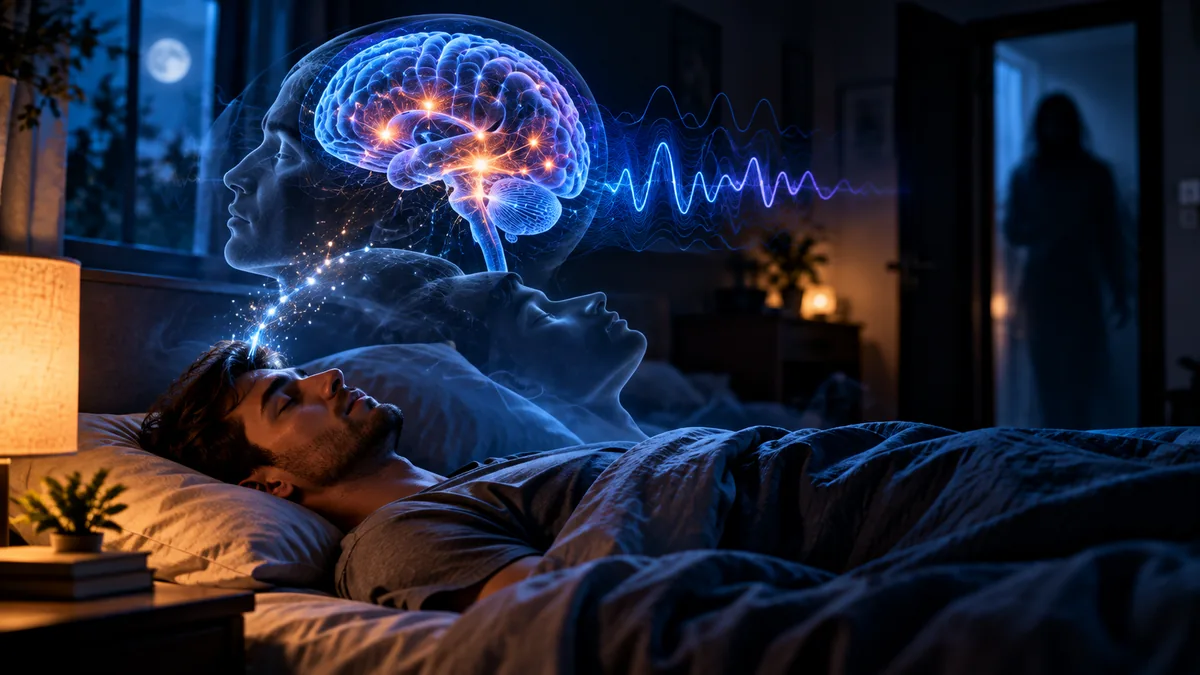
You wake in your bedroom and recognize the ceiling, the window and the clock. Yet your arms will not move, your voice will not work and a frightening presence may seem to stand nearby. This unsettling experience has a name: sleep paralysis. It can feel supernatural, but its best-supported explanation comes from the neuroscience of sleep and the temporary overlap of waking awareness with features of rapid eye movement (REM) sleep.
During REM sleep, the brain is highly active and most major skeletal muscles are temporarily inhibited. Sleep paralysis occurs when awareness returns before that normal muscle inhibition has fully switched off, or when REM-like features intrude as a person falls asleep. The episode is usually brief and physically harmless, although repeated attacks can seriously disrupt sleep and cause anxiety. The hallucinations feel real because the brain is combining waking perception with dream-like imagery—not because an intruder is actually present.
The Short Scientific Explanation
Sleep paralysis is a state-boundary phenomenon. Three systems that normally change together become temporarily out of sync: conscious awareness, the motor system that allows voluntary movement, and the REM mechanisms that suppress most skeletal-muscle activity. You may know where you are while still experiencing REM atonia, the normal reduction of muscle tone that prevents acting out dreams. Sensory and emotional features of dreaming can persist too.
This is an explanatory model, not a claim that every episode has been captured with a brain scan. Scientists understand REM physiology much better than they understand why particular people experience recurrent episodes, and the exact triggers are not completely established.
What Happens During Normal REM Sleep?
Sleep cycles through non-REM and REM stages repeatedly during the night. REM sleep is associated with rapid eye movements, vivid dreaming, variable breathing and a characteristic change in muscle tone. Brainstem circuits help inhibit the motor neurons that ordinarily activate large voluntary muscles. This muscle atonia is protective: it reduces the chance that a sleeping person will physically act out a dream.
REM does not mean the entire body is motionless. Eye movements continue, breathing continues, and some small movements or twitches may occur. The important distinction is that the large muscles used for ordinary purposeful movement are temporarily suppressed. In normal sleep, you are not aware of this inhibition. In sleep paralysis, you become aware before the inhibition resolves.
Why Can You Be Awake but Unable to Move?
The most useful way to picture an episode is as an imperfect handoff between sleep and wakefulness. Your conscious experience begins to return while the REM-related motor brake is still engaged. You can often recognize the room, hear real sounds and remember what happens. But trying to sit up or call out does not produce the expected movement.
Episodes may occur as you fall asleep (hypnagogic sleep paralysis) or as you wake (hypnopompic sleep paralysis). They typically last seconds to a few minutes and end on their own. The fact that they are temporary does not make the fear trivial: a sudden loss of voluntary control is naturally alarming.
What Is REM Atonia, and Which Parts of the Brain Are Involved?
REM atonia depends on interconnected sleep-control networks, particularly circuits in the brainstem that influence spinal motor neurons. During REM sleep, inhibitory signaling reduces the ability of many skeletal muscles to contract voluntarily. Scientists study these pathways through sleep physiology, laboratory recordings and neurological research. It is more accurate to describe sleep paralysis as a temporary mismatch between neural states than as a brain that has “forgotten” how to move.
No single “sleep paralysis center” has been proven to cause every episode. Sleep and wakefulness emerge from interacting networks; individual episodes likely reflect changes in timing across those networks. The precise contribution of each region to a particular person’s experience cannot be determined from symptoms alone.
Why Does Sleep Paralysis Cause Hallucinations?
Some people experience only immobility. Others hear footsteps, see a shadow, sense someone approaching or feel themselves floating. These are sleep-related hallucinations: perceptions generated or altered by the brain during the transition between dreaming and wakefulness. The person may be partly oriented to the real bedroom, which makes the experience unusually convincing.
Sleep specialists commonly describe three overlapping patterns. An “intruder” experience involves a sensed presence, sounds or a threatening figure. An “incubus” experience involves pressure on the chest or a feeling of being restrained. Vestibular-motor experiences can include floating, spinning or an out-of-body sensation. These are descriptive categories, not proof of separate diseases or external forces.
Why Does a Shadowy Figure Feel So Real?
The brain constantly interprets incomplete sensory information. When someone is partly awake in a dark room, dream-like imagery and threat expectations may be superimposed on ordinary surroundings. A coat on a chair, a shadow near the doorway or an indistinct noise can be woven into a compelling scene. Fear may amplify attention to possible danger, making the perception even harder to dismiss in the moment.
Culture also influences the story people attach to the experience. Historical accounts describe spirits, witches, supernatural visitors and other nighttime entities. Similar bodily sensations can receive very different explanations across cultures. The existence of those traditions does not establish a supernatural cause; modern sleep research offers a physiological framework.
Why Does It Feel Like Someone Is Sitting on Your Chest?
Chest pressure and a sensation of difficult breathing are commonly reported. REM sleep changes muscle activity and breathing patterns, and fear can intensify awareness of normal respiratory effort. People can continue breathing during an ordinary sleep-paralysis episode even though they may feel unable to take a satisfying deep breath or call for help.
However, do not automatically attribute severe chest pain, persistent breathing difficulty, fainting or new neurological symptoms to sleep paralysis. Those symptoms require medical assessment, and sudden weakness with speech problems or one-sided facial or arm changes can be an emergency.
Can Sleep Paralysis Cause an Out-of-Body Experience?
Some people describe hovering above the bed, falling through the mattress, rotating or feeling detached from the body. These sensations are sometimes called vestibular-motor hallucinations. The brain constructs a sense of body position using information from vision, balance, movement and internal bodily signals. When those inputs and expectations are mismatched during a sleep transition, body-location experiences can become unusual.
This explanation is consistent with current neuroscience but does not mean researchers can fully reconstruct an individual out-of-body experience. A powerful subjective sensation is not, by itself, evidence that consciousness literally left the body.
How Long Does an Episode Last?
Most episodes end within seconds or a few minutes. Cleveland Clinic notes that some episodes can last longer, although prolonged experiences are less typical. Time may feel stretched because fear is intense and the person is waiting for movement to return. The episode often ends spontaneously as normal wakefulness and muscle control reestablish themselves.
A single isolated event generally does not imply brain damage, stroke or a serious neurological disease. Repeated episodes accompanied by other symptoms deserve more attention because sleep paralysis can sometimes occur alongside another sleep disorder.
What Makes Sleep Paralysis More Likely?
Researchers have found associations rather than a single universal cause. Risk factors and related conditions include:
- Not getting enough sleep or maintaining a highly irregular sleep schedule.
- Shift work, jet lag and other disruptions to the sleep-wake cycle.
- Insomnia and frequent nighttime awakenings.
- Stress, anxiety and some trauma-related conditions.
- Sleeping on the back, which is associated with episodes in some people.
- Narcolepsy and, in some cases, obstructive sleep apnea.
- Certain medications or substances that influence sleep, depending on the individual.
An association does not mean every person with anxiety or an irregular schedule will develop sleep paralysis. Nor does one episode establish any of these diagnoses. Sleep patterns, symptoms and health history matter more than a single presumed trigger.
Comparison Guide: Five Conditions That Can Be Confused With Sleep Paralysis
Sleep paralysis: The person is aware during a sleep transition but temporarily cannot move or speak. A sensed presence or dream-like image may occur. Movement returns spontaneously, usually within seconds to minutes. NHS clinical guidance.
Nightmare: A frightening dream, often remembered after waking. The person generally regains normal voluntary movement on awakening; immobility is not the defining feature.
Sleep terror: A partial arousal, typically from non-REM sleep, with fear, shouting or movement and often little later recall. It is not the same as being fully aware and unable to move.
REM sleep behavior disorder (RBD): The person may act out dreams through movements or vocalizations because normal REM muscle inhibition is reduced. This requires clinical assessment, especially if injuries occur.
Narcolepsy: A chronic sleep-wake disorder in which sleep paralysis can be one symptom; prominent daytime sleepiness and sometimes emotion-triggered muscle weakness (cataplexy) help distinguish it. A single episode of sleep paralysis is not evidence of narcolepsy.
Important limitation: These descriptions help readers recognize patterns; they cannot diagnose a sleep disorder. Episodes with persistent weakness, impaired speech or other sudden neurological symptoms require urgent assessment, not an online comparison. NHS emergency guidance.
Sleep Paralysis Versus Nightmares, Night Terrors and REM Behavior Disorder
These phenomena can sound similar but are not interchangeable. In a nightmare, a person typically wakes from a frightening dream and can move. A night terror often involves intense distress and incomplete awakening, with limited recall afterward. REM sleep behavior disorder involves movements or vocalizations during dreams because the usual REM muscle inhibition is impaired—the opposite of being awake and unable to move.
Sleep paralysis involves awareness plus temporary inability to perform voluntary movements, sometimes with dream-like hallucinations. If you regularly injure yourself during sleep, act out dreams, or have unusual events that do not match this description, ask a clinician to evaluate the pattern rather than assuming it is ordinary sleep paralysis.
Is Sleep Paralysis a Sign of Narcolepsy?
It can be, but most isolated episodes do not mean someone has narcolepsy. Narcolepsy is a disorder of sleep-wake regulation that often includes significant daytime sleepiness. Other possible symptoms include sudden loss of muscle tone triggered by emotion (cataplexy), vivid sleep-transition hallucinations and fragmented nighttime sleep.
A sleep specialist may ask about daytime sleep attacks, cataplexy, snoring, witnessed breathing pauses and the timing of episodes. Depending on the history, testing might include an overnight sleep study and a multiple sleep latency test. These investigations are not routinely required for an occasional, otherwise typical episode.
A Practical Decision Path: What to Check After an Episode
- First: Did the immobility happen only while falling asleep or waking, and did it fully resolve? This pattern is compatible with sleep paralysis but does not prove the diagnosis.
- Next: Were there repeated episodes, persistent fear of sleeping, or daytime exhaustion? Arrange a routine medical appointment and bring a sleep diary.
- Look for associated symptoms: Loud snoring or witnessed breathing pauses may warrant sleep-apnea evaluation; irresistible daytime sleep attacks or emotion-triggered loss of muscle tone may warrant narcolepsy evaluation.
- Escalate immediately: New one-sided weakness, trouble speaking, severe persistent breathing difficulty or significant chest pain should not be assumed to be sleep paralysis.
This decision path is an editorial synthesis of NHS and Cleveland Clinic advice; it is not a validated diagnostic algorithm. NHS · Cleveland Clinic.
What to Do During Sleep Paralysis
There is no proven instant switch that reliably stops every episode. The following strategies may help reduce panic while waiting for it to pass:
- Remind yourself that this is a temporary sleep-wake transition and that ordinary episodes end.
- Try to keep breathing calmly rather than struggling against the sensation of chest pressure.
- If it feels possible, focus on a small movement such as a finger or toe instead of trying to move the whole body. This helps some people but is not a guaranteed treatment.
- Focus attention on a neutral detail, such as the sound of a fan or a familiar object in the room.
- After movement returns, sit up if comfortable, orient yourself and allow the fear to settle before trying to sleep again.
If another person is present, calm reassurance can help afterward. Do not shake or physically restrain someone who appears distressed in sleep. If the event includes dangerous symptoms, seek appropriate medical care.
How to Reduce the Chance of Another Episode
Prevention usually focuses on improving sleep consistency and addressing factors that fragment sleep. These approaches are sensible, low-risk starting points, although they cannot prevent every episode:
- Aim for sufficient sleep; many adults need about seven to nine hours, with individual variation.
- Keep bedtimes and wake times reasonably consistent, including weekends when possible.
- If episodes happen mainly while sleeping on your back, consider a comfortable side-sleeping position.
- Reduce caffeine late in the day and avoid heavy alcohol use close to bedtime.
- Make the sleeping environment dark, quiet and comfortable.
- Address chronic insomnia, persistent anxiety or suspected sleep apnea with a qualified professional.
- Keep a brief sleep diary noting bedtime, wake time, stress, position and episode frequency.
A Simple Two-Week Sleep Diary
Write down when you went to bed, approximately when you fell asleep, nighttime awakenings, your final wake time and whether an episode occurred. Add notes about shift work, travel, caffeine, alcohol and whether you slept on your back. After two weeks, look for recurring patterns rather than trying to assign a cause from one night. Bring the diary to a clinician if episodes are frequent or disruptive.
When Should You See a Doctor?
Book a medical appointment if episodes recur often, make you afraid to sleep, cause persistent daytime fatigue, or occur with excessive daytime sleepiness, sudden sleep attacks, cataplexy or symptoms of sleep apnea. A clinician can look for underlying conditions and discuss treatment when appropriate. Medication is not usually needed for occasional isolated sleep paralysis, and it should not be started solely on the basis of an online article.
Seek urgent medical attention for sudden weakness that persists after full awakening, one-sided facial or arm weakness, speech difficulty, severe ongoing breathing problems, or significant chest pain. These are not features to dismiss as a typical sleep-paralysis episode.
What Treatments Can Help Frequent Sleep Paralysis?
For recurrent episodes, care may involve treating insomnia, sleep apnea, narcolepsy or another identified condition. Cognitive behavioral approaches and anxiety management can help when fear and poor sleep reinforce each other. Specialists sometimes consider medicines that influence REM sleep in selected cases, but benefits, risks and the underlying diagnosis require individual assessment. There is no universally established medication for an isolated episode.
Common Myths Versus What Research Supports
- Myth: You are physically trapped forever. Reality: ordinary episodes are temporary and resolve as the sleep-wake transition completes.
- Myth: A frightening presence proves a real intruder or spirit is there. Reality: sleep-related hallucinations can create a vivid sensed presence.
- Myth: Sleep paralysis means you have narcolepsy. Reality: isolated episodes are common and do not establish that diagnosis.
- Myth: Everyone stops breathing. Reality: breathing generally continues, although it may feel uncomfortable or restricted.
- Myth: A single trick can cure it instantly. Reality: coping techniques may help, but no technique reliably ends every episode.
What a Large 2024 Review Found—and Why Its Numbers Need Context
A 2024 systematic review and meta-analysis combined 76 observational studies involving 167,133 participants across 25 countries. Its pooled estimate was that about 30% of participants had experienced sleep paralysis, with a 95% confidence interval of 22%–39%. This describes reported experience across the included samples—not the chance that any particular reader will develop frequent attacks.
The researchers also reported marked between-study heterogeneity (I² near 100%) and evidence of publication bias. Participants came from different settings, and studies used different definitions and questionnaires. Consequently, the pooled figure should not be presented as a precise worldwide rate or as evidence that sleep paralysis is increasing.
In the review’s symptom subset, most recorded cases did not report hallucinations. The researchers reported visual-and-auditory hallucinations together in about 24.25% of that subset; the denominator and reporting method matter, so this percentage cannot be generalized uncritically to everyone with sleep paralysis.
What this study can tell us: Sleep paralysis is widely reported and hallucinations are not universal. What it cannot establish: The direct cause of an episode, whether a proposed remedy works, or a person’s individual risk. Observational data reveal associations, not proof of causation. Study record on PubMed.
What Scientists Still Do Not Know
Researchers continue to investigate why some people experience sleep paralysis repeatedly while others never notice it, why hallucination themes differ and which interventions work best. Much of the available research relies on self-reported episodes rather than direct laboratory capture. Studies also vary in how they define recurrent symptoms, which makes simple prevalence or treatment claims difficult to compare.
The strongest conclusion is narrower and more useful than a sensational headline: sleep paralysis is a real, often frightening state in which waking awareness and REM-related motor inhibition briefly overlap. The associated images and sensations arise from the brain’s processing during this transition. That explanation is compatible with taking the experience seriously without treating its content as literal evidence of danger.
What Makes the Brain Explanation More Than a Ghost Story?
The evidence connects several independently observed features: REM sleep normally includes suppression of most voluntary muscle activity; awareness can return during a transition; and dream-like sensations may overlap with real bedroom perception. The model explains the distinctive combination of awareness, temporary immobility and sometimes hallucinations without requiring a supernatural event. However, it does not identify one precise neural trigger for every episode or invalidate how distressing the experience feels. Clinical overview.
What to Record Before Speaking With a Sleep Clinician
- Whether the event occurred while falling asleep or waking, and approximately how long it lasted.
- Whether you could move your eyes, breathe normally, or move a finger or toe.
- Whether you experienced a sensed presence, sounds, chest pressure or unusual body-motion sensations.
- Sleep duration, shift-work changes, travel, stress, alcohol or caffeine before the event.
- Any snoring, witnessed breathing pauses, excessive daytime sleepiness, sudden sleep attacks or cataplexy-like symptoms.
Record observations without trying to self-diagnose. A clinician can decide whether the pattern warrants assessment for insomnia, sleep apnea, narcolepsy or another condition.
Editorial Method and Medical Accuracy
This article separates established REM physiology from plausible but incompletely proven explanations of hallucinations. Its self-care suggestions follow public clinical guidance; it does not promise a cure or recommend medication without assessment. The research figures are described with their sampling and methodological limits. The article is educational, not individually tailored medical advice, and has not been represented as independently physician-reviewed.
The Bottom Line
During sleep paralysis, your brain can become aware of the bedroom while REM-related muscle inhibition is still active. Dream-like sensory activity may also persist, producing a shadowy presence, chest pressure or a floating sensation. Most episodes are brief and harmless, but repeated attacks or significant daytime symptoms deserve evaluation. Understanding the REM connection, protecting sleep consistency and recognizing red flags can make the experience less mysterious and easier to manage.
Medical and Scientific Sources
- NHS — Sleep paralysis: symptoms, causes and self-care
- MedlinePlus (U.S. National Library of Medicine) — Sleep paralysis
- Cleveland Clinic — Sleep paralysis
- NCBI Bookshelf — Sleep Paralysis (StatPearls)
- Harvard Health — Sleep paralysis: causes, symptoms and treatments
- NHS — When sudden paralysis needs emergency assessment
- Hefnawy et al. (2024) — Systematic review and meta-analysis of sleep paralysis
- Northern Ireland government — When to seek medical help for sleep paralysis
Editorial note: This article is educational and does not diagnose a sleep disorder or replace medical advice. Clinical statements have been checked against the linked public medical resources; no independent clinician review is claimed.
You may also like

Why Your Laptop Battery Says 100% but Dies Suddenly: Causes, Health Tests, and Fixes
Laptop battery shows 100% but turns off when unplugged? Diagnose battery wear, power issues, Windows battery reports, Mac…

Why Does the Moon Look Enormous Near the Horizon? The Science of the Moon Illusion
Why does the rising Moon look huge? Discover the Moon illusion, scientific explanations, easy experiments, and the difference…

How to Remove Personal Data From Data Broker Websites: Free Opt-Outs and California DROP
Learn how to remove personal information from people-search and data broker sites for free, use California DROP, request…