
UK Right to Rent Checks October 2026: eVisa, Share Codes and New Landlord Rules
England Right to Rent checks updated 1 October 2026: landlord and tenant steps for eVisa, R share codes, registered digital verification, deadlines, LCS and penalties.
Contents
- Right to Rent October 2026: the essential changes
- Who must have a Right to Rent check — and who does not?
- Why a Right to Rent check is different from tenant referencing
- The quickest way to choose the correct verification route
- How tenants generate a Right to Rent share code in 2026
- How landlords check an R share code — step by step
- A simple record that helps avoid audit confusion
- What's genuinely new about digital checks after 1 October?
- Does a registered DVSP replace a tenant's R share code?
- What if the person refuses facial recognition?
- eVisa, BRP, BRC and visa vignettes: the 2026 differences
- Deadlines: 28 days, 90 days and one year are different clocks
- Worked case: checking before a student arrives from abroad
- Worked case: settled status versus limited status
- Share code not working: seven troubleshooting scenarios
- When to use the Landlord Checking Service (LCS)
- Penalties for missing or incorrect checks in October 2026
- A practical three-part audit before handing over keys
- How to avoid unlawful discrimination during checks
- Landlord and tenant checklist before signing
- For landlords and agents
- For tenants
- Official links for the current process

England’s Right to Rent rules were updated on 1 October 2026. Landlords and letting agents must check every adult who will occupy qualifying residential accommodation as their only or main home, irrespective of nationality. The new Home Office guidance changes how registered digital verification providers can be used, clarifies acceptable digital documents and reflects the wider move to eVisas. It does not require everyone to purchase a private identity-check service. The appropriate route depends on the person’s status and evidence. This guide was fact-checked against the Home Office guide dated 1 October 2026 on 27 October 2026.
For most eVisa holders, the practical route is simple: the occupier generates a nine-character right to rent share code starting with R, then the landlord uses GOV.UK’s landlord checking service, checks that the returned photograph and details match the person, and saves a dated copy of the result. The code lasts 90 days, but its validity period is not the same as the person’s immigration permission. British and Irish citizens normally use acceptable original documents or a properly registered digital verification provider, not a share code.
Right to Rent October 2026: the essential changes
| Question | Correct answer on 27 October 2026 |
|---|---|
| Where do the rules apply? | England only, to qualifying residential arrangements; not Wales, Scotland or Northern Ireland. |
| Who is checked? | Every adult occupier (18+) using a property as their only or main home, not merely people named on the tenancy. |
| What changed on 1 October? | Registered/certified digital verification service requirements, broader clarity on digital documents and eVisas, revised categories and updated anti-discrimination guidance. |
| Can I still check documents myself? | Yes, where the prospective occupier provides acceptable List A or List B evidence and a manual check is prescribed. |
| What about an eVisa-only holder? | Use the Home Office online right to rent service, with a purpose-specific R share code. |
| How long do share codes last? | 90 days from issue; an R code can be reused during that period. |
| How long should evidence be kept? | Throughout the tenancy and for at least one year after it ends, then securely destroyed. |
The Home Office’s October 2026 guidance is the primary source. Treat third-party summaries as a starting point, not as a substitute for checking the exact document list and applicable code of practice.
Who must have a Right to Rent check — and who does not?
A landlord should establish who will occupy the property as their only or main home. The duty can include an adult partner or housemate who is not named on the contract. It does not become optional because the tenant is a British citizen, has been a customer for years or is paying several months of rent upfront. A discriminatory approach, such as asking only applicants who appear foreign to provide evidence, is prohibited.
The scheme applies to qualifying residential tenancy agreements in England. It does not apply to all forms of accommodation indiscriminately: some arrangements are specifically excluded under Schedule 3 of the Immigration Act 2014, including certain accommodation types. Landlords should check the relevant exemptions in the Home Office guide instead of assuming that every hotel stay, university residence or social tenancy is subject to the same procedure.
If an adult divides time between addresses, assess their circumstances rather than assuming the place they sleep most nights is automatically their main home. Connections such as family, possessions, healthcare registration and correspondence can be relevant. Where uncertain, the official guidance recommends treating the accommodation as the proposed only or main home and obtaining the appropriate check.
Why a Right to Rent check is different from tenant referencing
Credit searches, income checks, employment references, landlord references, passport scans and anti-fraud screening may be useful for the rental process, but they are not interchangeable with the statutory immigration check. A tenancy platform may say that identity verification passed while the landlord still lacks the required Home Office online result or prescribed document check. Always record the immigration-check route separately from affordability and identity screening.
The quickest way to choose the correct verification route
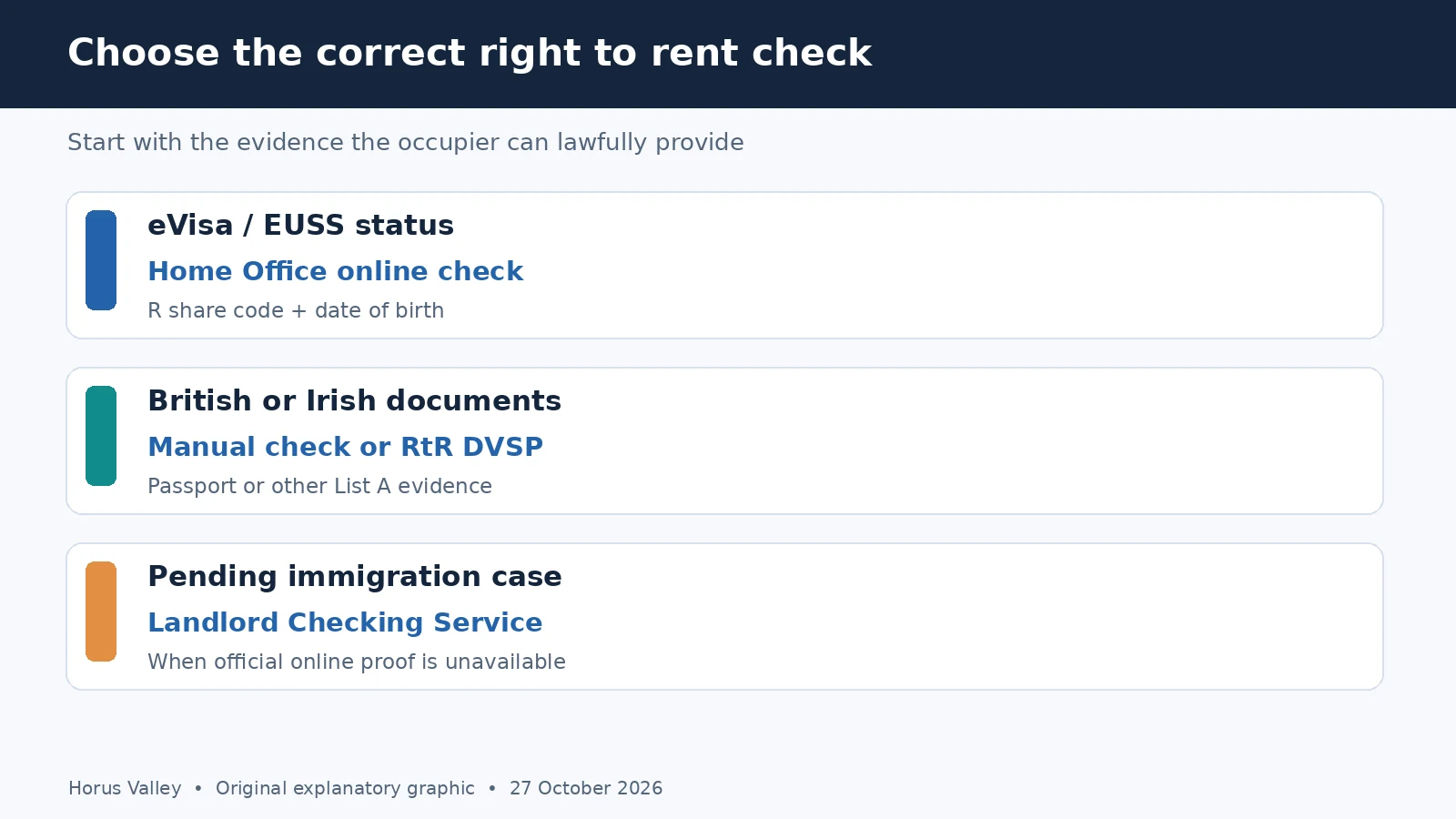
Use the following decision table before asking for documents. It prevents the common error of demanding a share code from a British passport holder, or trying to accept a physical BRP from an eVisa holder.
| Occupier’s situation | Appropriate route | What not to do |
|---|---|---|
| British or Irish citizen with acceptable original evidence | Manual List A check; registered Right to Rent DVSP may be an option | Do not demand a share code they cannot generate. |
| Non-British/non-Irish occupier with eVisa or EU Settlement Scheme status | Home Office online check with R code and date of birth | Do not simply photograph the tenant-facing eVisa screen. |
| Holder of acceptable original List A or List B documents, where manual proof is permitted | Prescribed manual document check | Do not assume every immigration document is acceptable. |
| Immigration application/appeal pending and right cannot be shown online | Home Office Landlord Checking Service (LCS), where eligible | Do not conclude automatically that a missing share code means unlawful presence. |
| Passport holder choosing an identity app | Verify that the DVSP is registered and certified specifically for Right to Rent | Do not rely on generic screening accreditation. |
| Person arriving from abroad before a UKVI account is set up | Check the relevant Home Office special rules, vignette/other eligible evidence or LCS if applicable | Do not assume an offer agreed in principle equals a completed check. |
The official check-route page lists the three main methods. Not all individuals can use all three; select the one that applies to their status and acceptable documents.
How tenants generate a Right to Rent share code in 2026
This section describes the live GOV.UK route, not a fabricated application screen. The government portal can change its layout; the important controls and outcome are described below.
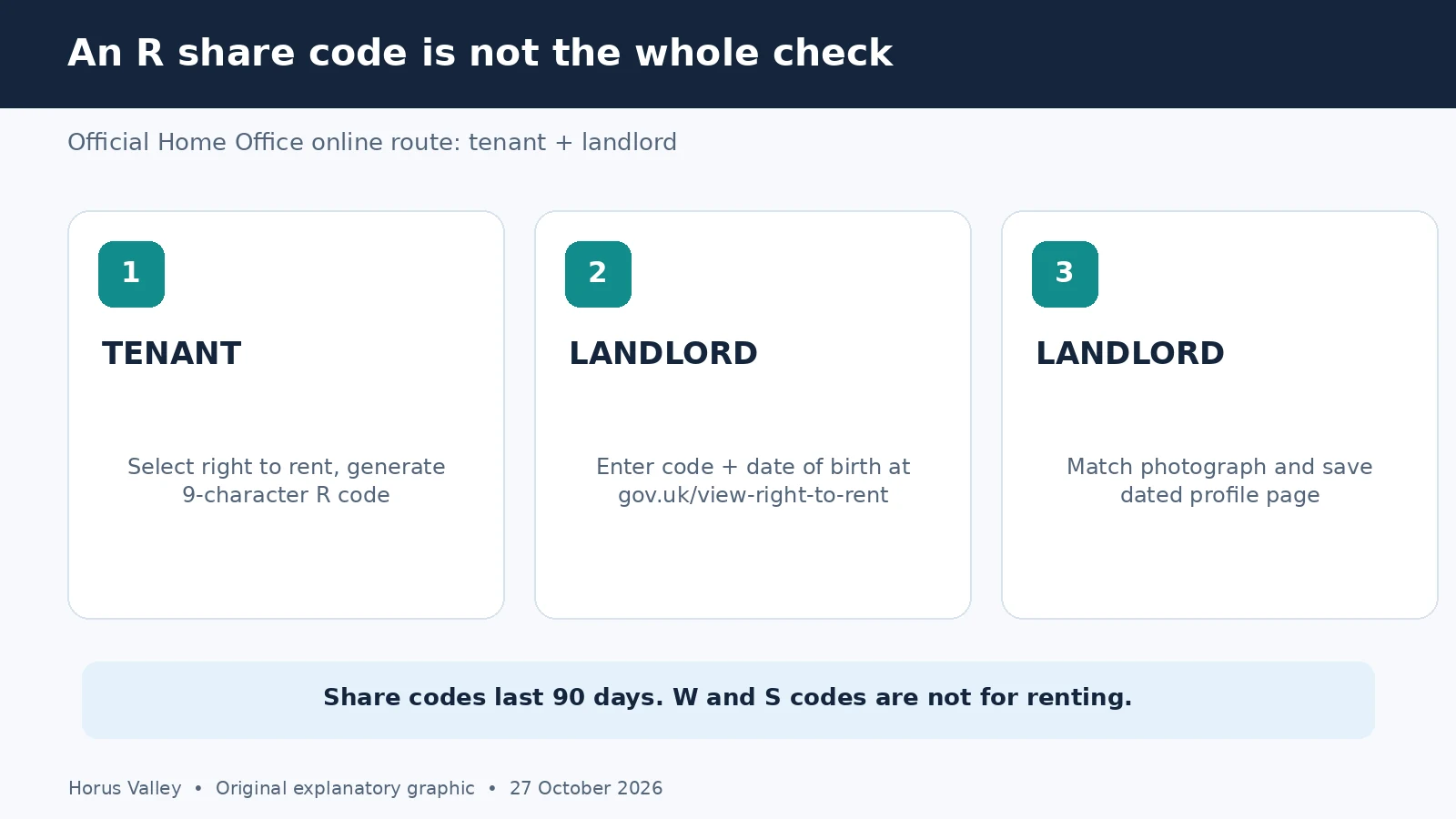
- Open Prove your right to rent in England — Get a share code. Make sure the domain is
gov.ukrather than a paid third-party copycat. - Start the official service and sign in with the UKVI identity details used for your digital immigration status. You may need a passport, national identity card or BRP details, your date of birth and a verification method linked to your account.
- When asked why you need to share your status, choose to prove your right to rent in England — not the options for proving your right to work or generic immigration status.
- Generate the nine-character share code. A right to rent code begins with R. Codes beginning W and S serve other purposes and should not be substituted.
- Give the landlord or letting agent the share code and your date of birth. You can normally share it using the built-in service or through another appropriate private channel.
- If the code expires before the landlord completes their prescribed check, generate a new one. A code’s 90-day validity merely controls access to the result; it does not extend your immigration status.
British and Irish citizens should not be told to generate an R code: the landlord page says these citizens cannot get one. Use the correct accepted documents or registered verification route instead.
How landlords check an R share code — step by step
Landlords must open the landlord-facing result themselves. A tenant’s screenshot, forwarded profile PDF from the tenant side or a digital copy of an old residence permit is not by itself the prescribed online check.
- Go to Check a tenant’s right to rent in England. Enter the share code and the tenant’s date of birth using the official service.
- Review the result shown by the Home Office. Verify that the photograph and biographical information match the person who will occupy the home. The identity comparison can be done in person or by a live video link where the guidance permits it.
- Read any restriction and the displayed date for a follow-up check. A time-limited right to rent does not mean the person is ineligible to rent.
- Save the actual profile page returned through the landlord-facing system as a clear PDF or printout that cannot be altered. Record the date the check was performed, rather than the date the tenant sent the code.
- Store the file securely for the whole tenancy and at least one year afterward, applying data protection rules. Destroy it securely after the required period.
- If a follow-up is required, create a reminder based on the date stated in the official result or applicable statutory excuse period. The code’s 90-day validity is not your follow-up date.
A simple record that helps avoid audit confusion
Store one dated record per adult: full name; tenancy/property identifier; whether the check was Home Office online, prescribed manual or registered DVSP; date performed; outcome; saved evidence location; follow-up due date if any; the staff member or agent who performed the check. Minimise unnecessary personal information and restrict access. The point is to make the legally relevant sequence verifiable, not to build a general immigration database.
What’s genuinely new about digital checks after 1 October?
A Digital Verification Service Provider (DVSP) is a commercial or other registered service that can verify identity or eligible documents through approved technology. Under the 1 October 2026 Home Office guidance, using a DVSP for a digital Right to Rent check is optional; however, where that route is chosen, the provider must be on the Office for Digital Identities and Attributes (OfDIA) register and authorised/certified for the relevant Right to Rent checks. A generic provider advertising ‘KYC compliant’ is not enough.
The government’s register guidance explains how to check registration and services offered. The landlord must retain the provider’s prescribed output and check it relates to the actual occupier. Using an intermediary does not automatically transfer the landlord’s legal responsibility. If an agency subcontracts verification, ask which registered provider did the underlying check and retain evidence of the provider’s identity and authorisation.
Does a registered DVSP replace a tenant’s R share code?
Do not treat these routes as automatically interchangeable. A British or Irish passport holder may be eligible for a registered provider’s document check, whereas an eVisa-only person must prove the right to rent by the Home Office online service. Some registered providers may support identity matching alongside an online result, but the check must still satisfy the relevant prescribed Home Office route. Ask the provider precisely what it verifies before paying.
What if the person refuses facial recognition?
The Home Office says a landlord should not disadvantage a person who cannot or does not wish to use an eligible digital verification service. Where an alternative prescribed manual route exists, offer it. Facial recognition is not a universal mandatory condition of renting in England.
eVisa, BRP, BRC and visa vignettes: the 2026 differences
This part matters because screenshots and search results from 2023–2025 may be technically misleading in late 2026.
| Evidence | What to do in October 2026 |
|---|---|
| eVisa / UKVI digital immigration status | Holder generates an R share code; landlord uses the Home Office online checker. |
| EU Settlement Scheme settled or pre-settled status | Usually Home Office online result; follow the result and the EUSS-specific official guidance. |
| Biometric Residence Permit (BRP) / biometric residence card (BRC) | A physical BRP/BRC is not accepted for a manual Right to Rent check. Use a qualifying online route; document identifiers may still be usable to access the service. |
| Visa vignette | From 1 July 2026 new vignettes stopped being issued as evidence of permission. An existing valid vignette may still be acceptable in specified transitional circumstances; check the exact guide. |
| British or Irish passport | Use prescribed acceptable evidence or an eligible registered DVSP; expired passports can be acceptable under the stated conditions. |
| Visitor who entered via eGate without a passport stamp | Special visitor rules can require passport plus evidence of entry, such as a boarding pass; not a blanket share-code demand. |
An expired BRP being usable to access a UKVI account is completely different from an expired BRP being valid as a physical document for a manual landlord check. The first may still be possible under GOV.UK systems; the second is not the compliant method described in the 2026 guide. Always see the immigration document guide.
Deadlines: 28 days, 90 days and one year are different clocks
Mistaking one deadline for another is a significant compliance risk. The government discusses three different time periods, each serving a different purpose:
| Period | What it controls | Example |
|---|---|---|
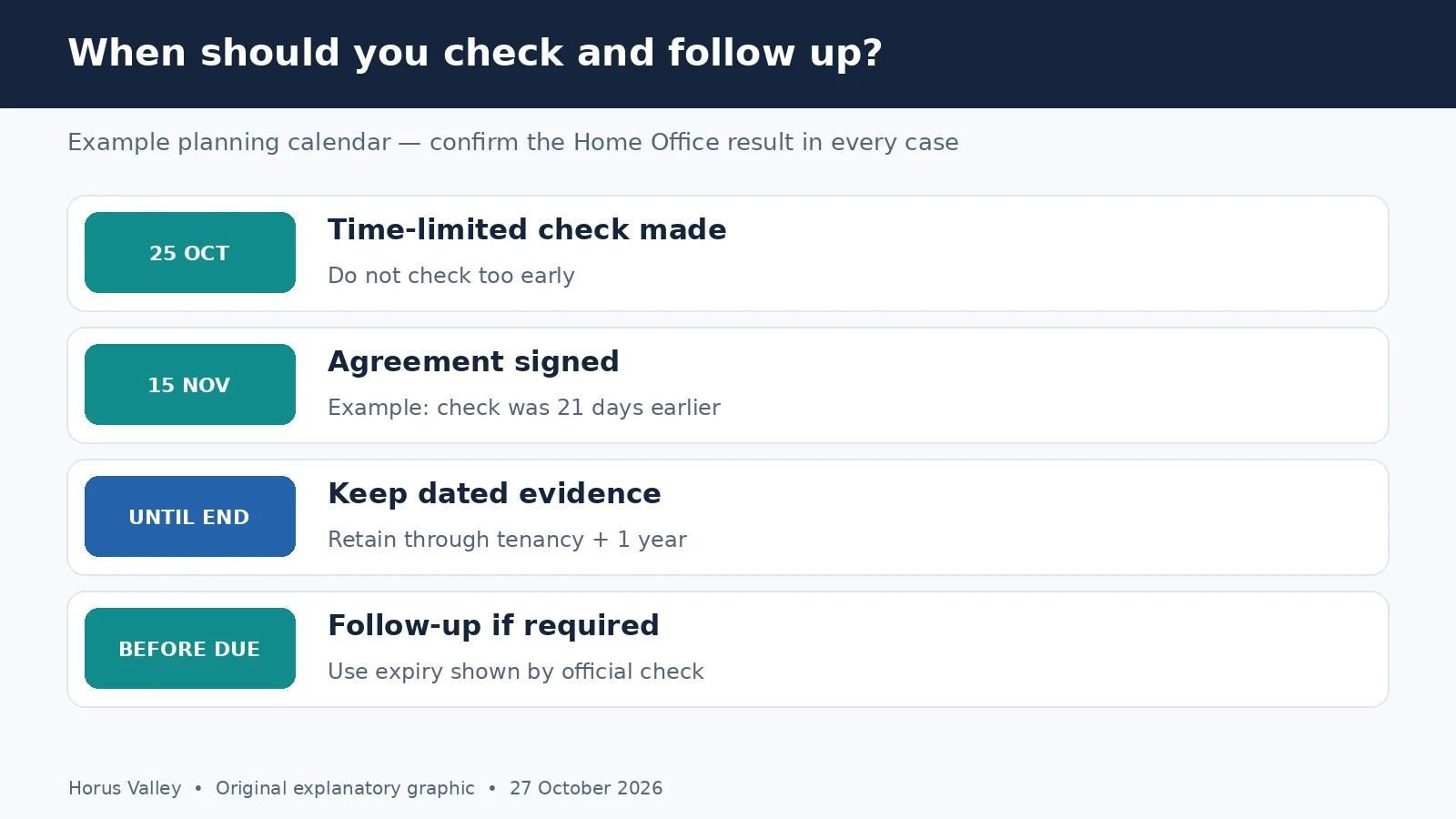
| 28 calendar days | For a time-limited right, when the initial check can be performed relative to entering the tenancy agreement. | Signing 15 Nov 2026: a check on 25 Oct 2026 was made 21 days before signing and falls within the 28-day window. |
| 90 days | How long a generated right to rent share code remains valid for use. | A code issued 1 Nov normally remains usable for 90 days; this says nothing about the tenancy’s expiry. |
| One year after tenancy ends | Minimum extra period to retain prescribed check records following the end of the tenancy. | Tenancy ends 30 Sept 2027: retain through at least 30 Sept 2028, then dispose securely. |
For someone with an unlimited right to rent, the initial check can be completed at any time before the agreement is entered into and typically needs no follow-up. For someone with a time-limited right, a check must be performed no earlier than 28 calendar days before the tenancy agreement is entered into, normally when signed. A planned move-in date is not a substitute for this signature-date test. Read the Home Office guide carefully for specific exceptions involving overseas students and preliminary agreements.
Worked case: checking before a student arrives from abroad
A postgraduate student plans to sign on 15 November but enter England in January. Suppose their UKVI account shows a time-limited right to rent on 25 October. The initial check is 21 days before signing, so its timing fits the ordinary 28-day rule. The landlord must still obtain the prescribed result, compare identity correctly, preserve proof and follow any dates shown. If the student cannot yet obtain digital proof while overseas, the Home Office guidance allows some arrangements to be agreed in principle with checks completed before occupation. That is not permission to bypass verification or to label the tenancy as cleared prematurely.
Worked case: settled status versus limited status
Two flatmates show Home Office online status. One has settled status; the other has time-limited permission. Both still require a valid initial check. A compliant result establishing an unlimited right generally does not require a repeat check. For the time-limited result, use the follow-up instructions and date the checker supplies. Do not schedule repeats based solely on the expiration date of the share code, and do not refuse the second flatmate simply because their right is time limited.
Share code not working: seven troubleshooting scenarios
| What you see | Likely reason | Correct next step |
|---|---|---|
| Share code starts W or S | Tenant selected employment or another status purpose. | Generate a new code specifically for Right to Rent; it must start R. |
| The R code has expired | More than 90 days passed or a new code is needed. | Tenant generates another R code on GOV.UK. |
| Date of birth is rejected | Typo or mismatched personal details. | Re-enter carefully; if the eVisa has wrong DOB, report an eVisa error. |
| Tenant can see an eVisa but not generate a code | Technical problem or status/account issue. | Use the dedicated Report an error with your eVisa route; consider LCS where applicable. |
| UKVI login or phone access lost | Authentication/account access issue. | Use official UKVI account-recovery support, not a third-party code seller. |
| Tenant made an in-time visa extension application | Updated evidence may be pending while 3C leave applies. | Try current digital result; use LCS if the system cannot verify eligibility. |
| Agency sent only a screenshot of the tenant’s profile | Landlord-facing statutory online check may never have occurred. | Conduct the proper Home Office landlord check and retain its dated output. |
Do not confuse two official channels. A person who can see their eVisa but notices a wrong date or cannot generate a share code should use Report an error with your eVisa. By contrast, the Landlord Checking Service is for the landlord or agent where Home Office verification is needed under the relevant rules. It is not a replacement for reporting and correcting an eVisa data error.
When to use the Landlord Checking Service (LCS)
LCS can help when the Home Office itself must verify permission — for example, an outstanding in-time immigration application, a pending appeal or review, a Certificate of Application that calls for LCS verification, Permission to Rent, or another situation specified in guidance where the online check cannot confirm eligibility.
The landlord/agent should use the official service linked from Checking your tenant’s right to rent — How to do a check. Have the appropriate Home Office reference details and tenant information ready. The Home Office generally gives a response in two working days, and a Positive Right to Rent Notice (PRRN) normally establishes a 12-month statutory excuse from the date specified in the notice. Save the notice; do not rely on a telephone promise or decide that the lack of a share code automatically bars the applicant.
If the Home Office gives a negative result or the occupier does not have an accepted way to prove the right to rent, seek tailored guidance before proceeding. You should not invent a substitute checking method, and you must apply your process without nationality-based discrimination.
Penalties for missing or incorrect checks in October 2026
The Home Office civil penalty code effective 1 October 2026 sets a matrix based on whether the breach is a first or repeated breach within three years and whether the person is a lodger or an occupier:
| Type | First breach in three years | Repeat breach within three years |
|---|---|---|
| Lodger | £5,000 | £10,000 |
| Occupier | £10,000 | £20,000 |
These are the statutory penalty levels, not a fee charged for carrying out a check. The Home Office considers whether a lawful statutory excuse was established, and its code includes mitigation and the Faster Payment Option in specified circumstances. Criminal consequences can apply to knowing breaches. Landlords should not infer that paying for a commercial digital check guarantees protection if the process was not prescribed or evidence is missing.
A practical three-part audit before handing over keys
- Eligibility: Did you check every applicable adult and use a method permitted for their circumstances?
- Identity and evidence: Did you match the applicant to the original/document or Home Office result and save the output with the check date?
- Timing and follow-up: Was the initial time-limited check within the 28-day window, and have you scheduled a repeat if the official result requires one?
A quick spreadsheet with columns for occupier, method, check date, saved evidence, follow-up due and responsible staff member is often more useful than a stack of unchecked PDF attachments. It is an organisational tool, not a substitute for legal obligations.
How to avoid unlawful discrimination during checks
Apply the same pre-tenancy process to all potential adult occupiers rather than only applicants with particular names, accents or nationalities. The updated anti-discrimination code warns against treating people with time-limited rights less favourably or penalising applicants because they need a legitimate alternative verification route. Do not insist that everyone hold a passport or use facial recognition. Allow reasonable time for valid documentation or official Home Office checks.
An eVisa technical problem is not proof that a person has no lawful status. Meanwhile, a person’s assurance that an application is pending is not the prescribed evidence a landlord needs. Respect the applicant and obtain the legally appropriate verification. Both parts matter.
Landlord and tenant checklist before signing
For landlords and agents
- Identify all adult occupiers and whether the property is within the scheme.
- Check the latest acceptable document lists, and select online, manual, DVSP or LCS appropriately.
- For a time-limited right, use the 28-day-before-signing rule.
- For eVisa, use the landlord-side GOV.UK checker and an R share code.
- Verify identity against the result; record the check date and save secure evidence.
- Check that any DVSP is registered and approved for Right to Rent, rather than general ID checks.
- Record any follow-up expiry and monitor it; keep documents through the tenancy plus one year.
- Apply the same respectful, lawful process to all applicants.
For tenants
- Prepare the lawful evidence that fits your immigration status; do not assume everyone needs a share code.
- If you have an eVisa, use the official portal and choose Right to Rent to generate your R code.
- Give the landlord your code and date of birth privately, not on a public social post.
- If details are wrong, use the official eVisa error process; if access is lost, contact UKVI.
- If an in-time application is pending, tell the landlord so that the appropriate Home Office check can be arranged.
- If a landlord refuses solely because of a nationality assumption, a time-limited status or a need for an alternative prescribed method, consult the official discrimination code and seek specialist advice.
Official links for the current process
| Official resource | What it is for |
|---|---|
| Home Office landlord guide — 1 October 2026 | Definitive instructions, timing, exceptions and acceptable document lists. |
| Tenant: generate Right to Rent share code | Tenant-facing process to get an R code. |
| Landlord: check tenant with share code | Official landlord-facing result to save as evidence. |
| Choose manual, online or digital checks | Simpler GOV.UK step-by-step instructions, including LCS access. |
| Report an eVisa error | Incorrect biographical data, status, or inability to generate a code. |
| Registered digital verification services | Confirm DVSP registration before using its service. |
| Civil penalty code effective October 2026 | Legal framework and civil penalty calculation. |
| Anti-discrimination code effective October 2026 | Fair treatment of prospective tenants. |
Editorial note: All figures and legal rules above reflect the published Home Office material checked on 27 October 2026. The diagrams are original editorial illustrations, not screenshots of live GOV.UK screens. This page is general information, not personal immigration or legal advice. For unusual visas, disputed status or complex residential arrangements, consult the current Home Office code and an appropriately qualified adviser before acting.
You may also like
 UK Guides
£100 Energy Payment: Council Tax Bands and Eligibility
Check the £100 Household Energy Payment, Council Tax bands, official postcode search and January 2027 payment arrangements in…
 UK Guides
UK Digital ID Cancelled: What Happens to Right-to-Work Checks, One Login and eVisas?
The UK cancelled its national Digital ID programme, but One Login, eVisas and right-to-work checks continue. See the…
 UK Guides
UK Student Visa Financial Requirements From 30 November 2026: New Funds and Bank Statement Rules
UK Student visa financial requirements rise on 30 November 2026: London £1,570/month, outside London £1,203/month. Learn tuition calculations,…