
Can Hair Turn Gray Overnight? Stress, Alopecia & Evidence
Can stress make hair turn gray overnight? Learn what studies show about sudden whitening, alopecia areata, reversibility and signs to get checked.
Contents
- Can hair actually turn white overnight?
- Three different patterns that can look similar
- How hair gets its color
- What the landmark 2020 stress experiment actually showed
- Can stress-related gray hair regain pigment?
- November 2026 research changes the alopecia discussion
- What else can contribute to early gray hair?
- When should you see a dermatologist?
- What can you do now?
- Common myths, corrected
- Frequently asked questions
- Can stress make my hair turn gray in a week?
- Is Marie Antoinette syndrome a medical diagnosis?
- Can white hairs become dark again?
- Should I take vitamin B12 when I notice gray hair?
- Medical and scientific sources

Sudden gray hair is not reliable proof of chronic stress. Emotional stress can influence pigment-related processes, but a head of hair does not typically lose all its color overnight. A rapid change in appearance—especially alongside shedding, bald patches or loss of color in a localized area—deserves a closer look at conditions such as alopecia areata rather than a self-diagnosis of stress.
This guide focuses on the practical difference between gradual stress-related graying and apparently sudden whitening. It explains what scientists have actually observed, including new research published in November 2026, and when a dermatologist may be helpful.
Can hair actually turn white overnight?
Usually, no. Hair generally acquires its color as the fiber is produced within the follicle. Changes in melanin production typically become apparent as newly grown hair emerges. Cleveland Clinic explains why stress-related graying does not normally happen in a single night. However, rare medical presentations can look rapid, and recent studies in alopecia areata have documented more varied patterns of pigment loss than the familiar explanation of preferential loss of darker hairs alone.
The historical label canities subita—sometimes called “Marie Antoinette syndrome”—describes a dramatic appearance of whitening. A famous historical anecdote is not evidence that acute fear directly bleaches existing hair fibers, and the term is not a substitute for a medical diagnosis.
Three different patterns that can look similar
| What you notice | Possible explanation | What it does not prove |
|---|---|---|
| Gray hair accumulating over years | Age-related pigment change, often influenced by genetics | That stress is the sole cause |
| More white roots after a stressful period | Stress may be one factor affecting pigment production | That every white strand is permanent |
| Rapid whitening with hair shedding or patches | Alopecia areata or another hair/skin condition may be involved | That the event was caused by psychological stress |
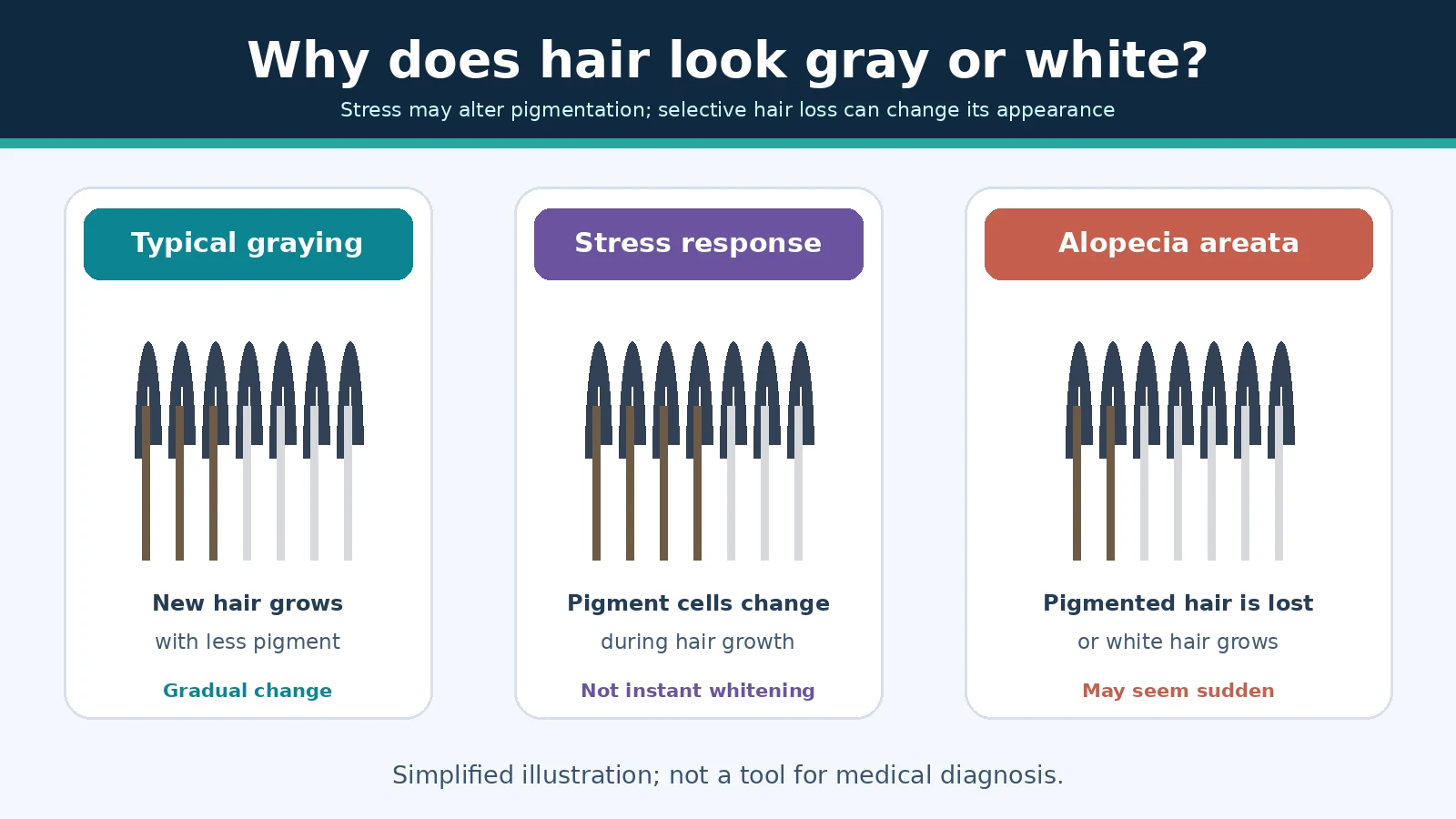
How hair gets its color
Hair color comes from melanin made by melanocytes in the hair follicle. A reservoir of melanocyte stem cells replenishes the pigment-making machinery across hair cycles. Aging can disrupt this system, resulting in newly grown hair with less color. Research highlighted by the US National Institutes of Health in 2023 adds detail about how the movement and maturation of these cells may contribute to graying.
What the landmark 2020 stress experiment actually showed
In a 2020 Nature study, scientists stressed mice and found that the sympathetic nervous system released norepinephrine around the follicles. This drove melanocyte stem cells out of their normal state and depleted the pigment-generating supply. The findings offered a biological mechanism for accelerated graying in mice; NIH summarizes the experimental work.
A crucial limitation is species and context: a controlled mouse experiment does not demonstrate that every human who experiences stress will permanently lose hair pigment, nor does it validate dramatic overnight-whitening stories.
Can stress-related gray hair regain pigment?
A small human hair study published in eLife in 2021 mapped pigmentation along individual hair shafts and documented instances of hairs regaining color. In some examples, changes tracked with self-reported shifts in life stress. That is intriguing evidence of possible reversibility in selected hairs, not evidence that stress reduction will reverse every gray hair. Columbia University explains the study.
November 2026 research changes the alopecia discussion
A retrospective study published on November 10, 2026, in the British Journal of Dermatology examined records from 5,155 people with alopecia areata. Researchers identified alopecia-related white hair in 826 patients (16%), with presentations ranging from patchy white hair to diffuse patterns. They also described loss and return of pigmentation in hair fibers in some cases, potentially without completing another entire follicular cycle. Read the paper.
Do not misread that percentage: 16% describes people with alopecia areata in this study, not the general population. As a retrospective study, it cannot establish that stress caused these changes. It adds an important nuance: the classic explanation of selective loss of dark hairs is not sufficient to describe every case of apparently rapid whitening.
What else can contribute to early gray hair?
- Age and family history: often the biggest influence on when graying begins.
- Alopecia areata: immune-mediated hair loss that can involve pigment changes or white regrowth.
- Vitiligo: a white patch of hair may appear where nearby skin loses pigmentation.
- Nutrient deficiencies: vitamin B12 deficiency is one possible contributor in some patients, not an explanation for everyone.
- Thyroid disorders and selected medications: may be relevant when other signs or medical history point to them.
- Smoking and stress: may contribute but cannot replace an individualized assessment.
For clinical context, consult the American Academy of Dermatology and this dermatology review.
When should you see a dermatologist?
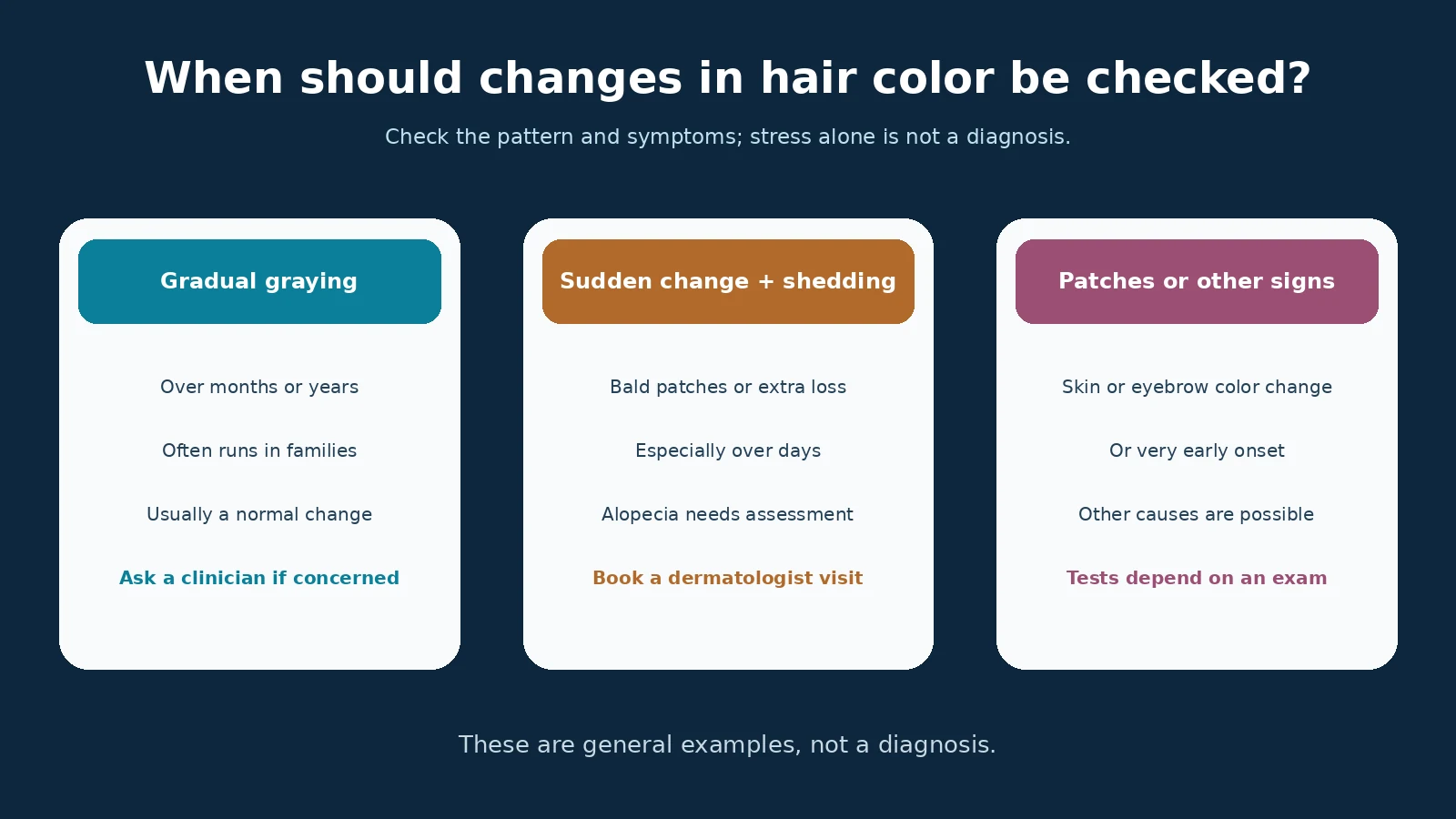
| Pattern | Practical next step |
|---|---|
| Slow graying with no other symptoms | Usually a normal change; discuss if it starts unusually early or troubles you |
| Abrupt change plus extra shedding or bald spots | Arrange a dermatologist appointment for evaluation |
| White tuft with a pale patch of skin | Get the skin and hair assessed for pigment disorders |
| Early graying with fatigue or other symptoms | Ask about targeted evaluation; blood tests depend on your medical history |
What can you do now?
- Note when the change appeared and whether you also see shedding, a new bald spot or altered skin pigmentation.
- Look for other symptoms and note relevant medication changes or recent illness before the appointment.
- Focus on adequate sleep, balanced nutrition and stress management as sensible health measures, not guaranteed cures for gray hair.
- Avoid unproven “anti-gray” supplements or high-dose vitamins without evidence of deficiency.
- See a dermatologist for sudden unexplained patterns, particularly when hair density or nearby skin color changes.
Common myths, corrected
| Claim | What the evidence supports |
|---|---|
| One frightening event can bleach all hair instantly | Stress can influence graying, but dramatic rapid changes need other explanations |
| The 2020 mouse study proves the outcome in all people | It identifies a mechanism in mice; human effects are more varied |
| Every gray strand is permanently white | Some human hairs have shown repigmentation, but it is not predictable |
| Vitamins restore gray hair regardless of the cause | Treating a diagnosed deficiency may help in selected cases; routine supplements do not restore all hair color |
Frequently asked questions
Can stress make my hair turn gray in a week?
Stress may influence pigment-related processes, but the appearance of more gray hair over a short period does not establish stress as the cause. Seek an assessment if there is rapid shedding, bald patches or other changes.
Is Marie Antoinette syndrome a medical diagnosis?
It is a historical label for dramatic hair whitening, not a precise diagnosis. Clinicians evaluate possible alopecia, pigment disorders and other conditions according to the actual pattern.
Can white hairs become dark again?
Some individual human hairs have shown repigmentation in research. It is not guaranteed, and there is no universally effective treatment to restore the natural color of gray hair.
Should I take vitamin B12 when I notice gray hair?
Not automatically. B12 deficiency is one possible cause of premature graying, but supplementation is most appropriate when a clinician identifies a relevant deficiency or indication.
Medical and scientific sources
- Nature 2020 – Zhang et al. (mouse study)
- NIH – How stress causes gray hair
- eLife 2021 – Rosenberg et al. (human hair)
- BJD 2026 – Alopecia areata-associated white hair
- American Academy of Dermatology – Gray hair
- Cleveland Clinic – Why Does Hair Turn Gray?
- IJDVL – Premature graying of hair
- Columbia University – Research on reversibility
You may also like
 HEALTH
Ebola Outbreak 2026: UK Risk and Vaccine Trials
What the 2026 Bundibugyo Ebola outbreak means for UK risk, how the virus spreads, and why new vaccine…
 HEALTH
Birth Control and Weight Gain: What Genetics and Research Really Show
Do implants, pills or injections cause weight gain? Understand the 2020 ESR1 genetics study, newer evidence, differences between…
 HEALTH
Why Are Native Kidneys Usually Left in Place During a Kidney Transplant?
Kidney transplant surgery usually leaves the recipient’s two original kidneys in place. Learn where the donor kidney goes,…