
Why Is the SS United States Being Sunk? History and Reef Science
Why the SS United States is becoming an artificial reef: its history, cleanup, Florida deployment and the science behind marine habitat.
Contents
- What is happening to the ship—and when?
- Why sink it instead of restoring it?
- The history behind “America's Flagship”
- What must be removed before a ship becomes a reef?
- Does an artificial reef become a coral reef?
- Attracting fish and producing more fish are different outcomes
- Can visitors dive the SS United States immediately?
- Photograph credit
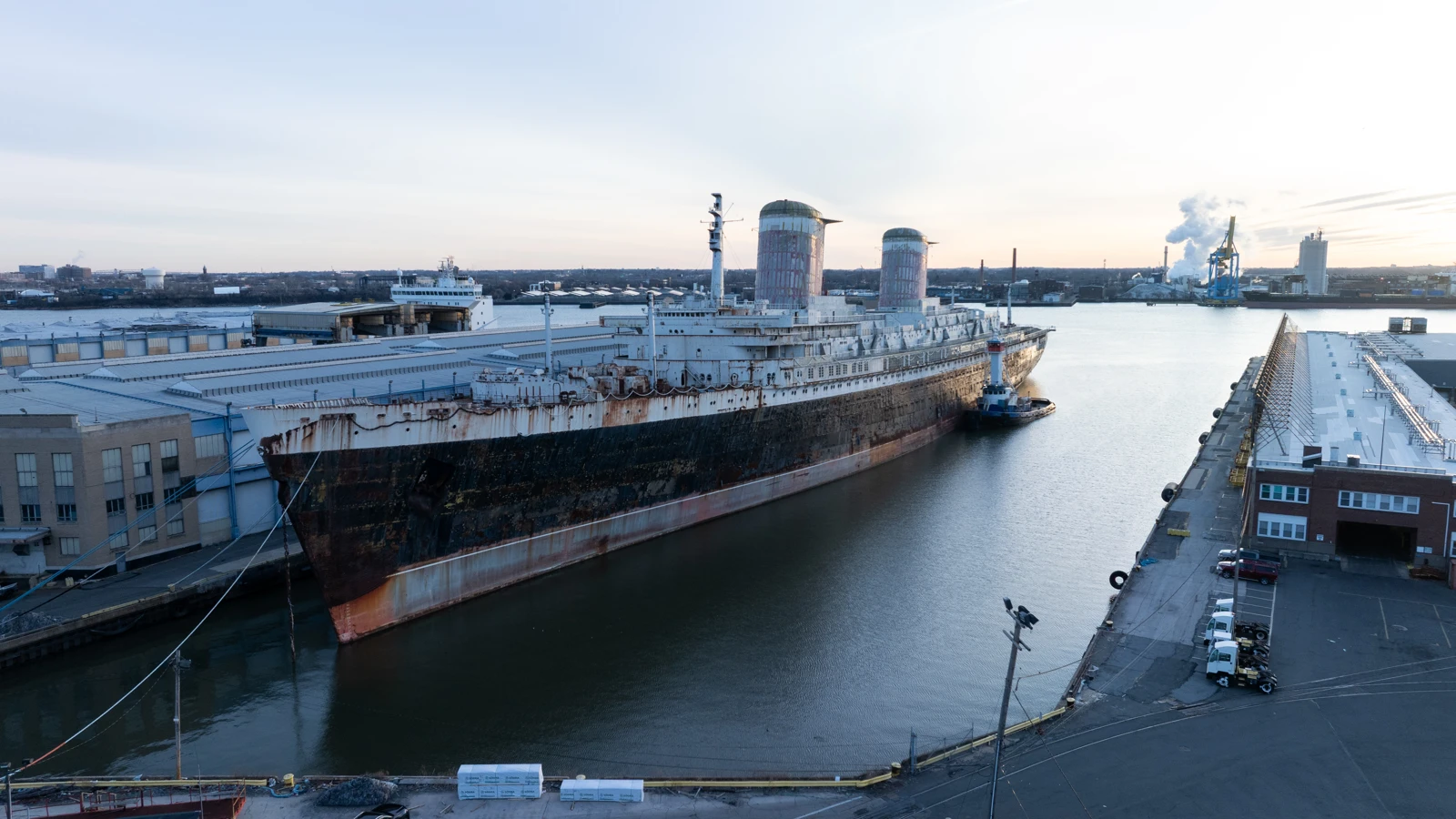
The SS United States is being converted into an artificial reef off Florida, giving the retired ocean liner a new role as marine habitat and a diving attraction. Okaloosa County chose reefing after decades of unsuccessful redevelopment efforts. The project also preserves selected artifacts for a planned museum, rather than keeping the entire vessel afloat.
There are two separate questions behind the headlines: why retire a historic ship underwater, and what would make the resulting reef ecologically successful? A large steel structure can provide habitat, but its size alone does not establish its environmental value.
What is happening to the ship—and when?
Status checked on 12 November 2026: the deployment was brought forward from 12 November to 11 November, with operations scheduled to begin at 1 p.m. Central Standard Time. The revised announcement distributed through Destin Chamber attributes the change to forecast heavy winds and unsafe conditions on the original date.
The official project page links to deployment coverage. The sources checked for this article do not establish a final seabed survey or public-diving clearance. A scheduled start time should not be read as the exact moment the ship reaches the bottom, and this guide does not claim a verified completion time.
The announced site is approximately 22 nautical miles southwest of Destin-Fort Walton Beach. Older project pages describe the location more broadly; use current official project updates for operational details rather than an old event listing.
Why sink it instead of restoring it?
Okaloosa County's explanation is that redevelopment had become impractical: the vessel had been heavily stripped, its engines could no longer operate, and a suitable permanent public berth remained a challenge. The county presents reefing as an alternative to scrapping after years of unsuccessful attempts to find a workable future.
That explains the owner's decision; it does not mean an underwater ship is equivalent to a preserved working liner. Reefing retains a large physical structure but ends the possibility of experiencing the complete vessel afloat. The museum and retained artifacts preserve a different part of its history.
The trade-off matters. A tourism project, a maritime preservation project and an ecological intervention have different measures of success. More visitors would demonstrate tourism demand; it would not, by itself, prove that marine populations had increased.
The history behind “America's Flagship”
The official historical overview records the liner's service debut and record-setting transatlantic maiden voyage in 1952. Its design combined luxury passenger service with the potential to serve as military transport.
Retired in 1969 as airline travel reshaped transatlantic journeys, the ship later spent 1996 to 2025 on Philadelphia's waterfront. That long interval helps explain why the current operation attracts attention beyond Florida: the vessel is both an engineering landmark and a familiar part of another city's landscape.
For another example of how ships preserve historical evidence, see our guide to the ancient Kekova shipwreck and Mediterranean trade. That archaeological wreck and this deliberately deployed reef have very different origins.
What must be removed before a ship becomes a reef?
Sinking an untreated vessel would leave its contents underwater too. Preparation therefore matters as much as the final placement. The project's remediation report describes work on tanks, decks, coatings and materials before deployment.
| Preparation reported by the project | Detail | Why readers should distinguish it |
|---|---|---|
| Tank cleaning | All 128 fuel and lubricant tanks emptied and cleaned | Cleaning precedes the use of water for ballast |
| Material checks | More than 200 samples collected to address regulated PCBs | Sampling is part of remediation, not a forecast of future biodiversity |
| Artifact retention | Funnels, radar mast and propeller removed for the museum | Historical photographs show structures no longer present |
| Site assessment | Sonar and visual bottom surveys conducted | Choosing a site is a separate task from preparing the ship |
The project also reports removing PCB-containing exterior floor covering and arranging biological, physical and chemical monitoring with research partners. These are the operator's published preparation measures, not an independent ecological assessment by Horus Valley.
Does an artificial reef become a coral reef?
Not automatically. NOAA defines an artificial reef as a human-made structure that can reproduce some characteristics of a natural reef. It can offer hard surfaces and shelter for fish and invertebrates; that definition does not require an instant covering of living coral.
The ship is the artificial structure. The community of organisms using it is a separate, developing biological system. A rendering of a wreck covered in coral is therefore an illustration of a possible appearance, not evidence of what this site already supports.
This distinction also makes before-and-after images easier to interpret. A photograph of fish beside the hull demonstrates their presence at that moment. It cannot, by itself, establish a mature ecosystem or a net increase in fish across the surrounding region.
Attracting fish and producing more fish are different outcomes
NOAA's scientific review of artificial reefs identifies unresolved questions about living-resource production, species dispersal, toxicological effects and long-term structural integrity. These questions are why a deployment announcement should be treated as the start of ecological evaluation.
An attraction effect means fish gather around a structure. A production benefit would involve additional survival or growth supported by the habitat. To judge the project over time, useful evidence would include repeated surveys, comparisons with surrounding habitats, species composition and the condition of the structure—not simply a busy first dive video.
A NOAA synthesis of 39 studies found that artificial reefs can support fish communities, while emphasizing site-specific design and evaluation. That supports investigating the new reef's benefits; it does not establish this vessel's results in advance.
Can visitors dive the SS United States immediately?
Do not book on the assumption that a planned sinking date is an opening notice. Check the project's current diving information and the operator's actual arrangements first. Weather, clearance and confirmed wreck conditions are separate from the historical event.
The county's planning information gives a proposed bottom depth of about 180 feet, with the upper deck around 55 feet. Those figures refer to different parts of a very tall structure, not a single dive depth suitable for everyone. They also do not replace a post-deployment survey or a dive plan appropriate to training and conditions.
For readers following the story remotely, the most useful next updates are confirmation of the ship's final position, official access information and published monitoring findings. Those will say more about its new role than the “world's largest” label alone.
Photograph credit
Historical photograph: WSRower, SS United States before its departure from Philadelphia, 19 February 2025, CC0 1.0. Cropped and converted to WebP. It shows the ship before reef preparation, not the deployment operation.
You may also like
 Science & Discoveries
UK Polar Vortex 2026: Is Heavy Snow Really Coming?
The UK polar vortex is unusually disturbed, but does that mean heavy snow? See the Met Office outlook,…
 Science & Discoveries
Climate Prediction Center Heavy Snow Map: November Outlook
Read NOAA’s November heavy-snow outlook, see the mountain areas at risk, understand the map’s limits, and find local…
 Science & Discoveries
UK November Cold Snap: What the Met Office Forecast Says
What the Met Office forecast says about the UK November cold snap, possible northern wintry showers, frost and…