
A 4,700-Year-Old Shipwreck Near Turkey: What It Reveals About Trade in the Age of the Pyramids
Early Bronze Age jars near Kekova may mark one of the oldest Mediterranean shipwrecks. Here is what their dating, clay, residue and trade-route clues really establish.
Contents
- What did archaeologists actually find near Kekova Island?
- Five figures that put the discovery in perspective
- Why did the news break in October 2026 if the site was identified in 2024?
- How can archaeologists date a shipwreck when its timber has disappeared?
- Why matching two jars is not enough
- Is this really the oldest shipwreck in the world?
- A claim-by-claim evidence guide
- What does the wreck have to do with the construction of Egypt's pyramids?
- Why pottery parallels matter even without an Egyptian inscription
- Were the jars manufactured in the Jordan Valley?
- What further scientific analysis could reveal
- Did the ship carry olive oil, wine, resin, or something else?
- How can scientists identify the contents of a seemingly empty jar?
- The nine-marked jar: were sailors making cheese at sea?
- Where was the ship sailing from—and where was it headed?
- What trade networks can and cannot tell us
- How did sailors navigate the Mediterranean nearly five millennia ago?
- Why did the pottery survive when the ship's wood did not?
- How can researchers tell whether all the jars came from one sinking?
- How does Kekova compare with other famous shipwrecks?
- Can one ceramic jar really change the history of trade?
- A model voyage: what might have happened, without pretending it did
- Five questions future excavation and analysis may answer
- Why should readers in Egypt and the wider Middle East care?
- How to tell a reliable archaeological report from an exaggerated headline
- The conclusion: a window into an ancient economy, not a recovered treasure ship
- Primary sources and further reading
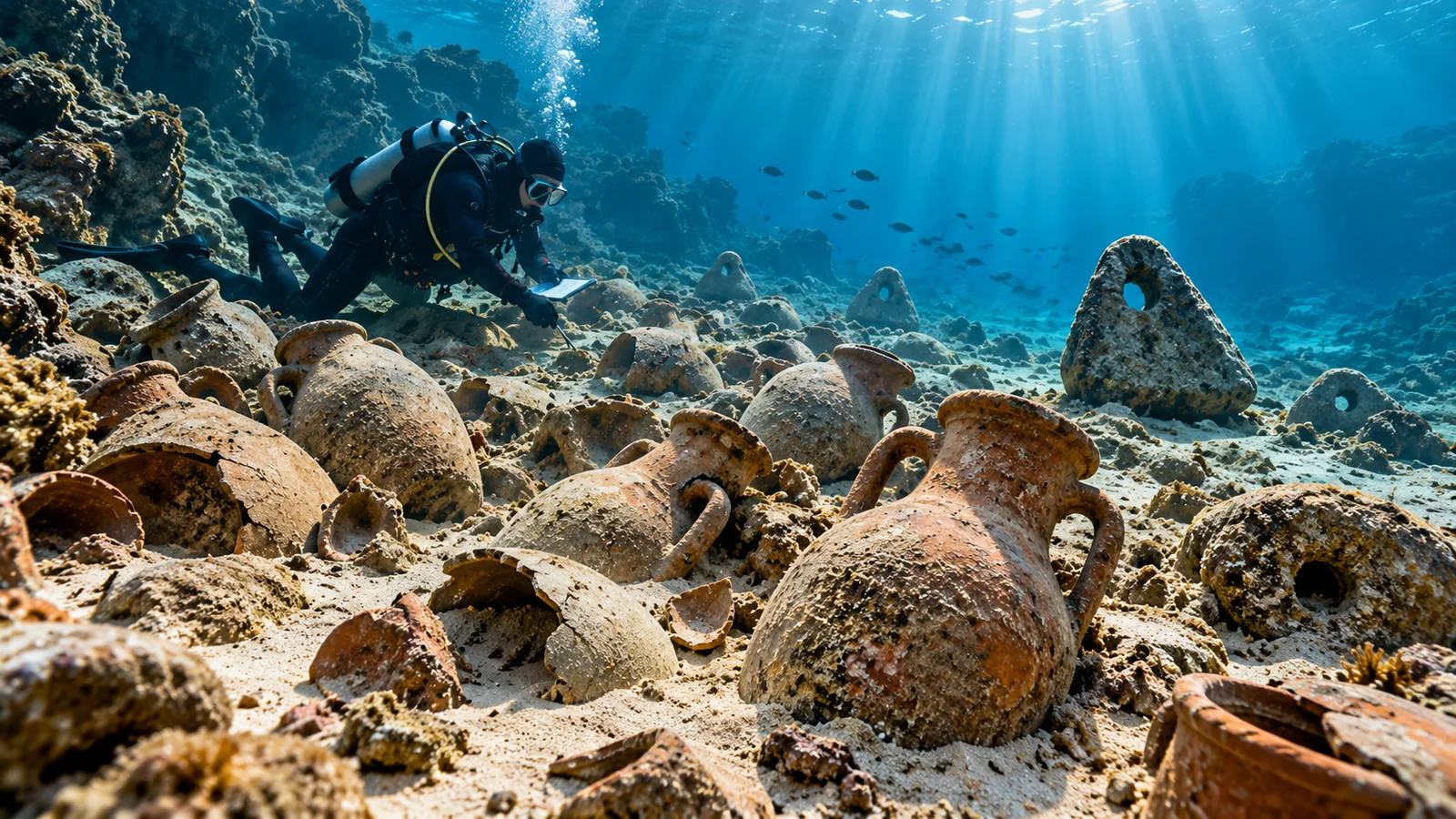
Featured image: original artistic reconstruction commissioned for Horus Valley; not an authentic photograph of the 2026 Kekova excavation or its archaeological finds.
Off the coast of Kekova in southern Turkey, archaeologists have identified a remarkable cluster of ancient transport jars resting on a rocky Mediterranean seabed. The pottery may be between 4,400 and 4,700 years old. If the interpretation holds, the site could represent one of the earliest known shipwrecks associated with Mediterranean commerce—dating to approximately the era when Egypt’s great pyramids were being built.
Yet the most important part of this discovery is also the easiest to misunderstand. No complete wooden ship was recovered. Much of the excitement concerns a surviving cargo, the arrangement of objects on the seafloor, comparisons with Bronze Age pottery, and what those traces might reveal about people moving goods across the eastern Mediterranean nearly five millennia ago. The site’s importance does not depend entirely on whether it ultimately keeps the record for the “oldest shipwreck.”
The short answer: A wreck site first documented by researchers in 2024 was the subject of an international announcement on October 14, 2026. It contains distinctive Early Bronze Age jars, with nearby stone anchors whose association with the same vessel has not yet been established. Researchers suspect a small trading vessel traveled west from the Levant, perhaps toward Crete or the region of Troy. But its departure port, destination, individual cargoes, and precise sinking date are not established facts. The most informative starting points are the peer-reviewed preliminary report by Hakan Öniz and Ceyda Öztosun, the Akdeniz University announcement, and the October 2026 announcement reported by Anadolu Agency.
This guide separates what divers actually observed, what archaeologists infer, and what remains an engaging but untested hypothesis. It also explains why the age of the pottery matters, how researchers reconstruct trade routes without a ship’s log, and why a resemblance to Egyptian vessels does not make the ship Egyptian.
What did archaeologists actually find near Kekova Island?
Kekova lies off the Mediterranean coast in Antalya province, in a region whose bays and submerged landscapes have drawn the attention of maritime archaeologists for years. Researchers from Akdeniz University documented an underwater concentration of storage jars on a sloping seabed. Some jars remain fairly intact; others are fragmented or embedded in marine deposits. Accounts based on interviews with the excavation team mention more than 30 transport jars at a depth of approximately 30 meters.
Three large stone anchors were also documented in the vicinity: two with three holes and one with a single hole. Their presence is interesting because stone anchors occur in Bronze Age maritime contexts, but the original academic report explicitly says it is not yet known which, if any, belong to this wreck. The difference between “found near the site” and “belonged to this ship” is small in ordinary conversation and enormous in archaeology.
The wooden hull has not survived. There is no intact deck, cabin, mast, or rudder available for measurement. The roughly ten-meter length mentioned in field reporting is a reconstruction proposed by the team, not the measured length of a preserved wooden structure. The interpretation of a trading vessel comes from the cargo and its spatial context, not from an identified ship name or written manifest.
Five figures that put the discovery in perspective
| Detail | Reported figure | What it means—and does not mean |
|---|---|---|
| Estimated date | 4,400–4,700 years old | A date range inferred chiefly from pottery comparisons, not a direct measurement of the vanished hull |
| Location | Near Kekova, Antalya, Turkey | The place where the assemblage was discovered, not a confirmed departure port |
| Depth | Approximately 30 meters | A reported depth on an uneven underwater slope, rather than a uniform depth everywhere |
| Ceramic vessels | More than 30 in field accounts | A working count that may change as excavation progresses |
| Stone anchors | Three found nearby | Their direct connection to the suspected shipwreck remains unresolved |
This caution matters because isolated objects can accumulate on the same stretch of seabed over different periods. Scholars must test whether the anchors, jars, and any other recovered material belong to one sinking event or reflect multiple episodes of activity.
Why did the news break in October 2026 if the site was identified in 2024?
The date of an announcement is not always the date of a discovery. The preliminary study states that an Akdeniz University survey documented the possible Early Bronze Age wreck in 2024. Researchers used underwater photography and spatial recording to examine the assemblage. Two jars received particularly close study after recovery: one in 2024, another in 2025. A wider excavation program followed in 2026, under the relevant Turkish museum and ministry authorities.
On October 14, 2026, Turkey’s culture and tourism minister, Mehmet Nuri Ersoy, publicized the findings, drawing international attention to the possibility that the site may be older than famous previously known wrecks. Reporting from the Republic of Türkiye Directorate of Communications records the team’s comparison of the vessels with Egyptian and Levantine pottery as part of the process by which their age was reconsidered.
| Stage | Evidence or activity | Why the stage matters |
|---|---|---|
| 2024 | Underwater site documented; one jar closely studied | Establishes that the story did not begin with the October headline |
| 2025 | A second jar recovered for detailed comparison | Expands the evidence beyond a single visually interesting find |
| July 2026 | Preliminary academic report published | Makes the team’s methods and limits available for scholarly scrutiny |
| October 14, 2026 | Public announcement attracts worldwide coverage | Moves an archaeological assessment into mainstream news |
| Further fieldwork | Excavation and laboratory work continue | May refine the date, cargo interpretation, and association of nearby objects |
Presenting this sequence gives readers a more realistic picture of archaeological research. Discoveries generally emerge through repeat surveys, careful recording, conservation, comparison, and debate—not a single cinematic moment when divers lift a finished story from the seabed.
How can archaeologists date a shipwreck when its timber has disappeared?
Wood, if preserved and suitable for testing, can sometimes be dated using radiocarbon methods. That option is not available for a hull that no longer exists. At Kekova, the principal chronological argument rests on ceramic typology: identifying distinctive vessel shapes, handles, bases, decorative patterns, and manufacturing features, then comparing them with pottery from better-dated archaeological settings.
The reported vessels have features familiar from Early Bronze Age Levantine pottery, including side handles and flat bases. Researchers also studied differences in the vessels’ technical characteristics and clay composition. The value lies in the convergence of evidence—not in saying that two pots happen to look alike from a distance. A decorative ridge, a specific handle attachment, fabric characteristics, and archaeological parallels can together narrow a period much more convincingly than one superficial resemblance.
Typology is an inference, not guesswork. Ceramic traditions develop through time, and material from securely dated excavations becomes a comparative reference. Yet some forms remain fashionable for generations, some vessels are reused, and trade can relocate them far from their original place of manufacture. Archaeologists therefore ask whether several independent traits point to a compatible date.
Why matching two jars is not enough
Imagine a storage jar made in one region, reused for decades, carried to another port, and eventually deposited in a wreck. Its manufacturing age would not necessarily equal its final voyage date. Objects could also slide down a seabed slope or be moved by storms, diving activity, or other disturbances. That is why investigators consider the objects’ positions, deposits, breakage patterns, and relationships to one another.
The 4,400–4,700-year estimate should be written as a range, not a precise sinking year. Roughly translated into calendar language, it points to the third millennium BCE—approximately the broad period 2700–2400 BCE, depending on the present-day reference year and the limits of the pottery chronology. The figure is not the equivalent of a dated inscription saying exactly when the vessel sank.
Is this really the oldest shipwreck in the world?
Turkish officials used the description “world’s oldest shipwreck” in announcing the discovery. That is understandable as a public-facing claim, but responsible reporting needs one additional word: possibly. The site’s age is substantial, and the evidence is promising; nevertheless the assessment remains dependent on how the assemblage is dated, how securely it is associated with a vessel, and how “shipwreck” is defined.
An older vessel in human history, an older surviving boat, and an older cargo assemblage interpreted as a shipwreck are not the same category. A watercraft preserved in a burial context, for instance, cannot be compared directly with transport jars scattered on the open seabed. Neither can a famous later wreck with an intact cargo automatically be assumed to be the earliest evidence of trading by sea.
The Maritime Stepping Stones (MaSS) heritage database labels the question in similarly cautious terms, referring to a possible oldest Mediterranean wreck. The famous Dokos wreck in Greece, commonly placed around 2200 BCE, provides one comparison; the Uluburun wreck off Turkey is much younger, from the Late Bronze Age, yet extraordinarily informative because its cargo offers a detailed view of a different commercial world.
A claim-by-claim evidence guide
| Claim often seen in headlines | Evidence status | Wording supported by current information |
|---|---|---|
| Ancient transport jars were discovered at Kekova | Documented and photographed | “Researchers documented Early Bronze Age-style jars near Kekova” |
| The jars probably formed a ship’s cargo | Strong site interpretation | “The assemblage is interpreted as a small trading vessel’s cargo” |
| This is definitively the world’s oldest shipwreck | Important but provisional claim | “The site may be among the earliest known maritime wreck assemblages” |
| Three anchors belonged to the ship | Not demonstrated | “Three stone anchors were discovered nearby” |
| The crew definitely made butter or cheese at sea | Hypothesis about one vessel | “One unusual jar may have served as a dairy-churning container” |
The distinction is not pedantry. If later excavations refine the date or identify material from a separate phase, the archaeological value of the site would survive, even if an enthusiastic record-breaking slogan did not.
What does the wreck have to do with the construction of Egypt’s pyramids?
The estimated date places the assemblage in a broad era overlapping the Old Kingdom of Egypt and the centuries associated with major pyramid construction. More importantly for the researchers, some Kekova jars resemble containers excavated in Egyptian contexts, including material reported from areas associated with the Giza, Saqqara, and Abusir pyramid complexes. Similarities have also been discussed with finds from the Levant, Troy, and Crete.
This produces an appealing historical headline—but shared chronology is not evidence of a direct connection to a particular building project. No available evidence shows that this vessel carried stone, tools, workers, or provisions specifically for the Great Pyramid. Nor does a similarity to pottery from Egypt establish that the vessel itself was Egyptian, visited an Egyptian harbor, or belonged to an Egyptian ruler.
The meaningful connection is more subtle: Egypt, the Levant, Anatolia, and the Aegean formed parts of an eastern Mediterranean world in which containers, goods, and techniques moved over long distances. Studying where comparable ceramics occur helps archaeologists trace possible interactions. It does not automatically reveal the identity of every trader or the itinerary of every ship.
Why pottery parallels matter even without an Egyptian inscription
An inscription naming a pharaoh would be striking, but pottery can convey information without written labels. The composition of its clay, the position of a handle, the design of a rim, and the way the vessel was fired can make it recognizable within a manufacturing tradition. Researchers then compare those features with excavated pieces whose locations and dates are documented.
Even a chemically similar jar may have traveled via several intermediaries. One merchant could buy empty containers from a workshop, another fill them, a third transport them to a port, and a fourth load them onto a vessel headed elsewhere. That chain is hypothetical here, but it explains why a jar’s birthplace, the place it was filled, and the ship’s final destination need not be identical.
This is also a useful reminder of the broader scientific tools behind archaeology. Readers interested in how researchers reconstruct antiquity from physical evidence can explore our related Horus Valley guide to how archaeologists date ancient objects.
Were the jars manufactured in the Jordan Valley?
The October announcement stated that clay analysis suggests the Jordan Valley as a probable manufacturing region for some containers. This matters because clay sources may retain mineralogical and geochemical signatures connected to particular landscapes and production traditions. When those signatures are compared with reference samples, researchers can evaluate candidate origins.
It is important to write “suggests” rather than “proves.” A secure provenance argument depends on sampling, analytical technique, comparison groups, and the possibility that more than one workshop used similar raw materials. A region of manufacture is not necessarily a unique village, a known workshop, or the port from which the ship last departed.
What further scientific analysis could reveal
Petrographic examination can identify minerals and inclusions in ceramic fabrics. Chemical comparisons may separate otherwise similar production groups. Microscopic study can reveal differences in temper and firing practices. As researchers analyze additional jars, they may discover that the cargo came from multiple manufacturing centers rather than a single source.
One especially valuable question is whether the jars form a relatively standardized commercial consignment or a mixed assortment collected and reused through successive journeys. Either result could illuminate how early Mediterranean trade operated; neither should be assumed before the evidence is published.
Did the ship carry olive oil, wine, resin, or something else?
Storage jars are containers, not self-explanatory labels. Based on their broad commercial context, olive oil and wine are among the products suggested publicly. Researchers examining some recovered vessels also described surviving viscous or glossy residues, opening the possibility of future organic-residue analysis. Yet such material has not, in the sources consulted for this article, produced a complete public inventory of proven contents for every jar.
This uncertainty is scientifically productive. A container might have held a product when new, been emptied at one port, and then carried a different product on a later voyage. Its surviving residue could reflect the last use, an older coating, environmental contamination, or several layers of reuse. In each case, a chemical signal must be interpreted in archaeological context.
How can scientists identify the contents of a seemingly empty jar?
Researchers may sample residues on inner surfaces, examine deposits under microscopy, and apply chemical methods to search for characteristic biomarkers. But a single molecule rarely solves an entire case. The same substance may occur in different plants or materials, and saltwater exposure, microbial activity, conservation treatments, or centuries of alteration can change what remains.
A robust claim would explain which chemical compounds were detected, how contamination was controlled, how the results compare with known reference substances, and whether the interpretation fits the shape and wear of the vessel. Until such results are published, “the jars contained wine” should be treated as a possibility, not a universally established conclusion.
The nine-marked jar: were sailors making cheese at sea?
Among the more intriguing finds is a jar described in official statements as carrying nine distinctive marks and two holes. Researchers have suggested that it could have worked as a churning vessel, potentially for butter or another dairy product. This raises a fascinating question about provisioning: did sailors rely only on food carried from shore, or could some longer voyages have involved processing food on board?
The more elaborate possibility—that sailors transported live goats, milked them, and turned the milk into dairy products during the journey—makes for compelling storytelling. It is also a hypothesis rather than a demonstrated reconstruction. Holes and markings alone cannot prove that particular sequence of events. The jar’s technological features and any future residue study need to support the proposed function.
There are other interpretive questions too. Could the holes have served drainage, suspension, repair, or a different mechanical task? Do the markings identify a manufacturer, user, capacity, or another system of organization? Asking these questions does not discredit the churn hypothesis. It establishes what evidence researchers would need before giving the answer a higher degree of confidence.
Where was the ship sailing from—and where was it headed?
The working reconstruction proposed in public accounts is a voyage westward from the Levantine coast, possibly toward Troy in northwestern Anatolia or Crete. That proposal is informed by ceramic parallels and the wreck’s position. It is not a route recorded by an ancient captain, and neither proposed destination is confirmed by an inscription, cargo manifest, or harbor receipt.
A helpful way to visualize this is to think of eastern Mediterranean trade as a network rather than one continuous direct line. Raw materials and finished products can travel through several land and sea stages. A jar produced inland might move by road to a port; it might be filled there or elsewhere; and the final ship carrying it might be the second or third vessel in its commercial history.
What trade networks can and cannot tell us
The evidence supports the idea that organized exchange moved goods between coastal communities earlier than many readers expect. But a single shipwreck cannot reveal annual shipping volumes, prices, tax systems, or the political relationship between every place where similar pottery has been found. It can tell us that certain objects could travel within a connected world. It does not provide a statistical census of that world’s whole economy.
This restraint is precisely why the site matters. A securely dated cargo from an early phase of Mediterranean trade can help test hypotheses developed mostly from terrestrial finds. Every new vessel profile, clay sample, or associated artifact can sharpen that picture.
How did sailors navigate the Mediterranean nearly five millennia ago?
Early seafaring required intimate knowledge of shorelines, anchorages, prevailing winds, sea conditions, and seasonal risk. A modern map can make a coastal passage appear easy, but a small craft without engines faced hazards from unpredictable wind shifts, exposed headlands, limited safe landing places, and strong currents. A vessel could be wrecked close to land even on a route its crew knew well.
Still, we cannot specify the construction, rigging, steering system, or crew size of the Kekova ship on the evidence reported. The hull is absent. General descriptions of Bronze Age navigation help readers understand what may have been possible, but should not be confused with a technical reconstruction of this particular vessel.
The same goes for proposed ship dimensions. Spatial distribution and cargo quantities can suggest a likely scale, but their reconstruction will remain open to revision unless additional structural evidence emerges.
Why did the pottery survive when the ship’s wood did not?
Wood and fired clay respond very differently to millennia underwater. Shipworms and other organisms can attack timber; oxygen, microorganisms, wave action, and shifting sediment can also help destroy it. Fired ceramic is often more resistant, although jars can fracture, erode, and become covered in marine growth. Over long periods, the ship may disappear while a scatter of containers remains.
That is why mapping matters. An amphora resting at a precise angle between two rocks can help reconstruct where cargo ended up and whether objects moved after the sinking. If it is removed without recording that relationship, the object survives but some of its historical information may be lost.
The Kekova investigation used underwater photogrammetry and orthophotography to record the scene. Many overlapping photographs can help researchers build a measured representation of the seafloor and compare object positions over time. This is an important part of the excavation’s scientific value—not simply a visually appealing technique used for publicity.
How can researchers tell whether all the jars came from one sinking?
A seabed is not a sealed museum case. Multiple vessels can pass the same headland for centuries; cargo may fall overboard without a ship sinking; currents and landslides can move individual pieces; and artifacts from different events can appear close together. Researchers therefore evaluate whether the vessels belong to compatible periods, whether their breakage and distribution form a coherent pattern, and whether any deposits suggest separate phases.
The question is especially relevant to the three nearby stone anchors. Two have three holes and one has a single hole, but different objects found near each other do not necessarily originate from the same vessel. The preliminary report leaves their association unresolved. That limitation should be treated as an example of careful scholarship, not hidden in the smallest type beneath an exciting headline.
How does Kekova compare with other famous shipwrecks?
| Site | Approximate period | Why it matters | Key distinction from Kekova |
|---|---|---|---|
| Kekova, Turkey | Proposed date 4,400–4,700 years ago | Possible Early Bronze Age commercial cargo | No preserved wooden hull; dating and associations remain under investigation |
| Dokos, Greece | Commonly placed around 2200 BCE | Major Early Bronze Age maritime cargo assemblage | Comparisons depend on evidence quality and how a “shipwreck” is defined |
| Uluburun, Turkey | Approximately 14th century BCE | Exceptionally informative Late Bronze Age international cargo | Much later, with a different evidentiary record |
| Antikythera, Greece | Last centuries BCE | Wreck associated with an extraordinary geared astronomical mechanism | Entirely different technological and historical period |
A shipwreck’s significance cannot be reduced to age alone. A younger wreck may preserve better clues about craftsmanship, trade, or scientific knowledge. Our Horus Valley article about the Arabic-language investigation of the Antikythera mechanism explores a striking example of that principle.
Can one ceramic jar really change the history of trade?
Sometimes it can reshape an important question, though it rarely rewrites the entire past by itself. The strongest discoveries combine a well-recorded archaeological context with analytical evidence and comparisons that other researchers can check. A vessel apparently made from clay far from its findspot provides a material clue to movement. A coherent cargo from one event may be far more informative than a similar jar found in isolation.
In Kekova, the possible combination of early date, Levantine ceramic features, and an offshore cargo concentration may give archaeologists more direct evidence of trading voyages. But the claim should still be kept proportionate: we do not know merchant names, trade tariffs, how frequently comparable ships sailed, or who ultimately consumed the products.
The most exciting development may be the ability to compare this maritime evidence with evidence from towns, production centers, and burials on land, building a less fragmented history of exchange.
A model voyage: what might have happened, without pretending it did
Consider this illustrative scenario, not a reconstruction of the Kekova ship. Workers manufacture jars in an inland valley. The containers are transported to a Mediterranean port, filled with food products, and sold to merchants. A trader loads the jars onto a small vessel bound west. Its crew stops at one or more intermediate harbors, perhaps sells part of the cargo, and reuses a container for provisions. During one leg, weather or currents force the ship into danger, and it sinks near a rocky shore.
Every step in that story is plausible in a general sense, but none of its specific events has been proved for this wreck. The point is to show how archaeology separates a jar’s manufacturing origin from the product inside it, from the port of departure, and from the eventual destination. Confusing those four pieces of information turns modest evidence into an unjustified story.
Five questions future excavation and analysis may answer
- Will any part of the hull be recovered? Timber or construction fittings could improve estimates of vessel design and dimensions.
- What was actually inside the jars? Published residue studies could distinguish some proposed products and reveal whether jars were reused.
- Do the stone anchors belong to this wreck? Spatial and contextual analysis may strengthen or weaken the association.
- Were the jars made in one production region? More clay analyses could test the Jordan Valley suggestion against alternative or multiple sources.
- Will the proposed date change? Additional finds may narrow, confirm, or modify the early chronological estimate.
An update worth publishing in the future should identify new evidence and where it was documented, rather than merely repeat that archaeologists have “solved the mystery.” Meaningful progress in historical research is usually incremental, and each carefully supported answer tends to generate better questions.
Why should readers in Egypt and the wider Middle East care?
Because this is a regional history told through an unexpected archive: a collection of jars on the seafloor. Pottery connections discussed by the researchers point toward the Levant and Egypt, while potential destinations lie farther west. The same Mediterranean that separated coastlines also connected producers, buyers, craftspeople, and sailors across considerable distances.
The Egyptian parallel is especially appealing, but it should encourage historical curiosity rather than exaggerated national claims. The jars need not be Egyptian, and the crew need not have visited the pyramids, for the discovery to matter to anyone interested in the ancient Mediterranean.
It also demonstrates how many disciplines contribute to modern archaeology. Divers document the site, ceramic specialists compare shapes, materials scientists examine fabric and residues, conservators stabilize fragile finds, and historians assess what those findings can reasonably imply about society and exchange.
How to tell a reliable archaeological report from an exaggerated headline
Whenever a story claims to reveal the world’s oldest, first, biggest, or most mysterious artifact, ask five practical questions. Is there a primary research report? What was physically found? How was it dated? What are the alternative explanations? Which claims come from the research and which from speculation around it?
| Reader’s question | Kekova example | Good reading habit |
|---|---|---|
| What was actually found? | Jars and objects on a seabed | Do not imagine an intact timber ship |
| How was it dated? | Ceramic comparison and context | Treat the date as a range, not an exact year |
| Where did the cargo come from? | Jordan Valley suggested for some jars | Do not equate a jar’s clay with its ship’s home port |
| What did the cargo contain? | Oil, wine, and other possibilities | Wait for analytical evidence before claiming certainty |
| What about the most unusual detail? | The possible dairy-churning jar | Enjoy the hypothesis without treating it as a proven scene |
This habit does not make the story less compelling. It makes its genuine mysteries clearer, and it allows the piece to remain valuable even after subsequent research revises an early interpretation.
The conclusion: a window into an ancient economy, not a recovered treasure ship
The Kekova discovery may become a landmark in the study of Early Bronze Age seafaring. Researchers have documented a concentration of jars whose features suggest an age of about 4,400–4,700 years, along with nearby maritime objects. The assemblage offers a rare opportunity to investigate how products and container technologies circulated through the eastern Mediterranean around the time of Egypt’s pyramids.
Yet a complete ship was not recovered. The jars’ exact contents remain under investigation; the three nearby anchors cannot yet be assigned to the wreck with confidence; the route remains hypothetical; and the claim that this is the world’s oldest shipwreck depends on further assessment. A responsible account should state all of those limits without apology.
Ultimately, the greatest value of the discovery is that apparently ordinary things—a jar handle, a clay mixture, a deposit on an inner wall, an object’s position among rocks—may preserve evidence of commercial choices and human journeys nearly five thousand years old. The archaeologists are not simply retrieving pots. They are learning how to read a submerged fragment of an ancient world.
Primary sources and further reading
- Öniz, H., and Öztosun, C. (2026), “Preliminary Report on the Early Bronze Age Shipwreck in the Kekova Region of Antalya,” Journal of Maritime Archaeology. Primary research, including the site’s recording and the unresolved relationship of the anchors to the assemblage.
- Akdeniz University (October 2026). Institutional announcement about the archaeological project.
- Anadolu Agency (October 14, 2026). Report on the Turkish culture minister’s announcement and claims about possible trade routes and jar function.
- BBC News Science (October 14, 2026). Field interviews, vessel descriptions, dating explanations, and residue questions.
- MaSS maritime heritage database — Kekova wreck. Specialist overview that retains appropriate caution about the “oldest” designation.
Editorial review: October 24, 2026. The artistic reconstruction used as the featured image is not a documentary photograph of the Kekova excavation. The actual excavation photographs seen in media reports have not been republished here without permission. The article distinguishes observations, scholarly interpretations, and unverified possibilities, and should be updated if new research changes the chronology or cargo analysis.