
Social Security Database Cleanup 2026: What Changed and Does It Affect Your SSN or Benefits?
SSA says it corrected tens of millions of SSN database records. Learn what changed, what it means for benefits and how to check errors safely.
Contents
- What the SSA actually announced on October 20
- Does the cleanup change your Social Security number?
- Does this affect Social Security retirement, disability or SSI payments?
- A practical decision guide: what should you do?
- Step 1: verify the news from its original source
- Step 2: review your own SSA information safely
- Step 3: use the correct route for an actual record error
- Step 4: protect yourself from cleanup-themed scams
- Why citizenship-status updates require careful interpretation
- What about the 17 million missing death dates?
- What remains unknown about the cleanup
- How this differs from the 2027 COLA announcement
- The bottom line
- Original sources and documentation
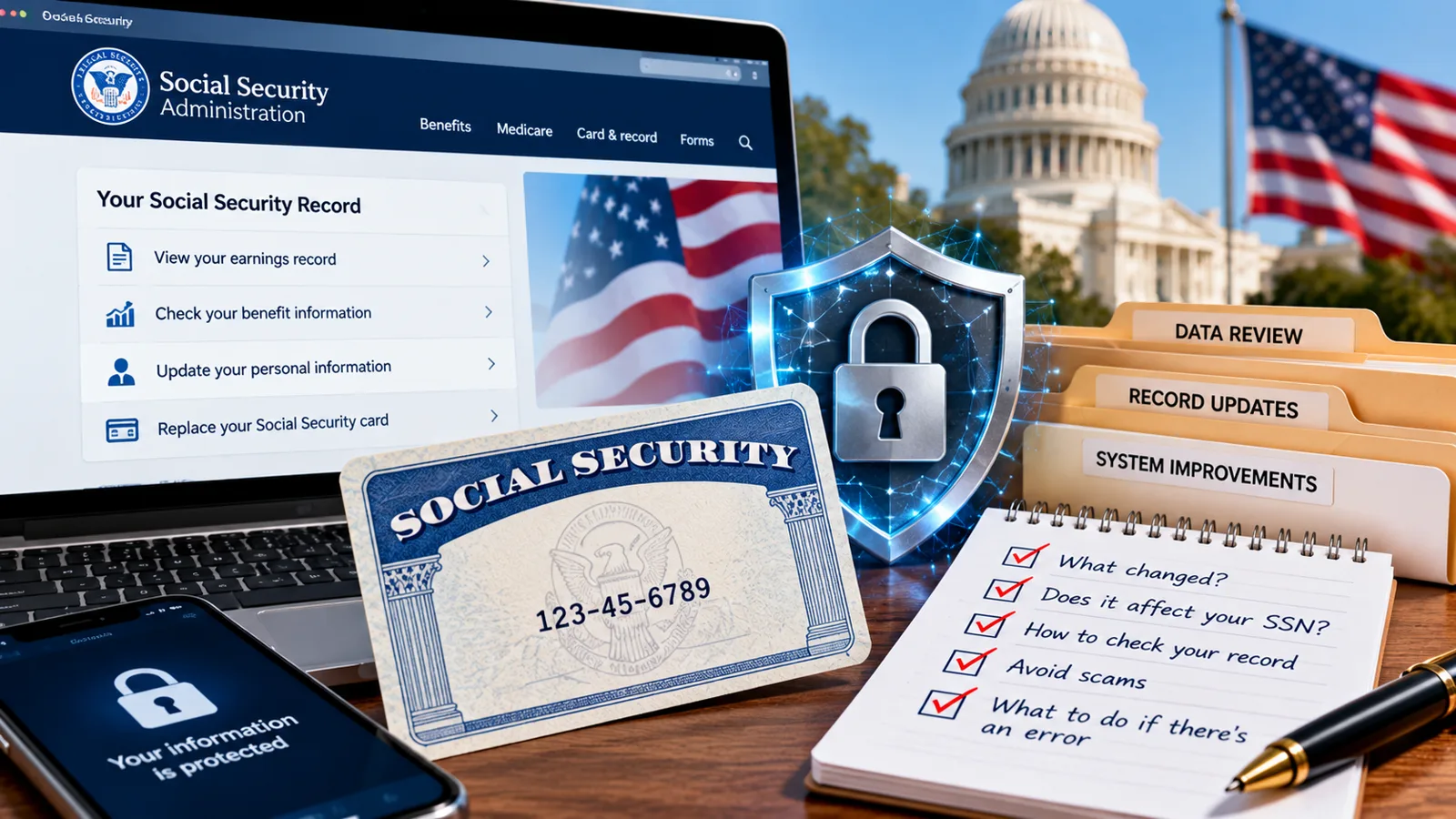
Updated October 21, 2026. The Social Security Administration (SSA) says it has corrected tens of millions of entries in its Social Security number database. The October 20 announcement describes updates to missing death dates, missing citizenship information and other inaccurate records. It does not say that everyone needs a new Social Security number, that benefits have been suspended, or that people must pay to verify their identity. If your own record or payment is wrong, use official SSA channels rather than links in unsolicited messages.
The most useful distinction is between a correction to information linked to an SSN and a change to the SSN itself. The announcement describes the former. This guide explains what the numbers mean, what has not been established, how to check your own information and how to respond to a genuine error.
What the SSA actually announced on October 20
In its October 20, 2026 press release, SSA characterized the effort as its most extensive SSN record cleanup and said it had corrected nearly 15% of active SSNs. It referenced approximately 330 million U.S. citizens and nearly 390 million total records. These are agency-reported figures, not independently verified counts of distinct people whose benefits were affected.
| SSA-reported action | Scale | Important limitation |
|---|---|---|
| Added previously missing dates of death | 17 million records | Does not establish that 17 million living beneficiaries were wrongly marked dead |
| Updated missing citizenship information using DHS SAVE data | Approximately 25 million records | Does not mean 25 million people lost citizenship or benefits |
| Further citizenship-status corrections in progress | 8.5 million records | In progress is not the same as completed |
| Additional internal data-entry controls | No count supplied | No published individual error-rate improvement in this announcement |
Do not add 17 million, 25 million and 8.5 million to calculate the number of unique affected people. The categories may overlap, some work is still underway, and SSA did not provide a deduplicated count for those three categories. Similarly, the reported percentage is not a personal probability that your record was wrong.
Does the cleanup change your Social Security number?
No automatic number replacement is described in the announcement. An SSN is an identifier; the Numident is SSA’s record of number assignments and associated identity information. Correcting a date-of-death field, citizenship field or data-entry error is not the same operation as issuing a different number. SSA’s operations guidance on changing Numident data explains that corrections and updated information follow defined documentation procedures.
A person can sometimes qualify for a different SSN under separate, limited SSA rules, but this cleanup is not evidence of a mass replacement program. Be skeptical of messages that say you must apply for a new number because of this news.
Does this affect Social Security retirement, disability or SSI payments?
The press release does not announce a nationwide benefit freeze, new payment schedule or blanket eligibility change. Accurate identity records can matter to benefit administration, but an administrative database project alone does not establish that any particular person’s payment will rise, fall or stop.
If a payment is missing or your online benefit information appears inconsistent, first compare it with your usual payment schedule and account notices. Check the official my Social Security account and contact SSA through its published contact options when necessary. Do not assume the cleanup caused a problem merely because the dates coincide.
A practical decision guide: what should you do?
| What you notice | What it means | Recommended next step |
|---|---|---|
| No notice, no discrepancy, payments normal | No individual problem established | No special action solely because of the press release |
| Name, birth date or other identity data appears wrong | Potential record discrepancy | Review official SSA correction instructions and supporting documents |
| SSA or another institution says you are recorded as deceased | Potentially serious identity-record error | Contact SSA promptly through official channels; retain notices and supporting proof |
| An employer or agency reports a citizenship verification mismatch | May involve data or matching rules, not necessarily status itself | Ask for the exact notice and follow the agency’s documented correction process |
| Text demands a fee to prevent SSN cancellation | Strong fraud warning sign | Do not pay, click or share credentials; report the attempt |
Step 1: verify the news from its original source
Read the SSA announcement directly. Check the date and distinguish the agency’s broad statistical claims from any notice addressed specifically to you. A news headline saying millions of records were corrected does not establish that your personal file was modified.
Step 2: review your own SSA information safely
Navigate to ssa.gov yourself rather than following a text-message link. If you have access to my Social Security, review available earnings and benefit information. Not every Numident field is necessarily visible in the consumer account, so a normal-looking dashboard cannot prove every underlying identity field is correct.
If you spot an error, note exactly which field is wrong and where you saw it. Save official correspondence securely. Do not publish screenshots showing your full SSN, birth date or account identifiers.
Step 3: use the correct route for an actual record error
SSA distinguishes documented transcription mistakes from changes that require a new application and supporting evidence. Its Numident correction policy describes the distinction. The documents and process depend on the field and circumstances; a birth-date correction is not necessarily handled like a name change or an incorrect death posting.
For a potential false death record, seek assistance promptly. SSA’s Inspector General reported in July 2026 that erroneous death postings can occur and that record-correction documentation has sometimes been inadequate. This is a separate audit, not proof that the October cleanup newly marked living people deceased. See the OIG audit summary.
Step 4: protect yourself from cleanup-themed scams
- Do not share your SSN, one-time login code or banking credentials with an unexpected caller.
- Do not pay a supposed “database correction” or “SSN reactivation” fee from a text or email.
- Type ssa.gov into your browser and navigate from there.
- If you receive a suspicious notice, verify it independently using published SSA contact information.
- If your identity information has actually been misused, consult IdentityTheft.gov for a recovery plan.
Why citizenship-status updates require careful interpretation
SSA says it used data from the Department of Homeland Security’s SAVE service to update approximately 25 million records with previously missing citizenship information, and is working on another 8.5 million with inaccurate status information. These are descriptions of database fields. They are not a count of newly naturalized people, people stripped of citizenship, or people removed from benefit rolls.
A verification mismatch can arise when data is incomplete, outdated or fails to match across systems. In a September 2026 OIG report, auditors found that minor name discrepancies sometimes prevented automated systems from matching records that other criteria could verify. That finding is relevant context for interpreting mismatches; it does not prove the specific causes of the October corrections.
What about the 17 million missing death dates?
A missing date of death in an administrative record is not the same as an incorrect declaration that a living person is dead. The October announcement says SSA added 17 million previously absent death dates using internal and State Department data. It does not disclose, in that release, a case-by-case breakdown of why those dates were missing, how old the records were or whether every change affected a current beneficiary.
Incorrect death postings are a distinct issue. A July 2026 OIG audit reported that SSA later found 12,504 of approximately 5.6 million death records posted during 2025 to be erroneous, and criticized incomplete documentation for some corrections. Those figures refer to the earlier audit period and must not be conflated with the 17 million missing-date additions announced in October.
What remains unknown about the cleanup
- Whether the agency will publish a deduplicated breakdown of unique records affected by each category.
- How many corrections, if any, caused an immediate change to a specific individual’s benefit payment.
- The full methodology and independent verification of the headline percentages.
- How quickly an individual correction propagates across every outside system that uses SSA identity data.
These limitations matter because a database-wide progress announcement is not an individualized benefits notice. For your own case, an official account record, letter and direct agency response are more useful than extrapolating from the nationwide totals.
How this differs from the 2027 COLA announcement
The October database-cleanup news concerns identity-record integrity. The separate 2027 cost-of-living adjustment concerns benefit amounts. Readers researching a raise or next year’s payments should consult the SSA press-release index for the relevant COLA announcement rather than treating this cleanup as a benefit-increase announcement.
The bottom line
SSA reports a large-scale cleanup of identity records, including missing death dates and citizenship fields. That is meaningful administrative news, but it does not automatically change your SSN or establish that your benefits are in danger. Check your own information only through official channels, act on documented discrepancies and ignore unsolicited demands to “fix” or “reactivate” your number.
Original sources and documentation
You may also like
 Useful Information
BC Ferries Cancellations: Check Sailings and Refunds
Check BC Ferries cancellations by route, understand rebooking and refunds, and avoid missing the special vehicle rules at…
 Useful Information
Canada Budget 2026: Benefits and Proposed Changes
Canada Budget 2026 explained: proposed grocery support, caregiver credit, workers benefit changes and heat pump help, with amounts,…
 Useful Information
Australia Card Surcharge Ban: Which Fees Can Still Apply?
Understand Australia’s card surcharge ban, which service and holiday fees can still apply, how to check a bill,…