
Sleep Paralysis Hallucinations: Why People See Shadow Figures
Why do shadow figures appear during sleep paralysis? Learn the REM sleep explanation, known risk factors, practical prevention and when to seek medical care.
Contents
- What happens during sleep paralysis
- Why a shadow figure can feel real
- Three common patterns of experience
- What increases the likelihood?
- How common is sleep paralysis?
- What to do during an episode
- Prevention and treatment
- When to seek medical advice
- Why REM sleep can spill into waking consciousness
- Three patterns of hallucination
- Why folklore around the world sounds surprisingly similar
- How frequent is sleep paralysis?
- What to do while an episode is happening
- A practical sleep routine for people with recurring episodes
- Distinguishing an isolated event from another sleep disorder
- Sources and further reading
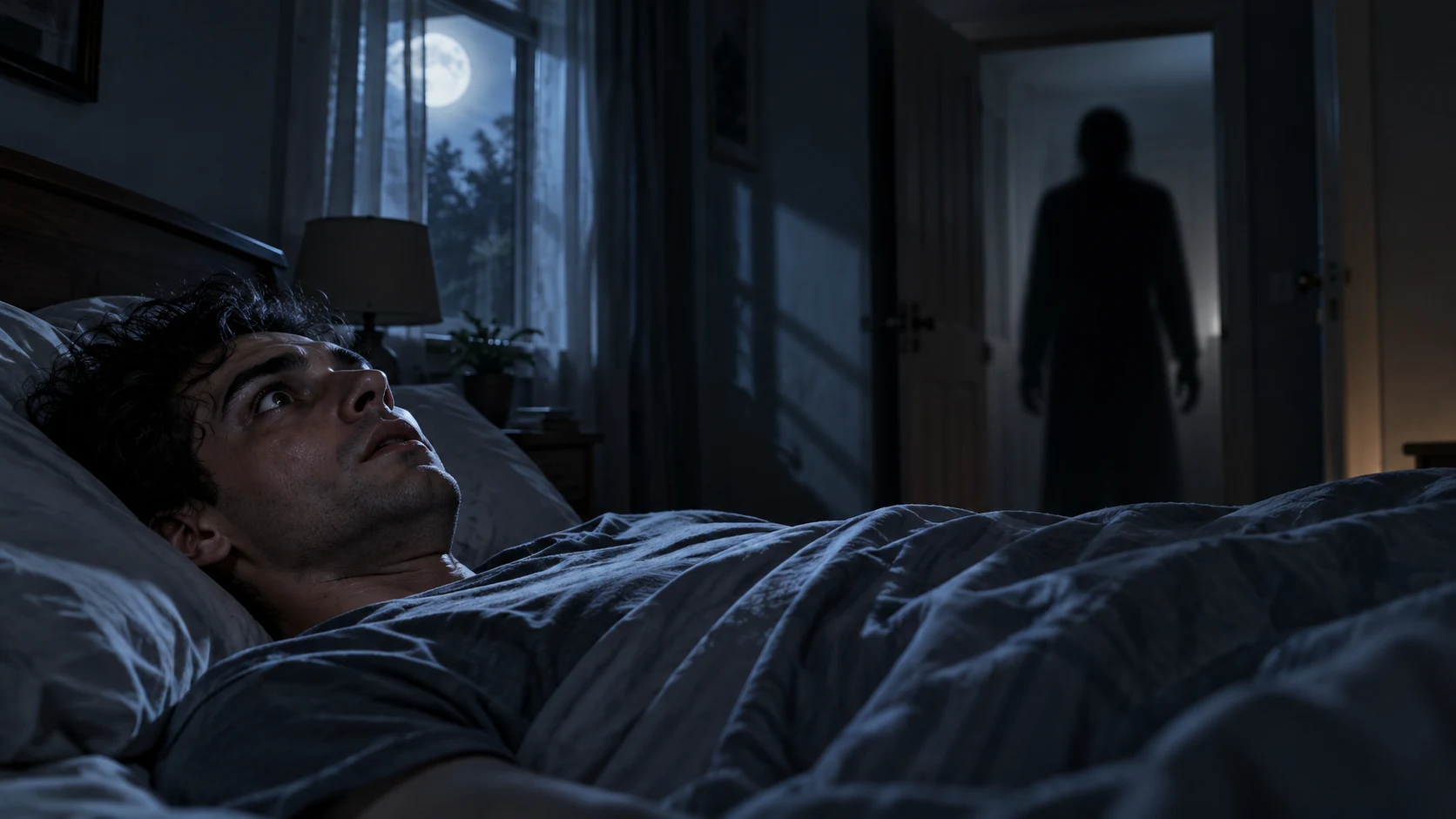
You wake and recognize your bedroom, but your body will not move. A shadow seems to stand nearby, and a few seconds feel endless. Sleep paralysis is a well-described sleep–wake phenomenon in which awareness and the normal muscle paralysis of REM sleep briefly overlap. The visions can feel real, but they do not demonstrate the presence of an intruder. Here is what research says about the experience, the factors associated with it, and safer ways to respond.
What happens during sleep paralysis
Sleep paralysis is a temporary inability to move voluntarily while falling asleep or waking up. Awareness returns while the muscle inhibition typical of rapid-eye-movement, or REM, sleep has not fully ended. Breathing continues automatically, although the sensation of chest pressure can make breathing feel difficult. Episodes commonly last seconds to minutes and end on their own. A frightening experience is not evidence of a supernatural presence.
Why a shadow figure can feel real
The brain is in an unusual mixed state: some aspects of dreaming remain active while a person perceives the bedroom. Threat-related imagery may be woven into real surroundings, producing the compelling sense of an intruder or figure nearby. Some people report footsteps, whispers, touch, or a weight on the chest. Others experience floating or out-of-body sensations. The content is shaped by culture and expectation, but the sleep physiology provides a natural explanation.
Three common patterns of experience
Researchers often group the experiences into sensed-presence or intruder phenomena, incubus-like chest pressure and breathing discomfort, and unusual vestibular or motor sensations such as floating. These are descriptive categories, not separate diseases. Importantly, not everyone with sleep paralysis hallucinates. Episodes may be distressing even when no figure appears because being awake and unable to move is itself alarming.
What increases the likelihood?
Irregular sleep schedules, sleep deprivation, shift work, and disrupted REM sleep can contribute. Stress and anxiety are associated with episodes, although a single event does not prove a psychiatric condition. Sleeping on the back is reported by some people as a trigger, but evidence is not strong enough to claim it causes all cases. Recurrent episodes may occur with narcolepsy, a disorder that also causes excessive daytime sleepiness and sometimes sudden loss of muscle tone.
How common is sleep paralysis?
Prevalence estimates differ substantially across studies because researchers use different questions and populations. A systematic review found that episodes are not rare, particularly in some student and clinical groups, but the pooled figures should not be treated as the probability for every individual. Visual or auditory hallucinations affect only a subset of people who experience paralysis. One frightening episode does not mean a person has a chronic illness.
What to do during an episode
Remind yourself that the event is temporary and that breathing continues. Some people find it useful to focus on slow, regular breathing and attempt a small movement of a finger or toe rather than struggling with the whole body. These strategies are practical coping suggestions, not guaranteed cures. A bed partner may help by speaking calmly and gently waking the person if an episode is recognized.
Prevention and treatment
A consistent sleep schedule, sufficient sleep, and managing factors that fragment sleep may reduce recurrence. A clinician can evaluate persistent daytime sleepiness, snoring or breathing pauses, medication effects, and possible narcolepsy. Treatment targets an underlying sleep disorder when one is found. For frequent distressing episodes, behavioral approaches and selected medical treatments may be considered by a specialist; medication is not routinely necessary for isolated episodes.
When to seek medical advice
Arrange an assessment if episodes are frequent, cause major sleep avoidance, or accompany severe daytime sleepiness. Seek urgent care for weakness that continues after full wakefulness, new neurological symptoms, chest pain, or true ongoing breathing difficulty; those symptoms should not automatically be labeled sleep paralysis. Understanding the REM-wake overlap can make an otherwise terrifying event less mysterious.
Why REM sleep can spill into waking consciousness
Rapid-eye-movement (REM) sleep is the stage in which vivid dreaming often occurs. During REM, the brain ordinarily suppresses much skeletal-muscle activity, a protective state called REM atonia. Sleep paralysis can occur when conscious awareness returns before that paralysis has fully ended, or as the brain transitions into sleep. Breathing continues and eye movements may remain possible, but the person cannot voluntarily move their arms, legs, or voice for a short period. The mismatch between awareness and bodily control is what makes the episode so unsettling.
Because dream-related imagery and emotion can overlap with waking perception, a person may believe that another presence is in the bedroom, hear footsteps, or feel pressure on the chest. Such sensations can be extremely convincing. The crucial distinction is that an intense and realistic experience does not establish that an actual intruder was present. Scientists can study the episode as a sleep–wake transition without dismissing how frightening it feels.
Three patterns of hallucination
Sleep researchers often describe three broad clusters. “Intruder” experiences involve the conviction that somebody is nearby, sometimes accompanied by a visible shadow or frightening sounds. “Incubus” experiences involve chest pressure, breathlessness, or a feeling that something is sitting on the sleeper. Vestibular–motor experiences can include floating, falling, spinning, or seeming to move outside the body. A single episode may combine more than one pattern.
The breathing sensation deserves special care. During REM sleep, breathing patterns differ from full wakefulness, and being unable to recruit voluntary movement can make ordinary respiratory effort feel restricted. Sleep paralysis itself usually resolves without harm, but new severe chest pain, persistent shortness of breath after waking, or other concerning symptoms should not automatically be attributed to it. Those symptoms may warrant urgent medical evaluation for a different cause.
Why folklore around the world sounds surprisingly similar
Different cultures have described demons, night visitors, invisible attackers, or a person sitting on the chest. The imagery and interpretation vary, but the central combination of wakefulness, immobility, fear, and a sensed presence recurs across accounts. Cultural expectations may influence which image the mind supplies and how the event is remembered. A scientific explanation can account for a shared physiological pattern without assuming that people invented their experiences.
The emotion is also biologically plausible. A brain that detects danger while the body cannot move may amplify alarm and interpret ambiguous bedroom details as threatening. Dim lighting, remembered dream fragments, and uncertainty about whether one is fully awake can intensify the effect. Not every episode includes a hallucination, and some people experience only brief immobility.
How frequent is sleep paralysis?
A 2011 systematic review by Sharpless and Barber pooled studies covering 36,533 people. It reported a lifetime experience of at least one episode in about 7.6% of general-population samples; rates were higher in samples of students and psychiatric patients. That figure is an estimate across older studies, not the chance of an episode on any given night. Differences in questionnaires, definitions, geography, and recruitment help explain why reported prevalence varies widely.
Sleep paralysis is linked with disrupted sleep schedules, insomnia, jet lag, shift work, anxiety-related difficulties, and narcolepsy. Sleeping on the back may also make it more likely for some individuals. None of these associations proves a single cause in every person. Experiencing one episode does not by itself mean someone has narcolepsy or a mental-health disorder.
What to do while an episode is happening
If you recognize the pattern, remind yourself that it is temporary and normally ends within seconds or minutes. Trying to control panic can be more useful than struggling to move every muscle simultaneously. Some people find it helpful to focus on slow, ordinary breathing or attempt a tiny movement such as a finger or toe; these are coping strategies, not guaranteed treatments. A reassuring explanation before an episode may reduce the fear attached to future events.
A bed partner should avoid dramatic attempts to “wake” someone by shaking them violently. A calm voice and gentle reassurance may be appropriate if the person is distressed. Because symptoms are usually short-lived, the goal is safety and understanding, not forcing a particular sensation to disappear. If breathing distress or another medical emergency persists after full awakening, the priority changes to getting medical help.
A practical sleep routine for people with recurring episodes
Keep a regular bedtime and wake time, including on days off when practical. Aim for sufficient total sleep rather than alternating sleep deprivation with long catch-up nights. A quieter bedroom, reduced late caffeine, and attention to alcohol or nicotine use may improve sleep quality. If episodes commonly happen when sleeping face up, experimenting with a different position can be reasonable. A sleep diary can record bedtime, wake time, shift work, stressful days, sleeping position, and episode frequency; such information is useful to a clinician.
There is no one-size-fits-all medication for isolated sleep paralysis, and taking sedatives or antidepressants without medical advice can create additional problems. A sleep specialist may investigate insomnia, obstructive sleep apnea, narcolepsy, or other conditions when the history warrants it. Behavioral approaches and treatment of an underlying disorder may be more useful than trying to eliminate one unusual symptom in isolation.
Distinguishing an isolated event from another sleep disorder
Recurrent sleep paralysis can occur without any other illness. However, pronounced daytime sleepiness, unintended sleep attacks, or episodes of sudden muscle weakness triggered by laughter or emotion suggest the need to assess for narcolepsy. Loud snoring and witnessed pauses in breathing may point toward sleep apnea. Clinicians also ask about medications, shift patterns, trauma, and anxiety because all can influence sleep quality.
A clear account of timing is more helpful than the label “ghost sighting”: did the person become aware while falling asleep or waking? Were their eyes open? Could they move after a minute? Did the vision end immediately when movement returned? Such details can help distinguish a sleep-boundary phenomenon from an event that happens fully awake.
Sources and further reading
NHS clinical guidance on sleep paralysis
Sharpless and Barber 2011: lifetime prevalence systematic review
You may also like
 Science & Discoveries
 Robot Dog Runs a Full Marathon on One Charge: How RAIBO2 Made It Possible
RAIBO2 completed a 42.195 km marathon on one battery. Explore the engineering, energy-saving gait, power figures and what…
 Science & Discoveries
 Can AI Discover New Antibiotics? Breakthroughs, Evidence and Limits
How does AI find possible new antibiotics? Explore halicin, abaucin, generative models, laboratory validation, resistance and the path…
 Science & Discoveries
 Diamond Rain on Neptune and Uranus: What Experiments Really Show
Can diamonds form inside Neptune and Uranus? Examine extreme-pressure experiments, the role of oxygen, conflicting results and what…