
Robot Dog Runs a Full Marathon on One Charge: How RAIBO2 Made It Possible
RAIBO2 completed a 42.195 km marathon on one battery. Explore the engineering, energy-saving gait, power figures and what the 2026 Nature study actually proves.
Contents
- What is RAIBO2?
- What happened during the marathon?
- Why are walking robots so power-hungry?
- Breakthrough one: a lighter, more efficient mechanical design
- Breakthrough two: reducing electrical and motor losses
- Breakthrough three: learning to move with less wasted effort
- What does a cost of transport of 0.25 mean?
- How much battery power was left at the finish?
- Was RAIBO2 faster than a human runner?
- Could this technology help after earthquakes or disasters?
- Other possible uses for long-range quadruped robots
- Does this mean batteries are no longer the main limitation?
- What the experiment does not prove
- Why the 2026 Nature paper matters
- The bottom line
- Original research and further reading
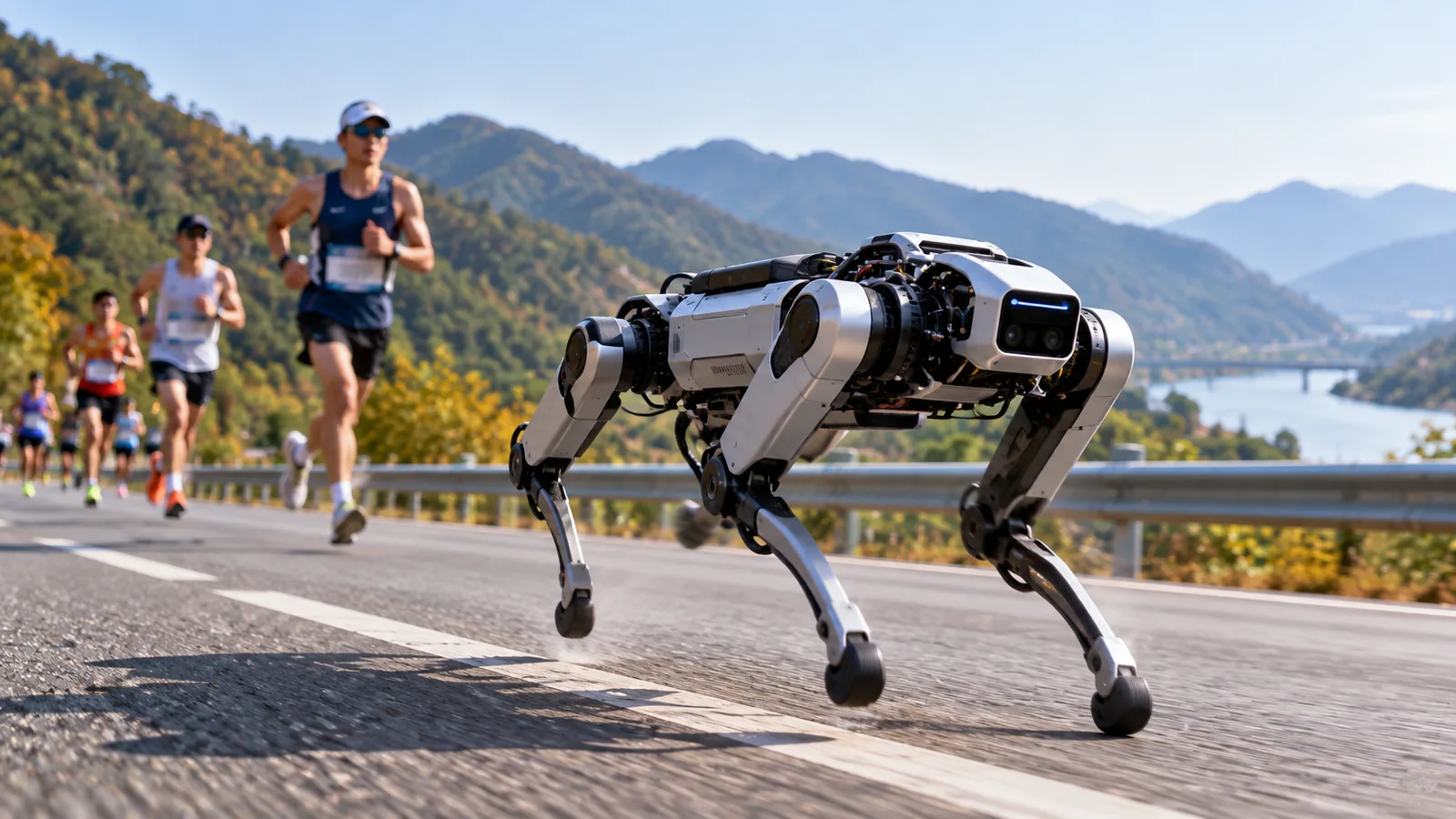
A four-legged robot has completed the full 42.195-kilometer distance of a marathon without swapping or recharging its battery. Developed by researchers at the Korea Advanced Institute of Science and Technology (KAIST), RAIBO2 finished the race in 4 hours, 19 minutes and 52 seconds. The run took place in South Korea in November 2024, while a detailed scientific paper describing the engineering behind the achievement appeared in Nature in September 2026. That distinction matters: the new scientific story is about how the robot conserved energy, not a claim that it raced for the first time in 2026.
The result points to a challenge far beyond running races. Walking robots are potentially useful on stairs, rubble and other terrain where wheels can struggle, but moving four mechanical legs for hours demands careful management of power, heat, weight and control. RAIBO2 offers an unusually concrete case study in how those problems can be tackled together.
What is RAIBO2?
RAIBO2 is a quadruped robot developed by a KAIST research team. It has four articulated legs, electrically driven joints, onboard control hardware and a battery. Its dog-like shape describes its locomotion; it is not a biological animal, nor does the marathon demonstrate animal-like intelligence. The engineering goal was to create a legged machine that could travel a long distance efficiently while maintaining stable, useful movement.
Quadrupeds are attractive because they can place their feet independently and adjust their stance on uneven ground. Yet every step requires the robot to accelerate and decelerate moving components, support its weight and compensate for disturbances. Those actions create energy costs that accumulate rapidly over long journeys.
What happened during the marathon?
RAIBO2 took part in the Sangju Marathon in South Korea on November 17, 2024. It completed the official 42.195 km course in 4:19:52 without a battery replacement. Its average speed over the course was approximately 9.7 km/h, including the full elapsed finishing time. This is an endurance demonstration, not a claim that the machine outran elite human marathoners.
- Distance: 42.195 kilometers (26.2 miles).
- Finishing time: 4 hours, 19 minutes, 52 seconds.
- Average course speed: approximately 9.7 km/h (6.0 mph).
- Battery capacity reported: 2,016 watt-hours (Wh).
- Energy used during the marathon: approximately 1,280 Wh.
- Race date: November 17, 2024; research paper published September 2026.
The energy figures describe this particular run and the reported configuration. They should not be interpreted as a guaranteed range for all routes, speeds, temperatures, payloads or operating modes.
Why are walking robots so power-hungry?
A wheeled machine can roll efficiently on a smooth road. A legged machine must repeatedly lift, swing and position its feet while its motors generate forces to stabilize the body. Electrical losses, friction, the inertia of moving limbs and poorly timed steps all draw from the battery. A robot that looks smooth to a spectator may still be wasting significant energy internally.
Long-distance performance therefore depends on more than buying a larger battery. Adding battery cells increases stored energy, but it also adds mass that the legs must carry. Engineers must balance battery capacity against the energy needed to move the heavier machine.
Breakthrough one: a lighter, more efficient mechanical design
One part of the RAIBO2 approach was to reduce unnecessary mass and resistance in the leg mechanisms. Mass near a swinging foot is particularly costly because the motors must repeatedly accelerate it and bring it to a stop. Mechanical design choices that lower the inertia of moving components can reduce the work required during thousands of strides.
The overall structure also needs to transmit forces effectively. A lighter robot that flexes unpredictably or cannot withstand repeated impacts is not necessarily better. The engineering challenge is to save weight while retaining stiffness, durability and reliable foot placement.
Breakthrough two: reducing electrical and motor losses
A robot consumes energy even when some of the mechanical work it performs does not translate into forward progress. Electric motors and their drive electronics lose energy as heat, including losses associated with electrical resistance. The design of the actuation system and the way current is commanded both influence efficiency.
The research emphasizes an integrated approach to hardware and control. Improving a motor alone may not help if the gait repeatedly demands unnecessarily high torque. Likewise, a clever gait is less effective if the mechanical and electrical system wastes energy at every joint.
Breakthrough three: learning to move with less wasted effort
RAIBO2 also used a locomotion controller developed with reinforcement learning. In broad terms, this approach trains a control policy by rewarding useful behavior and penalizing undesirable outcomes, such as instability or excessive energy consumption. A learned controller can coordinate joint motion, body posture and foot contact rather than relying solely on manually designed sequences.
For an endurance task, the aim is not to maximize sprinting speed. The controller needs to maintain forward progress with manageable forces and repeatable steps over a very long period. Optimizing for energy efficiency can lead to a different gait from one designed for short bursts of acceleration or jumping.
Reinforcement learning does not mean the robot independently understood the marathon or planned the race like a human. It means a control system was trained to produce useful movement under specified objectives and constraints.
What does a cost of transport of 0.25 mean?
Robotics researchers often use a measure called cost of transport (CoT) to compare the energy needed to move different machines. In a common dimensionless formulation, energy is normalized by the robot’s weight and the distance traveled. Lower values generally indicate more efficient movement under comparable measurement conditions.
The RAIBO2 research reports a cost of transport around 0.25. That is notable for a legged robot, but comparisons require care: studies may differ in whether they count electrical energy at the battery, mechanical work at the joints, or other components. Terrain, speed and payload also matter. A single CoT value does not tell us everything about a robot’s real-world usefulness.
How much battery power was left at the finish?
The reported battery capacity was 2,016 Wh, while approximately 1,280 Wh was consumed during the marathon. Subtracting those figures gives about 736 Wh of nominal capacity not consumed during the event. That arithmetic should not be mistaken for a precise measurement of usable remaining charge or a promise that the robot could travel another proportional distance.
Battery voltage, power limits, reserve settings, temperature and changes in terrain can all affect how much additional travel is actually possible. Still, the figures help illustrate why improving efficiency is so valuable: a machine can achieve a substantial increase in endurance without simply carrying a bigger energy pack.
Was RAIBO2 faster than a human runner?
No broad claim of human superiority follows from this result. A 4-hour-19-minute marathon is a substantial endurance accomplishment for a legged machine, but elite human runners finish much faster. Recreational human marathon times vary enormously, and the robot was built for a research demonstration rather than head-to-head competition with people.
The most useful comparison is technological: a robot with many actuated joints sustained motion for the entire course on a single battery. That is a different achievement from breaking a human athletics record.
Could this technology help after earthquakes or disasters?
Potentially. Search-and-rescue teams may need machines that can move through dangerous environments without exposing people to unstable structures, hazardous substances or falling debris. A legged robot could be useful where wheels cannot easily cross gaps or irregular obstacles. Longer battery endurance would allow it to inspect a larger area before returning for power.
However, a paved marathon is not the same as a collapsed building. Rubble introduces loose footing, sharp edges, slopes, dust and unexpected obstacles. Rescue missions may also require cameras, communications equipment, sensors or tools that add weight and draw power. RAIBO2’s road endurance does not establish that it can already complete those missions.
Other possible uses for long-range quadruped robots
- Industrial inspection: repeated patrols around facilities, pipelines or remote equipment.
- Infrastructure monitoring: carrying cameras or sensors across difficult access routes.
- Agriculture: inspecting uneven fields and locations inaccessible to conventional vehicles.
- Hazardous-area reconnaissance: collecting observations while limiting direct human exposure.
- Research: testing more energy-efficient control methods for legged machines.
These are possible applications of efficient quadruped locomotion, not verified commercial deployments of RAIBO2. A practical robot must also demonstrate safe navigation, communications, reliability, maintenance and an acceptable operating cost.
Does this mean batteries are no longer the main limitation?
Not at all. Battery energy density still constrains how long a mobile robot can operate. But the marathon illustrates that endurance is a whole-system problem. Designers can extend operating time by improving mechanical transmission, lowering moving mass, reducing electrical losses, choosing an efficient gait and managing computation and sensors.
Those changes may be as important as increasing battery capacity, especially when extra battery weight raises the energy needed for every step. Future systems will likely combine better energy storage with smarter actuation and control.
What the experiment does not prove
- It does not show that every quadruped robot can run a marathon.
- It does not establish equivalent endurance while carrying a heavy payload.
- It does not prove the same efficiency on rubble, mud, stairs or steep slopes.
- It does not demonstrate that a robot can autonomously handle every emergency scenario.
- It does not mean a single marathon test settles long-term durability or maintenance costs.
Scientific demonstrations are most valuable when their conditions are described clearly. The marathon is strong evidence for the performance of this particular robot under the tested circumstances; generalizing it to other robots or tasks requires further experiments.
Why the 2026 Nature paper matters
The race happened in 2024, but the September 2026 publication made the underlying engineering available for scientific scrutiny. A peer-reviewed technical description allows other researchers to examine the design principles, energy measurements and control approach rather than relying on a headline or a short video of the robot running.
That makes the story relevant well beyond robotics enthusiasts. It illustrates how advances in mechanical engineering, electric drive systems and machine learning can reinforce one another. The interesting lesson is not simply that a robot finished a race, but that efficient movement can be engineered across the entire system.
The bottom line
RAIBO2 completed a full 42.195 km marathon in South Korea in 4:19:52 on a single battery charge. Its achievement, analyzed in a Nature paper published in September 2026, highlights the value of combining lightweight hardware, efficient electric actuation and energy-aware learned locomotion. The result is an important endurance benchmark for legged robotics, not proof that robot dogs are ready to replace people in disaster zones or outperform elite athletes.
Original research and further reading
Read the original Nature research paper on the quadruped robot marathon. For context on the institution behind the project, visit the official KAIST website. Figures in this article refer to the reported research demonstration; they are not universal specifications for all quadruped robots.
You may also like
 Science & Discoveries
 Can AI Discover New Antibiotics? Breakthroughs, Evidence and Limits
How does AI find possible new antibiotics? Explore halicin, abaucin, generative models, laboratory validation, resistance and the path…
 Science & Discoveries
 Diamond Rain on Neptune and Uranus: What Experiments Really Show
Can diamonds form inside Neptune and Uranus? Examine extreme-pressure experiments, the role of oxygen, conflicting results and what…
 Science & Discoveries
 Rogue Planets: The Mysterious Worlds That Wander Without Stars
Explore rogue planets that drift without stars: planetary ejection, gravitational microlensing, space telescope discoveries and the uncertain prospects…