
Rogue Planets: The Mysterious Worlds That Wander Without Stars
Explore rogue planets that drift without stars: planetary ejection, gravitational microlensing, space telescope discoveries and the uncertain prospects for life.
Contents
- What is a rogue planet?
- How a world gets expelled
- How astronomers detect invisible wanderers
- What microlensing can and cannot tell us
- Could a rogue planet support life?
- How many could exist?
- Why NASA’s Roman telescope matters
- What these worlds teach us
- Not every free-floating world has the same origin
- The violent physics of planetary ejection
- How microlensing reveals an object that emits almost no light
- What direct images can reveal—and what they cannot
- How cold could a planet become without sunlight?
- Could moons make a difference?
- Why counts of rogue planets are so uncertain
- The most useful scientific takeaway
- Sources and further reading
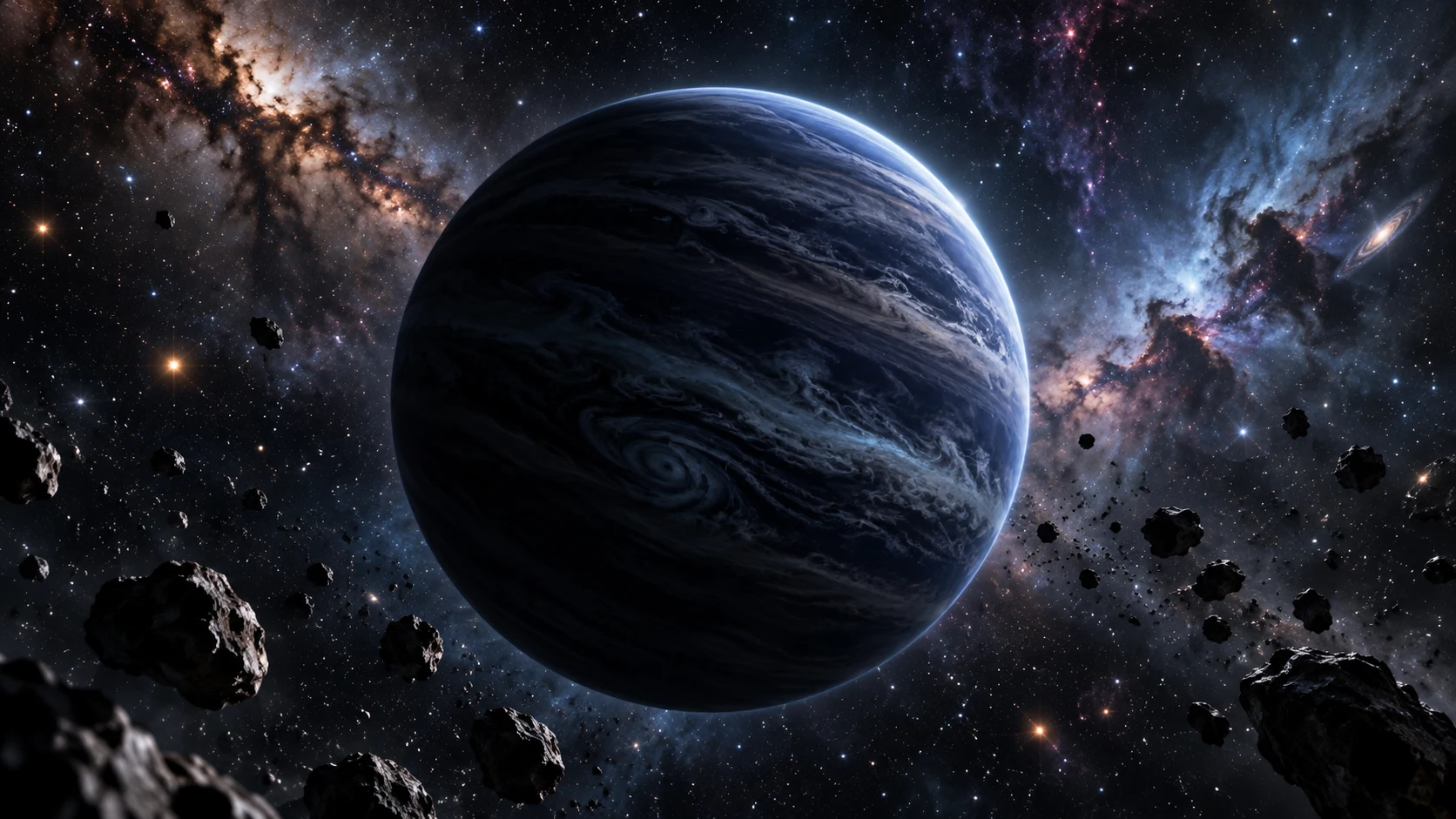
Not every planet has a sunrise. Some planetary-mass objects travel through interstellar space without orbiting a star, making them among the most elusive worlds astronomers study. They may be expelled from young planetary systems or form by other routes. Discovering them requires clever techniques, particularly gravitational microlensing, and population estimates remain uncertain. Their existence offers clues to the origins and instability of planetary systems.
What is a rogue planet?
A rogue planet, also called a free-floating planet, is a planetary-mass object that is not gravitationally bound to a star. Unlike Earth, it has no regular sunrise from a parent sun. Some may have formed in disks around stars and later been ejected by gravitational encounters; others may have formed more directly from collapsing gas. Their origins are still debated, especially at the boundary between low-mass stars and giant planets.
How a world gets expelled
Young planetary systems can be dynamically crowded. When large planets interact, gravity can scatter smaller worlds onto highly elongated orbits or eject them entirely. Close encounters between stars in clusters can also disturb planetary systems. Simulations show several possible pathways, but astronomers cannot reconstruct the complete history of most individual rogue-planet candidates. A planet without a star is not necessarily the remnant of a destroyed civilization or a recent cosmic disaster.
How astronomers detect invisible wanderers
A cold, isolated planet emits little visible light, making ordinary telescope images difficult. Gravitational microlensing provides a powerful alternative: when the object passes almost directly in front of a more distant star, its gravity briefly magnifies that star’s light. The brightening pattern can reveal a compact lens even when the lens itself is dark. Very young, warm planetary-mass objects may also be seen in infrared surveys, though distinguishing them from other low-mass objects is challenging.
What microlensing can and cannot tell us
A short microlensing event may suggest a low-mass object, but the inferred mass depends on assumptions about distance and relative motion. A single event does not always prove that the object is unbound; a very distant host star may escape detection. Follow-up observations and statistical analysis improve confidence. Headlines claiming that astronomers have counted every rogue planet should be treated skeptically because the population is inferred from incomplete surveys.
Could a rogue planet support life?
Without sunlight, the surface of a rocky rogue planet would usually be extremely cold. Nevertheless, theoretical studies consider whether thick insulating atmospheres, internal radioactive heat, or subsurface oceans could preserve liquid water in certain circumstances. These are hypotheses, not evidence that inhabited rogue planets exist. Habitability depends on many unknowns, including composition, atmospheric retention, and energy sources for chemistry.
How many could exist?
There is no settled count for the Milky Way. Surveys sample limited regions and favor certain object masses; extrapolating to the entire galaxy introduces substantial uncertainty. Different studies produce different estimates, so a single dramatic number should not be presented as established fact. The important scientific question is how free-floating objects are distributed by mass, which can reveal how planetary systems form and evolve.
Why NASA’s Roman telescope matters
The Nancy Grace Roman Space Telescope is designed to survey dense star fields and use gravitational microlensing to detect planets over a wide range of distances from their stars, including candidates with no detectable host. Its broad survey will complement the transit method, which is biased toward close-in planets. Expectations are mission forecasts, not already completed detections. Results should sharpen estimates of the rogue-planet population.
What these worlds teach us
Rogue planets force astronomers to question the assumption that a planet must orbit a sun. Their study connects planetary formation, gravitational dynamics, and the distinction between planets and brown dwarfs. A lonely world can still be a valuable record of its birthplace, even if the star it once orbited is impossible to identify. Future observations will test whether ejection or isolated formation dominates different mass ranges.
Not every free-floating world has the same origin
A rogue planet is a planetary-mass object that does not orbit a host star. Some may begin life in an ordinary planetary system and later be thrown out by gravitational interactions with massive planets or passing stars. Others may form directly from small collapsing clouds of gas and dust, more like the way stars form. Astronomers debate where the boundary lies between a free-floating planet and an extremely low-mass brown dwarf because physical formation histories are often hard to reconstruct from a distant object.
This distinction matters when interpreting discoveries. Finding a young, faint object in a star-forming region does not prove that a completed solar system expelled it. By contrast, dynamical calculations can show how young systems naturally scatter smaller worlds into interstellar space. The overall rogue-planet population probably contains objects formed by more than one pathway.
The violent physics of planetary ejection
During the early stages of a planetary system, orbits can change as growing planets exchange gravitational energy. A close approach to a giant planet can accelerate a smaller world until it escapes the central star. The process is not a science-fiction explosion: it is a cumulative exchange of orbital energy and momentum. A planet might first be pushed onto a long, eccentric orbit and only later lose its connection to the star.
Ejections may also happen when two stars pass close together or in unstable systems with several giant planets. Astronomers use computer simulations to estimate how frequently these encounters should occur, but simulations depend on their initial assumptions. Observed rogue-planet masses and ages help test whether those models are realistic.
How microlensing reveals an object that emits almost no light
Gravitational microlensing is among the strongest methods for identifying isolated low-mass candidates. Imagine a distant background star. If an unseen object passes almost directly in front of it from Earth's perspective, the intervening mass bends and magnifies the star's light. A telescope records a characteristic temporary brightening. Short events are especially interesting because an event's timescale relates to the mass, distance, and relative motion of the lens.
A brief signal does not hand astronomers a ready-made planet mass. The distance to the lens and its motion are often uncertain, and an apparently isolated lens may still be bound to a star far away. Teams look for additional observations, timing signatures, or parallax measurements to narrow the possibilities. That is why papers often use the word “candidate” and why a microlensing survey is statistically powerful even when individual events remain ambiguous.
What direct images can reveal—and what they cannot
A different approach observes young planetary-mass objects glowing faintly from the heat left over after their formation. Infrared instruments can sometimes detect them in star-forming regions, and spectra may reveal features of molecules in their atmospheres. Such imaging is biased toward young, relatively warm objects and usually misses old, cold, Earth-mass wanderers. Scientists also must establish that the source is not an unrelated star or distant background object.
Direct imaging and microlensing therefore sample different corners of the population. Combining them is more informative than treating one survey as a complete census. The most realistic article about rogue planets explains these observational selection effects instead of giving a single dramatic total as a settled fact.
How cold could a planet become without sunlight?
A planet separated from a Sun-like star would lose familiar day–night cycles and surface heating from starlight. Yet darkness does not automatically mean absolutely no energy. A young world can retain internal heat; radioactive decay may supply additional heat inside a rocky planet; and a thick atmosphere could trap some of that energy. On larger worlds, gravitational contraction and other internal processes can continue for long periods.
Some theoretical studies consider whether a sufficiently insulated rogue world might maintain water beneath ice or deep below the surface. That possibility is not evidence that rogue planets actually host life. The outcome depends on planetary mass, composition, atmospheric loss, water inventory, geological history, and many parameters that are nearly impossible to measure for an individual cold wanderer today.
Could moons make a difference?
A rogue giant planet might carry moons with it when expelled, although intense scattering could destabilize some satellite orbits. If a moon remains bound and receives significant tidal heating as it moves around the planet, its interior might stay warmer than starlight alone would allow. Researchers discuss such systems as hypothetical habitats because liquid water, chemical nutrients, and long-term environmental stability are all separate requirements.
The right framing is a chain of testable possibilities: moons may exist; some may retain internal heat; some might host liquid water. None of those steps justifies the statement that astronomers have found life on a rogue planet. Hypotheses about habitability need to be separated from confirmed detection.
Why counts of rogue planets are so uncertain
NASA reported in 2023 that an analysis of microlensing observations suggested rogue planets could outnumber stars in the Milky Way by a large factor, with one estimate around twenty per star. That is a model-dependent population estimate, not a list of individually photographed planets. Survey completeness, event-duration thresholds, and the assumed distribution of lens masses all influence the extrapolation.
The Nancy Grace Roman Space Telescope is designed to survey microlensing events from space with an exceptionally wide field of view. Its observations are expected to improve population statistics, especially for low-mass worlds. Even so, a future telescope will not see every rogue planet in the galaxy. Large statistical samples and careful uncertainty estimates matter more than sensational counts.
The most useful scientific takeaway
Free-floating planets are a natural laboratory for testing theories of planetary formation, orbital migration, and gravitational scattering. If low-mass wanderers are common, planetary systems may lose material more readily than older textbooks suggested. If some isolated objects formed directly from gas clouds, the boundary between making stars and making planets may be more complicated than a neat mass cut-off.
For readers, the essential habit is to ask how a claimed object was detected, whether its mass is directly measured or modeled, whether a parent star has been ruled out, and whether the headline refers to one world or a population estimate. Those distinctions transform a strange space story into useful astronomy.
Sources and further reading
NASA 2023: Roman and free-floating planet population estimates
You may also like
 Science & Discoveries
 Robot Dog Runs a Full Marathon on One Charge: How RAIBO2 Made It Possible
RAIBO2 completed a 42.195 km marathon on one battery. Explore the engineering, energy-saving gait, power figures and what…
 Science & Discoveries
 Can AI Discover New Antibiotics? Breakthroughs, Evidence and Limits
How does AI find possible new antibiotics? Explore halicin, abaucin, generative models, laboratory validation, resistance and the path…
 Science & Discoveries
 Diamond Rain on Neptune and Uranus: What Experiments Really Show
Can diamonds form inside Neptune and Uranus? Examine extreme-pressure experiments, the role of oxygen, conflicting results and what…