
Can AI Discover New Antibiotics? Breakthroughs, Evidence and Limits
How does AI find possible new antibiotics? Explore halicin, abaucin, generative models, laboratory validation, resistance and the path to clinical trials.
Contents
- Why the search for antibiotics is urgent
- What AI contributes
- Halicin and a different way to search
- Abaucin and a difficult hospital pathogen
- Explainable models and new chemical structures
- From a promising molecule to a prescription
- Can AI solve resistance on its own?
- What to watch next
- The search problem AI is designed to help solve
- How a discovery pipeline works in practice
- Halicin: a landmark discovery with defined limits
- Abaucin: a more targeted approach
- Explainable AI and the search for genuinely new structures
- Generative AI takes a step beyond screening
- Four major reasons promising AI antibiotics fail
- What readers should look for in the next headline
- Sources and further reading
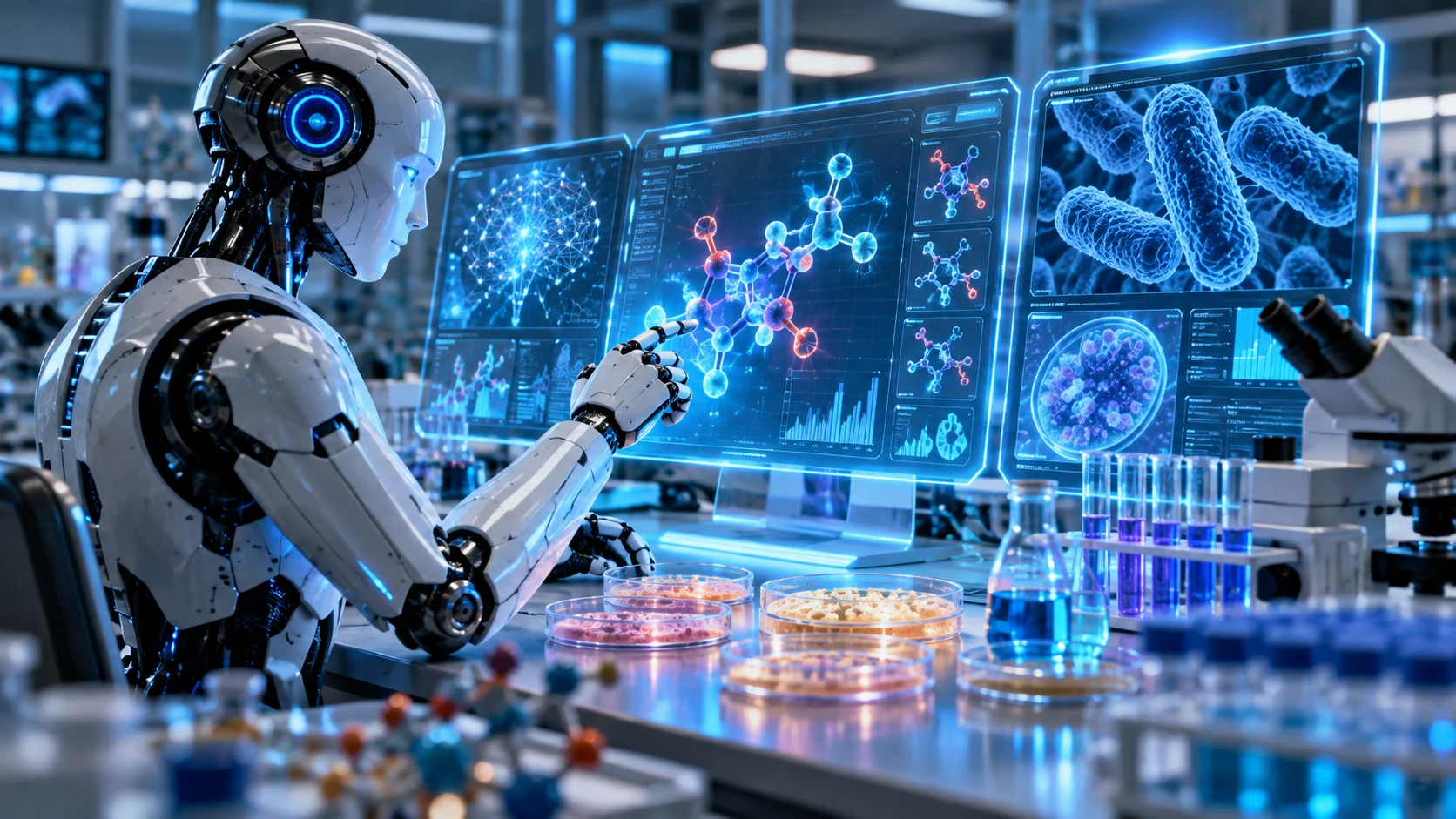
Artificial intelligence has helped researchers identify antibacterial candidates such as halicin and abaucin and has more recently supported the design of new chemical structures. That is genuine scientific progress, but it does not mean a computer can instantly produce an approved antibiotic. Every promising molecule must survive physical experiments, toxicology, formulation work and clinical trials. This guide explains exactly where AI helps, what the landmark studies showed, and why bacterial resistance remains a serious challenge.
Why the search for antibiotics is urgent
Antibiotic resistance is a growing public-health challenge because bacteria can evolve ways to survive drugs that once killed them. The World Health Organization reported that roughly one in six laboratory-confirmed bacterial infections in its 2023 surveillance analysis showed resistance to antibiotic treatment, although this figure should not be generalized to every infection in every country. Discovery of genuinely useful antibiotics is difficult, expensive, and often slower than the evolution of resistance.
What AI contributes
Machine-learning models can examine patterns linking molecular structure to antibacterial activity, toxicity, or other properties. Researchers first generate reliable experimental data, train a model, and then use it to prioritize compounds for laboratory testing. The advantage is not magical knowledge: AI helps narrow enormous chemical search spaces. Poor training data, biased assays, and uncertain predictions can still produce failures, so experimental confirmation remains essential.
Halicin and a different way to search
In widely discussed research, a machine-learning approach highlighted a compound later named halicin as a promising antibacterial candidate. The finding illustrated how algorithms can prioritize molecules unlike familiar antibiotics. But identifying a molecule that works in laboratory or animal experiments is not equivalent to establishing safe, effective treatment for patients. Clinical development requires extensive additional testing.
Abaucin and a difficult hospital pathogen
A 2023 Nature Chemical Biology study trained a neural network using growth-inhibition data from roughly 7,500 molecules against Acinetobacter baumannii. Researchers identified abaucin, a compound with relatively narrow activity against that pathogen, and reported encouraging laboratory results and activity in a mouse wound-infection model. This is a discovery-stage result, not proof that abaucin is an approved medicine. Its selectivity is scientifically interesting because broad-spectrum treatment is not always desirable.
Explainable models and new chemical structures
A separate study published in Nature used explainable deep-learning methods to search large chemical spaces for structural classes with antibacterial potential. The team combined activity and human-cell toxicity measurements with computational screening. Explainability can help researchers identify molecular features associated with predictions, but it does not eliminate experimental uncertainty or guarantee that a predicted mechanism is correct.
From a promising molecule to a prescription
A compound must survive many hurdles: reproducible activity, acceptable toxicity, pharmacokinetics, resistance testing, formulation, manufacturing, and controlled clinical trials. A drug that kills bacteria in a dish may fail because it cannot reach the infected tissue safely. Some compounds are too toxic or break down too quickly. AI may accelerate candidate selection, but it does not replace regulatory review or clinical evidence.
Can AI solve resistance on its own?
No. Bacteria continue to evolve, and resistance can arise even to new medicines. Better diagnostics, infection prevention, vaccination, appropriate prescribing, surveillance, and access to quality care are also necessary. A powerful discovery tool cannot compensate for widespread unnecessary antibiotic use. Patients should never interpret early-stage AI research as a reason to obtain experimental compounds or self-medicate.
What to watch next
Useful milestones include independently replicated antibacterial activity, published toxicology, demonstrated effectiveness in relevant infection models, and eventual human clinical-trial results. Claims that an algorithm “cured superbugs” should be checked against the actual stage of evidence. The most defensible conclusion is that AI has already helped researchers find compelling leads, while turning those leads into approved antibiotics remains a major scientific and medical challenge.
The search problem AI is designed to help solve
An antibiotic candidate must do more than damage bacteria in a laboratory dish. It should reach the pathogen in a patient's body at useful concentrations, avoid unacceptable human toxicity, remain stable long enough to work, and not be defeated immediately by common resistance mechanisms. Researchers also need viable methods of synthesis, formulation, manufacturing, and clinical testing. Because millions of chemical structures are theoretically possible, testing every structure one by one is prohibitively slow.
Machine-learning models help prioritize which molecules to examine first. They are trained on datasets linking chemical structures to experimentally measured antibacterial effects, then used to rank molecules that have not yet been tested. A model may identify unfamiliar combinations of chemical features that human researchers would not prioritize intuitively. The result is a shorter and more informed list for human researchers to synthesize or purchase and test—not a digital prescription ready for a hospital.
How a discovery pipeline works in practice
First, scientists choose a pathogen or biological assay and collect reliable measurements from known compounds. Next, software represents molecular structures in a form a model can learn from, such as molecular graphs. The team trains and checks the model on data kept separate from its training examples to estimate how well it generalizes. Then researchers screen a much larger virtual library, balancing predicted antibacterial activity with toxicity and other chemical constraints.
Promising hits return to the real laboratory. Researchers determine minimum inhibitory concentrations, compare activity across bacterial strains, investigate the mechanism of action, and check whether the molecule harms mammalian cells. Later steps can include pharmacokinetics, animal models, optimization of the molecule, and eventually human trials. A virtual prediction that fails any of these checks is still scientifically informative, but it is not a successful drug.
Halicin: a landmark discovery with defined limits
In a 2020 Cell study, Stokes and colleagues used deep learning to help identify halicin, a compound structurally unlike many conventional antibiotics. It showed activity against a range of pathogens, and researchers reported success in particular mouse infection models. The study helped demonstrate how models could surface candidates from chemical collections outside the usual antibiotic discovery routes.
The key qualification is that halicin was a research candidate, not proof that a new AI-designed antibiotic was approved for human patients. Results in a culture dish and in mice support further development, but do not settle clinical safety, effective dosing in people, or long-term resistance. A credible explainer distinguishes the original experimental evidence from promotional claims of a medical revolution.
Abaucin: a more targeted approach
A 2023 Nature Chemical Biology paper described abaucin, a candidate identified using a neural-network-guided search against Acinetobacter baumannii, a difficult hospital-associated pathogen that can show resistance to multiple medicines. The researchers first assembled growth-inhibition data from approximately 7,500 molecules, made computational predictions for other structures, and performed laboratory follow-up. The reported antibacterial activity was relatively narrow-spectrum, aimed at A. baumannii rather than every bacterium.
The study investigated a mechanism involving interference with lipoprotein trafficking and showed activity in a mouse wound-infection model. This illustrates why narrow-spectrum drugs can be valuable: a compound designed for a particular organism might reduce unnecessary pressure on unrelated bacteria, although that benefit must be demonstrated in practice. Abaucin remains a research example; it should not be described as an approved pharmacy product.
Explainable AI and the search for genuinely new structures
Some neural networks can rank molecules without telling chemists clearly which part of a structure drives the result. Explainable approaches attempt to link predictions to chemical substructures. In research published in Nature, investigators measured activity and toxicity for tens of thousands of compounds and computationally assessed more than 12 million structures. They then used model explanations to help identify candidate classes with activity against drug-resistant Gram-positive bacteria, including MRSA.
Those findings illustrate a second task for AI: not merely picking familiar chemicals faster, but suggesting which chemical features might define a useful new family. Yet an explanation generated by a model remains a hypothesis until chemists test it. Algorithms can expose patterns in data; laboratory experiments still decide whether those patterns reflect real biological mechanisms.
Generative AI takes a step beyond screening
Traditional screening asks which existing molecule deserves testing. Generative models can also propose molecular structures that may not already exist in a purchased chemical library. In a 2025 MIT report, researchers described designing and computationally screening over 36 million possible compounds in work focused on resistant Neisseria gonorrhoeae and methicillin-resistant Staphylococcus aureus. Some top designs showed laboratory promise and appeared to act through membrane-related mechanisms.
Here the distinction between a designed structure and a usable medicine is especially important. A chemically inventive suggestion may prove too difficult to synthesize, too unstable, or too toxic. Even when a compound works in an animal model, that remains an early-stage result. The realistic breakthrough is a larger, better directed space of possible starting points—not the end of clinical drug development.
Four major reasons promising AI antibiotics fail
Data bias comes first. Training collections may overrepresent familiar chemical scaffolds or use assays that do not translate to clinical infections. A second problem is generalization: models can perform well on closely related test molecules but struggle with genuinely new chemistry. Third, bacterial species differ in cell envelopes, transport systems, and resistance pathways; a hit against one strain may fail against another. Fourth, medicines need adequate exposure in patients without harming human tissues or disrupting beneficial microbes to an unacceptable degree.
There are practical bottlenecks beyond biology. Researchers must synthesize candidate compounds reliably, evaluate how bacteria develop resistance, and conduct expensive clinical trials. New antibiotics also face economic challenges because stewardship rightly discourages unnecessary use. None of these barriers disappears because screening is faster. AI is most useful when paired with microbiologists, medicinal chemists, clinicians, and rigorous experiments.
What readers should look for in the next headline
Check whether the cited result comes from a computational model, a test tube, an infected animal, or a human clinical trial. Ask which bacterial species were tested, whether resistant clinical isolates were included, what happened in toxicity experiments, and whether the study reports actual treatment outcomes. Be cautious when a headline says an algorithm has “cured superbugs” while its evidence consists of predicted molecular scores.
The public-health conclusion is practical: AI may broaden the pipeline of antibiotic candidates, but careful prescribing, infection prevention, vaccination where applicable, sanitation, and antimicrobial-resistance surveillance remain essential. No experimental compound discussed here should be used for self-treatment.
Sources and further reading
Stokes et al. 2020: halicin and deep-learning discovery
Liu et al. 2023: discovery of abaucin
Wong et al. 2024: explainable learning and antibiotic classes
You may also like
 Science & Discoveries
 Robot Dog Runs a Full Marathon on One Charge: How RAIBO2 Made It Possible
RAIBO2 completed a 42.195 km marathon on one battery. Explore the engineering, energy-saving gait, power figures and what…
 Science & Discoveries
 Diamond Rain on Neptune and Uranus: What Experiments Really Show
Can diamonds form inside Neptune and Uranus? Examine extreme-pressure experiments, the role of oxygen, conflicting results and what…
 Science & Discoveries
 Rogue Planets: The Mysterious Worlds That Wander Without Stars
Explore rogue planets that drift without stars: planetary ejection, gravitational microlensing, space telescope discoveries and the uncertain prospects…