
Shamonda Virus: First Human Case in France, How It Spreads and What We Know About the Risks
France has reported the first documented human Shamonda virus infection. Here is what is confirmed, what remains unknown and why Shamonda-like virus terminology matters.
Contents
- What happened in France: the facts and the limits of the report
- A timeline: from livestock surveillance to the human announcement
- What is Shamonda virus?
- Shamonda virus versus “Shamonda-like virus”: why the names matter
- How is Shamonda virus transmitted?
- Symptoms in humans: what is actually known?
- What does the case say about death risk?
- Where has the virus been detected in Europe?
- Risk in the UK, United States and other English-speaking markets
- Should people avoid cattle, milk or meat?
- What can farmers and veterinarians do now?
- What if someone is immunocompromised or becomes ill after insect bites?
- The scientific questions that matter next
- 1. Can people with normal immune function become infected?
- 2. How did the French patient acquire the virus?
- 3. Are all European detections the same virus?
- 4. Does the virus cause neurological disease in humans?
- 5. What would make the public-health assessment change?
- How this differs from a breaking-news headline
- Bottom line: a significant discovery, not a confirmed outbreak
- Primary sources and expert interpretation
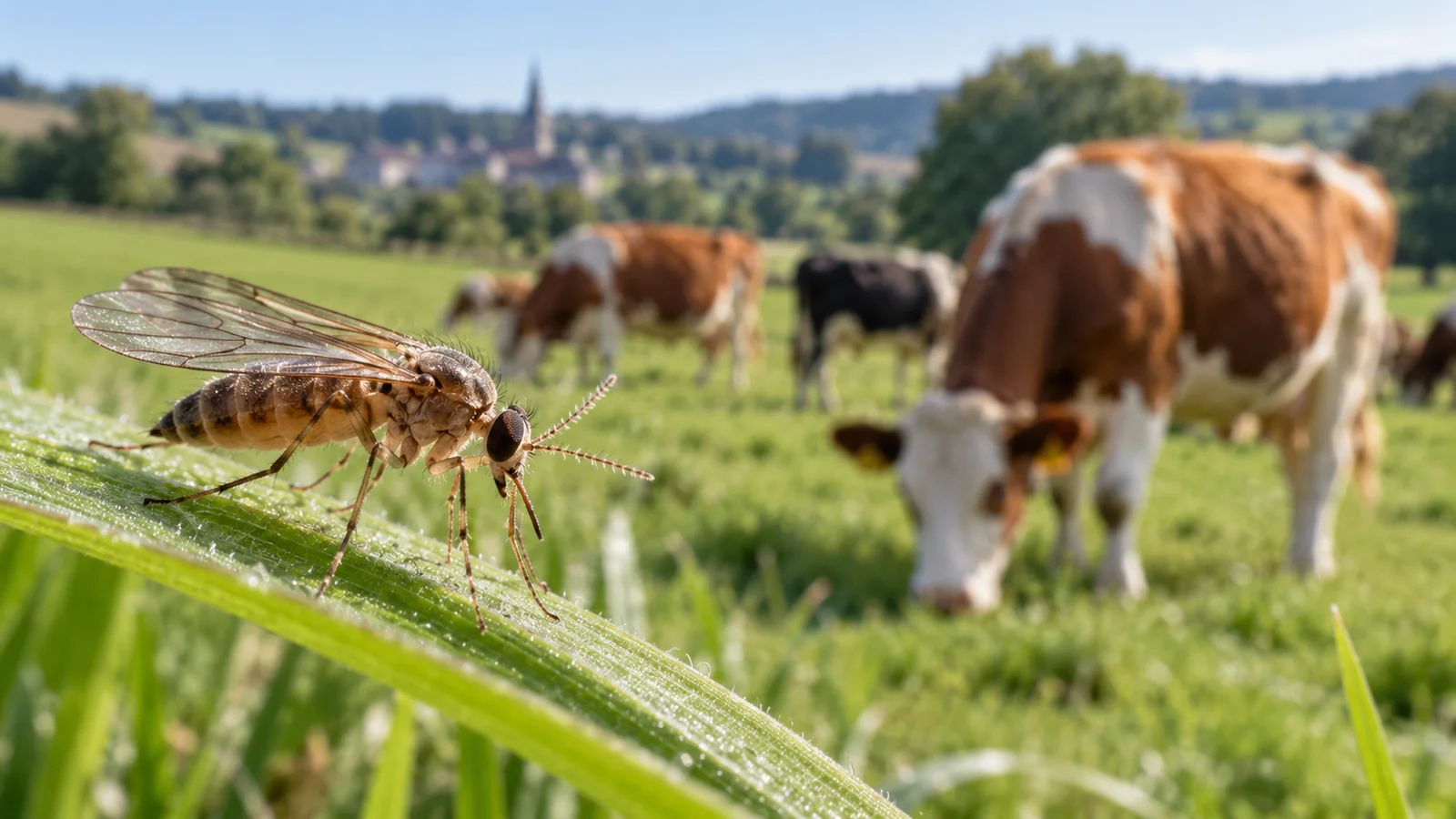
On 22 October 2026, French authorities reported the first documented human infection with Shamonda virus (SHAV). The patient was severely immunocompromised, was being treated for a serious illness in Lyon, and died in early October. Investigators are examining how infection occurred and whether the virus caused or contributed to the death. This is an important scientific discovery, not evidence of a human outbreak. France reported no identified health risk to the general population at the time of its announcement. Read the French official statement and the ECDC situation report.
Quick answer: Shamonda virus is an insect-associated orthobunyavirus historically detected in livestock. Biting midges are its established animal vectors. One recognized human infection does not establish typical human symptoms, an incubation period, human-to-human spread, or a new pandemic threat. This article separates confirmed findings from hypotheses and explains what future evidence would change the assessment.
What happened in France: the facts and the limits of the report
The French statement described a patient with severe immunosuppression receiving care at Hospices Civils de Lyon. The patient died in early October; the public announcement followed on 22 October. Investigations involve clinical, biological and epidemiological specialists under a One Health approach that considers people, animals and the environment together. The authorities have notified international public-health partners.
French investigators considered the neurological complications before death very likely associated with the infection. This is stronger than simply saying that viral material was found, but it is not identical to a completed determination of cause of death. The ECDC explicitly says the contribution of the virus to the death and the route of acquisition remain under investigation. Neither agency released a complete clinical case report in the cited announcements.
| Statement | Evidence status | Why it matters |
|---|---|---|
| One human infection documented | Confirmed by French authorities and ECDC | Changes the known host range |
| Patient had severe immunosuppression | Confirmed | Limits generalization to healthy adults |
| Neurological complications linked to infection | Considered very likely by French investigators | Not a full symptom profile |
| Virus caused the death | Under investigation | Avoid definitive fatality claims |
| Infected midge caused exposure | Working hypothesis | Specific exposure and insect species unconfirmed |
| Virus spreads between people | Not demonstrated | Do not infer an outbreak |
A timeline: from livestock surveillance to the human announcement
| Period | What is documented | Interpretation |
|---|---|---|
| Mid-1960s | Shamonda virus first identified in Nigeria | The virus is not newly discovered |
| Before 2026 | Animal detections reported in Africa and Japan | Animal circulation predates the French case |
| Spring–summer 2026 | Animal circulation reported in parts of Europe | Relevant to suspected exposure in eastern France |
| June 2026 | Clinical signs observed in European farm animals, per ECDC | Signs preceded definitive identification |
| Late July 2026 | Virus identified in European livestock, per ECDC | Laboratory confirmation matters |
| Early October 2026 | The patient in Lyon died | Cause-of-death investigation ongoing |
| 22 October 2026 | France announced first documented human infection; ECDC published an assessment | No identified general-population risk |
A timeline helps avoid a common headline error: “first human case” does not mean the virus itself appeared for the first time in October. The discovery follows decades of animal observations and months of European livestock surveillance. Dates reflect the information available on 23 October 2026 and may be revised as investigations progress.
What is Shamonda virus?
Shamonda virus belongs to the orthobunyaviruses, a group of RNA viruses that includes several animal pathogens. It has been associated especially with cattle, and animal detections have also involved small ruminants and equids. It is transmitted among animals by tiny biting midges of the genus Culicoides. These are flies, not mosquitoes; both groups can bite, but their biology and ecology differ. The animal transmission cycle is better established than the circumstances of the single reported human infection.
An animal pathogen can sometimes be detected in a person without being adapted for efficient human transmission. Infection, clinical illness, severe disease, onward transmission and sustained community spread are distinct steps. Evidence for the first does not automatically prove the others. This is why public-health agencies can treat a first infection seriously while still judging the immediate population risk to be low.
Shamonda virus versus “Shamonda-like virus”: why the names matter
Belgian public-health information uses the term Shamonda-like virus for a virus found in European ruminants that resembles Shamonda virus but has genetic differences still being characterized. That caution matters: a laboratory result described as “Shamonda-like” should not be casually presented as a fully resolved identification of exactly the same viral variant implicated in every report. Naming, sequencing and taxonomic classification may evolve as laboratories compare genomes. See Belgium’s federal public-health explanation.
The French and ECDC announcements refer to Shamonda virus in the human case and in their regional overview. The Belgian description does not overturn those announcements; it signals that different surveillance reports may use different degrees of taxonomic precision. A careful article should quote the agency’s exact designation, distinguish confirmed species-level identification from provisional labels, and avoid asserting that all European detections are genetically identical.
| Term | How to interpret it | What not to conclude |
|---|---|---|
| Shamonda virus (SHAV) | Name used by French authorities and ECDC for the first reported human case | That every related European isolate is identical |
| Shamonda-like virus | A related virus or provisional characterization used in Belgian livestock guidance | That it is necessarily a separate human pathogen |
| Orthobunyavirus | Broader taxonomic group | That all members cause the same disease |
| Schmallenberg virus | Related livestock virus often mentioned for context | That symptoms, vaccines or human risks transfer automatically |
How is Shamonda virus transmitted?
For livestock, the best-established mechanism is transmission by infected biting midges. In the French case, investigators suspect a bite in eastern France, where the virus had circulated among animals during spring and summer 2026. This remains a hypothesis rather than a documented exposure event. ECDC says the specific midge species responsible is unknown. Midge activity in Europe generally increases in warmer months and declines as temperatures cool, but patterns depend on geography, species and weather.
It is important not to confuse vector-borne infection with routine person-to-person contagion. The current announcements do not document sustained transmission between humans. That does not constitute proof that every theoretical route has been experimentally excluded. It does mean that claims about ordinary contact, airborne spread or a spreading human epidemic lack evidence in the available reports.
Symptoms in humans: what is actually known?
There is no validated list of “typical Shamonda virus symptoms in humans” based on the first recognized case. Neurological complications occurred in a severely immunocompromised patient and were judged very likely linked to infection by French investigators. No reliable human incubation period, attack rate, proportion of asymptomatic infections or case-fatality rate can be estimated from one recognized case. A website presenting a neat symptom checklist as settled human medical guidance would overstate the evidence.
Animal disease descriptions are different. In livestock, veterinary agencies discuss fever, diarrhea, reduced appetite, lower milk production and sometimes reproductive effects. Those findings can inform veterinary surveillance but cannot be copied into a human diagnostic checklist. Similar symptoms also occur in many other animal infections. Clinical observation alone does not identify the virus; veterinary evaluation and appropriate laboratory testing are required.
| Question | Humans | Livestock |
|---|---|---|
| Documented infection | One reported case as of 22 October | Multiple detections |
| Typical symptoms | Unknown | Veterinary signs reported, variable |
| Neurological involvement | Observed in first patient; association considered likely | Other neurological reports require context |
| Incubation period | Not established | Cannot be transferred to humans |
| Transmission | Route suspected but unconfirmed in human case | Biting midge transmission established |
| Vaccine or specific therapy | No established human-specific vaccine or treatment | Consult veterinary authority; do not extrapolate from related viruses |
What does the case say about death risk?
The patient died, but a single case cannot support a human mortality percentage. Dividing one death by one recognized infection would yield a mathematically dramatic but scientifically meaningless “100% fatality rate.” It ignores undetected infections, selection bias, the patient’s serious underlying condition and uncertainty about the contribution of the virus to death. A reliable severity estimate would require a defined population, systematic case finding, clinical follow-up and consistent diagnostic criteria.
The same caution applies to statements that Shamonda virus “kills humans.” Investigators consider a relationship with neurological complications likely, while the complete role in the death remains under examination. A responsible headline should distinguish a patient who died after infection was identified from a death conclusively caused by the infection.
Where has the virus been detected in Europe?
ECDC reported farm-animal detections in Austria, Belgium, France, Germany, Ireland, Italy, Liechtenstein, Luxembourg, the Netherlands, Portugal, Spain, Switzerland and Jersey. These are animal detections, not a map of human cases. The specific country list comes from the 22 October ECDC update; new reports may change it.
The presence of infected livestock can help prioritize veterinary monitoring, vector studies and laboratory preparedness. It does not directly tell us how often humans are exposed or infected. Comparing case counts across countries is difficult if sampling intensity, diagnostic assays and terminology differ. Reports of a related or Shamonda-like virus should retain their original qualification.
Risk in the UK, United States and other English-speaking markets
United Kingdom: The detection of virus in livestock on Jersey is geographically relevant, but it does not demonstrate a UK human outbreak. University of Glasgow expert commentary found no current evidence of sustained human-to-human spread and no reason for the general UK public to change routine activities based on this case. These expert views are contextual interpretation, not a substitute for official future surveillance updates. Expert reactions.
United States: The French case alone does not establish local transmission, domestic animal circulation or a US public-health emergency. A US reader should distinguish a news story from a domestic advisory. Relevant developments would include confirmed US animal or human detections, a formal risk assessment, or specific instructions from federal or state health agencies. This article does not claim that a nationwide surveillance program has ruled out every infection.
Ireland and continental Europe: ECDC’s list includes Ireland and several European countries for farm-animal detections. Farmers and veterinarians may have practical reasons to watch for updated animal-health guidance, even though the evidence for human disease remains extremely limited. The public-health and animal-health questions should be tracked separately.
Should people avoid cattle, milk or meat?
The French human case does not establish foodborne transmission. Belgian guidance on the related Shamonda-like virus reports no known risk from consumption of meat or milk from infected animals. However, that statement should not be turned into an unsupported claim that every conceivable transmission route for every related strain has been exhaustively studied. Continue ordinary food-safety measures such as using pasteurized milk and properly preparing meat; follow national food-safety notices if advice changes. Belgian guidance.
Likewise, merely living near a farm does not mean someone has been exposed to the virus. Vector ecology, local circulation, season, contact patterns and individual health all affect risk. There is no basis in the available announcements for avoiding all livestock or imposing new restrictions on ordinary activities.
What can farmers and veterinarians do now?
Veterinary surveillance is the area where immediate practical action is most relevant. Unexplained fever, reduced milk yield, diarrhea, abortions or congenital abnormalities warrant veterinary assessment because many diseases can cause these signs. Where official guidance recommends it, laboratories may use molecular tests and additional characterization to distinguish Shamonda-like detections from other pathogens. Report notifiable conditions according to local rules rather than assuming the same requirements apply across Europe.
- Document the event: note dates, affected animals, reproductive outcomes and recent movements.
- Call a veterinarian: do not diagnose the virus from signs alone.
- Use proportionate vector control: follow locally recommended midge-management and animal-welfare measures.
- Track official terminology: distinguish “suspected,” “Shamonda-like,” and laboratory-confirmed results.
- Avoid unsupported treatments: no human or veterinary product should be assumed effective solely because it works against a related virus.
Belgian public-health guidance discusses repellents, screens in livestock housing, environmental management and veterinary consultation. The precise choice of products and legal reporting requirements depends on jurisdiction, species and professional advice. There is no established reason for a person to self-medicate or take preventive antibiotics for this virus.
What if someone is immunocompromised or becomes ill after insect bites?
People with weakened immune systems should use the infection-prevention advice already provided by their clinical team. General measures against biting insects—appropriate clothing, approved repellents used according to the label, and avoiding concentrated exposure when feasible—are reasonable in relevant settings. They are not a Shamonda-specific proven human prevention regimen. Severe neurological symptoms, confusion, seizures or rapidly worsening illness warrant urgent medical evaluation for many possible causes, not an online self-diagnosis of Shamonda virus.
A clinician may consider travel, location, occupational exposure, immune status and local public-health advice when deciding what testing is appropriate. The first case does not justify routine Shamonda testing for everyone with fever or a recent insect bite. Availability and validation of human tests may differ from veterinary assays, and specialist public-health laboratories may be involved.
The scientific questions that matter next
1. Can people with normal immune function become infected?
One recognized infection in a severely immunocompromised patient cannot tell us whether infections in healthy people are impossible, rare, mild or simply undetected. Investigators would need broader, ethically designed surveillance, validated assays and appropriate comparison groups. A small convenience sample would not by itself establish population prevalence.
2. How did the French patient acquire the virus?
The leading vector-bite hypothesis is biologically plausible because biting midges transmit the virus among animals and local animal circulation had been reported. Confirming a particular exposure would require epidemiological evidence, potentially insect and animal surveillance, and laboratory comparison. A plausible route is not a witnessed transmission event.
3. Are all European detections the same virus?
Sequencing and careful nomenclature can establish how closely related different isolates are. Belgium’s use of “Shamonda-like” highlights the importance of not conflating preliminary characterization with final taxonomic conclusions. Relatedness alone does not predict identical pathogenicity or transmission properties.
4. Does the virus cause neurological disease in humans?
The French investigation considers the patient’s cerebral complications very likely associated with infection. Understanding mechanism and frequency would require clinical pathology, laboratory studies and additional carefully documented cases, if any emerge. The initial case is a signal for research, not a population-level risk estimate.
5. What would make the public-health assessment change?
A cluster of independently confirmed human infections, evidence of onward transmission, reproducible severe disease in otherwise healthy patients, or a change in official risk guidance would all materially alter the interpretation. Conversely, stronger evidence that infection is exceptionally rare and limited to unusual circumstances would support continued low-risk assessments. Neither direction should be assumed in advance.
| New development | What it would demonstrate | What it would not prove by itself |
|---|---|---|
| Another confirmed human case | Human infection is not unique | Sustained human transmission |
| Confirmed infected midge linked to exposure | Supports vector transmission | That every midge species transmits it |
| Positive livestock test in a new country | Animal geographic range | Human infections there |
| Virus sequence differs from prior isolates | Genetic variation | Greater human danger |
| Official revised risk assessment | Agency interpretation changed | That every online claim is correct |
| No additional reported human cases | No new recognized cases in that reporting window | Zero unrecognized infections |
How this differs from a breaking-news headline
Many news reports correctly emphasize the first human detection and the patient’s death, but a practical evidence guide must go further: it should explain the uncertainty about cause of death, separate animal signs from human symptoms, identify the provisional “Shamonda-like” label in some surveillance reporting, and make clear why one recognized case cannot yield a mortality rate. It should also explain which future findings would change public-health advice. These are editorial analytical distinctions, not claims of having conducted new laboratory research.
Bottom line: a significant discovery, not a confirmed outbreak
The 22 October announcement expands the known evidence of Shamonda virus infection to include one documented human case. It does not establish a typical human illness, widespread transmission, a human fatality rate or a pandemic trajectory. The patient’s severe immune suppression and the unresolved contribution of the virus to death are central limitations. The most responsible next step is to follow official human-health and animal-health updates separately, without dismissing the discovery or exaggerating what it means.
Primary sources and expert interpretation
- Inserm / French health authorities — first human detection (22 October 2026)
- ECDC — first reported human infection and European animal surveillance (22 October 2026)
- Belgian Federal Public Service Health — Shamonda-like virus nomenclature and veterinary guidance
- UK Science Media Centre — independent expert reactions (22 October 2026)
Editorial update: 23 October 2026. This article is informational and does not replace medical or veterinary advice. Its risk assessment reflects published evidence on this date and should be revisited when authorities release further case details.
You may also like
 HEALTH
Can Scientists Kill Harmful Gut Bacteria Without Harming Good Bacteria?
A 2026 study found argyrin B could target C. difficile in mice while preserving much of the gut…
 HEALTH
Does Fish Oil Improve Memory? What a Two-Year DHA Trial Actually Found
A two-year DHA trial raised omega-3 levels near the brain without improving memory. What the results mean for…
 HEALTH
Can a Disrupted Body Clock Increase Depression Risk? What New Research Shows
A 2026 study proposes circadian depression in 23% of a selected Australian cohort. Explore what the evidence shows,…