
Can a Disrupted Body Clock Increase Depression Risk? What New Research Shows
A 2026 study proposes circadian depression in 23% of a selected Australian cohort. Explore what the evidence shows, what it cannot prove, and safer sleep strategies.
Contents
- What happened in October 2026?
- The six features researchers used
- How the body clock could affect mood
- Three explanations that can coexist
- What the genetics add—and what they do not
- Is “circadian depression” officially recognised?
- How the study differs from insomnia and seasonal depression
- Does the study show that antidepressants do not work?
- What about light therapy, melatonin and chronotherapy?
- A practical, low-risk way to observe your own sleep pattern
- A seven-day sleep-and-mood log
- A simple example of social jet lag
- When to seek help—and when it is urgent
- What independent scientists criticised
- Five questions future research must answer
- The takeaway
- Original study and further reading
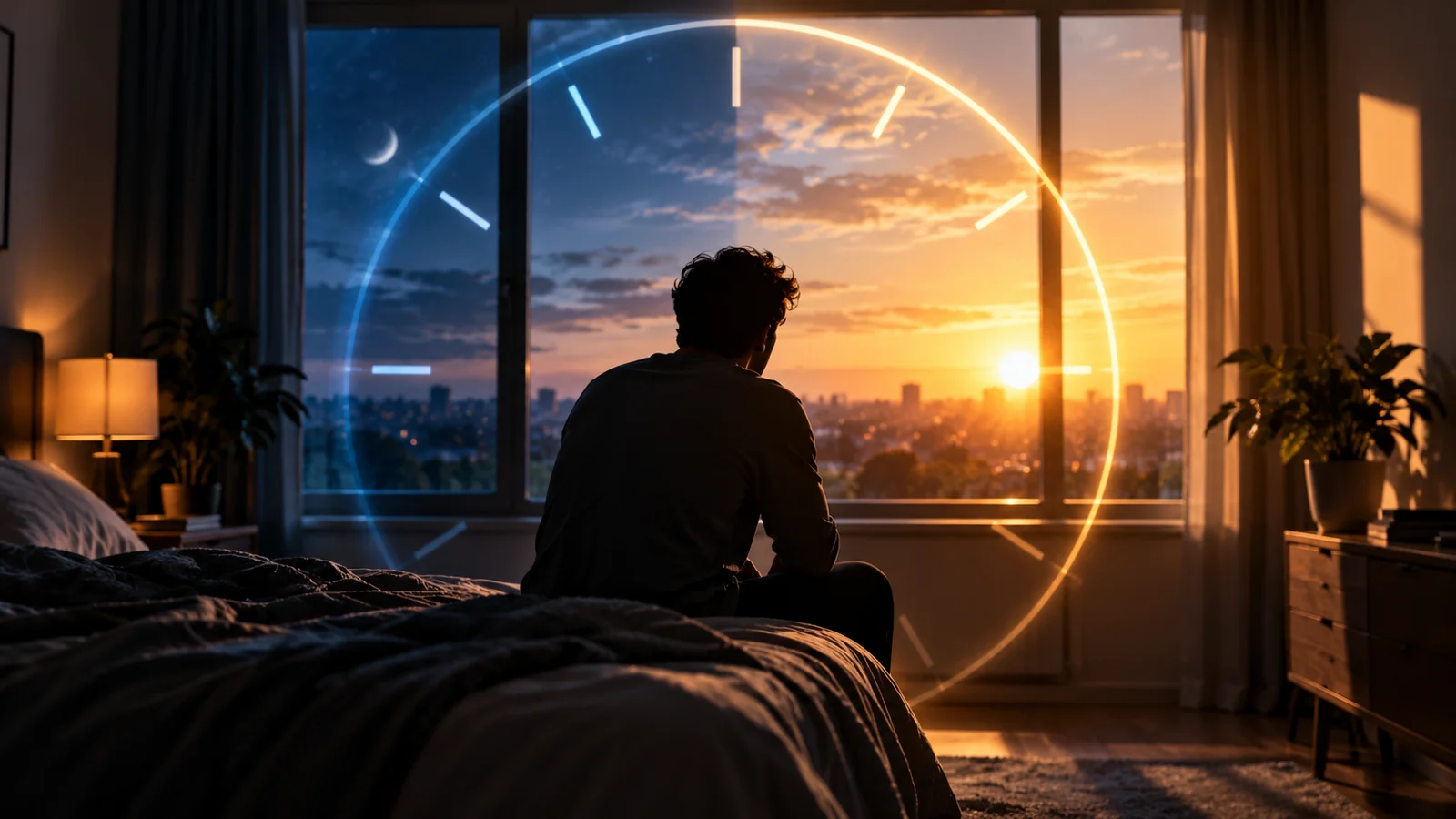
Bottom line: A study published on 21 October 2026 suggests that a cluster of late sleep timing, social jet lag, seasonal changes and unrefreshing sleep may identify a group of people with depression who have different clinical and genetic patterns. It does not establish that a disrupted clock causes depression, that one in four people everywhere have a new disease, or that anyone should stop prescribed medication. The proposed label, circadian depression, is not yet an established standalone diagnosis.
The research offers a promising way to ask better questions about sleep and mood. Its most useful lesson is not a miracle treatment: clinicians may need to assess when people sleep, not only how long they sleep. Below, we examine the study, its criticisms, and practical next steps without mistaking a research classification for a self-diagnosis.
What happened in October 2026?
Researchers from the University of Sydney and collaborators analysed data from the Australian Genetics of Depression Study. Their paper, “Clinical and genetic correlates of a circadian subtype of depression in the Australian Genetics of Depression Study,” appeared in The British Journal of Psychiatry in October 2026 (DOI: 10.1192/bjp.2026.10798). The university announced the findings on 21 October.
Among 11,380 participants with histories of mostly severe, recurrent or persistent depression, 2,604 met the researchers’ proposed definition. That is about 22.9%, conventionally rounded to 23%. This proportion applies to the selected study sample; it is not a measured prevalence for everyone with depression, and certainly not for the entire population.
The team reported that this subgroup tended to experience depression at younger ages, more severe symptoms and differences in genetic risk profiles. They also reported less favourable experiences with some conventional antidepressants. These associations are potentially important, but they need replication and prospective treatment trials.
The six features researchers used
The study defined a candidate circadian profile by the presence of at least three of six features. Importantly, the threshold is a research rule, not a validated home screening tool. Several features can occur for reasons unrelated to a disrupted biological clock.
| Study feature | Plain-English meaning | Important alternative explanation |
|---|---|---|
| Seasonal pattern | Mood symptoms vary with seasons | Seasonal depression or other seasonal stressors |
| Delayed sleep timing | Habitual sleep onset is late | Work demands, caregiving or screen use |
| Longer sleep during depression | More sleep than usual in episodes | Medication effects or another sleep disorder |
| Evening preference | Feeling naturally more alert at night | Normal chronotype variation |
| Unrefreshing mornings | Waking up tired despite time in bed | Sleep apnoea, insomnia or medical illness |
| Social jet lag | Different sleep schedules on workdays and days off | Shift work or social obligations |
A person who likes staying up late and sleeps in on weekends does not automatically have depression, and a person with depression and three features has not necessarily been shown to have an abnormal circadian pacemaker. Researchers and clinicians need objective measures and broader assessment to establish what the cluster represents.
How the body clock could affect mood
The circadian system helps coordinate the timing of sleep and wakefulness, melatonin release, body temperature, alertness, appetite and many other functions across roughly 24 hours. Light entering the eyes helps synchronise the central clock in the brain with the day-night cycle. The clock interacts with, but is distinct from, the homeostatic pressure to sleep that builds while we are awake.
A mismatch between biological timing and daily obligations can make it harder to sleep when desired, increase fatigue and disrupt regular activity. These difficulties may aggravate emotional functioning. Depression can also alter sleep and activity patterns, creating feedback loops. The direction of cause and effect is difficult to separate in a study that measures participants at a particular point in time.
Three explanations that can coexist
- Clock disruption contributes to symptoms: delayed or unstable timing may worsen mood in susceptible individuals.
- Depression changes the clock: low motivation, fatigue, reduced daylight exposure and medication effects may shift sleep timing.
- A third factor influences both: work schedules, chronic illness, anxiety, ADHD, genetics or environmental stress may affect sleep and mood simultaneously.
Because all three are plausible, headlines saying “body clock disruption causes one in four cases of depression” overstate what this particular analysis proves.
What the genetics add—and what they do not
The researchers reported group-level associations with genetic scores linked to eveningness, ADHD, mood conditions and some metabolic or inflammatory traits. Such scores reflect patterns across many variants and generally explain only part of a complex outcome. They are not a genetic diagnosis for an individual reader.
There is also a methodological issue: if researchers define a group partly by late sleep timing and evening preference, finding more genetic variants associated with late sleep timing is not fully independent confirmation that a new disorder exists. Independent replication, objective circadian measurements and evidence of different treatment responses would provide stronger tests.
Is “circadian depression” officially recognised?
No. As of October 2026, circadian depression in this paper is a proposed clinical and biological profile, not a separately established diagnosis that people can confirm using an online checklist. Depression itself is diagnosed through a professional assessment of symptoms, duration, impairment and other possible explanations.
The distinction matters: a descriptive cluster can be useful for research even before it becomes a validated diagnosis. The responsible next step is to investigate whether the cluster reliably predicts outcomes across different populations and whether tailoring treatment improves recovery.
How the study differs from insomnia and seasonal depression
| Term | Main idea | Why it is not interchangeable |
|---|---|---|
| Insomnia disorder | Difficulty initiating or maintaining sleep with daytime consequences | Can occur with many sleep schedules and without depression |
| Delayed sleep-wake phase disorder | Persistent internal sleep timing later than required | Requires specific clinical criteria and is not the same as evening preference |
| Seasonal affective disorder | Recurrent mood episodes with a seasonal pattern | Only one of the study’s six proposed features |
| Circadian depression (proposed) | Depression plus a cluster of timing and sleep-related features | Exploratory research category, not yet independently validated |
Sleep apnoea, restless legs, medication effects, thyroid disorders and bipolar-spectrum symptoms may also require assessment. For example, markedly reduced need for sleep together with unusual energy, impulsivity or elevated mood needs a different clinical evaluation from ordinary difficulty falling asleep.
Does the study show that antidepressants do not work?
No. Researchers found differences in reported response and side effects in the proposed subgroup, but the study was not a randomised clinical trial assigning treatments according to circadian status. Observational treatment histories are vulnerable to confounding by illness severity, past treatment choices, other diagnoses and recall.
SSRIs and SNRIs remain established treatment options for depression when prescribed appropriately. The study does not show that people with late sleep timing should stop them or replace them with melatonin. Stopping antidepressants abruptly can cause withdrawal symptoms and relapse; discuss any change with the prescribing clinician.
What about light therapy, melatonin and chronotherapy?
Light timing and structured sleep schedules are biologically plausible approaches and have clinical uses in selected circadian and mood disorders. But a plausible mechanism is not proof that they treat the exact subgroup defined in this paper. A dedicated randomised trial would need to compare outcomes in patients identified using a validated definition.
| Approach | Potential role | Safety and evidence caveat |
|---|---|---|
| Consistent wake time | Helps stabilise daily sleep timing | A supportive routine, not a substitute for depression care |
| Daytime outdoor light | Supports daytime alertness and clock alignment | Individual timing matters, especially with circadian disorders |
| Bright-light therapy devices | Used clinically for selected mood and circadian conditions | Seek guidance with bipolar risk, eye disease or photosensitising drugs |
| Melatonin | Can shift sleep timing in selected circumstances | Dose and timing matter; not proven by this study to treat the proposed subtype |
| Sleep diary | Helps identify patterns over one to two weeks | Useful discussion aid, not a diagnostic test |
Bright light can trigger agitation or mania in some people with bipolar disorder; melatonin can interact with medications and may not be appropriate for everyone. Neither should be presented as a universally safe self-treatment for depression.
A practical, low-risk way to observe your own sleep pattern
For someone concerned about sleep and mood, the most actionable response is to collect clear observations and seek an assessment when needed. This is not a six-point self-diagnosis; it is a way to make a medical appointment more informative.
A seven-day sleep-and-mood log
- Record bedtime, approximate time you fell asleep, night awakenings and final wake time each day.
- Record workday versus free-day schedules, including whether you slept in substantially on days off.
- Note outdoor daylight exposure, caffeine late in the day, alcohol, shift work and major schedule changes.
- Track mood, energy and daytime functioning in simple terms without attempting to assign a psychiatric diagnosis.
- List medications and supplements and note any recent changes; do not change them solely to improve the diary.
A diary may reveal an unstable schedule, but it cannot establish whether the clock is biologically shifted. Wearables can estimate rest and activity but are not definitive measures of circadian phase or depression.
A simple example of social jet lag
Suppose someone sleeps from 11:30 p.m. to 7:30 a.m. on workdays, but from 2:30 a.m. to 10:30 a.m. on free days. Both periods provide eight hours in bed. Yet the midpoint of sleep moves from 3:30 a.m. to 6:30 a.m.—a three-hour shift. This illustrates a timing mismatch, not a diagnosis or evidence that the shift caused depression.
When feasible, a consistent wake time and a gradual adjustment of daily routines may reduce this mismatch. People with shift-work duties, caregiving obligations or chronic conditions may need a tailored approach rather than an unrealistic perfect schedule.
When to seek help—and when it is urgent
Seek professional assessment if low mood, loss of interest, impaired functioning or sleep problems persist, recur or worsen. Mention any family history of bipolar disorder, episodes of unusually high energy with little sleep, and any medication side effects. A clinician may also screen for sleep disorders and medical conditions that can mimic or worsen depressive symptoms.
Urgent safety note: If you or someone else may act on suicidal thoughts or cannot stay safe, contact local emergency services or a crisis service immediately. In the US, call or text 988; in the UK and Ireland, Samaritans can be reached on 116 123. Readers elsewhere should use their local emergency or crisis services.
What independent scientists criticised
The UK Science Media Centre published reactions from independent researchers. Critics noted that several features overlap with already recognised atypical depression presentations, that the proposed threshold needs stronger justification, and that the analysis has not been replicated in an independent sample.
Other concerns include self-reported symptoms, cross-sectional analysis and limited generalisability. The study participants were of genetically inferred European ancestry and many were women; findings may differ in more diverse populations and among people with less severe depression. Independent experts also questioned whether the study truly measured circadian biology or mostly captured reported sleep preferences and symptoms.
Five questions future research must answer
- Can independent researchers reproduce the 23% subgroup in a different, more diverse cohort?
- Do objective measures of circadian timing confirm that this group has a distinct clock disturbance?
- Does the proposed category predict treatment response after accounting for depression severity and other diagnoses?
- Do randomised trials show that clock-targeted treatment improves outcomes more than usual care for this subgroup?
- Is the profile sufficiently distinct from atypical depression and recognised circadian sleep disorders to change clinical guidelines?
The takeaway
The October 2026 study is a valuable step toward understanding why depression and treatment response vary between people. Its sample size and combined clinical-genetic approach are strengths. Yet its 23% figure is a study-specific classification, not a global prevalence estimate, and neither a causal mechanism nor a new treatment pathway has been proven.
The practical lesson is modest but useful: sleep timing, daylight exposure and day-to-day schedule deserve attention alongside other dimensions of mental health. Keep prescribed treatment decisions with qualified clinicians, and treat “circadian depression” as a research hypothesis worth following—not a diagnosis to assign yourself.
Original study and further reading
- Tonini et al., The British Journal of Psychiatry (2026), original study.
- University of Sydney, 21 October 2026, institutional announcement.
- Science Media Centre, independent expert reactions, 21 October 2026.
- Nature, analysis of the new research and its limitations, 20 October 2026.
- US National Institute of Mental Health: depression overview and care.
You may also like
 Artificial Intelligence
Why Do We Deny AI Consciousness Even When It Behaves Like a Human? What a 2026 Study Reveals
A study of 1,092 UK participants found that people rate human agents as more conscious than AI even…
 HEALTH
Can Scientists Kill Harmful Gut Bacteria Without Harming Good Bacteria?
A 2026 study found argyrin B could target C. difficile in mice while preserving much of the gut…
 HEALTH
Does Fish Oil Improve Memory? What a Two-Year DHA Trial Actually Found
A two-year DHA trial raised omega-3 levels near the brain without improving memory. What the results mean for…