
Rhabdomyolysis After Exercise: Warning Signs and What to Do
Rhabdomyolysis can follow intense exercise. Learn the warning signs, how it differs from normal muscle soreness, what CK testing shows, and when to seek urgent care.
Contents
- When is muscle pain after a workout an emergency?
- What does rhabdomyolysis actually do to the body?
- What can trigger exertional rhabdomyolysis?
- How is it diagnosed? What to ask about at urgent care
- What should you do if you suspect rhabdo?
- How to lower the risk during running or gym training
- Quick answers
- Can you have rhabdo without dark urine?
- Can one intense workout cause rhabdomyolysis?
- Will drinking extra water cure it?
- Sources and image information
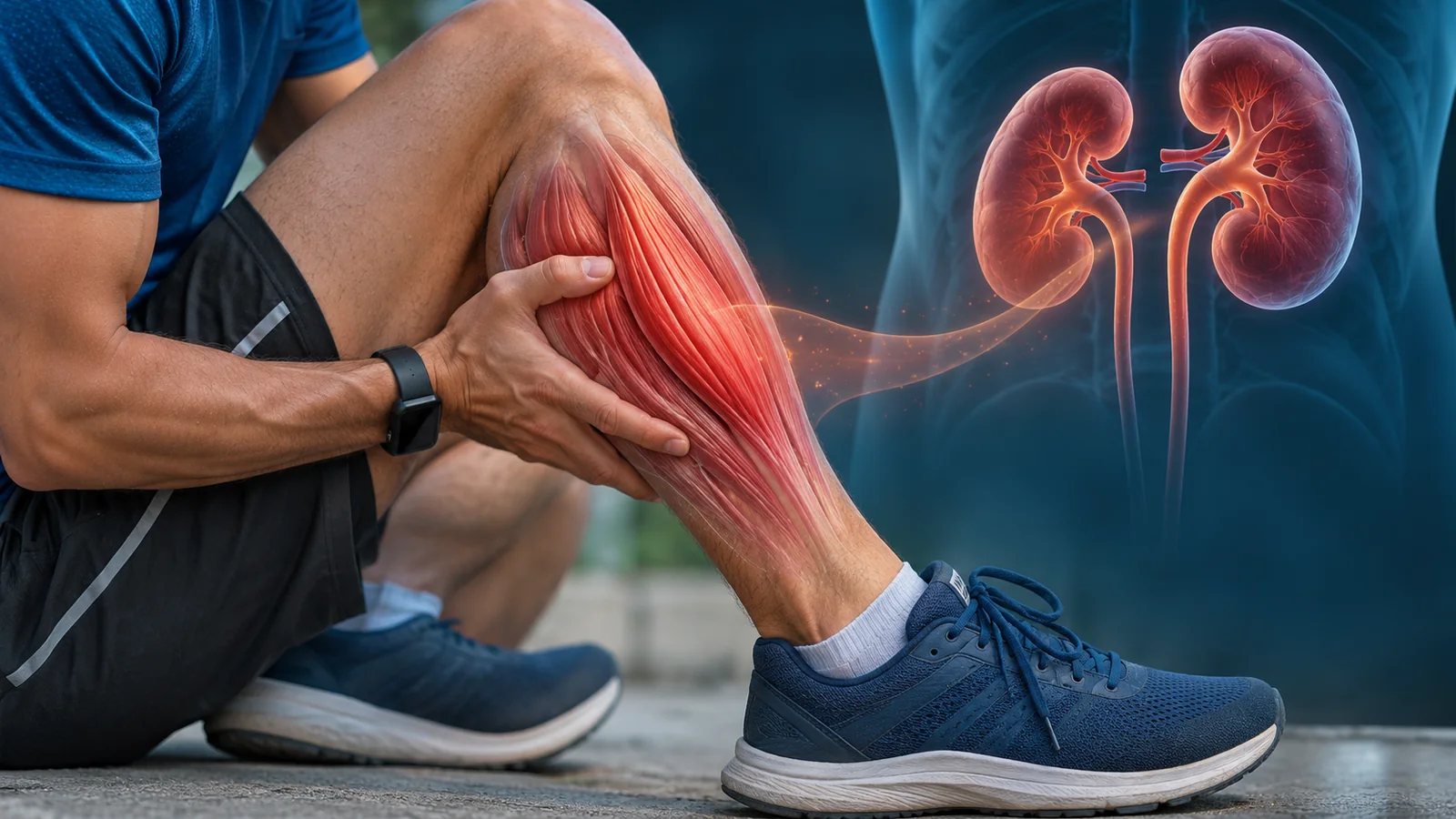
Rhabdomyolysis (“rhabdo”) is a potentially dangerous breakdown of skeletal muscle that can happen after unusually intense exercise, heat exposure, or injury. Damaged muscle releases substances into the bloodstream that may harm the kidneys and disturb the body’s electrolytes. Warning signs include unexpectedly severe muscle pain, weakness or swelling, and tea- or cola-colored urine. If rhabdo is suspected, stop exercising and seek medical assessment promptly—not another workout or a wait-and-see test at home. CDC guidance.
You do not need to have all three classic symptoms: a normal-looking urine color does not rule the condition out. The most useful confirmation is a blood test for creatine kinase (CK), interpreted by a clinician, often with repeat testing. Merck Manual, reviewed February 2026.
When is muscle pain after a workout an emergency?
Seek urgent medical care after strenuous activity if you notice severe or worsening muscle pain, marked swelling, unusual weakness, dark urine, or much less urine than normal. If there is collapse, confusion, or severe rapidly increasing swelling/pain, call your local emergency number. Symptoms can begin hours or even days after the activity, so feeling fine immediately after a workout does not settle the question.
| Feature | Usual delayed-onset muscle soreness (DOMS) | Possible rhabdomyolysis warning sign |
|---|---|---|
| Pain | Tenderness or stiffness after an unfamiliar workout; usually gradually improves | Pain much worse than expected, worsening pain, or pain with significant swelling |
| Strength | Movement can feel sore but daily tasks remain possible | Pronounced weakness or difficulty performing ordinary tasks |
| Urine | No characteristic urine-color change | Brown/tea-colored urine or reduced output; normal color does not exclude rhabdo |
| What to do | Rest, reduce training load, and monitor typical improvement | Stop exercise and get prompt professional assessment and blood tests |
Normal post-exercise soreness often starts 12–24 hours after unfamiliar exercise and is most noticeable at 24–72 hours, according to the American College of Sports Medicine. Rhabdo symptoms may overlap this window. Use the comparison as a reason to seek care for red flags, not to diagnose yourself.
What does rhabdomyolysis actually do to the body?
Muscle cells normally keep their proteins and electrolytes inside. When enough cells are damaged, substances including myoglobin and potassium can enter the blood. Myoglobin can injure the kidneys; abnormal potassium levels can affect the heart rhythm. Serious cases may also involve dangerous pressure inside a swollen muscle compartment. This is why the concern goes beyond sore legs. CDC explanation.
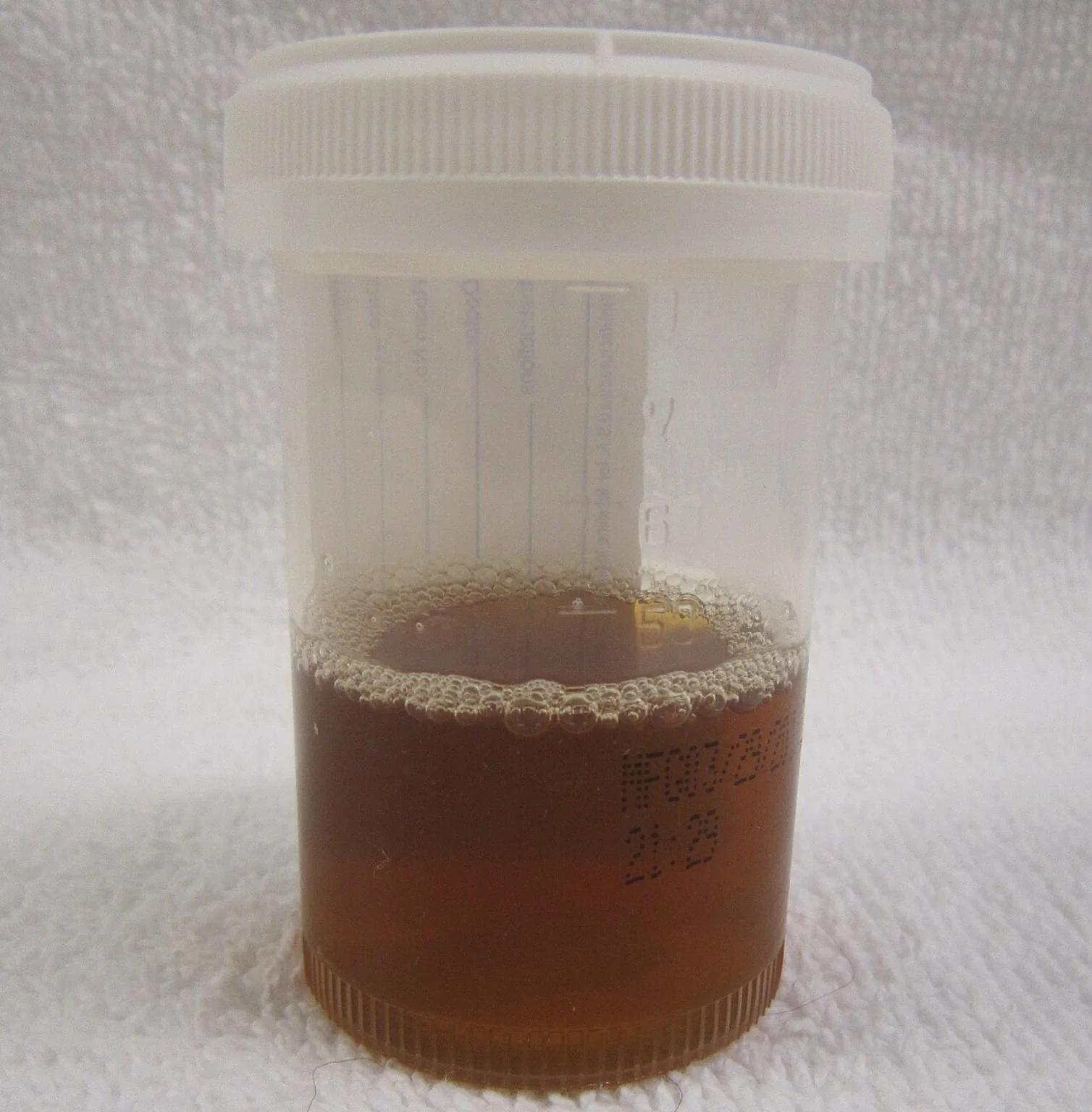
The clinical photograph below shows one possible brown appearance of urine in a documented rhabdomyolysis case. This is not a urine-color test or a way to diagnose yourself. Dark urine has several possible causes, and many patients with rhabdomyolysis do not notice dark urine. Photograph: James Heilman, MD / Wikimedia Commons; CC BY-SA 3.0. The supplied JPG has been converted to WebP for this article; the photographer does not endorse the content.
What can trigger exertional rhabdomyolysis?
- Doing too much too soon: an abrupt jump in running distance, high-repetition strength training, an intense spin class, or repeated drills beyond your current conditioning.
- Heat and prolonged exertion: especially physically demanding activity in hot conditions without adequate rest or acclimatization.
- Other contributors: muscle trauma, certain infections or seizures, and some medicines or underlying muscle disorders. Some risk factors can overlap.
Being young, athletic, or previously comfortable with hard training does not make a person immune. The U.S. Department of Defense’s May 2026 surveillance report notes risk with unfamiliar high-intensity effort and heat stress, including among trained service members. Do not stop prescribed medicines, including statins, on your own; discuss suspected side effects with the treating clinician.
How is it diagnosed? What to ask about at urgent care
Tell the clinician what exercise or injury occurred, when it happened, whether symptoms are worsening, and whether your urine output has changed. A clinician may order:
- Blood CK (creatine kinase): the central test for muscle damage. Levels may rise later, so repeat blood tests can be necessary to see the trend.
- Kidney-function tests: including creatinine, to check whether kidney injury is developing.
- Electrolytes: especially potassium, because significant abnormalities can be dangerous.
- Urine testing: useful for assessing other possibilities, but a urine dipstick or negative urine myoglobin result cannot reliably rule out rhabdo.
A CK value of around five times the laboratory upper limit of normal is commonly used in clinical definitions, but interpretation depends on symptoms, timing, and context. No single CK number tells you at home whether your kidneys are safe. Read the CDC testing guidance and the Merck clinical overview.
What should you do if you suspect rhabdo?
- 1. Stop the activity immediately. Do not push through the pain or attempt another workout to “loosen up.”
- 2. Move somewhere cool and rest. If fully alert and able to swallow, take ordinary sips of water while arranging medical care; do not force large quantities of water or delay evaluation.
- 3. Get assessed promptly. Tell the team you are concerned about exertional rhabdomyolysis and ask whether CK, kidney function, and electrolytes need checking.
- 4. Follow the results and return-to-exercise plan. Hospital treatment may include IV fluids, monitoring, and treatment of complications; some lower-risk patients may be managed outside hospital under clinician supervision.
Drinking water is not a substitute for testing or treatment. Decisions about fluids, hospital admission, and safe return to exercise depend on the clinical evaluation. CDC treatment guidance.
How to lower the risk during running or gym training
- Increase workload over time rather than suddenly doubling distance, reps, or workout intensity.
- Build in recovery after unfamiliar or very strenuous exercise; rest when symptoms are unusual.
- In hot conditions, take breaks, cool down, stay reasonably hydrated, and allow time to acclimatize.
- If you are ill, recovering from injury, or concerned about medication effects, discuss intense exercise with your healthcare provider.
These steps reduce risk but cannot guarantee prevention. The CDC advises gradual conditioning, hydration, and measures to avoid overheating. See the prevention guidance.
Quick answers
Can you have rhabdo without dark urine?
Yes. The classic combination of pain, weakness, and dark urine appears in fewer than 10% of cases according to the Merck Manual. Normal urine color should not reassure someone with severe pain, swelling, or weakness.
Can one intense workout cause rhabdomyolysis?
Yes. A single unaccustomed high-intensity session can trigger it, although most exercise-related soreness is not rhabdo. Risk is affected by the workload and other conditions; symptoms require medical assessment, not a guess.
Will drinking extra water cure it?
No. Appropriate hydration may be part of treatment, but suspected rhabdo needs assessment for kidney and electrolyte complications. Severe cases may require carefully monitored IV fluids in hospital.
Sources and image information
- CDC/NIOSH: Signs and Symptoms of Rhabdomyolysis (updated October 28, 2026).
- CDC/NIOSH: Treatment of Rhabdomyolysis and prevention guidance.
- Merck Manual Professional: Rhabdomyolysis (reviewed February 2026).
- Health.mil: Exertional rhabdomyolysis surveillance, 2021–2025 (May 2026).
- American College of Sports Medicine: Delayed-Onset Muscle Soreness.
- Real urine-sample photograph: James Heilman, MD, CC BY-SA 3.0. Included as an inline clinical photo; JPG converted to WebP. License: CC BY-SA 3.0.
Image note: Featured image is a newly created conceptual medical illustration showing the relationship between muscle injury and kidney risk; it is not a clinical photograph or a diagnostic image. This article is general health information, not a personal diagnosis. Medical sources checked November 4, 2026.
You may also like
 Health & Wellness
Can Jehovah’s Witnesses Accept Blood Transfusions?
Can Jehovah’s Witnesses accept blood transfusions? Understand current choices on blood components, whole-blood restrictions and patient consent.
 Health & Wellness
Ferritin Face: Can Low Iron Cause Dark Circles, Pale Skin or Hair Loss? The Evidence and Blood Tests Explained
What is ferritin face? Learn what low iron can and cannot change, why dark circles are unreliable, how…
 Health & Wellness
Why Does Your Nose Get Blocked When You Lie Down? Causes and Safe Fixes
Learn why your nose becomes blocked at bedtime, how to distinguish allergies from sinus and structural causes, and…