
Ferritin Face: Can Low Iron Cause Dark Circles, Pale Skin or Hair Loss? The Evidence and Blood Tests Explained
What is ferritin face? Learn what low iron can and cannot change, why dark circles are unreliable, how to read ferritin and haemoglobin tests, and when to seek help.
Contents
- What does “ferritin face” mean — and is it a real diagnosis?
- The physiology: iron stores can fall before you become anaemic
- Which “ferritin face” signs are credible? An evidence-by-sign assessment
- Pallor: an authentic symptom, not a selfie test
- Dark circles: the weakest link in the viral claim
- Hair shedding: relevant, but the research is more nuanced
- Brittle or spoon-shaped nails: a real photograph, with limits
- What a ferritin blood test really measures
- Important 2026 update: the American Society of Hematology raised diagnostic ferritin thresholds
- Ferritin 12, 25, 45 or 80: how to read numbers without treating them as verdicts
- Can you have a “normal” CBC and still need a ferritin discussion?
- Who should ask about iron testing — and who needs a different work-up?
- Practical UK pathway: what to do if you suspect low iron
- When to seek prompt or emergency medical help
- If iron deficiency is confirmed: treatment without social-media shortcuts
- Why iron tablets are not a cosmetic supplement
- Absorption, food timing and common mistakes
- How soon can you expect improvements?
- Food first, but food is not always enough to correct anaemia
- Myth check: six shortcuts that can mislead you
- Real-world examples: four different people, four different decisions
- Example A: a tired adult with heavy periods and a low ferritin result
- Example B: dark circles without other symptoms
- Example C: anaemia and ferritin that looks normal during inflammation
- Example D: a postmenopausal adult with new iron-deficiency anaemia
- Questions worth taking to a GP or healthcare professional
- What the best existing coverage misses — and the practical take-away
- Original clinical references and image-credit links

Evidence checked against NHS, British Society of Gastroenterology, American Society of Hematology 2026, WHO and NIH reference material; last verified 27 October 2026. This article is educational, not a diagnosis or personalised treatment plan. The term “ferritin face” is a social-media label, not a medical condition.
Short answer: Low iron can sometimes contribute to paler skin, unusual tiredness, brittle nails and hair shedding, particularly when iron-deficiency anaemia develops. But dark circles, a dull complexion and before-and-after selfies cannot diagnose low ferritin. You can be iron deficient with a normal haemoglobin result, and a normal or high ferritin reading may require additional interpretation if inflammation is present. The reliable next step, when your symptoms or risk factors warrant it, is a clinician-assessed blood test—not an iron supplement bought for cosmetic reasons. See the NHS symptoms guide and British Society of Gastroenterology guidelines.
The viral phrase has travelled through UK and US beauty and wellness feeds, drawing attention from major media including The Guardian and a research-based explainer in The Conversation. That attention creates a real public-health question: which visible changes have a physiological explanation, which are nonspecific, and what can the tests actually tell us? This guide turns the claims into a practical evidence checklist rather than a beauty diagnosis.
What does “ferritin face” mean — and is it a real diagnosis?
Ferritin is a protein that stores iron. A serum ferritin blood test helps estimate the iron available in your reserves. The internet term “ferritin face” typically groups together tired-looking skin, under-eye darkness, pallor, thinning hair, cracked mouth corners and brittle nails. It has no standard clinical definition, validated visual score, accepted photographic test or proven before-and-after appearance threshold.
There is a meaningful distinction between a genuine health condition (iron deficiency, potentially progressing to iron-deficiency anaemia) and a marketing-friendly appearance label. It is possible to have one without recognisable facial changes, and possible to have those changes without iron deficiency. Different cameras, skincare, pigmentation, lighting, sleep and body weight can all make comparison photos look convincing while telling us almost nothing about ferritin.
The question to ask is not “Do I look like the viral video?” but “Do I have symptoms, health history or blood-loss risks that make testing reasonable?”
The physiology: iron stores can fall before you become anaemic
Think of ferritin as stored supplies and haemoglobin as a working delivery system. Haemoglobin in red blood cells carries oxygen; iron is one ingredient needed to make it. Early in deficiency, the body can draw on reserves to keep haemoglobin in range. If deficiency progresses, the body may make less haemoglobin and eventually smaller, paler red blood cells. This is an illustrative clinical sequence, not a universal timeline: different illnesses and blood losses alter the pattern. NIH Office of Dietary Supplements; BSG guidelines.
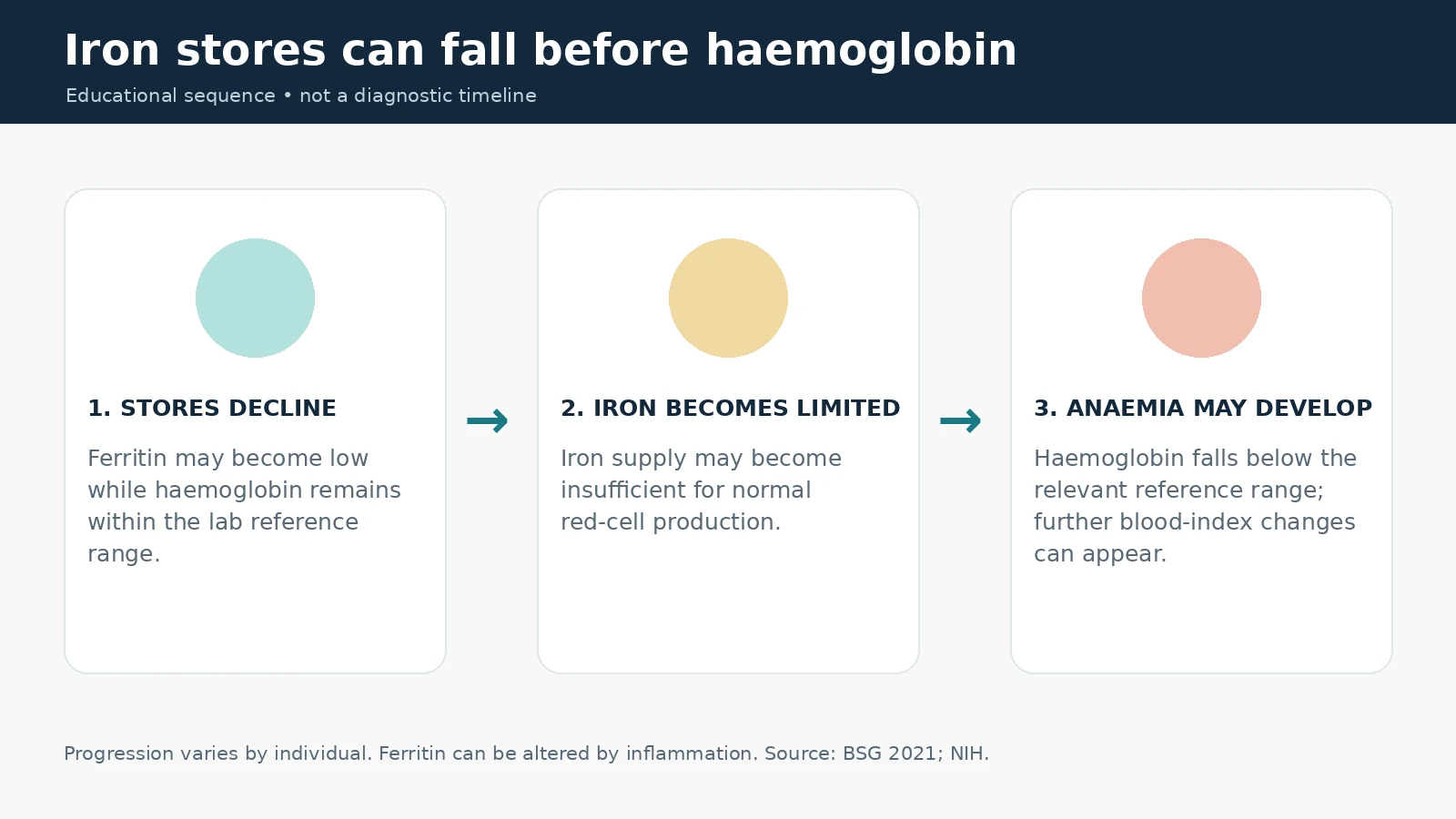
| Stage / pattern | Typical laboratory picture | What it does and does not establish |
|---|---|---|
| Iron stores depleted | Ferritin may be low; haemoglobin can still be normal | Iron deficiency without anaemia is possible. Symptoms vary. |
| Iron-deficiency anaemia | Ferritin often low, haemoglobin low for the reference population; MCV may fall | Requires diagnosis and a search for why iron was lost or not absorbed. |
| Inflammation complicates results | Ferritin may look normal or elevated despite inadequate available iron | Clinician may consider CRP, transferrin saturation and overall illness context. |
| Other cause of anaemia | Haemoglobin low but ferritin not necessarily low | Not every anaemia is iron deficiency; treatment depends on cause. |
This is one of the biggest omissions in many viral discussions: normal haemoglobin does not by itself rule out low iron stores. Conversely, an unexplained low haemoglobin result should not be self-treated on the assumption that iron is the cause. BSG clinical guideline.
Which “ferritin face” signs are credible? An evidence-by-sign assessment
| Claim in videos | What evidence actually supports | Key alternative explanations |
|---|---|---|
| Pale or unusually washed-out skin | Recognised possible sign of iron-deficiency anaemia, but visual assessment is imprecise | Natural skin tone, lighting, other anaemias, circulation, illness |
| Dark under-eye circles | No validated appearance-to-ferritin relationship | Genetics, allergies, pigmentation, anatomy, sleep, skin conditions |
| Diffuse hair shedding | Iron deficiency is one recognised possible contributor; association does not establish cause in every individual | Thyroid disease, illness, postpartum changes, stress, hereditary hair loss |
| Brittle or spoon-shaped nails | Spoon nails can appear in prolonged iron deficiency, but are uncommon and nonspecific | Trauma, nail disorders, exposure, other conditions |
| Cracked mouth corners or sore tongue | Can occur with nutritional deficiencies including iron deficiency | Irritation, infection, other deficiencies and skin conditions |
| A face that “looks older” | No clinically validated low-ferritin facial-age measurement | Expression, dehydration, sun exposure, photo settings, cosmetic differences |
Pallor: an authentic symptom, not a selfie test
A person with significant anaemia may appear paler than usual because less haemoglobin contributes colour to circulating blood. The NHS recognises paler-than-usual skin as a possible symptom. However, perceived pallor can be very subtle on darker skin and strongly affected by ambient light. Clinicians interpret signs together with symptoms and blood tests, not from social-media filters. A photograph of hand pallor by James Heilman, MD, exists under a Creative Commons licence at Wikimedia Commons (CC BY-SA 3.0); it shows a clinical example, not a tool to diagnose yourself.
Dark circles: the weakest link in the viral claim
Under-eye darkness can come from visible vessels, structural shadows, melanin, allergic inflammation, fatigue or natural facial anatomy. None is a specific marker of low ferritin. If your only concern is dark circles but you otherwise feel well, that is very different from persistent fatigue plus heavy periods and unexplained exercise intolerance. Do not treat a cosmetic observation as a laboratory finding. The The Conversation explainer makes this distinction central to its assessment.
Hair shedding: relevant, but the research is more nuanced
The NHS hair-loss guide lists iron deficiency among possible causes of temporary shedding. A 2022 systematic review found lower average ferritin levels in women with nonscarring hair loss than controls, but observational differences cannot prove that every shedding episode is caused by ferritin or that treating someone with normal stores will regrow hair. A 2026 systematic review of telogen effluvium likewise reported an association but noted heterogeneity. Clinicians investigate the pattern and duration of loss, recent illness, medication changes, thyroid issues and menstrual history alongside iron status.
Beware the “optimal ferritin for hair” numbers repeated online as universal targets. Published papers and clinics use different cut-offs and goals. There is no established ferritin number that guarantees thicker hair or reverses hereditary hair loss. Ask whether the test shows genuine deficiency and whether other causes remain plausible.
Brittle or spoon-shaped nails: a real photograph, with limits
Spoon-shaped nails (koilonychia) are a recognised possible finding in prolonged iron deficiency but are not common enough to screen the general population. A genuine clinical photograph is available by CHeitz at Wikimedia Commons (CC BY 2.0). The nail shape illustrates a sign physicians may evaluate, not proof of a specific ferritin concentration. Nail deformities warrant clinical assessment, especially when new or progressive.
For readers who want a genuine microscopic reference rather than simulated “low-iron skin”: Dr Graham Beards’ Giemsa-stained blood film of iron-deficiency anaemia (CC BY-SA 3.0) shows altered red blood cell morphology. Such changes occur in some established anaemia cases, not in everyone with mildly low ferritin.
What a ferritin blood test really measures
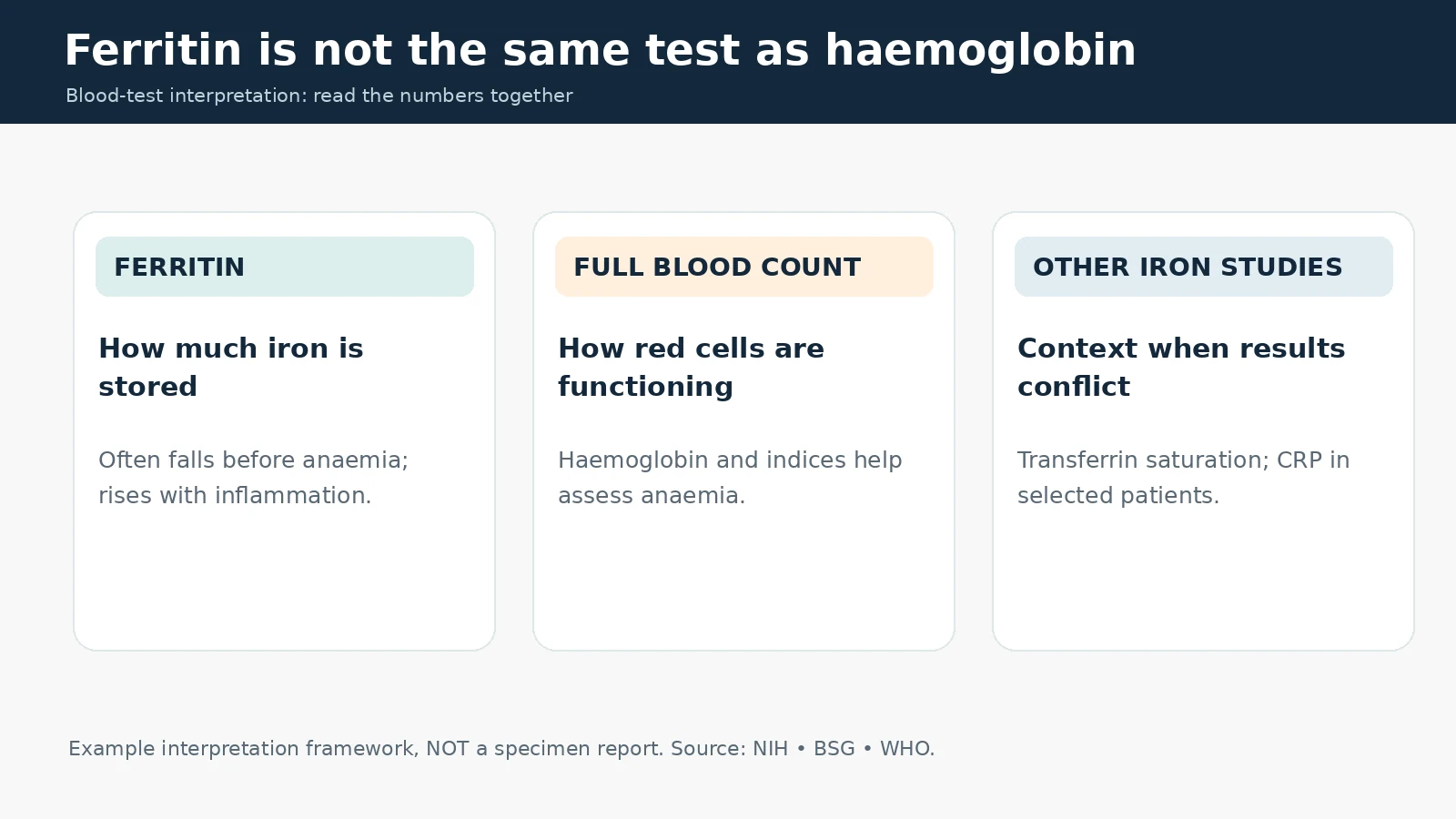
Ferritin is normally measured in a blood sample, and may be requested together with a full blood count (FBC, called CBC in the US). The FBC records haemoglobin, red blood cells and indices such as mean corpuscular volume (MCV). A clinician may add transferrin saturation (TSAT), iron-binding measurements and an inflammation marker such as C-reactive protein (CRP) when appropriate. Serum iron on its own varies and is not equivalent to iron stores. NIH professional fact sheet; BSG guidance.
Important 2026 update: the American Society of Hematology raised diagnostic ferritin thresholds
There is a major new development often missing from older iron-deficiency explainers. On 16 September 2026, the American Society of Hematology (ASH) released evidence-based diagnostic guidelines, providing higher ferritin decision thresholds for different clinical groups. These are diagnostic decision limits, not targets for brighter skin or hair growth. The guidance is intended for clinicians and must be used with symptoms and medical context. See the ASH official announcement and full guideline in Blood Advances.
| Population or clinical context | ASH 2026 suggested diagnostic criterion | Important interpretation caution |
|---|---|---|
| Adults, including menstruating or pregnant individuals | Ferritin ≤30 ng/mL (equivalent to µg/L) | This is a diagnostic threshold, not a universal treatment goal. |
| Certain higher-risk groups (for example heavy menstrual bleeding; pregnancy with anaemia) | Ferritin ≤50 ng/mL | Risk status and medical history determine applicability. |
| Adults with inflammation (for example inflammatory bowel disease, cancer, infection) | Ferritin <100 ng/mL OR transferrin saturation <20% | Inflammation can raise ferritin; clinician assessment is essential. |
| Young children aged 9 months to 4 years | Ferritin ≤20 ng/mL | Children require age-specific professional evaluation, never self-treatment. |
Why does this matter in the UK? UK practice may still cite the 2021 BSG markers—less than 15 µg/L for absent stores and less than 30 µg/L for low stores—while US-led ASH 2026 recommendations explicitly support ≤30 ng/mL in adults and higher limits in defined at-risk groups. These do not imply that every individual with ferritin 31–99 is iron deficient. The right cut-off depends on the scenario. Even a newer guideline does not turn “ferritin face” into a photographic diagnosis.
Ferritin 12, 25, 45 or 80: how to read numbers without treating them as verdicts
For otherwise healthy adults, the BSG guideline reports serum ferritin below 15 µg/L as strongly indicative of absent iron stores and below 30 µg/L as generally consistent with low iron stores. It also discusses a 45 µg/L cut-off as a possible balance of sensitivity and specificity in certain clinical decisions—not as a universal “beauty threshold”. Levels need interpretation against symptoms, age, sex, pregnancy, inflammatory conditions and your laboratory reference range. Read the original guideline.
| Hypothetical result | Reasonable interpretation to discuss | What NOT to conclude |
|---|---|---|
| Ferritin 12 µg/L, Hb within reference range | Stored iron may be depleted despite no anaemia; discuss cause and management | “Bloodwork is normal, so there cannot be iron deficiency.” |
| Ferritin 25 µg/L, fatigue and heavy periods | Low stores are possible; clinical history and FBC matter | “Everyone with this number will have ferritin face.” |
| Ferritin 45 µg/L, no symptoms or inflammation | Single reading cannot define ideal health or hair-growth target | “I must supplement until ferritin exceeds 100.” |
| Ferritin 80 µg/L, active inflammation and anaemia | Additional markers may be useful because ferritin can rise with inflammation | “Normal ferritin absolutely excludes iron restriction.” |
A ferritin of 80 in a healthy person is not interpreted the same way as 80 during an inflammatory illness. The WHO guideline explains why ferritin is an acute-phase reactant and why inflammation-aware thresholds may differ. Its population guidance is not a self-diagnosis rule: clinicians use additional tests and the individual context.
Can you have a “normal” CBC and still need a ferritin discussion?
Yes. Suppose a laboratory flags haemoglobin and MCV as normal while ferritin is below its low-store threshold. It is possible for iron depletion to precede red-cell changes. The opposite also happens: low MCV may reflect thalassaemia trait or another cause even when iron studies are not deficient. A clinician, not a visual trend, should distinguish these paths and avoid unnecessary iron treatment. BSG clinical guidance.
Who should ask about iron testing — and who needs a different work-up?
Testing is worth discussing when symptoms persist or risks cluster, rather than because a viral image resembles you. Reasons a GP may take seriously include disproportionate fatigue, breathlessness on routine exertion, palpitations, pica (for example craving ice), restless legs, ongoing shedding, heavy menstrual bleeding, pregnancy, restricted dietary intake and prior gastrointestinal problems. These are reasons to consider an assessment, not a one-size-fits-all lab panel.
| Situation | Why it matters | Reasonable next step |
|---|---|---|
| Heavy or prolonged periods | Regular blood loss can deplete iron stores | Discuss menstrual bleeding and assessment with GP or relevant clinician. |
| Pregnancy / recent delivery | Iron needs and blood loss can change substantially | Use maternity-specific advice and tests; do not self-prescribe high-dose iron. |
| Adult man or postmenopausal woman with confirmed iron-deficiency anaemia | A gastrointestinal cause may need excluding even if there is no visible bleeding | Seek timely clinician-led investigation rather than supplements alone. |
| Vegetarian or vegan eating pattern | Plant non-haem iron is absorbed less efficiently | Review varied intake, absorption factors and whether testing is indicated. |
| Long-term stomach/bowel symptoms or medicines | Ulcers, coeliac disease, inflammation or some medicines may affect losses/absorption | Review medical history and medicines with a clinician. |
| Hair loss without fatigue or blood-loss risks | Possible causes are numerous | Ask for appropriate hair/scalp evaluation; do not assume iron deficiency. |
A major safety point: in adult men and postmenopausal women, unexplained confirmed iron-deficiency anaemia commonly triggers consideration of gastrointestinal assessment under BSG recommendations. It would be unsafe to label the finding a beauty problem and move directly to supplements. Heavy periods are common in younger menstruating adults, but unexplained or concerning symptoms still merit investigation.
Practical UK pathway: what to do if you suspect low iron
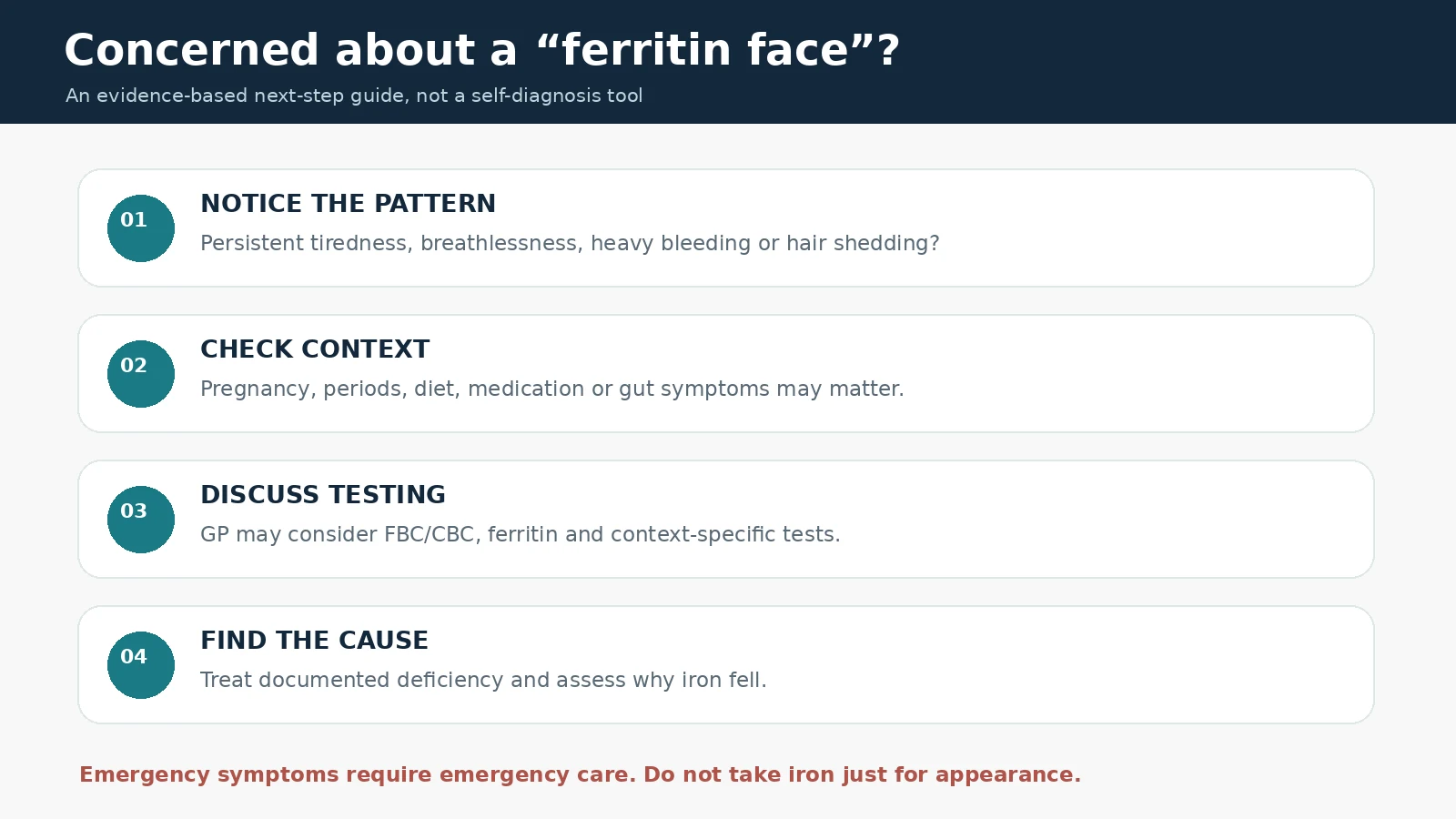
- Write down symptoms and duration. Include exertional breathlessness, fatigue, headaches, palpitations, hair shedding, changes in periods, unusual cravings and any recent illness. Record how symptoms affect daily life.
- List risks and medicines. Note pregnancy, previous iron deficiency, dietary restrictions, blood donation, gastrointestinal symptoms and medicines such as anti-inflammatory painkillers. Do not stop a prescribed medicine yourself.
- Contact your GP if symptoms persist. Ask whether a full blood count and ferritin or further iron studies are appropriate based on your history. You do not need to copy a TikTok diagnostic checklist.
- Review the results in context. Ask whether haemoglobin is low, whether ferritin suggests depleted stores, and whether an inflammation marker or transferrin saturation is needed.
- Identify the cause. Bleeding, dietary intake, absorption and other medical conditions may require very different approaches. Treating a number without understanding why it fell can miss an important diagnosis.
- Agree treatment and follow-up. If prescribed iron, ask how to take it, potential interactions, how side effects will be handled, and when repeat tests are due. Do not create your own iron-dose escalation plan.
For UK readers, the NHS iron-deficiency anaemia page gives a useful starting point. In the US, the NIH consumer iron guide explains diet and supplement considerations; US clinicians use local assessment and laboratory ranges. These guides are not substitutes for a consultation.
When to seek prompt or emergency medical help
Emergency symptoms come first. If you develop severe chest pain, fainting with concerning symptoms, severe breathing difficulty or signs of a medical emergency, seek emergency services immediately (999 in the UK, 911 in the US). Do not attribute acute symptoms to ferritin or wait for a routine blood test.
If you have black or dark-red stools, bloody diarrhoea, unexplained rectal bleeding, persistent worsening weakness, marked breathlessness or palpitations, seek prompt medical advice. NHS rectal-bleeding guidance distinguishes urgent warning patterns. Iron tablets themselves can darken stools, but this does not mean every dark stool is harmless.
Take extra care with children and pregnancy. Never give iron supplements to a child on the basis of a social-media post; accidental iron overdose can be fatal. NHS ferrous sulfate safety guidance.
If iron deficiency is confirmed: treatment without social-media shortcuts
The appropriate plan depends on severity, why the iron is low, other medical conditions, tolerance and clinician judgment. Iron replacement often involves prescribed oral iron; some people need alternative formulations or intravenous treatment. Addressing ongoing blood loss or malabsorption is essential, or low iron may recur. BSG treatment recommendations.
Why iron tablets are not a cosmetic supplement
Unnecessary iron can cause gastrointestinal problems and may be dangerous in excess, particularly to children. Side effects of therapeutic oral iron may include nausea, constipation, diarrhoea and dark stools. The aim is to treat documented deficiency and restore healthy function, not to reach a social-media ferritin score for brighter-looking skin. Do not start high-dose supplementation without professional advice, especially if you have liver disease, known iron overload, recurrent transfusions or take interacting medicines. NHS medicine guide.
Absorption, food timing and common mistakes
NHS guidance for ferrous sulfate notes it is generally better absorbed on an empty stomach, but taking it with food may help if it upsets your stomach. Tea, coffee, dairy products and eggs can reduce absorption around a dose, and some medicines require spacing; check the label and pharmacist rather than improvising. Vitamin C-rich food or drink can support absorption in some settings. NHS ferrous sulfate information.
The popular advice “take as much iron as you can tolerate” is unsafe. Formulations contain different quantities of elemental iron; treatment frequency can also differ. These decisions belong with the clinician and pharmacist, especially for pregnancy, children and people with other conditions.
How soon can you expect improvements?
Feeling less fatigued and rebuilding iron stores are not necessarily simultaneous. The NHS notes some people start feeling better after several weeks of prescribed ferrous sulfate, while treatment for iron-deficiency anaemia often continues for months to replenish stores. Skin and hair may not change, or may improve on a very different schedule because other causes coexist. Your clinician may repeat blood counts and other tests. An absence of “glow” does not prove that iron treatment failed; a prettier selfie does not prove stores have recovered. NHS overview and NHS monitoring guidance.
Food first, but food is not always enough to correct anaemia
A balanced diet can support iron intake, but diet alone may not adequately treat established deficiency caused by sustained bleeding or impaired absorption. Foods include lean meats, seafood, fortified grains, lentils, beans, peas, leafy greens, nuts and dried fruit. Heme iron from animal sources is generally absorbed more efficiently than non-haem iron in plant foods. Vitamin C at a meal can help with plant-iron absorption. See NIH dietary sources and NHS hospital nutrition guidance.
| Everyday food pairing | Why it makes sense | Caution |
|---|---|---|
| Lentil or chickpea salad + peppers or lemon | Plant iron plus vitamin C in the same meal | Not a treatment substitute for confirmed anaemia. |
| Iron-fortified cereal + fruit | Convenient sources that depend on label content | Check the actual iron on the product label. |
| Beans or tofu + tomato-based sauce | Plant sources and vitamin C-rich ingredients | Dietary variety remains important. |
| Fish or meat with vegetables | Heme iron plus other nutrients | Respect preferences and medical dietary restrictions. |
| Tea or coffee away from an iron-rich meal | May reduce an absorption inhibitor at the meal | No need to ban tea or coffee completely. |
One commonly overlooked detail is regional dietary guidance. The NIH lists US recommended intakes such as 8 mg/day for adult men aged 19–50, 18 mg/day for nonpregnant women aged 19–50 and 27 mg/day in pregnancy. UK reference nutrient intakes differ (for example 8.7 mg/day for adult men and 14.8 mg/day for women of reproductive age), so avoid mixing figures from different national systems as though they were one standard. Requirements depend on the individual; these numbers do not replace medical treatment. NIH US tables and UK NHS hospital guidance.
Liver is often cited as an iron-rich food but is not recommended during pregnancy because of its vitamin A content; NHS hospital dietary advice explicitly notes this. People with dietary restrictions, allergies or complex health conditions may benefit from a dietitian.
Myth check: six shortcuts that can mislead you
| Online shortcut | A more accurate conclusion |
|---|---|
| “Dark circles mean ferritin below 30.” | Dark circles alone do not establish an iron concentration. |
| “Normal haemoglobin means my iron is fine.” | Stores can be low before haemoglobin decreases. |
| “A normal ferritin always excludes deficiency.” | Inflammation can increase ferritin; discuss the full picture. |
| “Everyone needs ferritin above 100 for hair.” | No accepted universal cosmetic ferritin target exists. |
| “Iron is harmless because it is a mineral.” | Excess iron and overdose can be dangerous. |
| “You can stop treatment once your face improves.” | Treatment and monitoring depend on clinical and laboratory recovery. |
Real-world examples: four different people, four different decisions
Example A: a tired adult with heavy periods and a low ferritin result
A 28-year-old with months of heavy periods, exertional fatigue and ferritin reported as 12 µg/L may have depleted iron stores even if haemoglobin remains within the laboratory interval. A sensible discussion covers the blood count, iron status, menstrual bleeding and treatment options together. The lack of visible “ferritin face” changes would not erase the lab finding.
Example B: dark circles without other symptoms
A 34-year-old sees a viral clip and recognises dark under-eye shadows, but has no functional symptoms, bleeding history or dietary restrictions. A photograph is not enough to conclude iron deficiency; a GP may evaluate other causes and whether testing is worthwhile. Treating under-eye pigmentation with iron bought online would be unjustified.
Example C: anaemia and ferritin that looks normal during inflammation
A 56-year-old with chronic inflammatory illness has anaemia, but ferritin is not reported as low. The clinician may need transferrin saturation, inflammation results and other investigations. The usual “low ferritin only” internet rule is not reliable in this situation. The WHO and BSG both explain the limitations of ferritin when inflammatory activity is present.
Example D: a postmenopausal adult with new iron-deficiency anaemia
A 67-year-old is found to have iron-deficiency anaemia with no obvious dietary explanation. The important question is not whether their skin is pale but whether occult gastrointestinal blood loss or another condition needs investigation. BSG recommends appropriate clinical assessment and often gastrointestinal investigation in this group.
These examples are fictional, educational scenarios; their results are not personalised diagnoses and do not determine treatment.
Questions worth taking to a GP or healthcare professional
- Was my ferritin measured, or only my full blood count? What do the laboratory ranges mean for me?
- Could I have iron deficiency without anaemia, and is my symptom pattern consistent with it?
- Could an infection or inflammatory condition affect how my ferritin result is interpreted?
- If iron is low, what is the most likely reason: bleeding, intake, absorption, pregnancy or something else?
- Do my medications, diet or medical history change the safest treatment or test plan?
- When should I repeat a full blood count or iron studies, and what result would count as a response?
- If hair loss persists after iron correction, should thyroid, scalp or other causes be assessed?
A useful appointment note has dates and objective changes—such as how long you have been tired, whether your periods became heavier, whether your running/walking tolerance changed and which tests have already been done. A gallery of filtered selfies is much less useful.
What the best existing coverage misses — and the practical take-away
A sample of three relevant competing explainers—not a verified top-three Google ranking—includes The Guardian, The Conversation and Allure. Each discusses the trend, while Allure also updates readers on the 2026 ASH announcement. This guide adds three clinically important steps to that conversation: a ferritin-versus-haemoglobin framework, an inflammation-aware interpretation table, and a risk-based action pathway that distinguishes cosmetic worry from situations where investigating blood loss matters. These are educational tools drawn from primary clinical guidelines; they are not a validated diagnostic instrument or a substitute for a medical professional.
Bottom line: Take persistent fatigue, unusual breathlessness, hair shedding or new pallor seriously, especially alongside heavy periods or other risk factors. But do not diagnose yourself from facial appearance, assume every ferritin value has one universal meaning, or start iron treatment for a promised beauty transformation. Blood tests, personal history and finding the cause—not viral before-and-after photos—make the difference.
Original clinical references and image-credit links
NHS — Iron deficiency anaemia: symptoms, diagnosis, causes and treatment.
British Society of Gastroenterology — Guideline for management of iron-deficiency anaemia.
American Society of Hematology — New ferritin diagnostic thresholds, September 2026.
ASH 2026 evidence-based guideline — Blood Advances.
WHO — Guideline on use of ferritin concentrations.
US NIH — Iron: health professional fact sheet.
US NIH — Iron: consumer fact sheet.
NHS — Ferrous sulfate information.
Systematic review — Iron deficiency and nonscarring hair loss in women (2022).
Systematic review — Ferritin and telogen effluvium (2026).
The Conversation — Ferritin face evidence explainer (September 2026).
The Guardian — Ferritin-face trend overview (September 2026).
Allure — Ferritin Face feature, updated for ASH 2026.
Clinical image — Koilonychia (CHeitz; CC BY 2.0).
Clinical image — Iron-deficiency blood film (Dr Graham Beards; CC BY-SA 3.0).
Clinical image — Hand pallor (James Heilman, MD; CC BY-SA 3.0).
Image transparency: The featured illustration and three educational graphics accompanying this article are original explanatory artwork, not clinical photographs, scanned laboratory reports, or screenshots. Original licensed clinical photos are linked above with creator and licence so readers can inspect genuine examples without mistaking illustrative artwork for medical evidence.
You may also like
 Health & Wellness
Can Jehovah’s Witnesses Accept Blood Transfusions?
Can Jehovah’s Witnesses accept blood transfusions? Understand current choices on blood components, whole-blood restrictions and patient consent.
 Health & Wellness
Rhabdomyolysis After Exercise: Warning Signs and What to Do
Rhabdomyolysis can follow intense exercise. Learn the warning signs, how it differs from normal muscle soreness, what CK…
 Health & Wellness
Why Does Your Nose Get Blocked When You Lie Down? Causes and Safe Fixes
Learn why your nose becomes blocked at bedtime, how to distinguish allergies from sinus and structural causes, and…