
Rats Driving Tiny Cars: What the Experiment Really Showed
How researchers taught rats to operate tiny cars, why enriched housing mattered, and what the evidence says about stress, motivation and enjoyment.
Contents
- What did “driving” mean in this experiment?
- How do you teach a rat such an unfamiliar skill?
- The reward is part of the explanation
- What did the published driving study find?
- Why did the animals’ living environment matter?
- Did the rats enjoy driving?
- What did the later anticipation study actually test?
- Three claims to keep separate
- What can this tell us about people?
- How to watch a driving-rat video critically
- Sources, photographs and verification
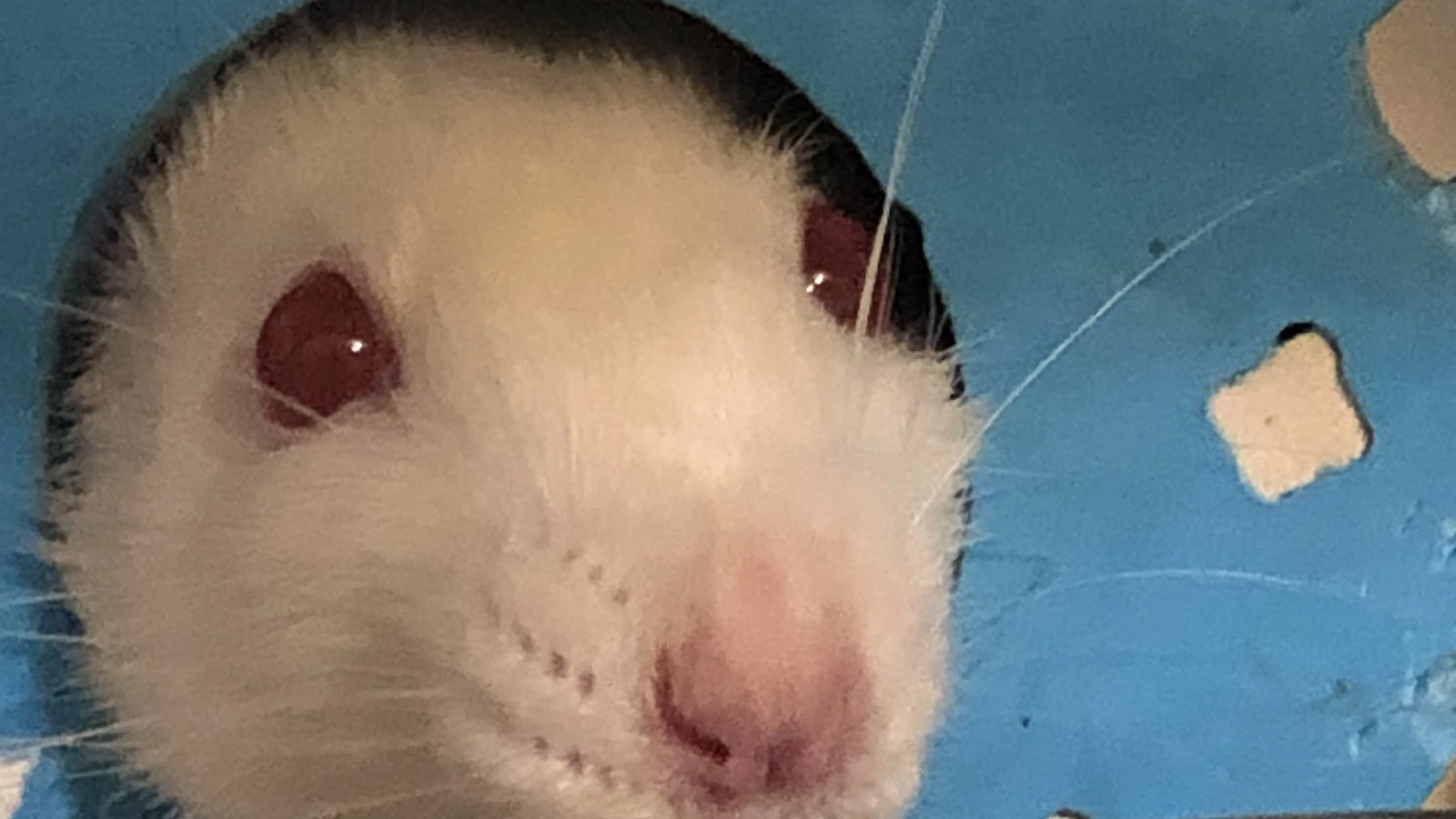
Yes, scientists taught rats to operate tiny cars and travel towards a food reward. The research at the University of Richmond was a way to study learning in a task combining movement, navigation and motivation. It was not a miniature road-safety test, and the entertaining videos do not by themselves tell us how a rat feels. These animals were rats, distinct from the smaller rodents called mice.
The story becomes more useful when we separate three questions: can the animals learn the controls, does their living environment affect that learning, and what evidence would support an interpretation about stress or enjoyment?
What did “driving” mean in this experiment?
The university’s original research announcement describes a wheeled vehicle made from a transparent food container, with an aluminium floor and three copper control bars. Food rewards encouraged the rats to navigate within a laboratory arena.
This is a meaningful learned task without being equivalent to human driving. The rat is operating an apparatus designed around its body and behaviour. Nothing here establishes an understanding of traffic signs, other road users or the rules a person must follow on a public street.
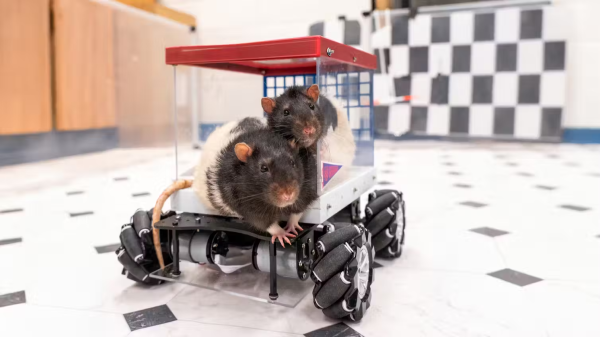
Read the photograph as evidence of what the apparatus looks like. To establish learning, researchers need observations across trials. To establish an emotional effect, they need an additional measurement. A compelling photograph cannot substitute for either.
How do you teach a rat such an unfamiliar skill?
In her first-person account, Kelly Lambert describes progressing from entering the vehicle and operating a control to steering towards a destination, with food rewards. The complete skill emerged through training.
The general learning principle is shaping: reinforce successive approximations of a target behaviour. OpenStax’s explanation of operant conditioning distinguishes that gradual process from waiting for a complex action to happen spontaneously.
For a non-animal analogy, imagine learning a new spreadsheet program. Opening a file, entering a formula and checking the result are manageable parts of a larger task. Showing only an expert’s final screen hides the practice that produced it. This analogy explains the logic of gradual training; it is not a measured comparison between rats and computer users.
The reward is part of the explanation
If an animal approaches a vehicle associated with food, several explanations remain possible. It might be responding to the food, the learned sequence, access to a different space, the action itself, or a combination. A good experiment creates comparisons that can distinguish these possibilities instead of choosing the most appealing story.
What did the published driving study find?
In Crawford and colleagues’ driving study, enriched-housed male rats showed stronger driving performance than standard-housed rats. Interest in the vehicle also persisted during extinction trials, when the usual reinforcement was withdrawn.
The abstract reports an increased ratio of DHEA to corticosterone metabolites in faecal samples during training across the animals. The authors interpreted this as consistent with improved markers of emotional resilience. A hormone-related measure is evidence to interpret, rather than a direct report of happiness.
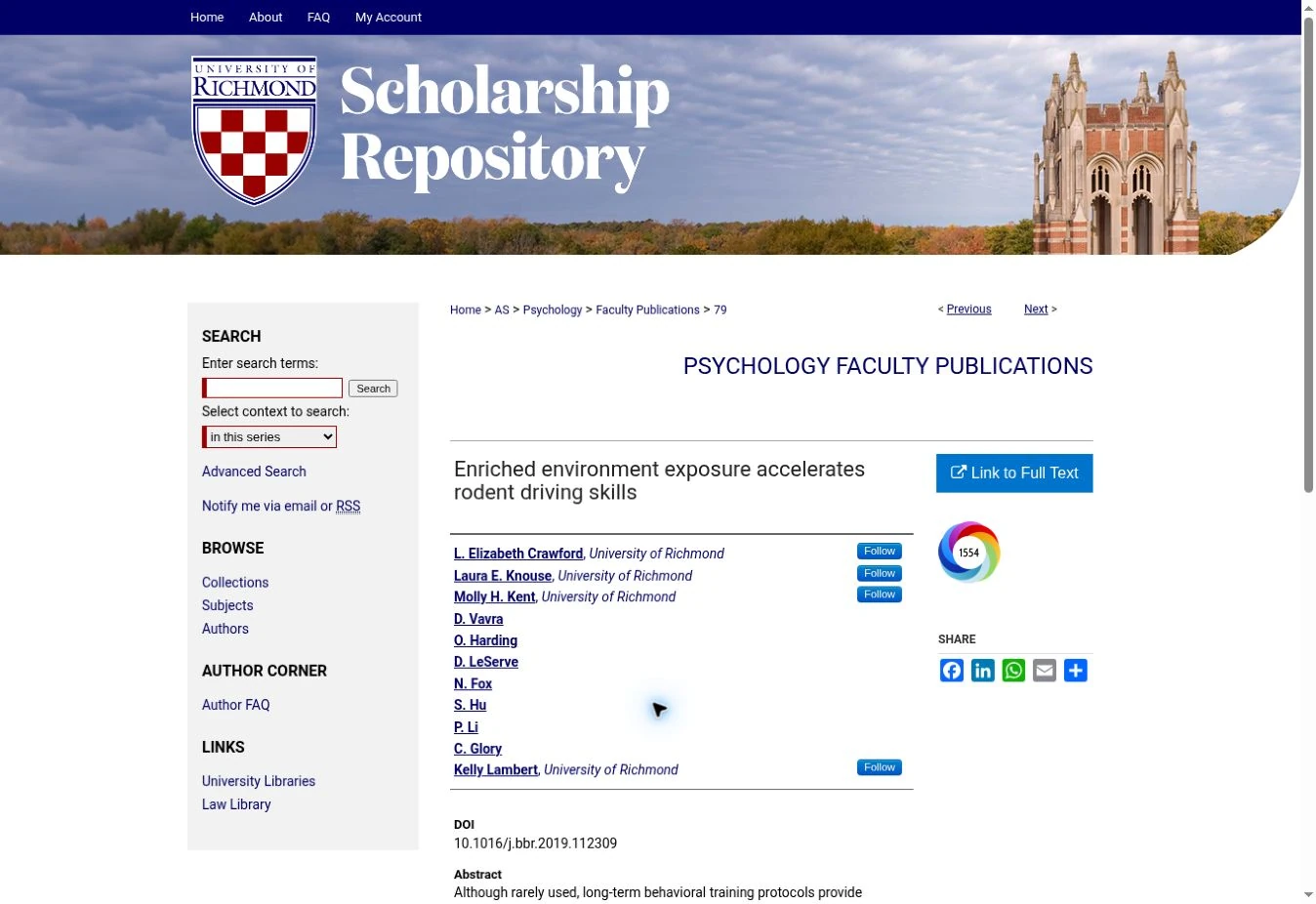
The timing can be confusing: the paper appeared online on 16 October 2019, while its journal issue is dated 27 January 2020. The bibliographic record distinguishes those dates. A recent retelling does not make the original experiment a new discovery.
Why did the animals’ living environment matter?
In the university’s research explainer, Lambert describes enriched housing as a larger, more engaging environment with social contact, exercise opportunities and changing objects. It is a package of experiences, not simply a toy added to an otherwise identical scene.
That matters when interpreting the comparison. If groups differ in several aspects of their experience, the result does not identify which single feature accounts for the difference. The interesting next question is which opportunities prepare an animal to engage with a demanding new task.
A useful reading habit is to ask what “better” means in the particular study: more successful trials, faster completion, fewer errors or greater willingness to participate? These are different outcomes. A headline about intelligence can conceal the actual performance measure.
Did the rats enjoy driving?
In her 2024 account, Lambert reports enthusiastic approaches to training and a choice in which two of three rats used a driving route despite a shorter walking option. She interprets this as suggestive of enjoyment, while acknowledging that rats cannot describe the experience.
A two-of-three observation is an interesting lead, not a population estimate. A stronger preference claim would need a larger sample, repeated choices and controls for food cues, familiarity, effort and other differences between routes. These are questions for evaluating the claim, not extra experiments we performed.
It is possible to take the behaviour seriously without translating it into a human sentence such as “I love driving.” The scientific task is to define what is observed and test competing explanations.
What did the later anticipation study actually test?
A paper published on 13 November 2025 studied anticipation of positive events over three weeks, rather than learning to drive. It compared anticipation-enhanced training with an enriched control condition.
Its results were mixed: some behavioural outcomes differed, while the reported optimism and corticosterone findings were nonsignificant trends. The authors described the findings as preliminary. This is related research, not proof that driving makes rats optimistic.
The distinction between a finding and a trend matters. Do not turn “a pattern worth investigating” into “the effect has been established.” Likewise, different results across measures should not be compressed into one global verdict that all animals became happier.
Three claims to keep separate
| Claim | What would support it? | Limit to remember |
|---|---|---|
| The rat learned to operate a vehicle | Recorded performance over training and appropriate control conditions | A successful clip alone does not show the whole learning history. |
| The rat preferred a driving-related option | Repeated choices with relevant alternatives controlled | Preference in one setup does not reveal every motive. |
| A task changes emotional or physiological responses | Specified behavioural or biological measures and comparisons | An animal result does not establish a treatment for people. |
This table is an editorial guide to evaluating evidence, not a report that every listed control was included in the original study.
What can this tell us about people?
The experiment gives researchers a way to ask how experience, action and motivation interact. Translating an animal model into a claim about people requires further work. It does not follow that driving lessons treat depression, or that buying a complicated toy produces the same effect in a person.
For an everyday illustration, someone might find a practical project satisfying because progress is visible. Another person may find that project frustrating. That observation suggests questions about control, difficulty and feedback; it does not provide a prescription derived from a rat experiment.
For another example of why a convincing account needs independent evidence, our guide to false memories examines the difference between confidence in a recollection and accuracy. The subjects differ, but the reading habit is useful: separate the experience being described from how it was verified.
How to watch a driving-rat video critically
- Identify the source. Look for the laboratory, paper or researcher’s account behind the clip.
- Locate the actual control action. Check what the animal does immediately before the vehicle moves.
- Ask about the training history. A short edited sequence cannot tell you how many attempts preceded it.
- Separate the outcome from its interpretation. Reaching food, choosing a route and enjoying a ride are related but different claims.
- Check the study date and scope. Do not combine a driving experiment with a later anticipation study as though they were one test.
The memorable part is the tiny car. The deeper question is how an animal learns an unfamiliar action and what a carefully chosen comparison can reveal about that process. That question survives even when the strongest claims about joy remain open.
Sources, photographs and verification
Reviewed 30 October 2026. The article draws on the original study’s abstract and bibliographic records, university explanations, Lambert’s accounts and the later open-access anticipation paper. We did not obtain the complete paywalled driving paper or run an experiment.
Featured photograph: Theshoedchicken, Lemon the rat, CC0; orientation corrected, cropped and resized. It shows a pet rat in a play structure, not a participant identified from the driving experiment.
Driving photograph: Kelly Lambert, reproduced complete from the image credited in her Greater Good article, CC BY-ND 4.0. Only a lossless file-format conversion to WebP was applied. The university repository screenshot is a genuine public-page capture from 30 October 2026.
You may also like
 Psychology
The Illusory Truth Effect: Why Repeated Claims Seem More Believable
Why does a repeated statement start to feel true? Explore the illusory truth effect, what 182 studies reveal,…
 Psychology
Why Do We Feel Nostalgic for a Time We Never Lived? The Psychology of Anemoia
Why do we miss decades we never experienced? Explore anemoia and historical nostalgia, the role of family stories…
 Psychology
What Happens When Actions Have No Consequences? Psychology Explained
Does a lack of punishment cause misconduct? Explore research on rule-following, accountability, behavior reinforcement and practical nonviolent boundaries.