
Bank Transfer Name Doesn’t Match the IBAN? Verification of Payee Explained
Understand European bank-transfer name warnings, verify a recipient safely, distinguish Close Match from Unable to Check, and document an enquiry with real official bank illustrations.
Contents
- What Verification of Payee actually checks
- Match, Close Match, No Match, and Unable to Check
- Real bank examples of the warnings
- A six-step check before you change the payee
- Why a genuine recipient’s name can differ
- A nickname or an old saved-payee label
- A business’s trading name differs from its legal name
- A joint account or a changed personal name
- Accents, punctuation, abbreviations, and transliteration
- When “Unable to Check” appears
- What changed in Europe, and where the rules apply
- How this differs from the UK’s Confirmation of Payee
- A changed IBAN needs more than a name correction
- A short message to send the intended recipient
- What to ask your bank
- Three worked examples without inventing bank outcomes
- An unchanged account saved under a nickname
- A contractor’s invoice arrives with a new account
- The name matches, but the purpose is suspicious
- If you already sent the money
- A verification log for households and small businesses
- Before pressing Authorise

If your bank says the payee name does not match the IBAN, pause before authorising the transfer. Check the recipient’s bank-registered name and the complete IBAN through a contact route you already trust. Do not replace the name with whatever makes the warning disappear unless you have independently established that the account belongs to the person or business you intend to pay.
European Verification of Payee, often shortened to VoP or VOP, checks account information before a payment. A mismatch needs investigation, but does not by itself establish fraud. A successful match is also limited: it does not prove that an invoice, investment, rental listing, or request to change bank details is genuine.
What Verification of Payee actually checks
The European Payments Council’s VOP scheme lets the sending payment provider ask the receiving provider whether the supplied payee details correspond to its account records. The response is returned to the payer before the transfer. It supports ordinary SEPA Credit Transfers and SEPA Instant Credit Transfers; it is not itself a payment or an identity-document verification service.
Keep three questions separate: does the account information match, is the request genuinely from the intended recipient, and have you authorised or completed a payment? A positive answer to one does not answer the others. You can have a valid account match for a payment you should never make.
Match, Close Match, No Match, and Unable to Check
| Result | What the check tells you | What to do before payment |
|---|---|---|
| Match | The supplied details match the receiving provider’s records | Still verify the purpose, amount, recipient, and any changed instructions |
| Close Match | The name is similar; a registered name may be shown | Confirm that name and the IBAN independently before correcting the entry |
| No Match | The supplied name does not match the account information | Pause and establish the correct account details with the intended recipient |
| Unable to Check | A verification result could not be obtained | Do not treat the missing result as a successful match; check with your bank |
These outcome categories are described by the EPC and Banco de España’s consumer guide. The IBAN remains the destination account identifier. If you continue using an incorrect IBAN, changing the displayed name does not redirect the money to the person you meant to pay.
Real bank examples of the warnings
The following illustrations are published in Bank of Ireland’s official VOP guide. They show that bank’s example messages, not a live transfer or a test we performed. Other providers can phrase the results differently.
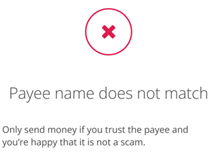
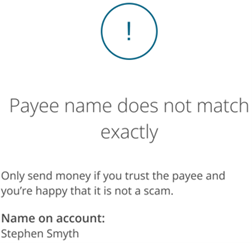
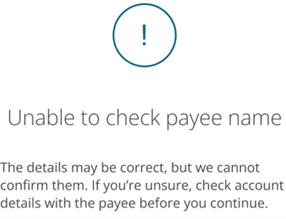
For a close match, the suggested account name is information to investigate. It is not an instruction to approve the transfer. For an unavailable result, the bank’s example describes an incomplete check, rather than confirmation that the name is wrong.
A six-step check before you change the payee
- Save the warning. Note the exact result, time, and transfer method. Keep the payment unauthorised while you investigate.
- Find the original instruction. Compare the invoice or agreed payment details with a previously verified record. Identify whether the name, IBAN, or both have changed.
- Contact the intended recipient independently. Use a known number from your established records, or navigate independently to the organisation’s genuine website. Do not use a new number supplied with the disputed instructions.
- Confirm both fields. Ask for the name associated with the account and verify the full IBAN through an appropriate trusted channel. Checking only the last digits is not a full account check.
- Correct verified information in your bank’s own interface. Follow the provider’s instructions for editing or recreating a payee. Read any new-payee limit or security notice.
- Review the new result and the payment itself. Recheck amount, currency, reference, destination, and the reason for paying. If something remains unexplained, ask the bank for help before proceeding.
This checklist is an editorial workflow, not a method for bypassing a bank’s security checks. It deliberately records the discrepancy before changing anything. Otherwise, you can lose the distinction between correcting an old nickname and accepting a fraudster’s new destination account.
Why a genuine recipient’s name can differ
A nickname or an old saved-payee label
Check whether the text in the payee field is the actual account name or only a label meaningful to you. A description such as “Rent,” “Mum,” or “Builder” may identify a payment in your address book without being the name the receiving provider expects.
Bank of Ireland specifically warns about nicknames in existing payees. Its editing process and any restrictions after creating a payee are provider-specific. Do not assume that deleting and adding a payee is necessary at every bank, or that another bank uses the same limits.
A business’s trading name differs from its legal name
A shopfront, invoice brand, and bank account may use different versions of a business name. The useful question is which name the receiving provider associates with that account, and whether that account is genuinely authorised to receive your payment. Do not assume a plausible company name answers either question.
For example, an invoice headed “Harbour Studio” might identify “Harbour Design Services Limited” as the legal supplier. Those fictional names illustrate a possible difference, not a guaranteed matching rule. Verify the relationship through the supplier’s established contact and account information; do not choose a replacement name simply because it looks related.
A joint account or a changed personal name
Ask the account holder which registered name should be supplied and whether their bank records reflect a recent change. Avoid inventing a combined name for a joint account or copying initials from a payment card. If the recipient is unsure, they should ask their own provider how their account is represented for incoming verification.
A familiar surname is not enough to establish that you have the correct account. Equally, an old surname does not prove an account belongs to a different person. Resolve the record with the intended recipient and their bank rather than using the warning as an identity lookup.
Accents, punctuation, abbreviations, and transliteration
Names can appear differently across documents and writing systems. However, there is no safe universal instruction to remove every accent, omit middle names, or replace a spelling with an English equivalent. Matching behaviour and accepted account names depend on the provider and its records.
Start with the recipient’s confirmed bank-registered spelling. If the form rejects a character, note the error and consult the bank’s instructions. Repeatedly trying different names until one succeeds can hide the original problem without confirming that the payment request is legitimate.
When “Unable to Check” appears
France’s official Service Public guidance lists technical problems, a non-participating bank, or a missing response among reasons verification may be impossible. An unavailable result is different from a confirmed mismatch. It also does not establish that a transfer has failed or that money has been debited.
Check the payment history before trying to submit anything again. If no payment was authorised, ask your provider whether the check can be retried and whether the destination is supported. If a transfer is pending or completed, deal with that transaction’s status first; do not create a second payment to test the beneficiary.
A separate bank check, transfer limit, compliance review, or authentication failure can also affect a payment. Record which message appeared at which stage. Asking “Why was my transfer rejected?” is less precise than explaining that name verification was unavailable before authorisation, or that the payment was declined after a successful check.
What changed in Europe, and where the rules apply
The European Central Bank’s implementation overview lists 9 October 2025 for the euro-area verification-of-payee requirement and 9 July 2027 for non-euro-area EU member states. It says verification applies to standard and instant credit transfers and must be free to the payer. The verification fee and any separate transfer charge are different questions.
The EPC’s scheme calendar lists version 1.1 as effective from 20 September 2026. That is a scheme update, not a new requirement that every customer must register, buy a certificate, or transfer money to activate checking. Consumers should use their provider’s normal payment service.
Do not treat “Europe,” “EU,” “euro area,” and “SEPA” as interchangeable. They describe different geographical or operational scopes. A provider’s participation, the payment route, and the applicable requirements matter. Ask your sending bank about the actual transfer instead of assuming every European destination or every euro-denominated payment produces the same check.
How this differs from the UK’s Confirmation of Payee
Pay.UK’s Confirmation of Payee guidance describes a UK domestic account-name check involving a sort code and account number, with additional information where applicable. Its outcomes are similar, but it is a separate service from European VOP.
A British customer paying a euro-area supplier should ask which verification applies to the bank and payment route being used. A U.S. sender should likewise not assume an international wire receives the same check. This article does not establish coverage for every cross-border provider or extend EU rules to every non-EU account.
A changed IBAN needs more than a name correction
Bank of Ireland’s payment-redirection fraud guidance explains how someone impersonating a supplier can request new bank details. Its advice is to verify the change using a known contact or independently obtained official contact information, rather than the details in the change request.
Compare these two situations. In the first, an established recipient confirms that an unchanged account needs their full registered name. In the second, a new email supplies a different IBAN and tells you to ignore the warning. Both can produce a mismatch, but only the second introduces an unexplained new destination. Your verification should address that change explicitly.
| What changed? | What to establish independently | What is insufficient by itself |
|---|---|---|
| Name only | The registered name and its connection to the intended recipient | A name that merely looks familiar |
| IBAN only | Whether the recipient genuinely requested that specific new account | A reply in the email thread that supplied it |
| Name and IBAN | Who will receive the money and why the destination changed | A logo, invoice header, or urgent explanation |
| Nothing changed, but a warning appeared | The saved payee details and the bank’s current result | “It worked last year” without reviewing today’s request |
Even a match on the new details cannot authenticate the email that supplied them. Verify the commercial request separately. A payment can reach the named account perfectly and still be a payment you were deceived into making.
A short message to send the intended recipient
My bank returned (…) when checking the account for invoice/reference (…). I have paused the payment. Please confirm the account-holder name registered with your bank and the correct IBAN through our established contact channel. If your payment details changed, please confirm when and why. I will verify the change independently before updating the payee.
Use the message through an established channel. Sending it only as a reply to a potentially compromised email does not make the confirmation independent. Do not ask the recipient to publish their account documents, and do not send your login details, payment codes, or full account statement to resolve a name warning.
What to ask your bank
Before authorising a transfer, I received the result (…) at (…). The intended recipient has confirmed (…) through a trusted channel. Please explain whether the result is a mismatch or an unavailable check, whether this payment route is supported, and how I should correct the payee details safely. No payment has been authorised / the transaction currently shows (…). Please provide a reference for this enquiry.
Choose the sentence that matches your actual payment status. A support request should distinguish an unsubmitted instruction from a payment already sent. If the provider needs documents, use its secure upload or messaging route and provide only what is relevant.
Three worked examples without inventing bank outcomes
An unchanged account saved under a nickname
Someone has paid a relative before, but saved the payee as “Family.” A new check warns about the name. The relative confirms their registered account name and the unchanged IBAN through an established contact. The payer follows their bank’s correction process and reviews the next result. This explains a sensible investigation; it does not predict which response every bank will return.
A contractor’s invoice arrives with a new account
A homeowner receives an updated invoice saying that the contractor’s account is temporarily unavailable and payment must go elsewhere today. The verification warning appears. The homeowner calls the contractor on a previously verified number and asks specifically about the changed destination. A reassuring answer from the new invoice’s phone number would not be an independent check.
The name matches, but the purpose is suspicious
A caller asks someone to move savings to a supposedly protected account and supplies details that return a match. The matching result does not establish that the caller represents the bank or that moving the savings is appropriate. The account check and the caller’s authority are separate questions. All three scenarios are fictional examples written for this guide, not actual customer cases or test transactions.
If you already sent the money
If you suspect misdirection or fraud, contact your bank immediately through its official app or published contact number. Explain whether you authorised the transfer, what warning appeared, and why you now believe the destination or request was wrong. Ask whether stopping, recalling, tracing, or reporting the payment is possible for its current status. Do not wait for the recipient to answer before alerting the bank to suspected fraud.
Keep the transfer reference, time, amount, currency, beneficiary details, warning, invoice, and communications. If you shared credentials or authentication codes, tell the bank that too so it can address account security as well as the transfer. Report suspected crime through the appropriate local route advised for your country.
Recovery is not guaranteed. Do not infer either a guaranteed refund or a complete loss of rights from the words “Match” or “No Match” alone. Ask the provider for its written assessment and complaint route; the transaction, applicable rules, warnings, and provider conduct all matter. If support requests more evidence, keep the originals and respond through its verified channel.
A verification log for households and small businesses
| Field | What to record |
|---|---|
| Payment purpose | Invoice, agreement, amount, currency, and reference |
| Original instruction | Where the account details came from and whether either field changed |
| VOP result | Exact wording, time, and a securely stored screenshot if useful |
| Independent contact | Who you reached, how the contact was verified, and what they confirmed |
| Bank follow-up | Question asked, response, case reference, and payment status |
| Decision | Paused, corrected, cancelled, or paid, with the reason and authorisation record |
For a business, separate supplier-record maintenance from payment approval where practical. A colleague checking an invoice is less useful if both people rely on the same unverified email for the new bank details. Agree a verification route before an urgent invoice arrives, and record who is allowed to approve a destination change.
If several payments are scheduled for the same supplier, review whether the confirmed correction affects future instructions as well as today’s transfer. Avoid treating one corrected screen as evidence that every saved record, standing instruction, or accounting-system export has also changed.
Before pressing Authorise
Confirm the intended recipient, the complete account details, the payment’s purpose, and the current verification result. A request to ignore an unexplained warning should trigger another check, not a faster payment. For separate checks on a questionable online merchant, see our guide to checking whether a website is a scam before entering payment details.
Sources checked October 26, 2026. The inline warning images are examples published by Bank of Ireland, not screenshots from a reader’s account. No payment, beneficiary edit, or bank-account test was performed. The checklists, templates, and scenarios are editorial aids; your provider determines the available verification and payment process for your account.
You may also like
 Personal Finance & Consumer Guides
ACA Marketplace Open Enrollment 2027: Dates, Subsidies, State Deadlines and How to Apply
ACA Marketplace 2027 enrollment usually runs November 1–January 15. Check your state’s deadlines, learn about 2027 subsidies, and…
 Personal Finance & Consumer Guides
HSA Contribution Limits 2027: New IRS Rules, Eligibility, Catch-Up Contributions and Tax-Saving Examples
Official 2027 HSA contribution limits, deductible thresholds, catch-up rules, expanded Bronze and Catastrophic plan eligibility, and examples to…
 Personal Finance & Consumer Guides
Social Security COLA 2027: New Benefit Amounts, Payment Dates, and How to Calculate Your Increase
Social Security COLA 2027 is officially 3.6%. Learn new retirement, SSDI and SSI amounts, January payment dates, earnings…