
Astronomers Detect the Most Distant Fast Radio Burst Ever Found — It Traveled More Than 10 Billion Years
Astronomers traced FRB 20240304B to a tiny galaxy seen more than 10.7 billion years ago, setting a new distance record for fast radio bursts.
Contents
- What is a fast radio burst?
- How far away is FRB 20240304B?
- Why could ground telescopes not see the host galaxy?
- Why the host galaxy surprised astronomers
- Does this prove magnetars cause all FRBs?
- Why FRBs are useful even before we know exactly what makes them
- The missing matter problem
- Why this particular burst is important
- How MeerKAT found the burst
- How Webb solved the distance problem
- Was the radio burst traveling for 10 billion years?
- How much energy did the burst release?
- Could it have been aliens?
- What astronomers want to find next
- Frequently asked questions
- What is FRB 20240304B?
- How old is the signal?
- What caused it?
- Why are fast radio bursts useful?
- Did James Webb detect the radio burst itself?
- The bottom line
- Sources
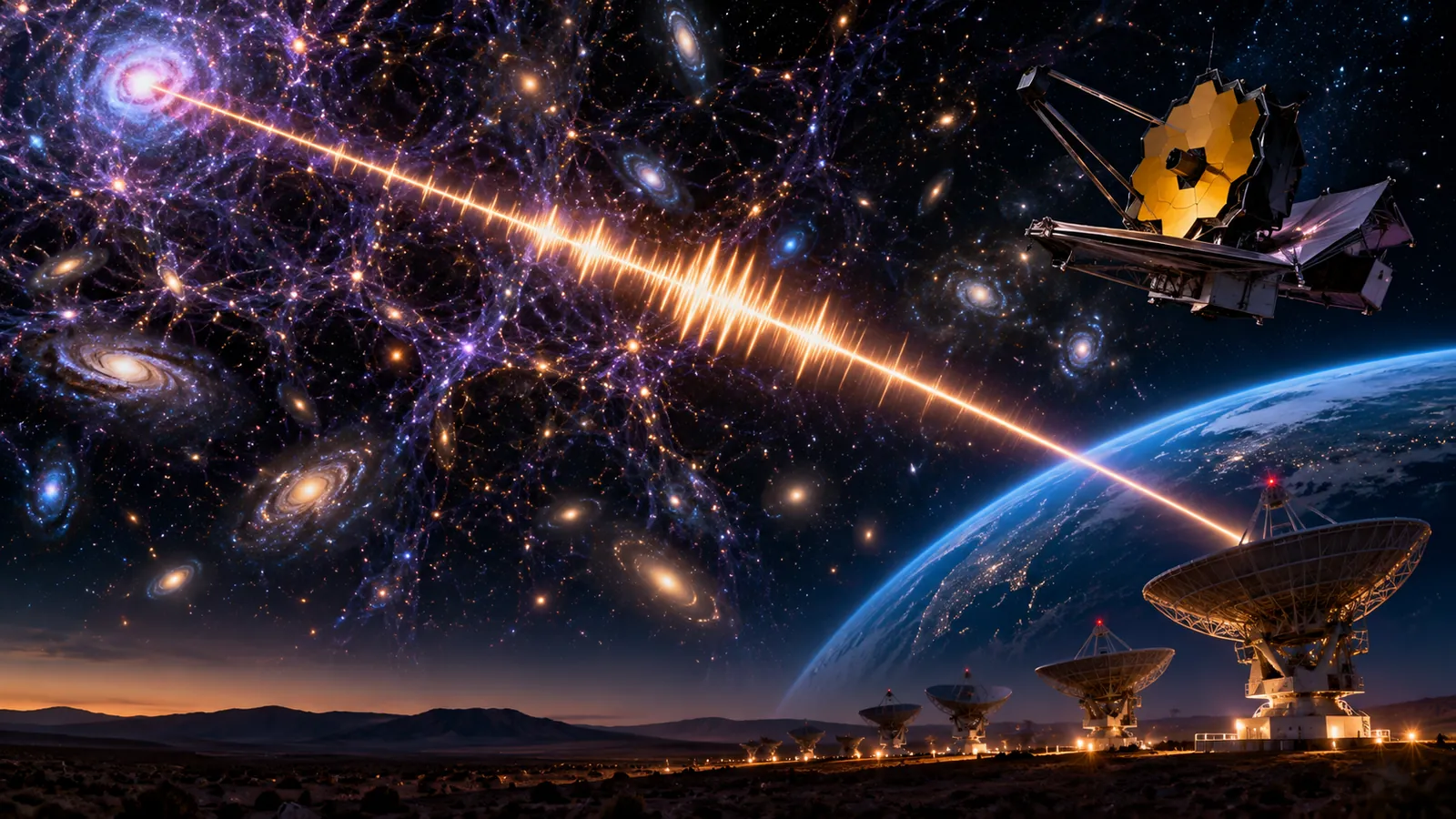
Last reviewed: October 9, 2026. Astronomers have traced the most distant fast radio burst ever confirmed to its home galaxy, a tiny star-forming galaxy whose light has been traveling toward us for more than 10.7 billion years.
The burst, called FRB 20240304B, was detected by South Africa’s MeerKAT radio telescope on March 4, 2024. The signal itself lasted only milliseconds, but locating its host galaxy required the sensitivity of the James Webb Space Telescope.
The result, published in Science on October 8, 2026, does more than set a distance record. It gives researchers a new way to test ideas about what produces fast radio bursts and how these mysterious flashes can be used to study otherwise invisible matter between galaxies.
What is a fast radio burst?
Fast radio bursts, usually shortened to FRBs, are extremely brief flashes of radio waves from deep space.
They can last only a few milliseconds, yet they are bright enough to be detected across billions of light-years. Some repeat. Many are seen only once.
Since FRBs were first recognized in 2007, astronomers have detected thousands, but the exact physical mechanism behind every class of burst remains uncertain.
How far away is FRB 20240304B?
Webb observations placed the host galaxy at a redshift of about 2.148, corresponding to a lookback time of more than 10.7 billion years.
That means the burst happened when the universe was only around three billion years old.
It more than doubles the previous distance record for a precisely localized FRB host, according to the research teams involved.
Why could ground telescopes not see the host galaxy?
Radio observations localized the burst very precisely, but even major ground-based optical telescopes could not identify a galaxy at that location.
That suggested the host was either extremely faint, extremely distant or both.
James Webb’s infrared sensitivity revealed a small, young dwarf galaxy actively forming stars.
Why the host galaxy surprised astronomers
Many FRB theories involve neutron stars — the dense collapsed cores left behind after massive stars die.
The newly identified galaxy is small and actively forming stars, which supports scenarios in which at least some FRBs come from relatively young neutron stars rather than requiring long delays after star formation.
One leading candidate is the magnetar, a neutron star with an extraordinarily strong magnetic field.
Does this prove magnetars cause all FRBs?
No.
Astronomers have strong reasons to suspect magnetars can produce at least some fast radio bursts, but FRBs may not all have exactly the same origin.
The new host galaxy strengthens the case for young compact objects in some systems, but it does not close the mystery.
Why FRBs are useful even before we know exactly what makes them
A radio pulse crossing billions of light-years does not travel through empty space. It passes through diffuse gas and plasma spread between galaxies.
Different radio frequencies are delayed by different amounts as the signal moves through that material. Astronomers can measure that delay and use it to estimate the amount of otherwise hard-to-see matter along the path.
In that sense, an FRB acts like a flashlight shining through the cosmic web.
The missing matter problem
Astronomers know ordinary matter exists throughout the universe, but much of it is difficult to see directly because it is spread as very thin gas between galaxies.
Distant FRBs can help map this material because their signals accumulate information about every region they cross.
The farther the FRB, the longer the cosmic path — and the more of the early universe researchers can probe.
Why this particular burst is important
- It is the most distant FRB with a confirmed host galaxy so far.
- It shows FRBs were already occurring when the universe was only about three billion years old.
- Its host is smaller and younger than many astronomers expected.
- It provides a long sightline through the cosmic web.
- It supports the idea that FRBs can arise relatively soon after intense star formation.
How MeerKAT found the burst
The MeerTRAP project uses the MeerKAT array in South Africa to search for short-lived radio events.
When FRB 20240304B appeared, the system was able to determine its sky position precisely enough for follow-up observations.
That precision was crucial. Without a reliable location, Webb would have had too much sky to search for the faint host.
How Webb solved the distance problem
Webb’s NIRCam instrument detected the faint galaxy, and spectroscopy was then used to determine its redshift.
The redshift tells astronomers how much the universe has expanded while the galaxy’s light was traveling toward us, which gives a distance and cosmic-age estimate.
Was the radio burst traveling for 10 billion years?
Yes, in the everyday sense of the phrase: the signal left its galaxy more than 10 billion years ago and reached our telescopes only recently.
Because the universe expanded while the signal traveled, cosmological distance language can be subtle. A lookback time is often the clearest way to describe how long ago the event occurred.
How much energy did the burst release?
Fast radio bursts can release extraordinary radio energy in a fraction of a second. Estimates depend on distance, spectrum and assumptions about how the emission is beamed.
The key point is that the flash was bright enough to be detected after crossing most of the observable history of the universe.
Could it have been aliens?
There is no evidence that FRB 20240304B was artificial.
FRBs are studied as natural astrophysical phenomena. Their properties are consistent with extremely energetic compact objects, especially neutron stars and magnetars.
What astronomers want to find next
The next goal is not simply to beat the distance record. Researchers want a large sample of very distant FRBs with well-identified host galaxies.
A population of such bursts could reveal how FRB sources changed over cosmic time and improve measurements of the diffuse matter between galaxies.
If Webb and future telescopes can identify hosts for more extreme bursts, FRBs could become a routine tool for studying the early universe.
For another new Webb discovery, see our article on changing water clouds beyond our solar system. You can also read how researchers are using AI to model living systems in our AI virtual cell report.
Frequently asked questions
What is FRB 20240304B?
It is the most distant fast radio burst with a confirmed host galaxy reported to date.
How old is the signal?
Its host galaxy is seen as it was more than 10.7 billion years ago, when the universe was only about three billion years old.
What caused it?
The exact source is not proven. Young highly magnetized neutron stars are a leading explanation.
Why are fast radio bursts useful?
Their radio waves interact with diffuse matter between galaxies, letting astronomers use them to probe material that is otherwise difficult to detect.
Did James Webb detect the radio burst itself?
No. MeerKAT detected the radio burst. Webb was used to identify and study the faint host galaxy.
The bottom line
FRB 20240304B is more than a record-breaking flash. It proves that detectable fast radio bursts were occurring in small young galaxies when the universe was only a few billion years old.
Its 10.7-billion-year journey also gives astronomers one of their longest radio sightlines through the cosmic web.
We still do not know exactly what creates every FRB, but each new distance record turns the mystery into a more powerful scientific tool.
Sources
NASA — Webb measures distance to farthest fast radio burst.
University of Sydney — Astronomers pinpoint the most distant fast radio burst ever detected.
ESA/Webb — Webb measures distance to farthest fast radio burst.
You may also like
 Science & Curiosities
 Scientists Found an Archaeon With a Record-Tiny Genome — Is This Near the Minimum Needed for Life?
Candidatus Sukunaarchaeum mirabile has just 189 protein-coding genes and the smallest known archaeal genome, offering new clues about…
 Science & Curiosities
 A 2-Million-Year-Old Adult Homo erectus Fossil Is Rewriting an Early Human Timeline
An adult Homo erectus skull fragment from Drimolen, South Africa, strengthens evidence that the species was present there…
 Science & Curiosities
 James Webb Detects Changing Water Clouds Beyond Our Solar System for the First Time
Webb monitored the nearby brown dwarf WISE 0855 for 11 hours and directly detected water clouds changing thickness…