
James Webb Detects Changing Water Clouds Beyond Our Solar System for the First Time
Webb monitored the nearby brown dwarf WISE 0855 for 11 hours and directly detected water clouds changing thickness over time.
Contents
- What is WISE 0855?
- Why call it a “world” instead of an exoplanet?
- What did Webb actually observe?
- Why is this the first direct confirmation?
- Does it rain there?
- Why Webb was necessary
- What molecules are in the atmosphere?
- Why this matters for exoplanet research
- A bridge between Jupiter and distant worlds
- How fast does WISE 0855 rotate?
- Could there be life in those clouds?
- What makes the result exciting anyway?
- Could Webb do this for an Earth-like planet?
- What astronomers want to study next
- Frequently asked questions
- What is WISE 0855?
- Did Webb find water outside the solar system?
- Is WISE 0855 an exoplanet?
- How long did Webb watch it?
- Does this mean the world is habitable?
- The bottom line
- Sources
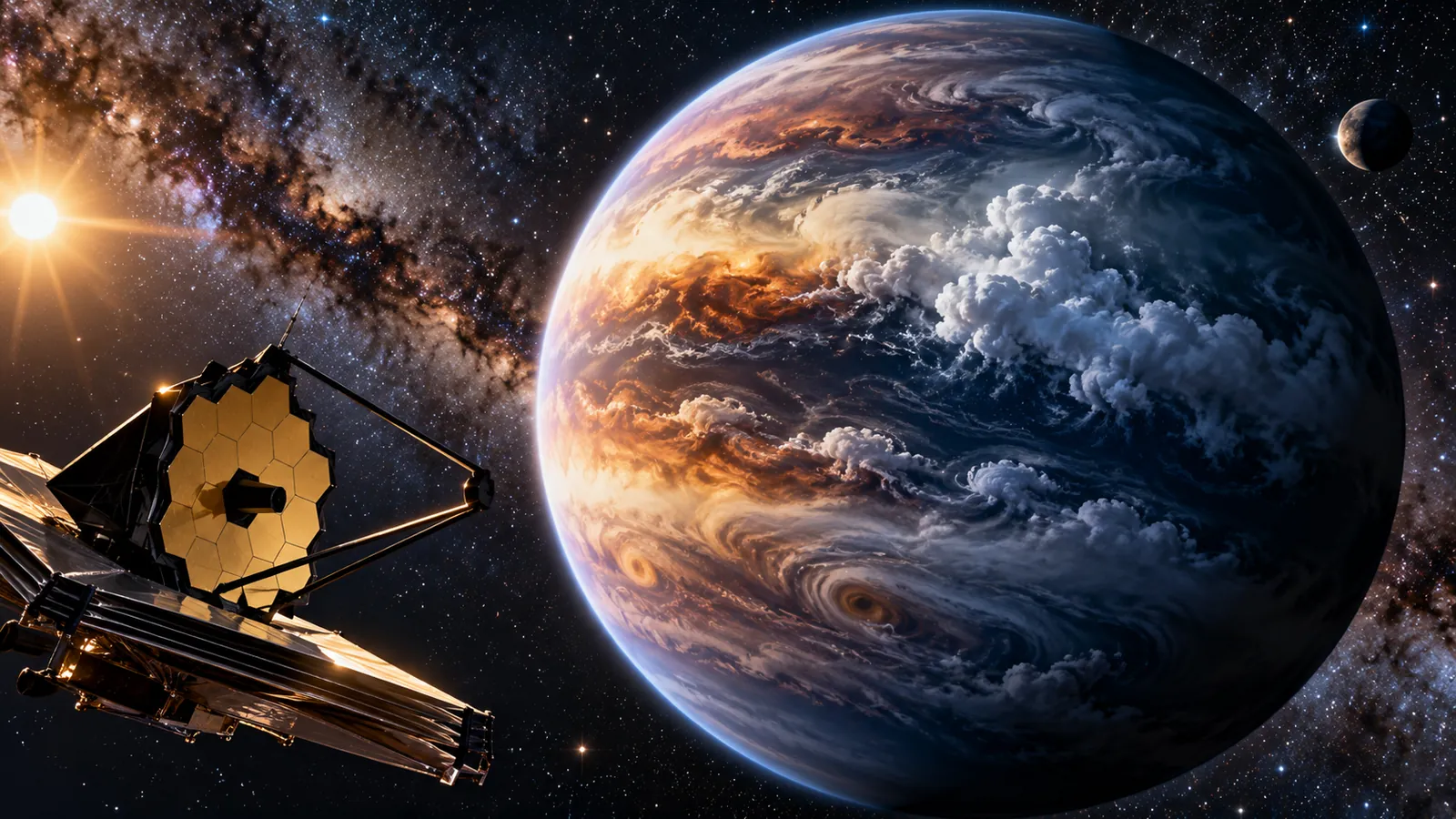
Last reviewed: October 9, 2026. The James Webb Space Telescope has detected something never confirmed before beyond our solar system: water clouds changing thickness over time on a cold world about 7.5 light-years from Earth.
The object is called WISE 0855. It is not a normal planet orbiting a star. It is a free-floating brown dwarf — an object larger than a typical planet but too small to sustain the hydrogen fusion that powers ordinary stars.
By watching WISE 0855 for 11 hours and taking a spectrum roughly every 15 minutes, astronomers built the most detailed time-series view yet of its atmosphere. The changing signal provides the first direct confirmation of variable water clouds outside our solar system.
What is WISE 0855?
WISE 0855 is one of the coldest known brown dwarfs. Its temperature is low enough for water vapor to condense into clouds, making it a natural laboratory for atmospheric physics that is more familiar on giant planets than on hot stars.
It sits only about 7.5 light-years away, which is extremely close in astronomical terms.
Why call it a “world” instead of an exoplanet?
Because WISE 0855 is a brown dwarf, not a confirmed planet orbiting a star.
Brown dwarfs form in a gray area between giant planets and stars. They are massive enough to have some star-like properties but not massive enough to sustain normal hydrogen fusion.
That distinction is important: the discovery is about weather beyond the solar system, but not on an Earth-like exoplanet.
What did Webb actually observe?
The team used Webb to record the object’s infrared spectrum repeatedly over an 11-hour window.
As WISE 0855 rotated, different parts of its atmosphere moved into view. The spectrum changed in ways that matched water-cloud layers becoming thicker or thinner across different regions.
This is similar in principle to watching Jupiter rotate and seeing changing bands and storms, except WISE 0855 is far outside our solar system and much harder to observe.
Why is this the first direct confirmation?
Astronomers had already found evidence suggesting water clouds could exist in very cold brown dwarfs.
The new result goes further because it measures those clouds changing over time rather than simply inferring that water condensates are present.
That turns a static atmospheric detection into a weather observation.
Does it rain there?
Possibly in a broad physical sense, but “rain” on a brown dwarf should not be imagined as an Earth storm.
Water can condense into cloud particles, and atmospheric circulation can move those particles through layers with extreme pressure, temperature and chemistry.
The new data demonstrate variable clouds, not a direct video of liquid raindrops falling onto a solid surface.
Why Webb was necessary
WISE 0855 is extremely faint at visible wavelengths but glows more usefully in infrared light.
Webb is designed for precisely this type of target. Its instruments can separate the infrared spectrum into wavelengths associated with different molecules and atmospheric depths.
Repeating those measurements over time lets astronomers see weather rather than just composition.
What molecules are in the atmosphere?
The atmosphere is chemically complex and contains water-bearing layers along with other molecules expected in a cold hydrogen-rich atmosphere.
Different wavelengths probe different heights, allowing scientists to infer which cloud layers are driving the observed brightness changes.
Why this matters for exoplanet research
Although WISE 0855 is a brown dwarf, the techniques used here can help astronomers interpret giant exoplanets.
Cold giant planets may have water clouds, complex chemistry and patchy weather systems that are difficult to model from a single observation.
Time-series spectroscopy can reveal how an atmosphere changes as the object rotates.
A bridge between Jupiter and distant worlds
Our own Jupiter and Saturn have bands, storms and evolving cloud structures. WISE 0855 gives scientists a chance to ask how similar atmospheric physics behaves in a completely different object.
Because the brown dwarf is isolated rather than hidden next to a bright host star, it is easier to study directly than many exoplanets.
How fast does WISE 0855 rotate?
The 11-hour observing sequence was designed to follow atmospheric changes across a substantial part of the object’s rotation.
Brown dwarfs can rotate relatively quickly, which means cloud structures can move into and out of view over hours rather than days.
Could there be life in those clouds?
There is no evidence for life on WISE 0855, and the discovery should not be interpreted as a habitability claim.
Detecting water clouds only means that water is participating in the atmospheric cycle. Habitability requires a much broader combination of temperature, chemistry, stability, energy sources and environmental conditions.
What makes the result exciting anyway?
For decades, astronomers have talked about “weather” on brown dwarfs based on changing brightness. Webb can now tie those changes to specific molecules and cloud layers.
That is a major step from seeing that an object varies to understanding what in the atmosphere is causing the variation.
Could Webb do this for an Earth-like planet?
Not in the same way yet.
Earth-sized planets are much smaller and often sit next to bright stars that overwhelm their light. WISE 0855 is large, nearby and isolated, making direct atmospheric monitoring easier.
But the methods being refined on brown dwarfs could inform future observations of cooler exoplanets with next-generation telescopes.
What astronomers want to study next
- How water cloud coverage changes during longer observing periods.
- Whether storms form and decay on predictable timescales.
- How different molecules vary at different atmospheric heights.
- How WISE 0855 compares with warmer brown dwarfs and giant planets.
- Whether similar water-cloud weather can be measured on other nearby cold worlds.
For another new Webb result, see our report on the most distant fast radio burst ever traced. You can also explore our AI virtual cell article for another example of new technology opening previously inaccessible scientific questions.
Frequently asked questions
What is WISE 0855?
WISE 0855 is a very cold, nearby brown dwarf about 7.5 light-years from Earth.
Did Webb find water outside the solar system?
Water has been detected beyond the solar system before. The new milestone is the first direct detection of variable water clouds changing over time on such a world.
Is WISE 0855 an exoplanet?
No. It is a free-floating brown dwarf rather than a confirmed planet orbiting a star.
How long did Webb watch it?
The team monitored WISE 0855 for about 11 hours, obtaining spectra at roughly 15-minute intervals.
Does this mean the world is habitable?
No. Water clouds alone do not imply habitability.
The bottom line
James Webb has turned a faint nearby brown dwarf into a weather laboratory.
By repeatedly measuring its infrared spectrum, astronomers directly watched water-cloud layers change as WISE 0855 rotated.
The discovery is not evidence for an ocean or life. It is something more fundamental: proof that scientists can now monitor changing water-cloud weather on a world outside our solar system.
Sources
University of Arizona — First detection of variable water clouds outside our solar system.
University of Arizona research summary — variable water clouds on WISE 0855.
You may also like
 Science & Curiosities
 Scientists Found an Archaeon With a Record-Tiny Genome — Is This Near the Minimum Needed for Life?
Candidatus Sukunaarchaeum mirabile has just 189 protein-coding genes and the smallest known archaeal genome, offering new clues about…
 Science & Curiosities
 A 2-Million-Year-Old Adult Homo erectus Fossil Is Rewriting an Early Human Timeline
An adult Homo erectus skull fragment from Drimolen, South Africa, strengthens evidence that the species was present there…
 Science & Curiosities
 Astronomers Detect the Most Distant Fast Radio Burst Ever Found — It Traveled More Than 10 Billion Years
Astronomers traced FRB 20240304B to a tiny galaxy seen more than 10.7 billion years ago, setting a new…