
Scientists Discover a 165-Million-Year-Old Otter-Like Mammal Relative That Swam With Dinosaurs
A newly described Jurassic mammal relative from China had a broad swimming tail, predatory teeth and surprisingly modern throat anatomy 165 million years ago.
Contents
- What exactly was Megacauda sungei?
- How big was it?
- A body built for swimming
- What did Megacauda eat?
- Why scientists are so excited about its throat
- A surprisingly modern way to swallow
- Was it the first semiaquatic mammal relative?
- Why this changes the picture of mammals in the dinosaur age
- What dinosaurs lived around it?
- How could such delicate anatomy survive for 165 million years?
- The strange combination of modern-looking features
- Why convergent evolution matters here
- Did it have a platypus bill?
- Could it breathe while feeding?
- What the fossil does not tell us
- Why the discovery matters beyond one strange animal
- What does 'mammaliaform' mean?
- How old is 165 million years, really?
- Could more animals like it still be waiting to be found?
- Frequently asked questions
- What is Megacauda sungei?
- Was Megacauda a real otter?
- How large was it?
- Why is its throat important?
- Did Megacauda live with dinosaurs?
- What did it eat?
- The bottom line
- Sources
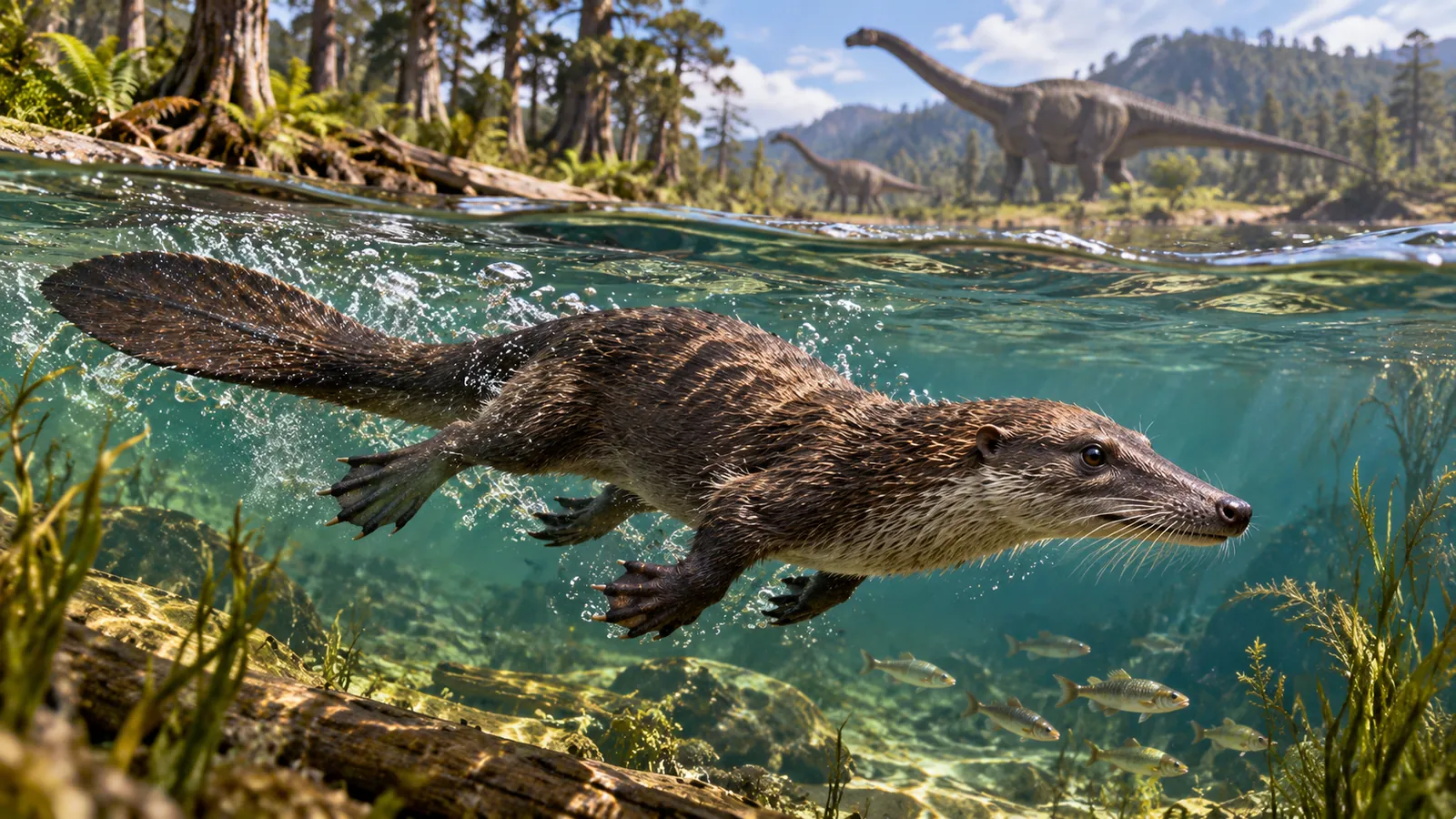
Last reviewed: October 9, 2026. Long before otters, beavers or platypuses evolved, a furry animal about the size of a modern platypus was already swimming through Jurassic waters and hunting small prey while dinosaurs dominated the land.
Scientists have described a newly recognized species named Megacauda sungei, a 165-million-year-old mammaliaform from what is now Inner Mongolia, China. Its unusually complete fossil preserves not only bones, but impressions of skin and fur, the outline of a broad tail, and delicate throat structures that help explain how some key mammal-style feeding abilities evolved.
The study, published in Nature on October 7, 2026, suggests that early mammal relatives were far more ecologically diverse than the old stereotype of tiny shrew-like creatures hiding beneath dinosaurs.
What exactly was Megacauda sungei?
Megacauda was not an otter, a beaver or a platypus. It was also not a modern mammal. It belonged to an extinct group called docodonts, early mammaliaforms that were close relatives on the broader mammalian evolutionary tree.
That distinction matters because headlines describing it as a ‘Jurassic otter’ are useful visually, but scientifically imprecise. The animal looked and behaved in ways that remind us of several living semiaquatic mammals, yet it evolved tens of millions of years before those modern groups appeared.
Its scientific name means roughly “big tail,” a reference to one of its most striking adaptations.
How big was it?
Researchers estimate Megacauda was about 40 to 50 centimeters long from nose to tail and weighed around 1 to 2 kilograms. That is roughly the size range of a living platypus.
That may sound small compared with dinosaurs, but it was unusually large for its time. Most Jurassic mammaliaforms were tiny, often closer to the size of shrews. According to the research team, Megacauda is the largest Jurassic mammaliaform currently known.
A body built for swimming
The fossil preserves several features that point strongly to a semiaquatic lifestyle.
- Strong hind limbs with relatively long feet.
- A broad, flattened tail that could help generate thrust in water.
- Tail vertebrae suited to side-to-side undulating movement.
- Body proportions broadly comparable to those of a platypus.
- Teeth suited for gripping and cutting animal prey.
Researchers think it paddled with its front and hind limbs while using the tail as an additional propulsive surface. It may also have dug burrows along waterbanks or lakeshores.
The animal was found in rock formed from lake sediment, strengthening the case that it spent substantial time in and around water.
What did Megacauda eat?
Its skull and teeth tell a predatory story.
Megacauda had robust canine teeth and shearing cheek teeth that could cut meat. Some of the tooth cusps curved backward, a useful shape for holding slippery prey.
Even more compelling, researchers found tiny vertebrate bones preserved in the stomach region. That is direct evidence that it ate small animals.
Salamanders were abundant in the same fossil beds, so fish, salamanders and other small aquatic or shoreline vertebrates are plausible prey. The study does not prove every item on the menu, but it clearly supports a carnivorous or strongly animal-based diet.
Why scientists are so excited about its throat
The swimming adaptations are visually dramatic, but the most important evolutionary discovery may be hidden under the skull.
The fossil preserves delicate hyoid bones and associated throat structures. In modern mammals, these structures help coordinate the tongue, throat and larynx during chewing, swallowing and suckling.
Humans use the same general anatomical system when we chew food into small pieces and then swallow one compact mouthful at a time.
Many other vertebrates feed differently. Snakes can swallow prey whole, while crocodilians may gulp down large chunks. Mammals evolved a highly coordinated system in which complex teeth process food and the throat then moves the chewed material efficiently into the esophagus.
A surprisingly modern way to swallow
The anatomy of Megacauda suggests that this mammal-style swallowing system was already present in early mammal relatives by the Middle Jurassic.
That pushes an important part of the feeding story deep into the age of dinosaurs.
The same anatomical arrangement is also linked to suckling in infant mammals. Being able to handle milk efficiently, and later chew and swallow many kinds of food, may have helped open the door to the enormous variety of mammalian diets seen today.
In other words, the fossil is interesting not just because it swam like an otter-like animal. Its throat records a major step in the evolution of mammalian feeding.
Was it the first semiaquatic mammal relative?
The new study describes Megacauda as the oldest-known example of a semiaquatic lifestyle in mammalian evolutionary history.
Another famous swimming docodont, Castorocauda, was described years ago and also came from China. But Megacauda is older and more completely preserved in several crucial areas.
That means mammal relatives were experimenting with life in the water earlier than researchers had previously documented.
Why this changes the picture of mammals in the dinosaur age
For decades, popular images of the Mesozoic often portrayed early mammals as tiny nocturnal creatures that mostly hid from dinosaurs.
That picture is incomplete.
Fossils now show that early mammaliaforms occupied a surprising range of ecological niches. Some climbed trees. Some burrowed. Some lived mainly on the ground. And at least a few became specialized swimmers.
Megacauda adds a particularly vivid example: a relatively large Jurassic predator adapted to hunting in water.
It did not challenge giant dinosaurs for dominance, but it shows that mammals and their close relatives were already evolving specialized bodies and lifestyles long before the asteroid impact 66 million years ago.
What dinosaurs lived around it?
Megacauda lived roughly 168 to 163 million years ago, during the Middle Jurassic.
Theropod dinosaurs — the meat-eating lineage that includes famous later forms such as Tyrannosaurus — were already established. The researchers suggest feathered theropods may have been among the predators that threatened Megacauda.
Because of that danger, it may have been most active at night, dawn or dusk, although its exact daily behavior cannot be proven from the fossil alone.
How could such delicate anatomy survive for 165 million years?
This specimen is exceptional because it preserves far more than a typical skeleton.
Scientists can see traces of fur and skin, a clear body outline and fine structures in the throat region. Those delicate tissues and tiny bones are rarely preserved well enough to study.
The specimen was analyzed using modern imaging methods including CT scanning and X-ray fluorescence imaging. The large fossil slab had to be divided into smaller sections for some scans, allowing researchers to reconstruct details that are difficult to see with ordinary visual inspection.
The strange combination of modern-looking features
One reason Megacauda captures attention is that it looks almost like evolution assembled familiar parts from several animals:
- A torso and hind limbs reminiscent of a platypus.
- A broad swimming tail comparable in function to those of beavers or platypuses.
- An otter-like predatory lifestyle.
- Scales on the tail surface.
- A mammal-like throat capable of sophisticated swallowing.
But this does not mean modern otters, beavers and platypuses directly descended from Megacauda. Similar lifestyles can produce similar solutions through convergent evolution.
Why convergent evolution matters here
Animals living in similar environments often evolve comparable shapes even when they are only distantly related.
A broad tail is useful for propulsion. Long feet can help with swimming. Backward-curving teeth help grip slippery prey.
So when scientists say Megacauda was otter-like or platypus-like, they are describing ecological similarities, not claiming it was an early version of either modern animal.
Did it have a platypus bill?
No. Despite the comparisons with a platypus, researchers do not describe Megacauda as having the distinctive duck-like bill of a living platypus.
The comparison comes mainly from its body proportions, limbs, aquatic lifestyle and broad tail.
Could it breathe while feeding?
The preserved throat anatomy suggests a level of coordination similar to the mammalian system that separates feeding and breathing pathways efficiently.
According to the research team, this arrangement would have supported chewing, swallowing and suckling-style function. That is one reason the throat is scientifically more important than its unusual appearance.
What the fossil does not tell us
A spectacular fossil can still leave big gaps.
Scientists cannot know its exact fur color, social behavior, mating habits or daily routine. They cannot say with certainty how often it entered the water, how long it could stay submerged, or exactly which prey species it preferred.
The fossil provides anatomical evidence. Behavioral reconstructions are based on comparisons with living animals and the physical demands of swimming and predation.
Why the discovery matters beyond one strange animal
Megacauda helps answer two broader questions.
First, it shows that ecological experimentation among mammal relatives was already well underway during the Jurassic. Second, it offers rare evidence about when the sophisticated throat anatomy of mammals evolved.
Those two stories — lifestyle and feeding — come together in a single exceptionally preserved specimen.
That is why the discovery is more significant than simply finding another unusual prehistoric animal.
What does ‘mammaliaform’ mean?
A mammaliaform is part of a broader evolutionary group that includes true mammals and some of their extinct close relatives.
Scientists use the term because not every animal close to mammals fits neatly inside the crown group containing all living mammals and their most recent common ancestor.
Megacauda sits on that broader family tree. Calling it a “mammal relative” is therefore more precise than simply calling it an otter-like mammal.
How old is 165 million years, really?
Megacauda lived roughly 100 million years before the asteroid impact that ended the Cretaceous Period and eliminated non-avian dinosaurs.
Humans, by contrast, appeared only a tiny fraction of that time ago.
The fossil therefore captures mammalian evolutionary experimentation at an extraordinarily early stage.
Could more animals like it still be waiting to be found?
Almost certainly.
Fossilization is rare, and preservation of fur, skin outlines and throat structures is rarer still. Every exceptionally preserved specimen can reveal anatomical details that ordinary fossils miss.
China’s Jurassic fossil beds have already produced several important mammaliaforms, and future finds could further reshape how scientists understand mammal evolution before the rise of modern groups.
If you enjoy discoveries that rewrite familiar ideas about animal evolution, you may also like our report on Jonathan, the 194-year-old tortoise whose biology may offer clues about longevity.
And for another recent science story about researchers using new technology to understand living systems, see how scientists are trying to build AI “virtual cells” for drug discovery.
Frequently asked questions
What is Megacauda sungei?
Megacauda sungei is a newly described semiaquatic docodont mammaliaform that lived about 165 million years ago in what is now Inner Mongolia, China.
Was Megacauda a real otter?
No. It was an extinct mammal relative with some otter-like ecological adaptations. True otters evolved much later.
How large was it?
It was roughly 40–50 cm long and weighed about 1–2 kg, making it unusually large for a Jurassic mammaliaform.
Why is its throat important?
The fossil preserves hyoid and throat structures associated with mammal-style chewing, swallowing and suckling, helping scientists trace the early evolution of these feeding abilities.
Did Megacauda live with dinosaurs?
Yes. It lived during the Middle Jurassic, tens of millions of years before the extinction of non-avian dinosaurs.
What did it eat?
Its teeth and preserved stomach contents indicate a carnivorous diet that included small vertebrates. Fish and salamanders are considered likely prey.
The bottom line
A 165-million-year-old fossil from China is giving scientists an unusually detailed look at an early mammal relative that was already adapted to swimming, hunting and sophisticated food processing while dinosaurs ruled terrestrial ecosystems.
Megacauda sungei had a broad propulsive tail, powerful limbs, meat-cutting teeth and a throat built in a surprisingly mammal-like way.
The discovery reinforces a growing idea in paleontology: the age of dinosaurs was not a period in which mammal relatives simply waited in the shadows. They were already experimenting with water, trees, burrows, different diets and specialized anatomy.
And sometimes, evolution produced something that — 165 million years later — looks strangely familiar.
Sources
Nature — A Jurassic mammaliaform swimmer and transformation of the mammalian pharynx.
University of Chicago — A Jurassic otter that could chew and swallow like modern mammals.
Reuters — Otter-like critter swam lakes and rivers in the age of dinosaurs.
Nature Portfolio — An ancient platypus-like relative of mammals.
You may also like
 Science & Curiosities
 Scientists Found an Archaeon With a Record-Tiny Genome — Is This Near the Minimum Needed for Life?
Candidatus Sukunaarchaeum mirabile has just 189 protein-coding genes and the smallest known archaeal genome, offering new clues about…
 Science & Curiosities
 A 2-Million-Year-Old Adult Homo erectus Fossil Is Rewriting an Early Human Timeline
An adult Homo erectus skull fragment from Drimolen, South Africa, strengthens evidence that the species was present there…
 Science & Curiosities
 James Webb Detects Changing Water Clouds Beyond Our Solar System for the First Time
Webb monitored the nearby brown dwarf WISE 0855 for 11 hours and directly detected water clouds changing thickness…