
The World’s Oldest Land Animal Is 194 — Scientists Think His DNA May Hold Clues to Longer Life
Jonathan, the world’s oldest known living land animal, is about 194 years old. A new Science Advances study reveals unusual genetic and epigenetic traits that may help explain his extreme longevity.
Contents
- Who is Jonathan, and why is he so unusual?
- What did scientists analyze?
- The 287 genetic variants that stood out
- His mitochondria may be one of the biggest clues
- Why would stable energy production matter for longevity?
- Jonathan's epigenome did not simply stop aging
- Could this explain why he has avoided cancer?
- How reliable are the findings?
- What does this mean for human aging research?
- A living time capsule of aging biology
- Frequently asked questions
- Is Jonathan really 194 years old?
- Did scientists discover the gene that makes Jonathan live longer?
- Can Jonathan's DNA be used to make humans live to 194?
- What was the most interesting finding?
- The bottom line
- Sources
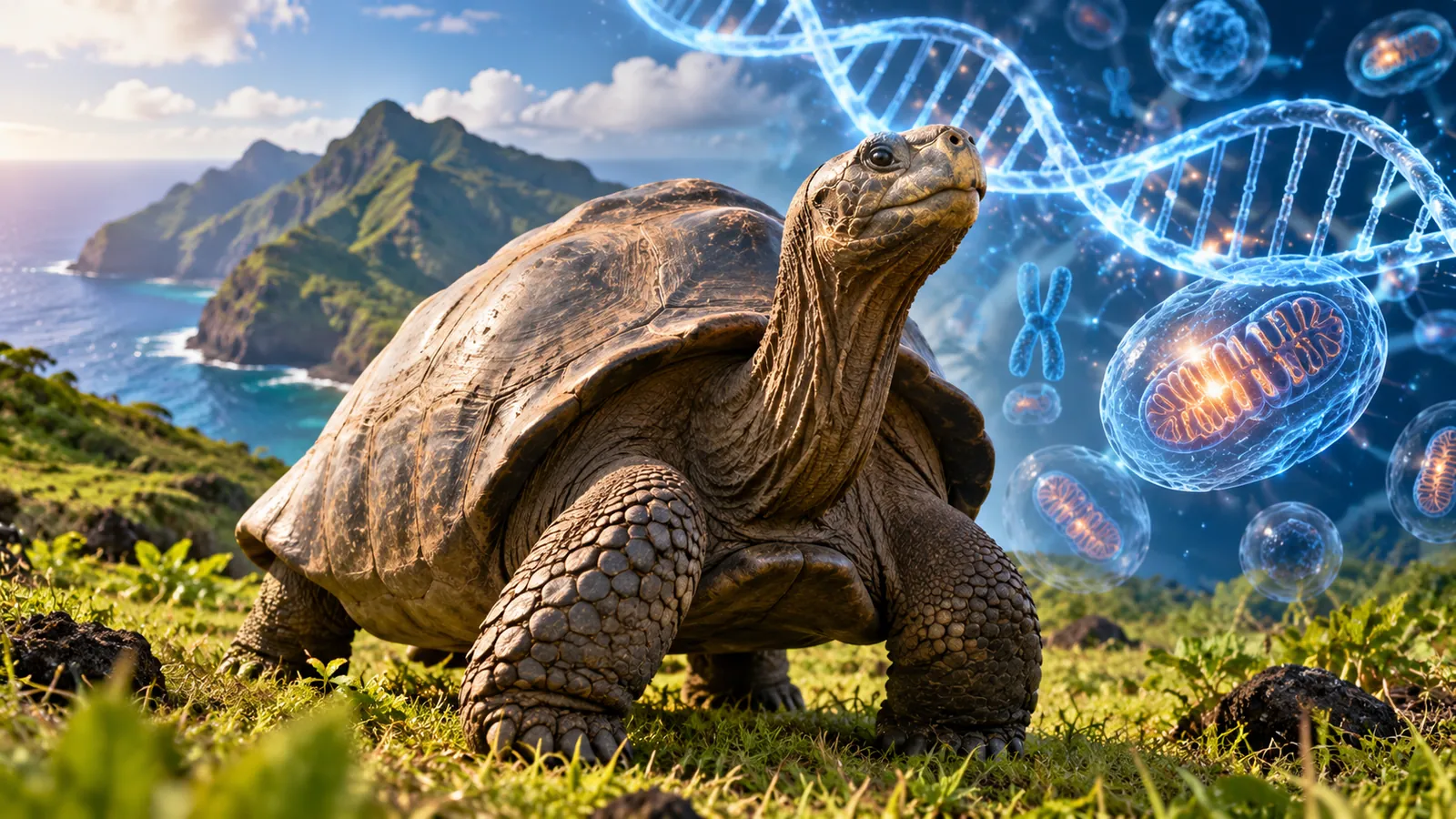
Jonathan has been alive for roughly 194 years. He was already a mature tortoise when he arrived on the remote Atlantic island of St. Helena in the 19th century, and he is now recognized as the world’s oldest known living land animal. That alone would make him remarkable. But scientists are now interested in something more specific: what has happened inside his cells while almost two centuries passed around him?
A new study published in Science Advances has examined Jonathan’s genome and epigenome in an attempt to understand the biology behind his extraordinary lifespan. The results do not reveal a single “longevity gene,” but they point to an unusual combination of genetic variants and remarkably stable molecular systems involved in energy production, RNA processing and DNA maintenance.
The findings are fascinating, but they also come with an important warning: Jonathan is one animal. His biology may offer clues about extreme longevity, not a recipe that can simply be transferred to humans.
Who is Jonathan, and why is he so unusual?
Jonathan is a giant tortoise living on St. Helena, a British Overseas Territory in the South Atlantic. His estimated birth year is around 1832, which makes him about 194 years old in 2026.
Giant tortoises are already famous for long lifespans, but Jonathan is exceptional even by their standards. His age makes him a rare natural experiment: a living animal whose cells have remained functional for far longer than those of most vertebrates.
Scientists have long studied giant tortoises because they combine large body size with unusually slow aging. That combination is especially interesting because larger bodies contain more cells, which in theory should create more opportunities for harmful mutations. Yet many giant tortoises appear unusually resistant to age-related decline and cancer.
What did scientists analyze?
Researchers sequenced DNA from Jonathan and compared it with genetic data from other giant tortoises, including younger Aldabra tortoises and the famous Pinta Island tortoise Lonesome George.
They also studied DNA methylation, an epigenetic process in which chemical tags influence how genes are switched on or off without changing the underlying DNA sequence.
DNA methylation patterns tend to become less orderly with age. Researchers sometimes describe this loss of order as increasing methylation entropy. In simple terms, the control system governing gene activity becomes noisier over time.
The 287 genetic variants that stood out
The team identified 287 gene variants in Jonathan that were not seen in the comparison tortoises used in the study. Many of those variants occurred in pathways already associated with aging biology.
Those pathways included DNA repair, telomere maintenance, mitochondrial function and insulin-related signaling. Some of the genes also have known links to tumor suppression.
That does not mean scientists found 287 separate “anti-aging genes.” The safer interpretation is that Jonathan carries an unusual collection of variants in biological systems that are already known to matter for cellular maintenance.
His mitochondria may be one of the biggest clues
One of the most intriguing findings involved mitochondria, the structures inside cells that generate much of the energy cells need to function.
Mitochondrial dysfunction is considered a hallmark of aging in many species. As cells age, energy production can become less efficient and molecular damage can accumulate.
In Jonathan, however, promoters controlling genes involved in the mitochondrial electron transport chain showed unusually low methylation entropy. That suggests the genetic instructions for important energy-producing pathways may still be regulated with relatively high precision.
The researchers propose that this molecular stability could help preserve efficient energy production even at an extreme age.
Why would stable energy production matter for longevity?
Keeping a cell alive for decades is expensive. DNA must be repaired, damaged proteins must be replaced, RNA must be processed correctly and countless quality-control systems must continue operating.
All of those processes require energy. If mitochondria continue producing energy efficiently, cells may be better able to maintain and repair themselves.
The new study therefore supports a broader model in which long life may depend partly on preserving the systems that keep gene expression accurate and cellular energy dependable.
Jonathan’s epigenome did not simply stop aging
It would be easy to imagine that Jonathan’s DNA somehow remained permanently “young.” That is not what the study found.
Researchers detected substantial age-related methylation changes in his genome. Jonathan has clearly aged at the molecular level.
What stood out was that some key regions remained unusually ordered, particularly promoters linked to mitochondrial function and RNA metabolism. The distinction matters: he appears to have aged while preserving certain critical systems unusually well.
Could this explain why he has avoided cancer?
Possibly, but the evidence is not strong enough to make a direct claim.
Several of Jonathan’s unique genetic variants occur in pathways related to tumor suppression and genome maintenance. Giant tortoises more broadly have also attracted scientific interest because of their apparent resistance to cancer.
Still, finding a variant in a cancer-related pathway is not the same as proving that the variant protected Jonathan from cancer. That will require experiments and comparisons across more animals.
How reliable are the findings?
The study is peer reviewed and was published in Science Advances, but there are important limitations.
Jonathan is a single individual. Scientists cannot easily separate what is unique to him from what may be typical of exceptionally old giant tortoises.
The DNA also came from cheek tissue rather than a pristine blood sample, which limited the completeness of the sequence. Researchers say additional samples and studies of other long-lived species will be needed.
Environment matters too. Jonathan has spent much of his life in a protected setting, with veterinary care and a controlled diet in later years. Genes are only part of the story.
What does this mean for human aging research?
For now, the answer is: clues, not treatments.
Some of the pathways highlighted in Jonathan — DNA repair, mitochondrial health, telomere biology and insulin signaling — are also important in human aging research. That overlap makes the tortoise scientifically valuable.
But humans and giant tortoises are separated by vast evolutionary differences. A mechanism that contributes to a 194-year lifespan in a tortoise may not work the same way in people.
The real opportunity is to identify biological principles that remain important across species, then test those principles carefully in laboratory models and eventually, where appropriate, in clinical research.
A living time capsule of aging biology
Jonathan was alive before the invention of the telephone, before electric lighting became widespread and long before genetics existed as a modern science.
Now his own genome is being used to study one of biology’s oldest questions: why do some organisms remain healthy for so much longer than others?
His DNA does not give scientists a secret formula for immortality. What it offers is something more useful: a rare example of a body that has maintained essential cellular functions for almost two centuries.
Frequently asked questions
Is Jonathan really 194 years old?
His exact birth date is not known, but records and historical estimates place his birth around 1832, making him approximately 194 years old in 2026.
Did scientists discover the gene that makes Jonathan live longer?
No. The study identified many genetic and epigenetic differences, not one single longevity gene.
Can Jonathan’s DNA be used to make humans live to 194?
There is currently no evidence for that. The findings may help researchers understand biological pathways involved in healthy aging, but they do not provide a human anti-aging treatment.
What was the most interesting finding?
One of the strongest signals involved unusually low methylation entropy in gene-control regions linked to mitochondrial energy production and RNA processing.
The bottom line
Jonathan’s extraordinary age appears to be associated with a mixture of unusual genetic variants and unusually stable regulation of key cellular systems. His mitochondria, DNA repair pathways and gene-control mechanisms may have remained more orderly than scientists would normally expect in such an old animal.
That does not make Jonathan a blueprint for human immortality. But as researchers search for ways to extend healthy lifespan rather than simply add years of frailty, the world’s oldest land animal may turn out to be an unexpectedly valuable teacher.
Sources
Vanderbilt University Medical Center — Study summary and researcher comments.
Reuters — Jonathan the tortoise and the new longevity study.
You may also like
 Science & Curiosities
 Scientists Found an Archaeon With a Record-Tiny Genome — Is This Near the Minimum Needed for Life?
Candidatus Sukunaarchaeum mirabile has just 189 protein-coding genes and the smallest known archaeal genome, offering new clues about…
 Science & Curiosities
 A 2-Million-Year-Old Adult Homo erectus Fossil Is Rewriting an Early Human Timeline
An adult Homo erectus skull fragment from Drimolen, South Africa, strengthens evidence that the species was present there…
 Science & Curiosities
 James Webb Detects Changing Water Clouds Beyond Our Solar System for the First Time
Webb monitored the nearby brown dwarf WISE 0855 for 11 hours and directly detected water clouds changing thickness…