
How to Find Lost Workplace Pensions in the UK for Free
Find lost UK workplace pensions for free. Use the government Pension Tracing Service, track old employers and contact providers to confirm your pension.
Contents
- Choose the right starting point
- Before you begin: gather the clues that make a search easier
- Step 1: make a list of the places you worked
- Step 2: identify the pension scheme or administrator
- Step 3: use the free GOV.UK Pension Tracing Service
- Step 4: contact the administrator to confirm whether a pension exists
- What if you cannot find the employer or the pension provider?
- The employer changed name or was dissolved
- You remember the provider, but the name no longer exists
- You have no paperwork and cannot remember the employer name
- When the first search fails, use this diagnosis
- Workplace pension versus State Pension: they are different searches
- After you find a pension: ask these questions before taking action
- Is tracing a lost pension free? How to avoid scams
- Keep a simple pension-search record
- The practical next step

To find a lost workplace pension in the UK, start with a former employer or pension scheme name, use the free government Pension Tracing Service to find the scheme’s contact details, then ask its administrator to check whether it holds benefits in your name. You do not need to pay a tracing company just to use the government service.
There is an important limit: GOV.UK’s Pension Tracing Service gives contact information. It cannot confirm that a pension belongs to you or tell you its value. That confirmation must come from the pension provider or scheme administrator. The steps below cover missing paperwork, old employers, company name changes and what to do if the first search fails.
Choose the right starting point
| What you still know | Best first action | What you should get |
|---|---|---|
| Former employer’s name | Ask former HR/payroll or search the employer name through the government tracing service | The pension scheme or administrator’s contact details |
| Pension provider or scheme name | Search that name in the government service | An address or contact route for the current administrator |
| Only roughly when and where you worked | Rebuild your employment list from old records, then check company name changes | A shortlist of employer or scheme names to search |
| Provider details already found | Contact the provider directly and ask it to search for your record | A confirmed match or a clear request for further evidence |
A government search result is a lead, not an award letter. Keep the tracing stage separate from identity checks, verification of entitlement and any later decision about the pension.
Before you begin: gather the clues that make a search easier
You can start without a pension policy number. Make a private record of what you remember, and look for clues in documents you already own:
- Employer names: include trading names, old business names and any group company shown on payslips or contracts.
- Approximate employment dates: month and year are helpful; estimate rather than invent exact dates.
- Old pension communications: annual statements, enrolment letters, welcome packs, payroll deductions and emails from pension administrators.
- Previous addresses or surnames: these may help the provider match an older record later.
- National Insurance number and identity documents: keep them ready for a verified provider’s secure process, but do not post them in public search forms, messages or comments.
A P45, P60 or old payslip may help establish who employed you and when. It does not, by itself, prove that money was paid into a particular workplace pension. Similarly, a pension deduction on one payslip is a useful clue, not a current account balance.
Step 1: make a list of the places you worked
Write down each former employer, even if you were there briefly or the business has since changed name. Add a column for “pension found”, “provider unknown” or “need to check”. Do not cross an employer off just because you cannot find a statement: eligibility and what happened to past contributions depend on the scheme and the period involved.
For example, suppose you worked for “Northfield Services Ltd” from 2013 to 2016, but the business now trades as “Northfield Group”. Record both names. Search the old one first, then check the company’s history if you receive no useful result. The names in this example are fictional; they are not recommended providers.
The public-service guide from MoneyHelper also recommends reviewing past employers and scheme paperwork before contacting administrators. This usually saves time compared with sending the same vague enquiry to multiple firms.
Step 2: identify the pension scheme or administrator
Look for phrases such as “pension scheme”, “workplace pension”, “occupational pension”, “scheme administrator” and “pension provider” in old employment correspondence. If you still know the former employer’s HR or payroll contact, ask who operated its pension scheme during your years of employment—not only who manages pensions for current staff.
If the employer merged, changed its legal name or closed, the free Companies House company-information service can help you follow registered names and company status. A Companies House record identifies a business; it does not establish which pension scheme you joined.
Step 3: use the free GOV.UK Pension Tracing Service
Open the official Find pension contact details page on GOV.UK and select Start now. The public page explains the service’s purpose and makes clear that you need an employer or pension provider name. It can be used for a scheme you had yourself or for someone else’s scheme when you have their permission.
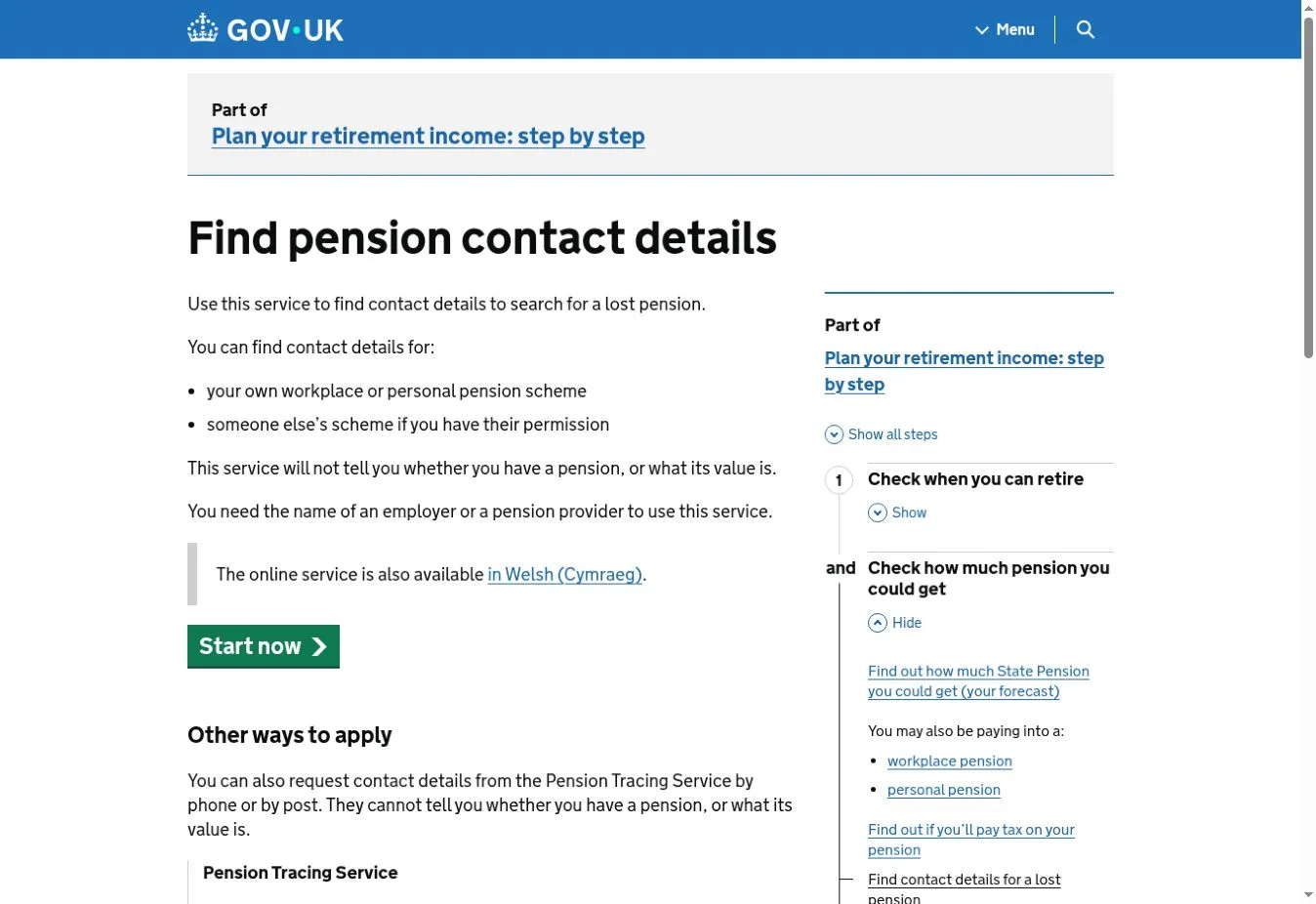
Screenshot: Department for Work and Pensions, GOV.UK service introduction, captured 20 November 2026. © Crown copyright; reused under the Open Government Licence v3.0.
The next public screen displays a declaration restricting use to your own pension or one you are authorised to investigate. Read it and select I agree only when that statement is true for you.
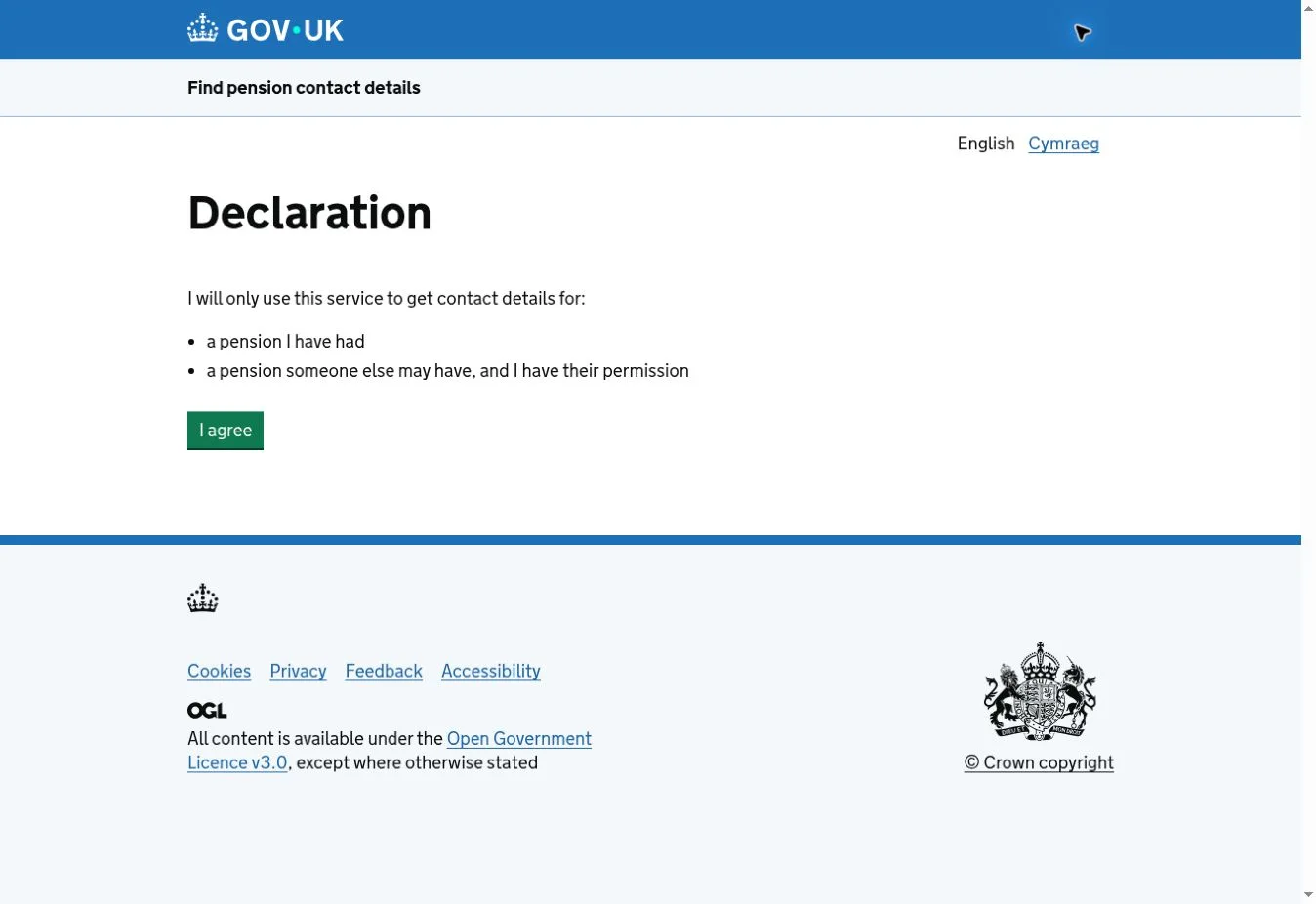
Screenshot: Department for Work and Pensions, Pension Tracing Service declaration, captured 20 November 2026. © Crown copyright; reused under the Open Government Licence v3.0.
After the declaration, follow the service prompts to search for a workplace or personal pension. The service supports searches using the name of an employer or pension scheme, including a previous name. Compare possible matches carefully and record the scheme name, any listed administrator and the official contact route. A similar company name is not proof that you have the right scheme.
- Start with the full employer name shown on an old contract or payslip.
- If necessary, try a known former trading name or the pension scheme name.
- Check the details of the matching scheme rather than relying on the first name in a list.
- Save the provider’s contact details and the exact name you searched.
- Contact the provider to establish whether it has a pension record for you.
The government also offers a telephone and postal route. The Pension Tracing Service number is 0800 731 0175 in the UK, or +44 (0)191 218 7777 from abroad. Its GOV.UK page currently lists telephone hours as Monday to Friday, 10am–3pm; check the live page for any change before calling.
Step 4: contact the administrator to confirm whether a pension exists
Once you have a plausible contact, use the scheme’s published website or telephone number, or independently verify the details before sharing personal information. Explain your previous employer and approximate employment dates. Ask the administrator to tell you which secure documents or identifying details it needs to search its records.
A simple first message keeps the request focused:
Subject: Request to trace a former workplace pension
Dear Pensions Administration Team,
I previously worked for [former employer name] between approximately [start month/year] and [end month/year]. I am trying to establish whether I hold a deferred benefit or pension account under a scheme you administer.
Could you please confirm the secure process for checking your records and the information you need from me? Please also let me know if the scheme has changed administrator or name.
Kind regards,
[your name]
Keep your National Insurance number, date of birth, previous addresses and scanned ID out of an ordinary initial email unless the administrator has directed you to an appropriately secure channel. When the provider locates a possible record, it may request those details to verify identity. Confirm the final contact channel independently, especially when a third party approached you first.
What if you cannot find the employer or the pension provider?
The employer changed name or was dissolved
Search the Companies House register using the old company name, then check its registered history and any successor named in your records. A dissolved employer does not automatically mean a pension disappeared. For certain eligible defined-benefit schemes whose sponsoring employer became insolvent, the Pension Protection Fund’s scheme list may be useful; not every missing pension is a PPF case.
You remember the provider, but the name no longer exists
Check whether the provider merged, rebranded or transferred administration. MoneyHelper advises using the Association of British Insurers’ information about insurers that changed names or ownership when relevant. Contact the current successor through independently verified details, giving the former name and approximate dates.
You have no paperwork and cannot remember the employer name
Start with old employment contracts, tax records, payroll emails, CVs, bank statements showing salaries and people who worked with you. Use any recovered employer name to restart the government search. The Pension Tracing Service is not a universal lookup that identifies every pension from a National Insurance number alone.
When the first search fails, use this diagnosis
| Problem | Likely reason to investigate | Next useful step |
|---|---|---|
| No matching employer result | A different trading or legal name may have been recorded | Check old payslips and Companies House history; retry with the alternate name |
| Several similar scheme names | Large employers may have used different schemes over time | Match employment years and ask the employer or administrator which scheme covered that period |
| Administrator says it has no record | Wrong scheme, name/address mismatch, transfer or past refund may be involved | Ask whether records moved and what evidence can help search again |
| Employer no longer exists | Scheme administration may have continued elsewhere | Check available successor information and relevant PPF scheme records |
| Provider confirms a pension, but no value yet | Identity or benefit calculation may still be outstanding | Ask when a current statement or formal benefit quote can be supplied |
Do not assume either “pension lost forever” or “money waiting to be paid” from a failed search. Ask the administrator what was checked and whether the enquiry can be escalated with further evidence.
Workplace pension versus State Pension: they are different searches
A workplace pension is arranged through an employer; the UK State Pension is based on government rules and your qualifying National Insurance record. Finding a workplace scheme will not repair gaps in your State Pension record, and a State Pension forecast will not list every old private pension pot.
For the government benefit, use Check your State Pension forecast. If the issue is missing qualifying years, our separate guide to checking your UK National Insurance record and missing years covers that route. Keep the two enquiries and their documents separate.
After you find a pension: ask these questions before taking action
Finding the plan is the beginning of a useful financial record, not a reason to transfer or withdraw anything immediately. Request a current statement and ask:
- Is this a defined contribution pot, a defined benefit promise, or another arrangement?
- What is the current value or accrued entitlement, and when was it last calculated?
- What is the scheme’s normal pension age, and how do you request an up-to-date benefit statement?
- Are there guarantees, safeguarded benefits, exit charges or conditions that would matter before a transfer?
- Are your contact information and beneficiary or expression-of-wish details current?
Be careful with offers to combine pensions. Moving a defined-benefit pension or another arrangement with guarantees can mean losing valuable rights; the rules and any regulated-advice requirement depend on the circumstances. Use impartial guidance from MoneyHelper and consider appropriately authorised professional advice before any irreversible decision.
Is tracing a lost pension free? How to avoid scams
Yes: the government Pension Tracing Service is free to use. A firm may sell additional tracing, consolidation or financial-advice services, but paying it is not a condition for accessing GOV.UK’s free contact lookup. Be cautious of unsolicited messages claiming a pension has been found and asking for an “unlock fee”, password, one-time code or bank transfer before proof of entitlement.
Start at the exact GOV.UK page rather than a search advertisement that uses similar branding. Never give a caller remote access to your phone or computer to “release” a pension. Keep copies of communications, but store personal documents privately.
Keep a simple pension-search record
A short tracking sheet helps avoid contacting the same scheme repeatedly. Use headings such as these in a private spreadsheet or notebook:
| Former employer | Years worked | Scheme/provider clue | Action and status |
|---|---|---|---|
| Employer A (example) | 2012–2015 | Old annual statement found | Contact administrator; await identity instructions |
| Employer B (example) | 2017–2019 | Not yet identified | Ask former payroll team for scheme name |
| Employer C (example) | 2020–2021 | Scheme contact found on GOV.UK | Check whether membership record exists |
Record the date of each request and the response, then set a reminder to follow up if necessary. Do not store passwords, copies of identity documents or full National Insurance numbers in the same general-purpose tracking sheet.
The practical next step
Choose one former employer today. Find its legal or trading name, open the free Pension Tracing Service, and get the contact details of the scheme that may have covered your time there. Then ask that administrator for a secure record check. Repeat the process employer by employer until each possible workplace pension is either located or thoroughly investigated.
You may also like
 Useful Information
Hotel Chocolat Recall UK: Batch Codes and Refund Steps
Check the UK Hotel Chocolat recall: affected Christmas box batch codes, best-before dates, purchase window and how to…
 Useful Information
How to Find a Lost 401(k) in the US: Government Database Guide
Search the free US Department of Labor database for a lost 401(k). Get Login.gov steps and official alternatives…
 Useful Information
Companies House Identity Verification: Requirements, Deadlines and Steps
Verify your identity for Companies House in the UK. Check director and PSC requirements, GOV.UK One Login steps,…