
Can One Extra Year of School Lower Dementia Risk 50 Years Later? The 2026 Evidence Explained
A 2026 PNAS study links a British school-leaving law to lower dementia diagnoses. We examine the 0.88-point estimate, genetics, and conflicting evidence.
Contents
- The surprising result, in context
- A 1972 school law became a 50-year health experiment
- What did the researchers actually examine?
- The 0.88 percentage-point result: why the headline number needs care
- An original worked example, not a prediction
- How the analysis tries to distinguish cause from correlation
- Did extra education change genetic risk?
- How could adolescent education affect the brain decades later?
- Why another 2026 study reached a less clear conclusion
- Why the ages studied matter more than headlines suggest
- Does this mean adults should go back to school to prevent Alzheimer's?
- What do other dementia-prevention experts recommend?
- A five-part checklist for reading future dementia headlines
- What should researchers test next?
- Conclusion: the real discovery is about life's influence on risk
- Primary research and authoritative sources

An extra year of compulsory secondary school was linked to fewer diagnosed cases of Alzheimer's disease and related dementias decades later in a new UK natural-experiment study. But the discovery is not a guarantee, a prescription to return to school, or proof that a specific classroom lesson prevents dementia. The strongest finding is that education may shape long-term dementia risk, including among people with higher inherited risk. The precise size of that effect remains uncertain.
The study by Silvia H. Barcellos and colleagues appeared online in Proceedings of the National Academy of Sciences (PNAS) on October 23, 2026, in an issue dated October 27. It analyzed UK Biobank participants and a British reform enacted in 1972. A separate 2026 investigation using a different aging dataset found no statistically detectable benefit from the same 1972 reform. Both results belong in an accurate account of the science.
The surprising result, in context
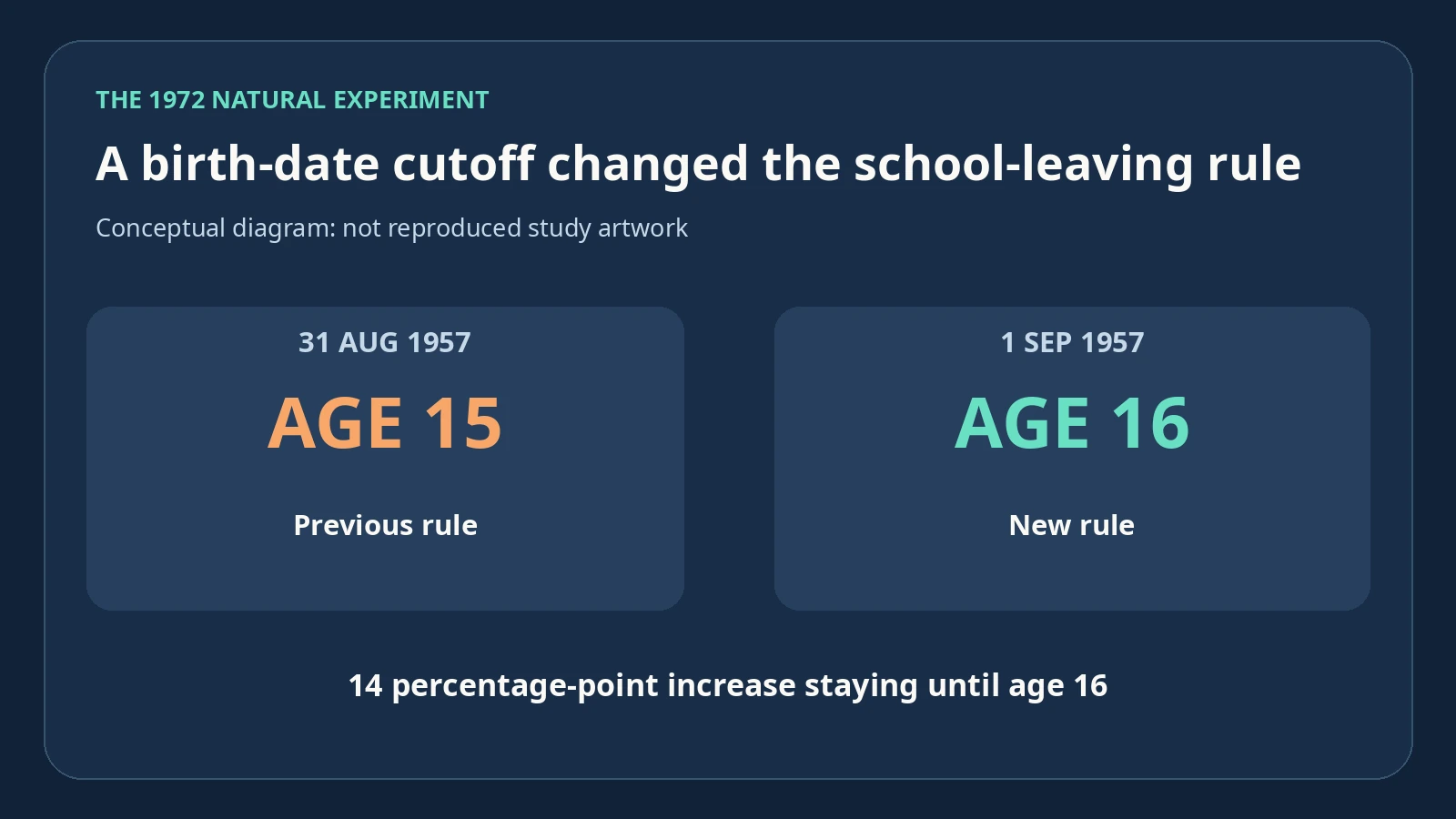
Researchers used a law that moved the earliest legal school-leaving age from 15 to 16 in England, Scotland and Wales. People born on August 31, 1957 could generally leave at 15; people born on September 1, 1957 came under the new requirement. Those birthdays were separated by a day, but the schooling rules were different. Such a sharp cutoff can allow an unusually informative comparison between otherwise similar people.
The reform raised the share remaining in school through 16 by approximately 14 percentage points. Looking at diagnoses recorded by December 2022, researchers saw a lower cumulative incidence of Alzheimer's disease and related dementias (ADRD) among those just on the affected side of the cutoff. They also found evidence that schooling weakened the observed relationship between genetic susceptibility and dementia diagnoses. These are population findings rather than predictions for any individual.
| Question | Evidence-based answer | Important limitation |
|---|---|---|
| Did staying in school become mandatory for longer? | Yes: minimum leaving age 15 to 16 | Not every person actually gained a full year of schooling |
| Were diagnoses less common? | Yes, around the reform cutoff in the PNAS study | Numbers were small before age 65 |
| Is the 0.88 figure a percentage drop? | No: the preferred estimate is **0.88 percentage points** | Too uncertain to treat as a reliable personal benefit |
| Did genetic risk disappear? | No, risk appeared modifiable in the studied setting | Genes still influence susceptibility |
| Is learning after retirement proven to reproduce this effect? | No | The study examined adolescent compulsory schooling |
A 1972 school law became a 50-year health experiment
In everyday life it is difficult to compare two adults who differ only in education. People who continue education often have different family incomes, childhood opportunities, health habits, neighborhoods and future occupations. If a highly educated group later experiences less dementia, that association does not reveal which factor made the difference.
The British government's 1972 Raising of School-Leaving Age reform (ROSLA) created something closer to a natural experiment. It was based on a fixed date of birth, not a family's prediction of future cognitive health. People born within days or months of the threshold were more comparable on many preexisting characteristics than arbitrary graduates and nongraduates. The team checked parental dementia history and genetic risk on both sides of the cutoff to test whether the comparison looked credible.
Crucially, the date boundary did not magically add a year of school to everyone. Many teenagers already intended to study beyond age 15. The share staying until 16 rose about 14 percentage points, but the mean school-leaving age in a broader specification increased by approximately 0.19 of a year—about 2.3 months across everyone affected. The one-year estimate pertains to people whose schooling changed because of the law, not to an average one-year increase across the entire sample.
What did the researchers actually examine?
The research used the UK Biobank, whose full enrollment is around half a million volunteers. The analysis drew on different subsamples, with as many as 107,200 people in a cohort born close to the September 1, 1957 cutoff. Individual regression specifications used smaller or slightly different groups; it would be misleading to say every reported statistic comes from exactly 107,200 people.
Dementia outcomes were assembled from hospital records, death registers and participants' reported medical histories, rather than one memory quiz. Cases recorded through December 2022 provided the central outcome measure. At that date, the first people covered by the reform were around 65 years old, so the findings chiefly concern dementia detected by approximately that age—not the much higher prevalence seen into the late seventies and eighties.
The study did not randomize children into classrooms or measure the brain biology of every participant. It examined whether the policy-driven increase in schooling predicted a measurable difference in diagnoses many decades later. That is a stronger design for causality than a simple correlation, though its conclusions still depend on research assumptions and the limits of the available data.
The 0.88 percentage-point result: why the headline number needs care
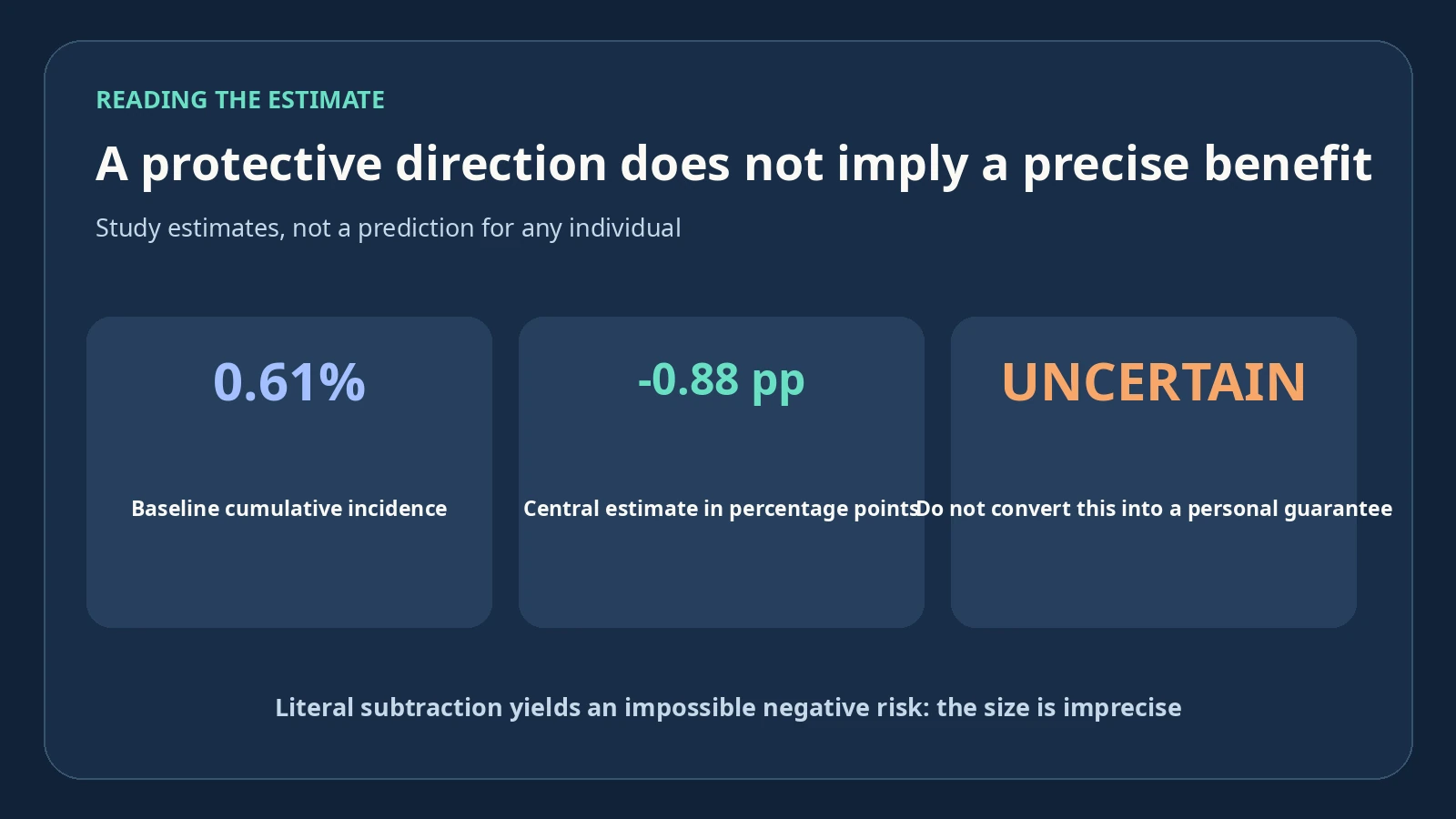
The authors' preferred instrumental-variable estimate, restricted to those who left school at 18 or younger, suggested that one additional year of education reduced cumulative ADRD diagnosis by 0.88 percentage points. Its reported 95% confidence interval was from −1.763 to −0.154 percentage points. In that restricted group's pre-reform comparison, the observed baseline cumulative incidence was approximately 0.61%.
That creates an important statistical warning: subtracting the point estimate of 0.88 points from 0.61% produces a negative incidence, which cannot occur in reality. The researchers explicitly note that their preferred estimate is larger than the baseline and is implausible as a literal prediction. In their interpretation, sampling variation is the most likely reason the numerical estimate is so large even though the study detects a protective direction.
An original worked example, not a prediction
Imagine a hypothetical population in which 0.61% develop a diagnosis by age 65. That corresponds to 61 people per 10,000. If someone mechanically applied a reduction of 0.88 percentage points, they would subtract 88 people per 10,000, predicting minus 27 cases—a mathematical impossibility. The correct response is not to promise that education eliminates all cases. It is to recognize that the point estimate has high uncertainty and is not suitable for projecting the number of prevented diagnoses.
The result is also not an “88% lower risk” claim. Percent and percentage points measure different things: going from 5% to 4% is a one-percentage-point decline and a 20% relative decline. When baseline incidence is tiny, mixing up these units can radically mislead readers. In its own discussion, the PNAS team asks readers to focus on evidence about a protective direction rather than overinterpreting the point estimate.
How the analysis tries to distinguish cause from correlation
A basic observational comparison might show that university graduates have less dementia than people who left school earlier. But graduates can differ in wealth, preexisting ability, childhood conditions and access to care. A regression discontinuity design compares people near a threshold whose chance of extra education changed abruptly for a reason outside their personal choice.
Researchers first checked a first stage: whether the reform truly changed schooling duration around the birthdate boundary. They then examined the difference in dementia diagnosis near the same threshold. A two-stage instrumental-variable approach used exposure to the law as the instrument for years of schooling. Its credibility relies on the assumption that no other abrupt change at precisely that date independently produced the later dementia difference.
The approach is clever, not infallible. UK Biobank volunteers are not a fully representative sample of everyone born in Britain. Diagnosis rates reflect health-service records and access as well as disease processes. A reform may affect employment, income and other pathways that influence health; researchers cannot isolate a single biological mechanism. And estimates near a discontinuity apply most directly to those whose schooling changed because of that specific law.
Did extra education change genetic risk?
The scientists built a polygenic index combining many genetic variants, including information related to APOE, a gene with established associations with Alzheimer's risk. Genetic risk scores describe statistical susceptibility; they do not determine an individual's fate or diagnose dementia.
The study found that the relationship between higher genetic predisposition and later dementia was weaker in the group subjected to more schooling. That is a meaningful result because it suggests the expression of an inherited vulnerability may depend partly on circumstances over a lifetime. It does not mean extra classes rewrite someone's DNA, neutralize APOE variants or prevent inherited forms of disease in every family.
Some stratified estimates have wide confidence intervals, and a difference in estimated effects between genetic-risk groups is not automatically statistically secure simply because one subgroup's estimate looks bigger. The value here is the interaction of social policy and genetic susceptibility, not a screening instruction for the public to buy a genetic test.
How could adolescent education affect the brain decades later?
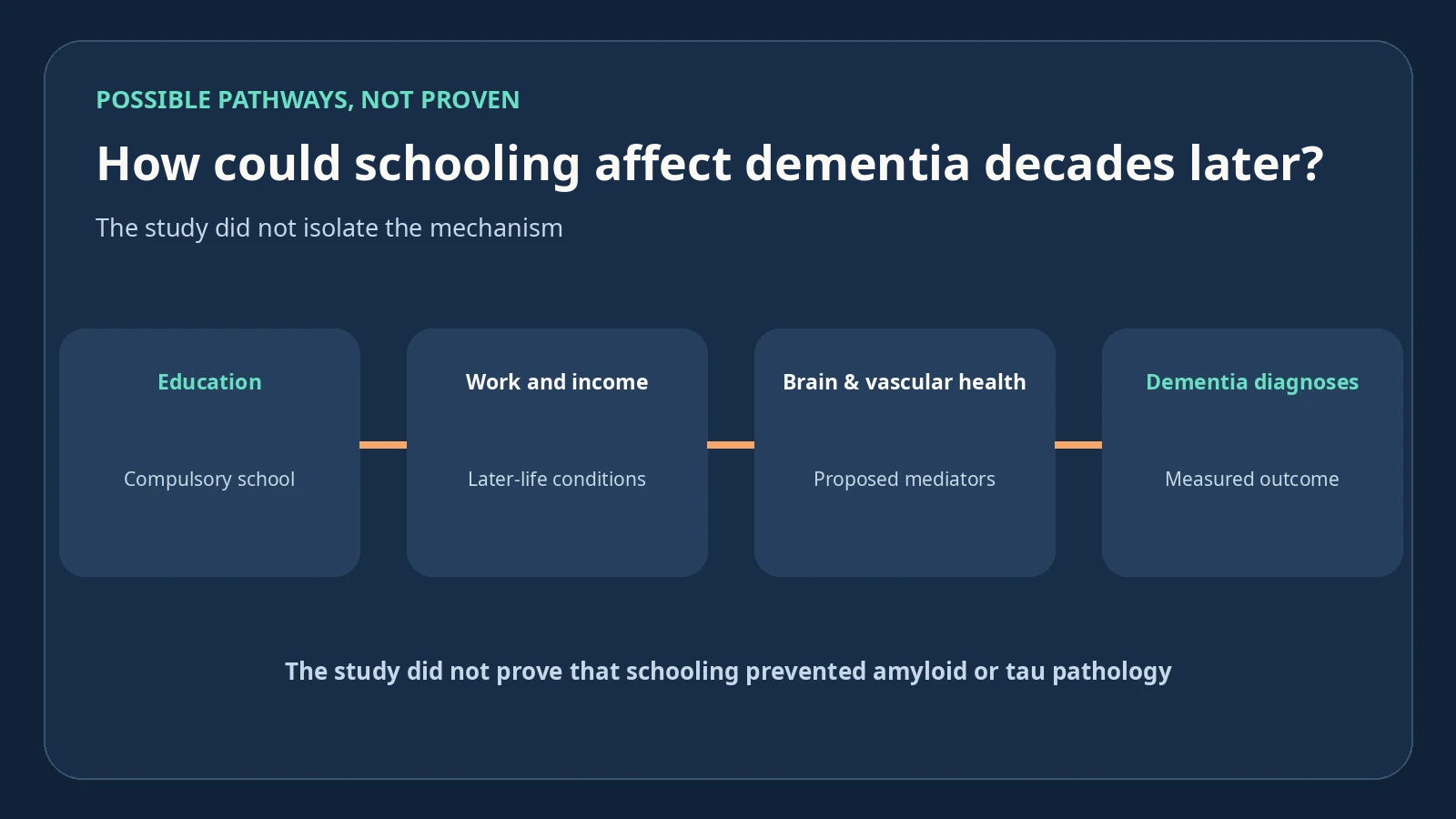
One proposed explanation is cognitive reserve: over time, learning and intellectually demanding activities may help some people cope longer with damage or age-related changes before clinical difficulties become evident. Another possible path runs through life conditions. More education may influence occupations, income, health knowledge, exposure to stress and access to medical care. Those in turn can affect vascular risk factors linked to dementia.
The PNAS study reported socioeconomic improvements associated with the reform and signs of improved cardiovascular outcomes. But it did not prove whether brain reserve, earnings, improved heart health or a combination of factors caused the dementia difference. The researchers were careful not to select one attractive story and label it the confirmed mechanism.
There is also a difference between delaying a clinical diagnosis and preventing pathological changes in the brain. A person with greater cognitive reserve might compensate longer despite underlying disease. The current study counted recorded diagnoses; it did not show that extra school prevented the buildup of amyloid or tau in a participant's brain.
Why another 2026 study reached a less clear conclusion
A study by Nathalie Monnet and colleagues, published in Social Science & Medicine in February 2026 and available in PubMed Central, used data from the English Longitudinal Study of Ageing (ELSA). It evaluated compulsory-schooling reforms in 1947 and 1972, with cognitive tests and a dementia-risk classification rather than solely the same record-linked diagnosis outcome used in the PNAS research.
That investigation found suggestive cognitive or dementia-related advantages from the 1947 reform for particular groups, especially women and people whose parents had lower educational attainment. For the 1972 reform, however, it found no statistically detectable reduction in dementia risk. That is not proof of zero effect; the authors acknowledged broad uncertainty. But it shows that not every dataset and outcome measure produces the same conclusion.
| Dimension | PNAS, October 2026 | Social Science & Medicine, February 2026 |
|---|---|---|
| Reform analyzed | Primarily 1972 change, ages 15 to 16 | 1947 and 1972 school reforms |
| Population/data | UK Biobank | English Longitudinal Study of Ageing |
| Health outcome | Recorded Alzheimer’s/related dementia diagnoses | Cognitive functioning and an algorithmic dementia-risk measure |
| 1972 conclusion | Protective effect detected | No statistically detectable reduction |
| Practical reading | Suggests schooling can matter | Magnitude and generalizability need more study |
The difference is important editorially. A study of diagnosed disease, a study of cognitive-test performance and a study of brain images ask overlapping but not identical questions. A third investigation published in eLife in 2025 also found no detectable sustained effect of the 1972 reform on measured adult brain structure. These results need not be logical contradictions: clinical symptoms, cognitive performance and structural imaging are distinct endpoints.
Why the ages studied matter more than headlines suggest
The new PNAS outcome period ended in 2022, when the first reform-affected cohort had reached around age 65. Most dementia diagnoses occur at older ages. That means the paper does not establish the precise benefit at age 75, 85 or 95. The authors themselves say that more follow-up could strengthen, weaken or change the magnitude of the association as participants age.
Selection matters too. UK Biobank participants tend to be healthier and more socioeconomically advantaged than the general population; most participants in this analysis were of European ancestry. The effect of schooling in 1970s Britain should not automatically be transferred to modern schools in Egypt, the United States or another country, let alone to entirely different adult courses.
Recorded clinical diagnosis is valuable, but it can miss people who never receive an assessment. Differences in healthcare access, survival and cognitive compensation could also affect rates of documented diagnosis. By combining hospital, death and medical history records, the team attempted to reduce some biases, but no observational database is a perfect census of disease.
Does this mean adults should go back to school to prevent Alzheimer’s?
No clinical trial in the article tested taking a new course at age 45 or 70. The study concerns an extra compulsory school year during adolescence created by a specific historical policy. Its design cannot tell us that an online degree, language-learning app or memory-training game later in life produces the same effect.
Continued learning may enrich life and offer social or intellectual benefits, but readers should distinguish those reasonable motivations from claims of proven disease prevention. Do not replace a clinical assessment with a promise about educational activities, and do not assume a person who left school early is destined to develop dementia. Dementia has multiple risk factors, many of which are unrelated to formal qualifications.
What do other dementia-prevention experts recommend?
The 2024 Lancet Commission reviewed evidence for 14 potentially modifiable risk factors across the life course. These include lower education early in life as well as hearing loss, high LDL cholesterol, hypertension, smoking, physical inactivity, diabetes, depression, social isolation and untreated vision loss, among others. The Commission estimated that addressing all 14 might theoretically delay or prevent a substantial share of cases at a population level; this should not be read as a guaranteed reduction for a given person.
A practical message is to think about brain health as a lifelong combination rather than a single intervention. Managing blood pressure, checking hearing or vision when needed, staying physically active within personal ability, avoiding smoking and maintaining social connection are sensible health topics to discuss with clinicians. No one should change medication or ignore symptoms on the basis of a news headline about schooling.
A five-part checklist for reading future dementia headlines
When another article claims something “halves dementia risk,” check what outcome was measured. Was it diagnosed dementia, a memory test score, a genetic risk score or a brain scan? These are not interchangeable. Ask who was studied and at what age. Examine absolute risk alongside relative percentages. Look for a comparison group that reasonably controls for wealth, upbringing and other confounders. Finally, read the confidence interval and whether independent research has produced compatible results.
Applied to this study, the checklist yields a measured conclusion: schooling forced by the 1972 reform appears to have reduced recorded dementia diagnoses through roughly age 65 in one sophisticated analysis, but the absolute magnitude is very imprecise and another 2026 analysis did not detect the same benefit with its own dataset and outcome definition.
What should researchers test next?
The highest-value next step is following the same birth cohorts as they age beyond 65, when dementia becomes much more common. Replication in more representative and ethnically diverse groups would test whether the relationship holds outside the particular UK Biobank sample. Researchers can also examine how schooling alters lifetime cardiovascular health, work, income and cognitive activity, and whether those channels help explain later diagnoses.
Longer follow-up and multiple outcomes matter: cognitive tests and imaging can be studied alongside medical diagnoses without assuming they all reveal the same biology. The question is not merely whether schooling matters, but for whom, when, through which pathway and by how much. Public policy requires answers to those details, not only a striking headline.
Conclusion: the real discovery is about life’s influence on risk
The story is bigger than an extra year at a school desk. It suggests that a societal decision affecting adolescents in the 1970s may have changed rates of dementia diagnosis decades later, even among people with increased genetic susceptibility. That is scientifically meaningful because genes do not operate in isolation from the world we grow up in.
Yet the strongest article is also the most careful: the preferred 0.88-percentage-point estimate is too large relative to the baseline rate to translate literally, evidence from other 2026 research is mixed, and effects in older adults or modern education programs remain unknown. Education may be one contributing layer of long-term brain health, not a personal shield against dementia.
Primary research and authoritative sources
• PNAS: Education reduces dementia incidence and mitigates genetic risk (23 October 2026)
• NIH: An extra year of secondary school lowered dementia diagnoses later in life
• USC Schaeffer: More Education Reduces Dementia Risk Decades Later
• Social Science & Medicine 2026: The Impact of Education on Dementia (full text)
• eLife: No effect of additional education on long-term brain structure
• Lancet Commission 2024: Dementia prevention, intervention, and care
You may also like
 Health & Science
Why Do I Feel Dizzy When I Stand Up? Causes and Warning Signs
Learn why you feel dizzy when standing up, how orthostatic hypotension works, what to do safely, and which…
 Health & Science
Why Do Some People Age Faster Than Others? Biological Age Explained
Chronological age and biological aging are different ideas. Genes, environment and habits influence health, but no single test…