
Why Do You Forget Why You Entered a Room? The Doorway Effect
Understand the doorway effect, mixed findings and two 2026 studies, with original research figures and practical ways to keep your goal in mind.
Contents
- What is the doorway effect?
- How did the early studies test it?
- Why has the effect not appeared in every experiment?
- What did two studies published in 2026 add?
- Three questions to ask about a memory headline
- Practical ways to keep an intention available
- Is this the same as a false memory?
- Sources and image notes

You may forget why you entered a room because the transition changes the context in which you were keeping your goal in mind, particularly when attention is divided. Doorway-effect research examines that relationship. It does not establish that every doorway causes forgetting or erases information from the brain. Results depend on the task and what participants must remember.
Imagine leaving your desk to fetch a charger. On the way, you read a message; by the time you reach the bedroom, you have lost the purpose of the trip. This is an illustrative scenario. That single episode cannot separate the effects of changing rooms, reading the message and how clearly you formed the intention in the first place.
What is the doorway effect?
The term concerns changes in the accessibility of information after crossing an event boundary, such as moving between rooms. One proposed explanation is that the mind organizes experience into event models and updates the current model when the situation changes. That framework can explain difficulty accessing some earlier information without implying permanent deletion.
To see the distinction, separate “I know I own a charger” from “I remember that fetching it is why I moved.” General knowledge and an active intention are different questions. You might recognize the destination and remember the room while temporarily losing the purpose of the trip.
How did the early studies test it?
In Radvansky and Copeland’s 2006 study, participants moved through virtual rooms and answered questions about objects they carried or had put down. Some object information became less accessible after a spatial shift. This measured memory for specified objects, not every possible cause of an everyday lapse.
In 2011 work described by the University of Notre Dame, virtual and real-room procedures compared crossing a doorway with travelling a similar distance within a room. Results supported an effect under those procedures. Returning to the original room did not improve memory in one experiment, so retracing your steps should not be presented as a guaranteed fix.
Why has the effect not appeared in every experiment?
A 2021 study by McFadyen and colleagues used four experiments and did not find a consistent overall doorway-related forgetting effect. Under added working-memory load in a VR experiment, false alarms increased for descriptions that did not match the relevant objects. That is narrower than “doors make you forget”: the kind of error and the testing conditions matter.
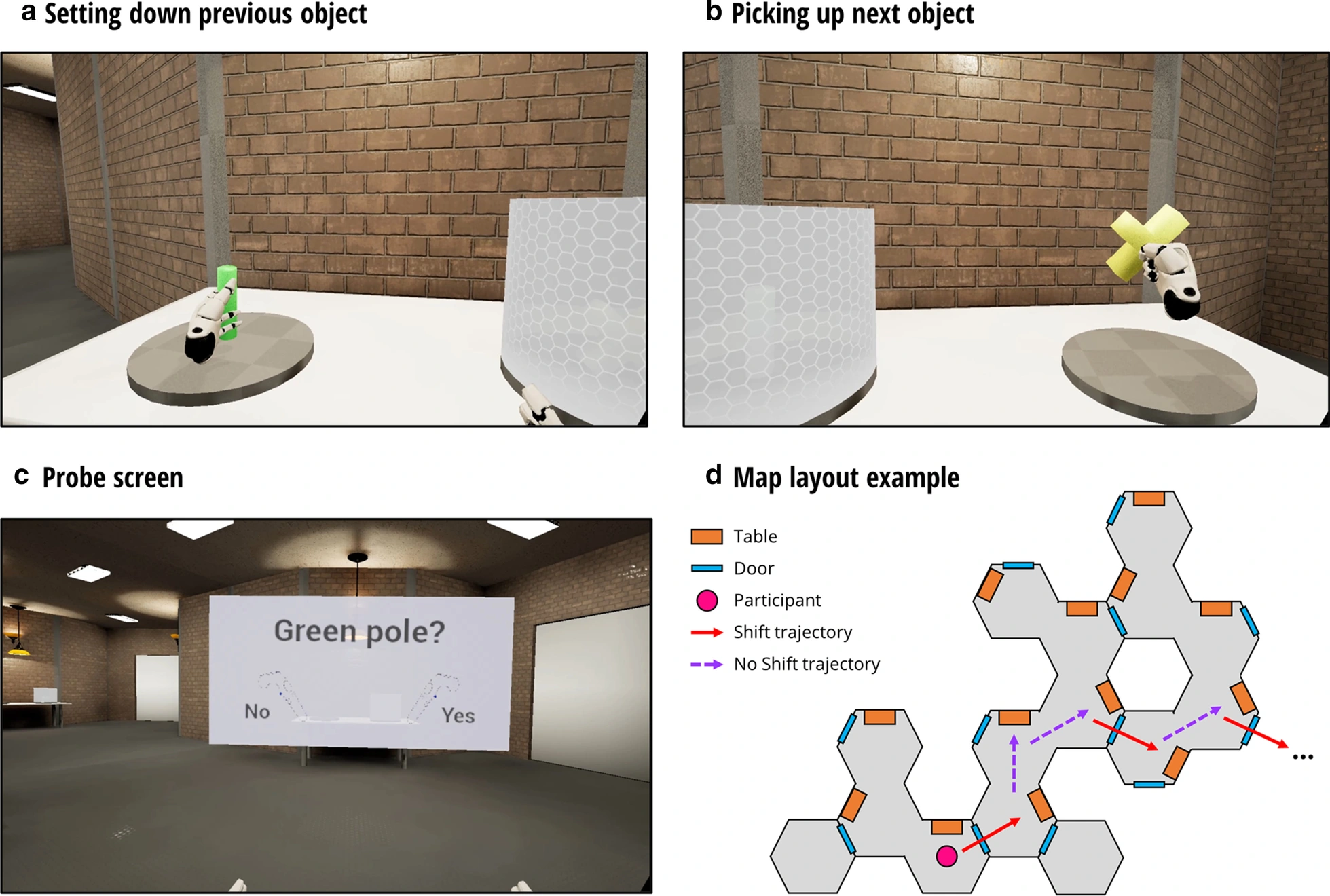
The figure shows the virtual task and movement layout, not brain activity. The next image shows the hallway arrangement used in two other experiments from the same paper.
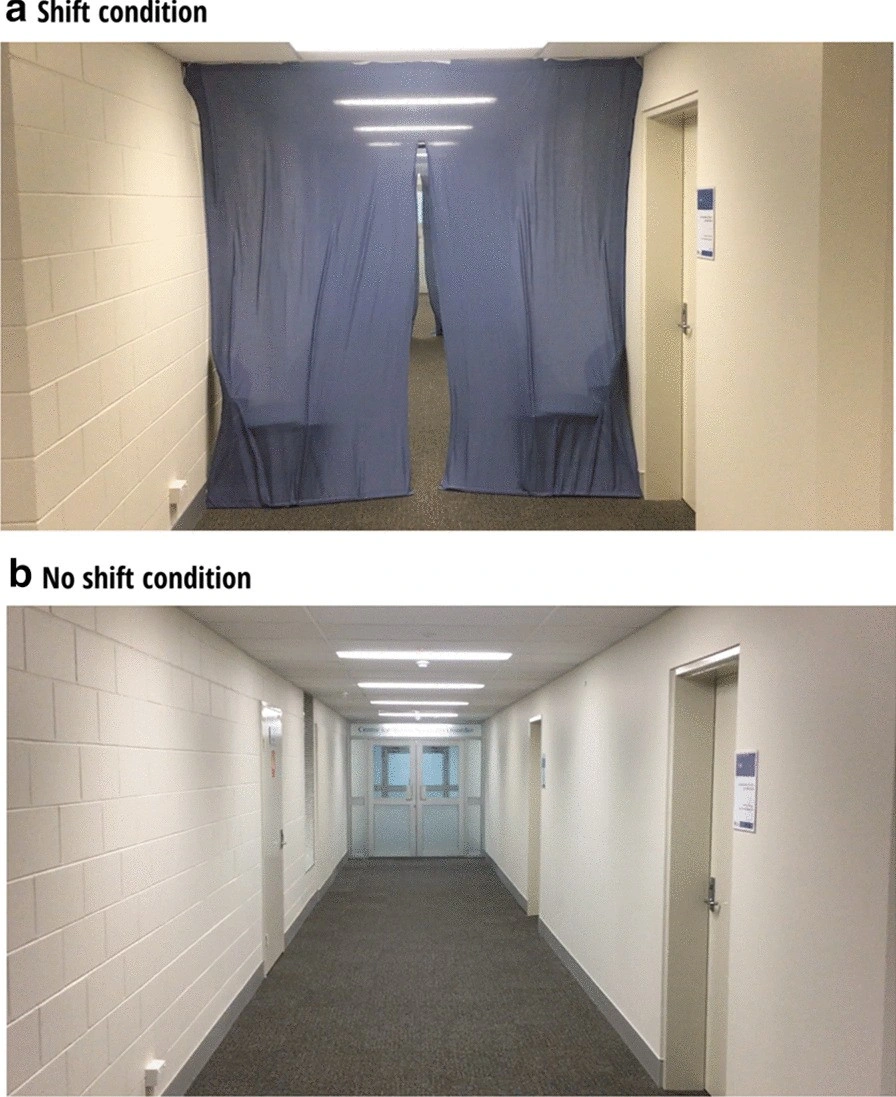
Source: McFadyen et al., 2021, Figures 1 and 2, CC BY 4.0. Original panels and labels retained; converted to WebP.
What did two studies published in 2026 add?
Published on January 26, 2026, Lamont and Bilkey’s study examined 90 participants exploring a five-room virtual building. Later tests concerned object order and contextual location. Spatial boundaries and spatial distractor tasks affected event memory, with results depending on where distraction occurred. This supports the importance of task design rather than a rule that doorways weaken every kind of memory equally.
A separate Crockett et al. paper, published January 9, 2026, tested whether learning words across two rooms improved later memory compared with one room. Evidence for a broad benefit was limited. One experiment found an advantage near the event boundary, but it faded after a short delay with intervening rooms. This does not justify recommending doorway crossing as a general memory enhancer.
Three questions to ask about a memory headline
| Question | Why it matters | Illustrative example |
|---|---|---|
| What was tested? | Recognition differs from remembering a goal or event order | Choosing an object’s colour is not recalling why you entered a kitchen |
| When was memory tested? | An immediate benefit may not survive a delay | A result just after moving does not guarantee the same result that evening |
| What was compared? | Doorways must be separated from distance, distraction and scene changes | Different rooms can change more than one feature |
The 2021 findings do not establish that the phenomenon is imaginary, and the 2026 papers do not remove all uncertainty. Related questions are being tested with different procedures and measures. The useful task is to understand each result’s limits rather than choose one headline to explain every lapse.
Practical ways to keep an intention available
These are organizational suggestions to try, not treatments shown by these studies to prevent forgetting in everyone:
- State a specific goal before moving: “I am getting the charger from the bedroom.”
- Where possible, finish that step before opening a new message or starting another task.
- For an important errand, write a brief reminder naming the needed item rather than relying entirely on recall.
- If you lose the goal, reconstruct your last clear decision and what preceded it. Retrace your steps if safe and useful, without assuming it will always work.
You can observe ordinary errands by noting the intended task, any interruption and whether you completed it. Do not deliberately distract yourself while driving, using tools or carrying something hazardous. Such notes may help organization; they do not measure the strength of a doorway effect or diagnose memory.
Is this the same as a false memory?
Failing to retrieve an intention differs from remembering a detail that did not occur or occurred differently. Retrieval and recognition errors can overlap in some tasks, but the terms are not interchangeable. Our guide to how false memories form addresses that separate question.
When you forget why you entered a room, the episode alone does not identify its cause. The useful lesson is to consider your goal, context and interruptions while distinguishing a laboratory result from a confirmed explanation of your individual experience.
Sources and image notes
Sources reviewed November 6, 2026. This article explains published research; Horus Valley did not run an experiment or collect participant data. The lead image is illustrative. The two research figures come from the licensed original paper, not an experiment conducted by this site.
You may also like
 Psychology
The Illusory Truth Effect: Why Repeated Claims Seem More Believable
Why does a repeated statement start to feel true? Explore the illusory truth effect, what 182 studies reveal,…
 Psychology
Why Do We Feel Nostalgic for a Time We Never Lived? The Psychology of Anemoia
Why do we miss decades we never experienced? Explore anemoia and historical nostalgia, the role of family stories…
 Psychology
What Happens When Actions Have No Consequences? Psychology Explained
Does a lack of punishment cause misconduct? Explore research on rule-following, accountability, behavior reinforcement and practical nonviolent boundaries.