
Cotard Syndrome Explained: Why Some People Believe They Are Dead
Explore Cotard syndrome, nihilistic delusions, clinical evidence, causes, diagnosis, treatments, risks, and what families should know.
Contents
- What is Cotard syndrome?
- Do people literally believe they are dead?
- The history behind the name
- Symptoms beyond the belief of being dead
- Is it a separate psychiatric diagnosis?
- The connection to psychotic depression
- Schizophrenia and other psychiatric contexts
- Neurological and medical associations
- What might happen in the brain?
- What do systematic reviews actually show?
- Delusion versus metaphor: a crucial distinction
- Cotard syndrome versus depersonalization
- How clinicians evaluate it
- Why urgent care may be needed
- Treatment depends on the underlying condition
- What is ECT, and what can the evidence support?
- Supporting a family member compassionately
- Can people recover?
- Common myths and misconceptions
- The bottom line
- Scientific references
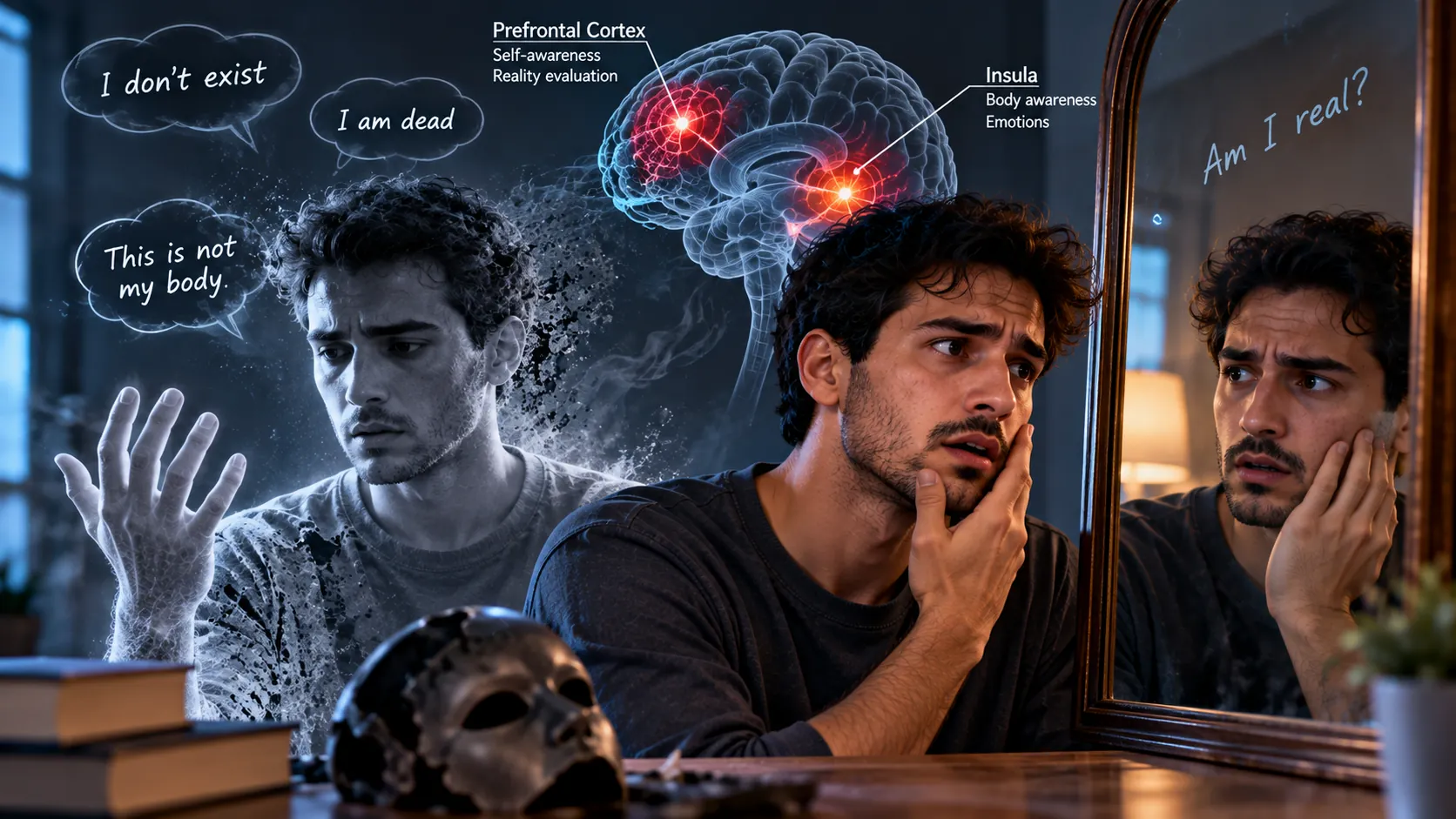
How can a living person become convinced that they are dead? Documented clinical cases of Cotard syndrome raise questions about bodily awareness and belief. This evidence-based guide separates medical findings from myths and explains practical safety concerns.
What is Cotard syndrome?
Cotard syndrome describes an uncommon cluster of neuropsychiatric symptoms centered on nihilistic delusions: a person may firmly believe they are dead, do not exist, or have lost their organs. Popular accounts call it “walking corpse syndrome,” but that sensational label risks trivializing a potentially serious and treatable clinical problem. The defining issue is not ordinary sadness or a metaphorical statement; it is a conviction that can persist despite contradictory evidence.
Do people literally believe they are dead?
Some individuals report being dead, lacking a heart or brain, or no longer having a body. Others deny the existence of the surrounding world or paradoxically believe they cannot die. Presentations vary substantially, and patients may act on their beliefs—for example, refusing meals because they believe eating is unnecessary. Such behavior makes timely assessment essential.
The history behind the name
French neurologist Jules Cotard described a striking clinical presentation in 1880 involving denial of bodily organs and existence. Later clinicians used his name for related nihilistic delusions. The historical case does not establish one single disease mechanism: the syndrome can occur in several psychiatric and neurological contexts.
Symptoms beyond the belief of being dead
Reported features include beliefs that organs are absent or have stopped working, profound guilt or damnation, beliefs of immortality, anxiety, depressive symptoms, hallucinations, social withdrawal, impaired self-care, and altered appetite or sleep. Not every patient has every feature. One unusual statement alone is insufficient for diagnosis; clinicians examine conviction, context, functional impact, and accompanying symptoms.
Is it a separate psychiatric diagnosis?
Cotard syndrome is generally treated as a descriptive clinical syndrome rather than a standalone diagnosis in major diagnostic manuals. The critical clinical task is to identify the underlying condition—such as psychotic depression, schizophrenia-spectrum illness, delirium, or a neurological disorder—rather than stopping at a memorable label.
The connection to psychotic depression
Severe depression with psychotic features is a frequently reported setting. Feelings of worthlessness, guilt, and catastrophe can take the form of fixed beliefs that the self or body has ceased to exist. However, most people with depression do not develop Cotard delusions, and Cotard presentations are not always depressive. This distinction matters for accurate reporting and stigma reduction.
Schizophrenia and other psychiatric contexts
Case reports document Cotard-type beliefs in schizophrenia and other psychotic disorders, sometimes alongside hallucinations or persecutory beliefs. The precise clinical picture differs from patient to patient. A careful psychiatric assessment examines mood, psychotic symptoms, medications, substance use, and the course of the illness.
Neurological and medical associations
Published cases have also described nihilistic delusions following strokes, traumatic brain injury, seizures, encephalitis, and certain neurodegenerative conditions. Association in a case report is not proof of a universal cause. New confusion, focal neurological deficits, or abrupt changes may warrant urgent medical investigation.
What might happen in the brain?
Researchers have proposed disruptions in how the brain integrates bodily sensations, emotions, familiarity, and self-related beliefs. Interoception—the processing of internal bodily signals—is one area of interest. These explanations remain hypotheses, not validated individual diagnostic tests. No single scan finding or brain region explains all cases.
What do systematic reviews actually show?
A systematic review published in 2020 examined 69 reported cases and identified several symptom clusters, including psychotic depression and delusional-hallucinatory presentations. Another literature-based review considered 328 cases when developing a proposed clinical approach. These are published cases, not a population sample, so the figures cannot be used to calculate prevalence or predict an individual patient’s outcome.
Delusion versus metaphor: a crucial distinction
Saying “I feel dead inside” during exhaustion or grief is not automatically a delusion. Clinicians ask whether the person literally believes they have died, how strongly they hold that belief, whether they can reconsider it, and how it affects behavior. Timing, sleep, nutrition, recent illness, neurological symptoms, and substance exposure are also relevant.
Cotard syndrome versus depersonalization
Depersonalization can involve feeling detached from the body or experiencing the world as unreal, often while retaining insight that this is a subjective experience. Cotard delusions involve a more fixed conviction of nonexistence or death. The two can overlap, and an online description cannot reliably distinguish them in a particular person.
How clinicians evaluate it
There is no specific blood test or consumer app that diagnoses Cotard syndrome. Assessment relies on psychiatric history, mental-status examination, evaluation of immediate risks, and a search for underlying causes. Blood tests, brain imaging, or EEG may be appropriate when the history or examination suggests a medical or neurological contributor, but are not universally required.
Why urgent care may be needed
Refusal of food or fluids, dehydration, malnutrition, severe self-neglect, and suicidal behavior have been documented in case reports. A person who stops eating or drinking, expresses intent to harm themselves, becomes acutely confused, or develops new neurological symptoms needs urgent professional assessment. Safety should take priority over debating whether a belief is true.
Treatment depends on the underlying condition
Management may involve antidepressants, antipsychotic medication, or combinations selected by a clinician for the underlying disorder. Electroconvulsive therapy (ECT) has been described as helpful in some severe presentations, particularly psychotic depression, but treatment decisions require specialist evaluation. There is no single proven medication regimen for all cases, and self-treatment is unsafe.
What is ECT, and what can the evidence support?
Modern ECT is a supervised medical procedure performed under anesthesia with physiological monitoring. Reports describe improvement in some patients with Cotard delusions. Yet the syndrome-specific evidence comes largely from case reports and literature reviews rather than large randomized trials, so effectiveness should not be represented as guaranteed.
Supporting a family member compassionately
Avoid ridicule, confrontation, or sensational language. Acknowledge distress without reinforcing the delusion: “That sounds frightening, and I want to help you get medical support.” Encourage assessment, watch for reduced eating or drinking and safety concerns, and involve emergency services if there is imminent danger. Family support is valuable but does not replace professional treatment.
Can people recover?
Recovery or substantial improvement has been documented, particularly when an underlying psychiatric or medical condition is treated. Some patients require longer follow-up. Reliable recovery percentages are unavailable because cases are rare and published reports are subject to selection bias. Early recognition and attention to hydration, nutrition, and safety are practical priorities.
Common myths and misconceptions
Cotard syndrome does not mean the brain has physically died, and it is not evidence of supernatural phenomena. Affected individuals are not necessarily pretending, and the syndrome is not synonymous with all experiences of dissociation. Responsible explanations emphasize clinical complexity, uncertainty, and treatability rather than horror-story framing.
The bottom line
Cotard syndrome is a rare clinical phenomenon involving fixed beliefs about death or nonexistence. It offers a striking window into how the brain constructs the sense of self, but the central real-world issue is prompt assessment, risk management, and treatment of the underlying condition. This article is educational and is not a substitute for individualized medical care.
Scientific references
Clinical review of Cotard syndrome
Systematic review of 69 reported cases
Medical review of 328 published cases
Two case reports and literature review
You may also like
 Science & Discoveries
 Robot Dog Runs a Full Marathon on One Charge: How RAIBO2 Made It Possible
RAIBO2 completed a 42.195 km marathon on one battery. Explore the engineering, energy-saving gait, power figures and what…
 Science & Discoveries
 Can AI Discover New Antibiotics? Breakthroughs, Evidence and Limits
How does AI find possible new antibiotics? Explore halicin, abaucin, generative models, laboratory validation, resistance and the path…
 Science & Discoveries
 Diamond Rain on Neptune and Uranus: What Experiments Really Show
Can diamonds form inside Neptune and Uranus? Examine extreme-pressure experiments, the role of oxygen, conflicting results and what…