
Choice Blindness: Why We May Defend a Choice We Didn’t Make
Explore the choice blindness experiment, the face and supermarket studies, and newer evidence separating noticing a switch from reporting it.
Contents
- What is choice blindness?
- The original face experiment
- A simple example of why the explanation can mislead
- Did the effect appear outside face photographs?
- Jam and the smell of tea
- Later preferences
- Why silence is not the same as failing to notice
- The experimenter’s apparent reliability also matters
- A 2026 study separates missing a switch from justifying it
- Four claims the evidence does not justify
- How this differs from false memories and changing your mind
- A practical choice-check worksheet
- Read the experiment without turning it into a verdict about yourself
- Sources and image credits

Choice blindness describes a striking experimental result: people sometimes accept a substituted outcome as their own choice and explain why they preferred it. But an explanation after a swap does not establish exactly what the person noticed or why they stayed silent. That distinction makes the research more interesting than the claim that we never know our own minds.
Imagine choosing one of two notebook covers. Someone returns the other cover and asks why you liked it. You might object, reconsider, or begin describing the cover in front of you. Those responses would tell different stories. This notebook example is an illustration, not an experiment conducted by Horus Valley.
What is choice blindness?
The term concerns a mismatch between an intended selection and the outcome presented as that selection. It asks two questions: does someone flag the mismatch, and what explanation do they give? A 2006 paper on choice blindness and introspection examined the language of these explanations.
Keep three records separate when reading a study: the original selection, the item subsequently shown, and the participant’s response. A persuasive reason for liking the displayed item cannot, by itself, tell us whether that item was selected earlier. The original record is what allows the researcher to check.
The original face experiment
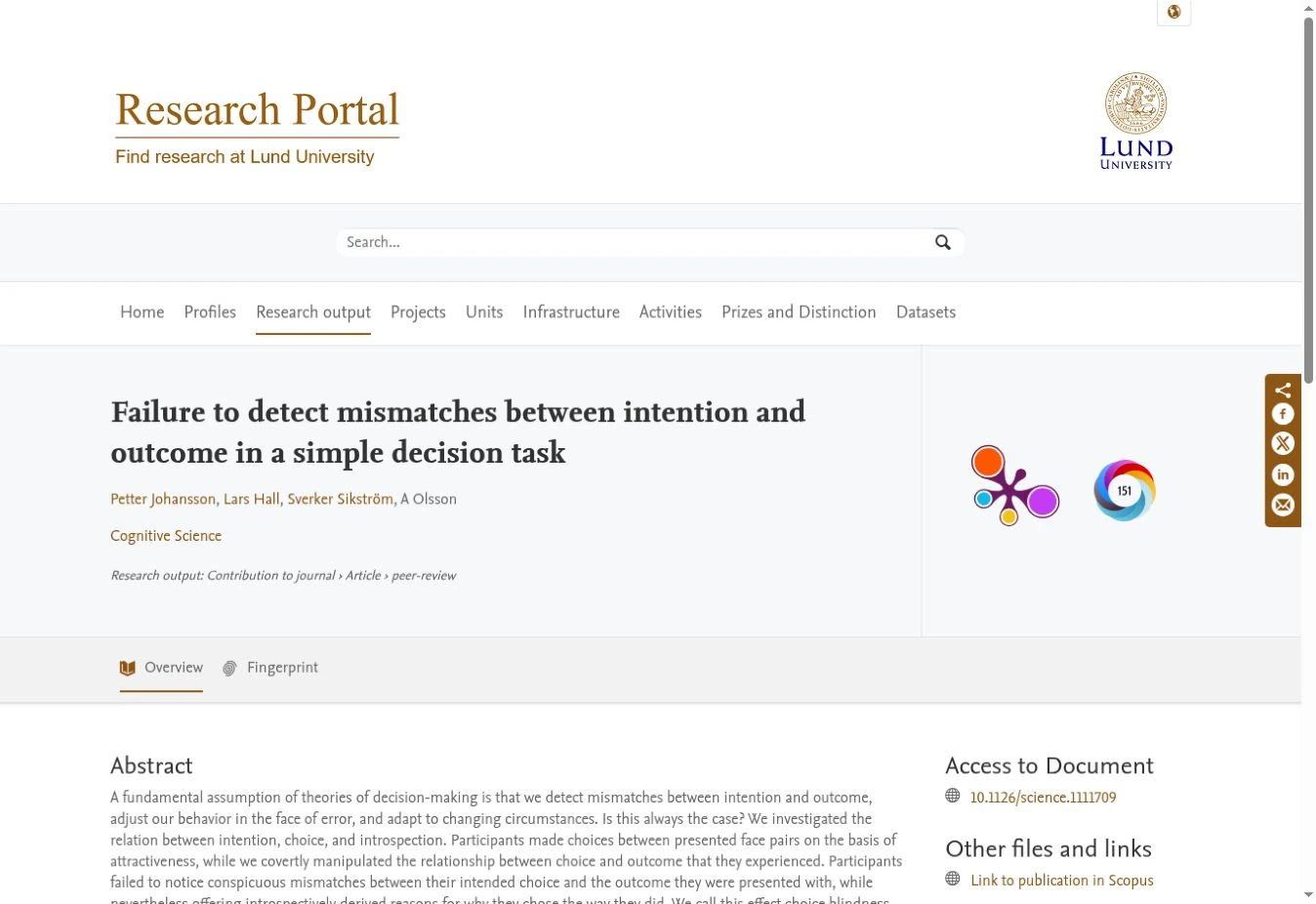
In the 2005 Science study by Petter Johansson and colleagues, participants selected the more attractive face from pairs. On some trials, a card trick substituted the rejected face. Participants were then asked to explain the selection presented to them; some supplied reasons without reporting the switch.
The original paper and supplementary material report 46 immediate detections among 354 manipulated trials, approximately 13%.
These percentages describe trials, not people. Check whether reporting occurred during the task or afterwards before comparing results.
A simple example of why the explanation can mislead
Return to the imaginary notebook choice. Suppose you initially select a plain blue cover, but are handed a patterned green cover and say that its pattern looks lively. The comment might be a perfectly understandable description of the object now in view. It still does not establish that the pattern motivated the earlier blue-cover selection.
To investigate that gap, ask separate questions: “Which cover did you select?” and “What do you like about the cover you are holding?” Combining them into “Why did you choose this?” builds an assumption into the question. This is an editorial example of how to inspect the logic, not evidence that every explanation is invented.
Did the effect appear outside face photographs?
Jam and the smell of tea
In a 2010 supermarket study, shoppers compared jams or smelled teas, selected a favourite, and received a secretly substituted sample to explain. Overall, no more than about one-third of manipulated trials were detected. This broadened the research beyond visual face judgements.
Later preferences
A follow-up published online in 2013 and in a 2014 journal issue examined repeated face choices and ratings. Initially rejected faces were selected more often after the manipulation, with increased attractiveness ratings. This concerns preferences measured within that task; it does not establish permanent changes in identity or values.
Why silence is not the same as failing to notice
A study published on 4 December 2025 used computerized image choices, retrospective reports and pupil measurements. The authors found evidence of noticing without immediate reporting, challenging broad interpretations of choice blindness. Its tasks differed from the original card experiment.
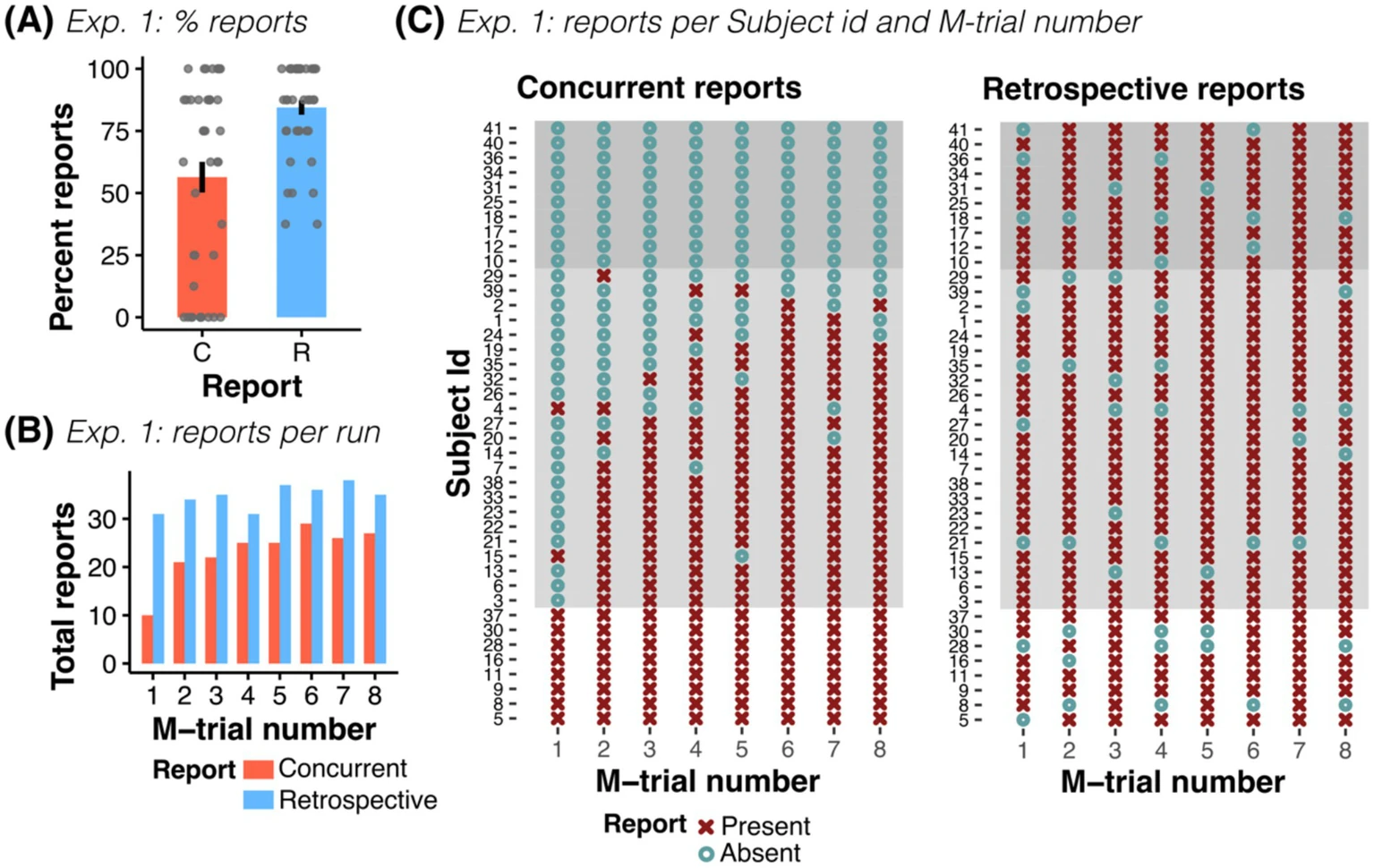
In the published figure, C means reports during the task and R means retrospective reports. Compare the two reporting stages before interpreting silence as absence of awareness. These are the researchers’ results, not data collected for this article.
The experimenter’s apparent reliability also matters
In three experiments reported in 2025, cues that made the experimenter appear less reliable increased reports of the mismatch. This supports treating the social context as part of the experiment, rather than assuming a fixed susceptibility that applies equally everywhere.
A 2026 study separates missing a switch from justifying it
A 2026 study of simulated military information tasks included novices and experts. Its abstract distinguishes missing a switch from producing a false justification; these outcomes did not always occur together. The tasks were simulations, so the findings should not be presented as measurements of real operational decisions.
Four claims the evidence does not justify
- “Free will has been disproved.” A preference task cannot settle that philosophical question.
- “People who do not object are lying.” The visible response does not establish an intention to deceive.
- “Anyone can be made to believe anything.” Such a universal claim needs evidence far beyond these tasks.
- “A confident explanation proves the original motive.” Check the initial selection and available evidence before treating an explanation as a record.
Consider a restaurant bringing the wrong meal. Recognising the dish, deciding whether to complain, and giving an opinion about its taste are three separate actions. That example helps clarify the questions; it does not supply a measured choice-blindness rate for restaurants.
How this differs from false memories and changing your mind
A changed preference is not automatically a mistaken recollection. You can accurately remember choosing blue and now prefer green. Equally, accepting an item handed to you does not demonstrate a durable false memory of selecting it. Ask what was actually measured: selection, verbal explanation, later recall, or a later preference.
For the separate question of remembering events inaccurately, see our guide to how false memories form. Keeping the questions distinct avoids turning every inconsistency into the same psychological phenomenon.
A practical choice-check worksheet
For an everyday purchase or design decision, try this record-keeping exercise. It is an editorial suggestion, not a validated treatment or a laboratory replication.
- Before choosing: write two or three criteria, such as price, readability or size.
- At selection: record the exact item or version and one short reason. A product code is more precise than “the nicer one.”
- At confirmation: compare the item in the basket, order or final design with that record.
- If your preference changes: record the new preference separately, including any new information.
- If something differs: ask which version is being discussed before defending its advantages.
For example, a reader might choose a smaller laptop because portability matters, then notice a larger model in the order summary. Checking the model number resolves the concrete mismatch. Debating which screen looks better does not answer whether the order matches the intended selection.
Read the experiment without turning it into a verdict about yourself
The strongest reading starts with a modest question: what links the recorded choice to the explanation given afterwards? Look at the task, the timing of objections and whether participants were offered a clear opportunity to correct the record. A surprising demonstration is a starting point for investigation, not a personality test.
If you discuss the idea with friends or students, use fictional examples or a fully explained exercise. Do not quietly switch someone’s real purchase, food or personal information and call the result a scientific test. A classroom anecdote without controls cannot establish the mechanism behind a response.
Sources and image credits
Reviewed 30 October 2026. The linked sources include the original experiment, later investigations two papers from 2025 and a simulation study from 2026. This is a research explainer; Horus Valley did not run an experiment or collect participant data.
Featured photograph: Wikideas1, Fork in the road, CC0; cropped and resized. It illustrates a choice of direction, not the laboratory setting. The Lund University image is a genuine capture of the original study’s public record.
Research figure: Grassi, Hoeppe, Baytimur and Bartels (2025), Figure 2, Frontiers in Psychology, DOI 10.3389/fpsyg.2025.1598254, CC BY 4.0; reproduced from the publisher and converted to WebP without changing the plotted results.
You may also like
 Psychology
The Illusory Truth Effect: Why Repeated Claims Seem More Believable
Why does a repeated statement start to feel true? Explore the illusory truth effect, what 182 studies reveal,…
 Psychology
Why Do We Feel Nostalgic for a Time We Never Lived? The Psychology of Anemoia
Why do we miss decades we never experienced? Explore anemoia and historical nostalgia, the role of family stories…
 Psychology
What Happens When Actions Have No Consequences? Psychology Explained
Does a lack of punishment cause misconduct? Explore research on rule-following, accountability, behavior reinforcement and practical nonviolent boundaries.