
NASA’s Cat’s Head Nebula: What Hubble and Webb Reveal in Three Images
NASA's new Cat's Head Nebula images show how Hubble and James Webb reveal different features of a stellar nursery inside Carina, 7,500 light-years away. Original image links and an evidence-led guide.
Contents
- View the original images: Hubble, Webb NIRCam and Webb MIRI
- Where is the Cat's Head Nebula, and was it just discovered?
- The main difference: visible light versus infrared light
- How to read Hubble's visible-light view
- What Webb's NIRCam adds that Hubble cannot show as clearly
- Why MIRI looks so different from NIRCam
- What could be creating the cat-like pillar?
- Are the dazzling colors real or made with AI?
- What have astronomers actually established — and what remains uncertain?
- A five-minute guided tour of the actual images
- Could you see the Cat's Head with your own eyes or a backyard telescope?
- Why this release matters beyond a striking picture
- Original sources, image credits and related reading
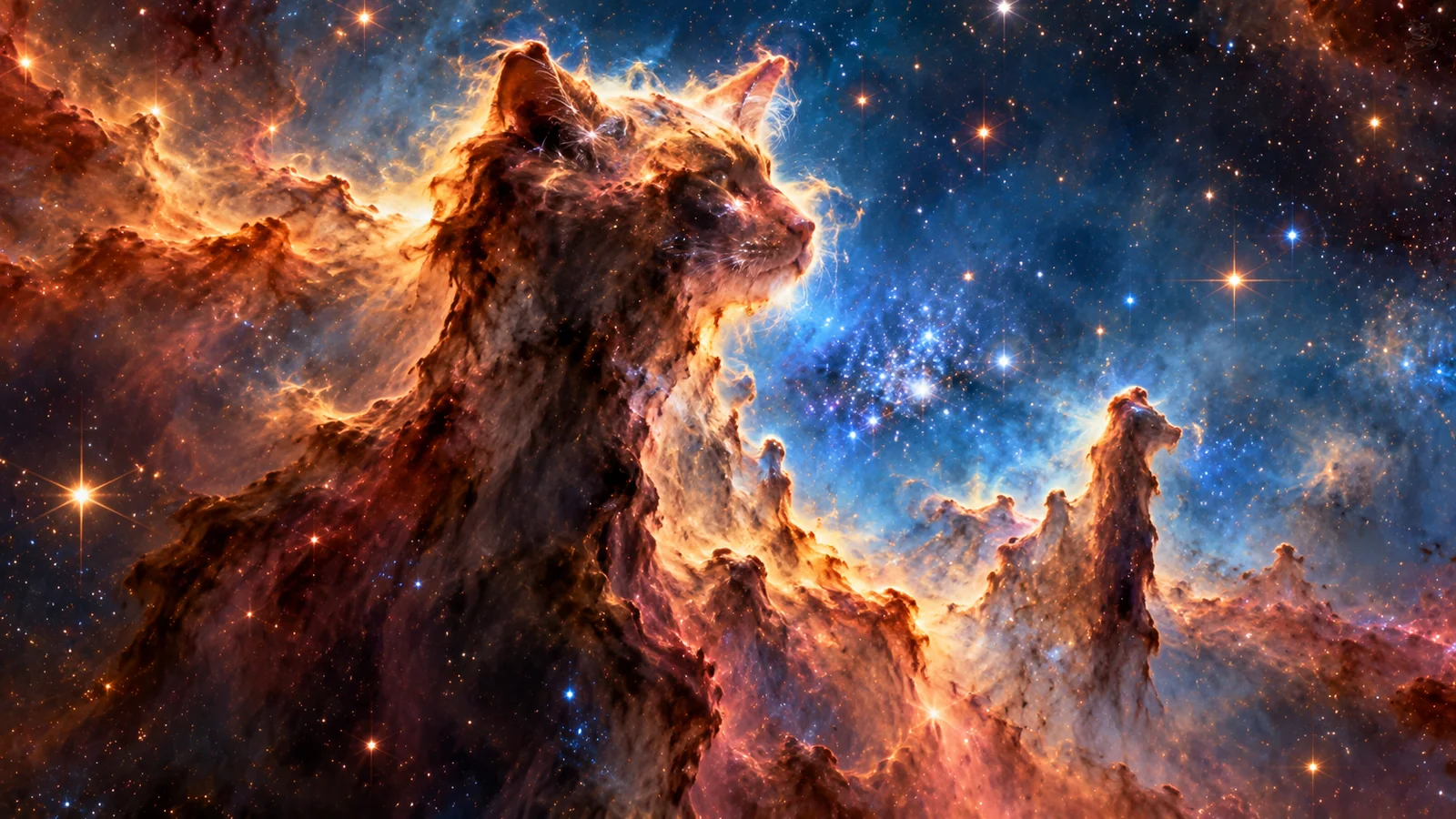
The "Cat’s Head Nebula" looks like a dark cosmic cat with a luminous eye, but the most interesting discovery isn’t the resemblance. On October 29, 2026, NASA and its partners released three complementary views of the same dusty structure inside the Carina Nebula: visible light captured by Hubble, near-infrared light captured by the James Webb Space Telescope’s NIRCam, and mid-infrared light captured by Webb’s MIRI. Together, they show how stars, radiation and dust shape a stellar nursery around 7,500 light-years from Earth. NASA’s original release.
The name is an informal nickname for a relatively small pillar or filament within the Carina Nebula (NGC 3372), not a newly detected galaxy or three separate nebulae. The eye-like bright spot may be associated with a young star embedded in the dust. NASA explicitly describes that identification as likely, not conclusive. Below is an evidence-led guide to the actual telescope images, with the key differences, what scientists can infer, and what the pictures cannot prove.
View the original images: Hubble, Webb NIRCam and Webb MIRI
The cover image accompanying this article is an illustrative visualization, not an observation. Start with the real telescope images below. All three were presented in the October 29 release. Each link goes to the original agency page with its image, resolution choices and credits. The images are available on ESA/Hubble under a reuse licence requiring clear attribution. These are real processed astronomical observations, not photographs of a fictional cat.
- Three-view side-by-side NASA/ESA comparison — Hubble visible, Webb near-infrared, Webb mid-infrared
- Original Hubble WFC3 visible-light image
- Original James Webb NIRCam near-infrared image
- Original James Webb MIRI mid-infrared image
- NASA’s multiwavelength fly-through video
Picture-reading tip: open the first comparison at full size and keep your eye on the bright tip of the vertical pillar. Then follow its edges downward. Hubble makes the dark silhouette easiest to recognize; NIRCam fills the background with stars and reveals wispy structure; MIRI emphasizes the warm, dust-rich material. This is a change in the kind of light we see, not evidence that the nebula physically transformed between exposures.
Where is the Cat’s Head Nebula, and was it just discovered?
The structure lies within the much larger Carina Nebula, NGC 3372, in the southern constellation Carina. NASA places the surrounding star-forming region approximately 7,500 light-years away. A light-year measures distance: light from this region takes roughly 7,500 years to reach Earth. The space telescope images therefore depict light emitted or scattered long before 2026, not a live video feed.
The October 29 date refers to the publication of these comparison images and explanation, not the first moment the gas cloud existed, not the birth of a new star on that date, and not necessarily the first time this area appeared in astronomical data. The "cat" is a recognizable pattern in a local part of a giant molecular-cloud complex. Astronomers often use informal nicknames to help people find structures in detailed images.
The object is different from the Cat’s Eye Nebula (NGC 6543) in Draco, a planetary nebula formed through the late life of a star. It is also different from the Cat’s Paw Nebula (NGC 6334) in Scorpius, another star-forming complex. Similar animal names should not be used to identify astronomical objects without checking their catalogue names and constellations. NASA’s Cat’s Eye reference.
The main difference: visible light versus infrared light
A dusty cloud does not look the same at every wavelength. Visible light, the band human eyes can detect, can be absorbed or scattered by dust. Infrared wavelengths interact differently with dust; some longer wavelengths reveal stars or structures obscured in visible light. But the simplistic slogan that "infrared sees through all dust" is wrong. The densest regions can remain opaque even in infrared, and the telescope’s filters and observing conditions matter.
| Observation | What dominates the released picture | What readers can learn |
|---|---|---|
| Hubble / WFC3 — visible | A dark brown silhouette, a glowing red eye-like spot and bright colored gas around the pillar | Where dust blocks visible light, plus illuminated gas edges and surrounding stellar radiation |
| Webb / NIRCam — near-infrared | More visible stars and subtle dust strands, including some distant background galaxies | How infrared reveals objects and textures hidden by part of the dust |
| Webb / MIRI — mid-infrared | Bluish-gray pillar, reddish surroundings and filigree around the main structure | Emission associated with warm dust and carbon-containing molecules excited by starlight |
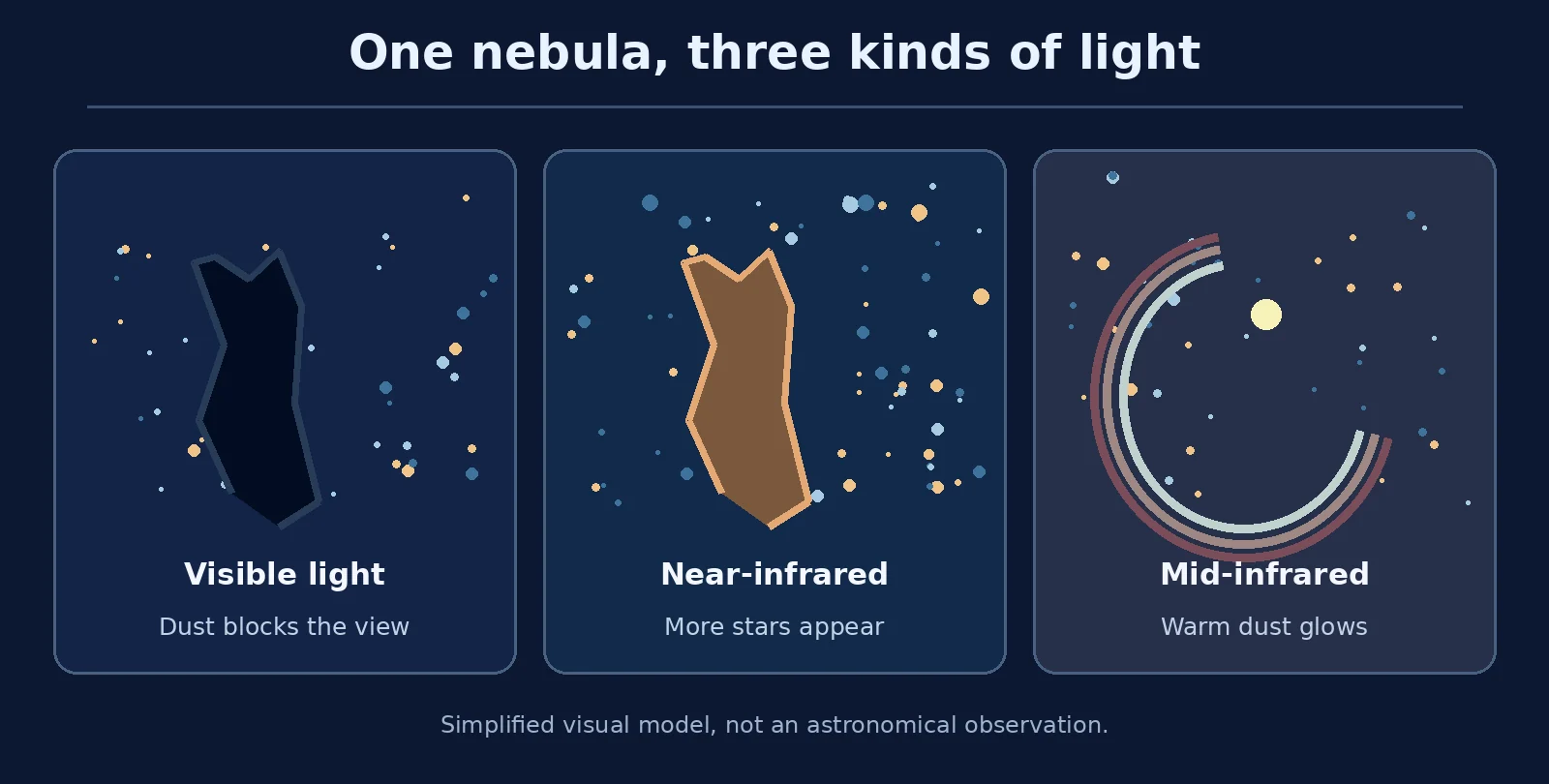
This is a qualitative guide, not a numerical measurement of dust density, temperature or stellar ages. Those require additional calibration, analysis and often other types of data. The table summarizes the interpretations described by NASA and ESA in their October 2026 image notes.
How to read Hubble’s visible-light view
Look at the Hubble panel first. The central shape is a dark, upright pillar with an irregular top that suggests ears and a face turned sideways. The most dramatic element is a red bright patch near the tip: the "eye." NASA says the brightness may indicate a young star partly buried in the dust. It does not establish, from the picture alone, the star’s exact mass or evolutionary stage.
The silhouette is dark because dust blocks much of the visible light behind or within it. The luminous rim along its right edge is consistent with gas illuminated and ionized by ultraviolet radiation from nearby massive stars. This process may drive photoevaporation: energetic photons heat and ionize exposed gas, allowing some material to flow away from the cloud. Dense regions hold out longer, so radiation can carve pillars and narrow shapes over time.
Notice the shifting background hues from blue and cyan to yellow, orange and red. NASA explains that Hubble’s filters include light associated with oxygen, hydrogen and sulfur, along with scattered starlight. It would be a mistake to interpret those display colors as an ordinary smartphone camera’s view of the nebula. The mapping of wavelengths into color is designed to communicate scientific structure.
What Webb’s NIRCam adds that Hubble cannot show as clearly
The near-infrared panel retains the pillar’s overall shape but changes the level of detail. The orange-brown filament looks less opaque in places; the right-facing head and glowing eye remain recognizable. To its left are faint strands of dusty material that are much less conspicuous in the visible-light picture. Across the background, blue and yellow star-like points become abundant, and NASA identifies some faint background galaxies.
Why does NIRCam reveal more? Some infrared light can pass through regions of dust that strongly attenuate shorter visible wavelengths. This permits the instrument to detect light from stars beyond or within parts of the cloud. However, the image is not a clean X-ray of a solid object. It records selected infrared bands that are converted to display colors; some stars and pockets of material are still partly hidden.
Here is a practical comparison exercise. Open Hubble’s image and count how many bright sources you can easily identify immediately left of the pillar. Then look at the equivalent region in NIRCam. You should see a richer pattern of points and fine filaments. Do not convert that visual count into a scientific number without matching the images’ exact fields of view, exposure depths and source detection criteria; the two images are not guaranteed to have identical scales and detection thresholds.
Why MIRI looks so different from NIRCam
Webb’s MIRI instrument observes mid-infrared light, longer in wavelength than NIRCam’s near-infrared bands. NASA reports that warm dust and carbon-based molecules excited by nearby starlight help generate the patterns seen in the MIRI image. In the released color rendering, the tall central form appears blue-gray, while large regions around it are reddish. Fine strands and tiny globules stand out particularly well to the left of the pillar.
The point isn’t that the dust "turned gray" or the background "became red." Those colors represent a mapping from invisible wavelengths into colors we can display on a screen. A different instrument detects a different combination of radiation sources and uses a different palette. MIRI makes it easier to trace certain dust-emission structures that are less obvious in near-infrared imaging.
Look to the right of the main pillar. NASA identifies a bright source portrayed as yellow in the mid-infrared view that is probably an infant star buried in dust. A narrow filament seems to cross the bright source, but NASA cautions that a crossing in a 2D image does not prove a physical connection. That detail is a useful lesson for anyone reading astronomy photography: two apparently overlapping features may lie at different distances along our line of sight.
What could be creating the cat-like pillar?
The Carina Nebula contains massive young stars that release strong ultraviolet radiation and powerful stellar winds. Radiation can heat and ionize the outer surface of a cloud; winds and pressure can help strip away more weakly bound material. Denser pockets erode more slowly. Over time, the combination can leave tall fingers, rims and pointed silhouettes, like the dark shape we see here.
Scientists describe this interaction between stars and their surrounding gas as stellar feedback. It can erode some dense clouds, expose young stars and reshape the conditions in which new stars form. Exactly how much feedback triggers or suppresses star formation in any particular parcel of gas can require detailed modelling and additional observations. The released three-color views alone do not settle that wider question.
The familiar cat shape is an example of pareidolia, our brain’s tendency to recognize faces and animals in irregular patterns. The analogy is a navigation aid; the nebula has no animal anatomy. The apparent eye does not establish that the rest of the silhouette is a single physical body with the same properties everywhere. A scientific interpretation comes from the gas, dust, radiation and geometry, not from the nickname.
Are the dazzling colors real or made with AI?
These agency images are based on actual telescope measurements. They are not AI-generated illustrations. However, space telescopes generally do not deliver the same ready-made color picture as a consumer phone. Hubble and Webb observe through different filters; image processors combine monochrome measurements and assign colors to distinguish wavelengths and features. Background correction, alignment and contrast adjustments can make faint structures visible.
For example, NASA’s Hubble image description identifies WFC3 filters including F475W, F502N, F656N, F673N and F814W; Webb’s NIRCam page lists filters from roughly F090W through F470N. These filter codes describe observing bands, not a Photoshop effect. The final composite colors are chosen to represent data at wavelengths our eyes could not directly see, particularly for infrared images.
There are two important cautions. First, processed color does not mean fabricated science: the information comes from telescope observations. Second, the precise apparent hue should not be treated as a direct thermometer or chemical assay. To estimate temperatures, abundances or ages, astronomers need calibrated data and physical models. Hubble image and color-method notes and NIRCam filter information explain the underlying processing.
What have astronomers actually established — and what remains uncertain?
Supported by the released observations: the region is a dusty star-forming structure in Carina; the pillar has an opaque silhouette in visible light; NIRCam resolves additional stars and fine structures; MIRI records emission associated with dust-rich material; the surrounding environment is exposed to energetic radiation from massive stars.
Plausible but not conclusively proven from these images: the eye-like bright spot is a young star; the bright source just to the right in MIRI is an embedded infant star; an apparently crossing filament is physically attached to that source. NASA uses careful language such as "may," "likely" and "probably" for such interpretations. We should not turn those qualified statements into confirmed discoveries of named stars, planets or life.
Not established: an exact date when the pillar formed, a precise lifespan remaining before it dissolves, the number of stars currently being born inside this small feature, or a claim that a new habitable planet was found. None of these conclusions is supported merely by the public comparison montage.
A five-minute guided tour of the actual images
- Open the three-image collage and identify the same head-shaped tip in all panels. Remember: left is Hubble visible light, middle is Webb NIRCam, right is Webb MIRI.
- Trace the dark pillar in Hubble. Look for the red eye-like glow and the narrow bright edge on the pillar’s right side. Ask what visible light is blocked and what gas is illuminated.
- Switch to NIRCam. Pay attention to the increased number of background points and the delicate wisps on the left. Ask why some structures become more visible, while others remain obscured.
- Switch to MIRI. Compare the fine warm-dust structures against the broad red background. Find the yellow source to the right, but remember that apparent overlap does not prove contact.
- Watch NASA’s official fly-through. The shape stays recognizable across the bands; the physical story becomes richer with each wavelength.
This procedure gives readers a repeatable way to examine primary data without inventing measurements from a press image. For a higher-resolution look, use the download options on the original agency image pages rather than low-quality social-media reposts.
Could you see the Cat’s Head with your own eyes or a backyard telescope?
The Cat’s Head is a small detailed feature inside the much larger Carina Nebula, and the dramatic views rely on sensitive space telescopes, chosen filters and careful image processing. It is not something you should expect to recognize as a sharp glowing cat with your unaided eye. The Carina Nebula itself can be observed from suitable southern locations under dark skies, but recognizing this particular pillar visually is a different challenge. It would be misleading to promise that a phone or basic backyard telescope reproduces Hubble or Webb’s multiwavelength view.
If you want to explore the region digitally, begin with the ESA image pages, where the position and field-of-view details accompany individual observations, or watch the agency’s narrated overview. This is more useful than an unverified sky-map pin showing a whimsical cat icon.
Why this release matters beyond a striking picture
The real scientific payoff is combining complementary observations. Hubble documents where visible light is absorbed and where gas is illuminated. NIRCam reveals stars and fine features through some of the obscuring dust. MIRI traces emission from different infrared sources, helping map the warm, dusty environment. The differences constrain interpretations of the geometry and physics of a stellar nursery in ways that any single image cannot.
It also teaches a broader method of scientific reading. First identify what the instrument directly records. Then separate observational descriptions from hypotheses. Finally, ask what further data would distinguish competing explanations. With an image as visually memorable as a cosmic cat, those habits help readers enjoy the wonder without repeating a sensational claim the evidence does not support.
Original sources, image credits and related reading
The images were released October 29, 2026. Core reporting for this guide is grounded in NASA’s announcement, the ESA/Hubble release, and NASA’s detailed Hubble, NIRCam and MIRI image records. Official image credit for the Hubble view: NASA, ESA, STScI; image processing: J. DePasquale (STScI). For Webb: NASA, ESA, CSA, STScI; image processing: J. DePasquale (STScI). The three-view collage is published by ESA/Hubble with NASA & ESA credit. ESA/Hubble reuse and attribution conditions apply to any reproduced images.
For related reading on the site, see how James Webb helps investigate a distant radio burst (Arabic) and the most remarkable Hubble pictures (Arabic). These cover broader astronomy and do not duplicate this specific three-image comparison.
Bottom line: Hubble and Webb did not find a literal cat in space. They provided three complementary, real-data views of a distant pillar whose dust, exposed edges, hidden stars and mid-infrared emission tell a much more valuable story: how a star-forming cloud is gradually reshaped by its stellar neighbors.
You may also like
 Science & Discoveries
Climate Prediction Center Heavy Snow Map: November Outlook
Read NOAA’s November heavy-snow outlook, see the mountain areas at risk, understand the map’s limits, and find local…
 Science & Discoveries
UK November Cold Snap: What the Met Office Forecast Says
What the Met Office forecast says about the UK November cold snap, possible northern wintry showers, frost and…
 Science & Discoveries
Altermagnetism Explained: What the New Evidence Shows
What is altermagnetism? Understand the new MnTe experiment, how it differs from other magnetic orders, and what the…