
Asteroid Bennu: Why Its Rocks Are Changing What We Know About the Early Solar System
Bennu’s returned samples reveal cracked boulders, ancient water chemistry and clues to where its parent body formed. Here is what the evidence actually shows.
Contents
- What exactly is asteroid Bennu?
- The 2026 discoveries, in the right chronological order
- Mystery one: why do Bennu’s giant rocks cool so quickly?
- The missing piece: internal pores and connected cracks
- Why a tiny sample can disagree with an orbiting spacecraft
- Mystery two: where did Bennu’s parent body form?
- What isotopes reveal that ordinary photographs cannot
- Mystery three: what do iron minerals say about Bennu’s chemical past?
- What Bennu’s water-related minerals actually mean
- A comparison: which technique answers which question?
- A worked example: why cracks change the heat signal
- Bennu versus Ryugu: what is similar and what differs?
- Could these discoveries help protect Earth from an asteroid impact?
- Five common headlines—and the accurate interpretation
- How to read future asteroid discovery stories critically
- What scientists still do not know
- Why Bennu matters beyond a single asteroid
- Original sources and further reading
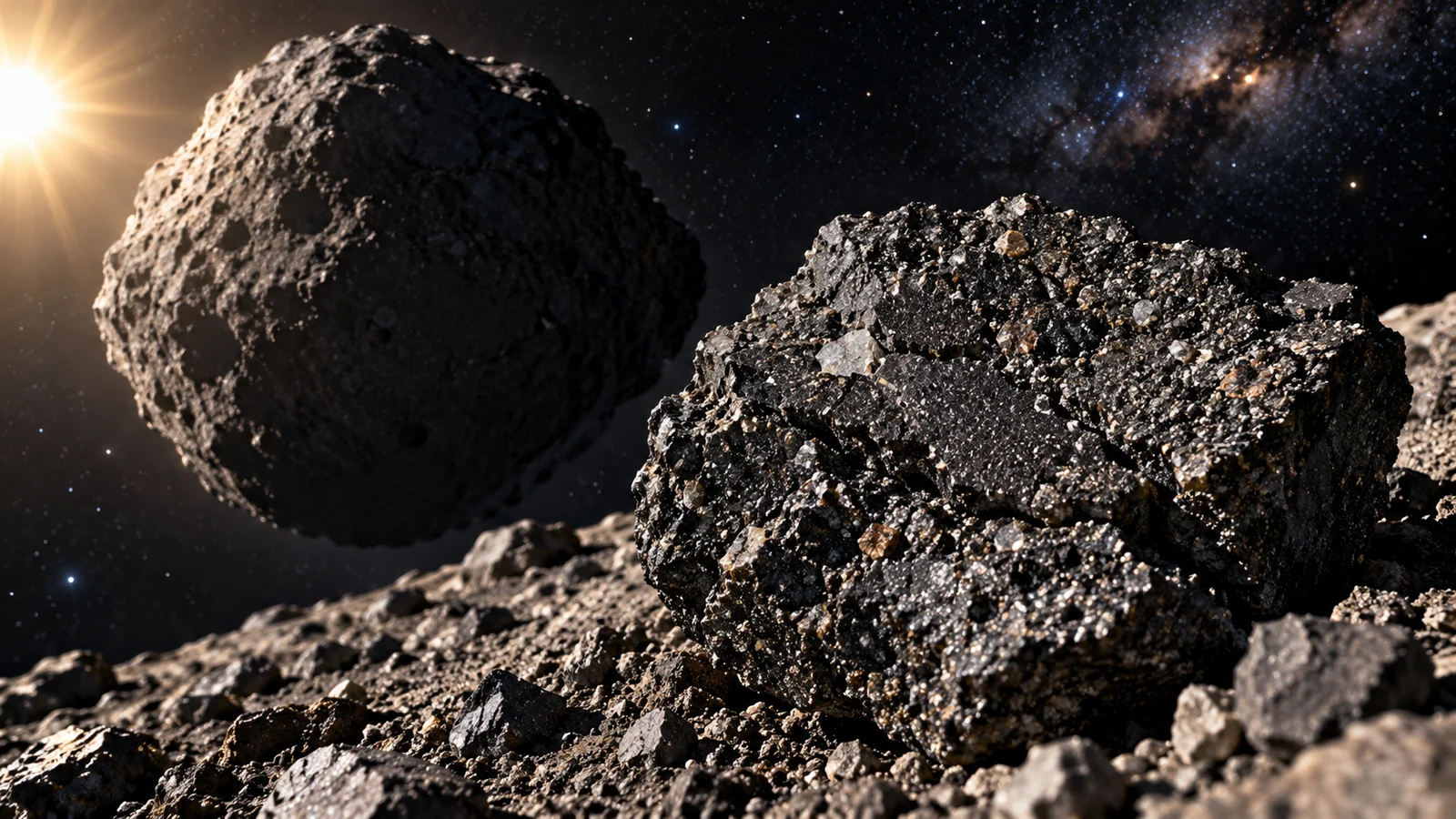
At a glance: Asteroid Bennu is not simply a collection of old rocks. Its returned samples have helped explain why giant boulders can cool like loose sand, why its parent body probably assembled from materials originating in different parts of the young solar system, and how water altered its minerals. A March 2026 study identified extensive internal cracks as a key reason for Bennu’s low thermal inertia. Separate September and October 2026 research offers further clues about its origin and chemical history. None of these findings proves that life existed on Bennu.
The important story is how independent methods fit together: spacecraft infrared observations, direct rock measurements, three-dimensional X-ray scans, isotope geochemistry and high-resolution mineral analysis. Each reveals a different layer of the same asteroid’s past. This guide distinguishes measured results from interpretations and explains why scientists cannot simply treat a meteorite found on Earth as a perfect substitute for a protected sample returned from space.
What exactly is asteroid Bennu?
Bennu, officially (101955) Bennu, is a near-Earth asteroid roughly half a kilometre across. It is a rubble pile: a gravitationally bound collection of fragments rather than a single solid monolith. Scientists think it formed when pieces of a much larger parent asteroid came together after a collision. That parent body formed in the early solar system, but Bennu itself is a later product of breakup and reassembly. The distinction matters when interpreting the age of minerals: an ancient grain does not mean today’s rubble pile has remained unchanged for 4.6 billion years.
NASA launched OSIRIS-REx in 2016, sampled Bennu in October 2020 and delivered the sample capsule to Earth on 24 September 2023. NASA reports a total recovered mass of 121.6 grams. This modest amount is extraordinarily valuable because researchers know where it came from and can protect it from Earth’s atmosphere during curation. NASA mission overview.
The 2026 discoveries, in the right chronological order
| Date | Finding | What it does—and does not—show |
|---|---|---|
| 17 March 2026 | Cracks inside Bennu rocks help explain low thermal inertia | Explains heat flow; does not mean every boulder has identical structure |
| 23 September 2026 | ETH Zurich reports isotope clues to a parent body near the early solar system snow line | A model-based origin interpretation, not an observed birthplace |
| October 2026 | New mineral spectroscopy research describes a less oxidising history | Constrains iron chemistry; does not reconstruct every stage of the parent body |
| 19 October 2026 | Popular coverage revisits the March crack study | A new article about an earlier peer-reviewed result, not a new October crack discovery |
This timeline prevents a common reporting mistake. An October headline saying scientists “finally solved” Bennu’s rock mystery can refer to work published in March. The original publication date is more useful than the republication date when deciding what is genuinely new. See the peer-reviewed crack study, the ETH Zurich origin report and the ESRF spectroscopy summary.
Mystery one: why do Bennu’s giant rocks cool so quickly?
Before the spacecraft arrived, astronomers used infrared observations to infer that Bennu’s surface heated and cooled relatively quickly as it rotated. That property is called low thermal inertia. A beach of fine grains often changes temperature quickly; a dense block of stone usually responds more slowly. Scientists therefore expected extensive fine-grained terrain. Instead, OSIRIS-REx found a surface crowded with boulders. The apparent contradiction was not that infrared data were wrong, but that a simple model—large boulder equals solid, thermally conductive rock—was inadequate.
Thermal inertia combines three material properties: conductivity, density and heat capacity. A common simplified expression is Γ = √(kρc), where k is thermal conductivity, ρ is density and c is specific heat capacity. Lower conductivity can lower thermal inertia even when the visible surface consists of large stones. The expression describes the physics, but a single remotely measured value cannot uniquely determine all three properties.
The missing piece: internal pores and connected cracks
Researchers studied returned fragments using laboratory heating measurements, mechanical characterization and X-ray computed tomography. Their results revealed two broad rock textures: more angular particles and darker, hummocky particles. Hummocky material tended to contain extensive crack networks and fine porosity. The researchers simulated heat flow through internal structures reconstructed from the scans and found that cracks interrupted the paths by which heat travels through rock.
The Nature Communications paper reported that simulated resolved crack networks in a hummocky particle could reduce thermal conductivity by as much as about 40%, corresponding to a roughly 23% reduction in thermal inertia in that model. Those are study-specific results, not a universal correction factor to apply to every asteroid. Many tiny pores were smaller than the resolution of the scans, and the laboratory fragments were much smaller than the boulders seen from orbit.
The useful mental model is a cracked ceramic tile: even if the tile looks substantial from a distance, the interruptions inside it can restrict the movement of heat. On Bennu, cracks work together with a porous mineral matrix. Neither a “solid boulder” model nor a “fluffy powder” model captures the full picture. NASA’s explanation and scan images.
Why a tiny sample can disagree with an orbiting spacecraft
Laboratory instruments heat and measure a small region of a particle. A spacecraft sees the effective response of a much larger surface volume as sunlight comes and goes. A short thermal wave in a laboratory can miss deeper fractures that matter during Bennu’s day-night cycle. Consequently, a fragment can appear to conduct heat better at one measurement scale than a large cracked boulder does when observed from space. This is a scale problem, not necessarily a measurement failure.
That distinction has practical consequences. If a scientist interprets low thermal inertia as proof of fine dust, they might misjudge a landing site or the mechanical properties of an asteroid surface. The Bennu mission showed that infrared readings need context from imaging, sample structure and material models. For future asteroid missions, the lesson is to keep multiple surface models alive until more evidence is available.
Mystery two: where did Bennu’s parent body form?
A September 2026 report from ETH Zurich described isotope and geochemical evidence pointing to a parent body assembled near a transition region in the early solar system associated with the water-ice line, sometimes called the snow line. This is where conditions allowed water ice to persist in the protoplanetary disk. Researchers interpret Bennu’s composition as a mixture of materials with different formation histories, rather than a simple product of one uniform zone.
The snow line was not a permanent ring at a fixed modern distance from the Sun. Its position could move as the young disk evolved, and material could migrate across it. A finding about the likely origin of Bennu’s parent body also should not be confused with the near-Earth orbit of Bennu today. Gravitational interactions and collisions reshuffled asteroid populations over billions of years. Read ETH Zurich’s original institutional explanation.
What isotopes reveal that ordinary photographs cannot
An isotope is a version of an element with a different number of neutrons. Isotope ratios can retain signatures of the environments and reservoirs from which a mineral formed. Researchers compare those signatures across samples and models of the early solar system. The method does not provide a GPS coordinate or a photograph of the primordial disk; it narrows which formation scenarios are chemically plausible.
An important nuance is that Bennu’s sample is a mixture. Some particles may preserve ancient signatures, while other minerals record later reactions with water or impacts. When a study identifies an origin region, it is synthesizing several lines of evidence. The conclusion is stronger than an unsupported guess but remains an interpretation subject to future tests.
Mystery three: what do iron minerals say about Bennu’s chemical past?
Research publicized by the European Synchrotron Radiation Facility in October 2026 used synchrotron Mössbauer spectroscopy to study iron-bearing minerals in Bennu material. The reported results suggest a less oxidising formation and alteration history than might be inferred from some meteorites. In chemistry, oxidation state describes the electron environment of an element such as iron; it is not a synonym for whether a rock contains oxygen or water.
Why does this matter? Meteorites often spend time exposed to Earth’s air, moisture and weather before laboratory study. These conditions can change minerals after arrival, potentially obscuring original asteroid chemistry. Protected sample-return material offers a more controlled reference. The research does not mean that every meteorite result is invalid; it means that Earth alteration must be considered when reconstructing the history of primitive bodies. ESRF report, 21 October 2026.
What Bennu’s water-related minerals actually mean
NASA has reported hydrated clay minerals, carbon-bearing material, organic molecules, phosphates and signs of a saltwater history in the returned sample. Some mineral assemblages imply that water once interacted with material in Bennu’s ancestral body. That does not mean liquid lakes exist on Bennu today. It also does not prove that Bennu itself was a watery world; water-related reactions could have taken place before the current rubble pile formed.
In June 2024, NASA highlighted a magnesium-sodium phosphate finding that had not been obvious from spacecraft remote sensing. In January 2025, NASA announced molecules important to terrestrial biology and evidence of ancient saltwater chemistry. Organic molecules are carbon-containing compounds and can form through nonbiological processes. The scientifically defensible statement is that Bennu preserves ingredients and environments relevant to prebiotic chemistry, not that scientists discovered extraterrestrial life. NASA phosphate report and NASA sample chemistry report.
A comparison: which technique answers which question?
| Method | What scientists measure | Strongest use | Important limitation |
|---|---|---|---|
| Thermal infrared observations | Surface heating and cooling | Estimate effective thermal behaviour | Cannot uniquely determine rock texture |
| X-ray CT scans | 3D pores and fractures | Map internal crack networks | Resolution misses the smallest pores |
| Laboratory thermal tests | Heat spreading across sample fragments | Constrain material properties | Tiny fragments differ from giant boulders |
| Isotope geochemistry | Elemental isotope ratios | Test formation and mixing scenarios | Interpretation depends on models |
| Synchrotron spectroscopy | Iron mineral states | Reconstruct chemical alteration | Only the analysed material is directly measured |
| Microscopy and mineralogy | Mineral phases and textures | Identify water-related alteration | Some processes can produce similar textures |
The table is a reading guide, not a ranking of instruments. A reliable explanation of Bennu depends on the overlap between measurements. When independent methods agree, researchers gain confidence; when they disagree, that mismatch can reveal a missing physical process, as happened with the boulders.
A worked example: why cracks change the heat signal
Imagine two equally sized rocks made of material with the same density and heat capacity. In a simplified demonstration, Rock A has thermal conductivity k = 1 unit, while cracks lower Rock B’s effective conductivity to k = 0.6 units. Because thermal inertia scales with the square root of conductivity when the other variables are fixed, Rock B’s relative thermal inertia is √0.6 ≈ 0.775. It is about 22.5% lower than Rock A’s. This is an illustrative calculation, not a measurement of a particular Bennu boulder.
That example explains why a substantial change in conductivity produces a smaller percentage change in thermal inertia, and why a rock can cool surprisingly quickly without being loose sand. Real Bennu rocks are more complex: porosity, mineralogy, fracture geometry, surface roughness and measurement depth all influence the signal. The calculation is best used to understand the direction and scale of the effect, not to infer Bennu’s exact temperature from a single photograph.
Bennu versus Ryugu: what is similar and what differs?
Japan’s Hayabusa2 mission returned material from asteroid Ryugu, another dark carbonaceous asteroid. Both bodies have porous material and relatively low thermal inertia; both returned samples show fractures. The 2026 crack study compared the samples to investigate whether a similar physical mechanism could explain the thermal behavior of both asteroids. Similarity does not imply identical histories. Their densities, crack patterns, rotation periods and mineral mixtures differ, and results from one sample type cannot be transferred to the other without testing.
This comparison also demonstrates why sample-return missions matter. Meteorites that survive passage through Earth’s atmosphere and later weathering may disproportionately represent sturdier material. Fragile, crack-filled material can be destroyed or altered before anyone studies it. Directly returned samples help reduce this selection bias, although collection and handling can still change some grains.
Could these discoveries help protect Earth from an asteroid impact?
Potentially, by improving the physical models used in planetary defense. How an asteroid absorbs heat influences subtle forces such as the Yarkovsky effect, in which anisotropic thermal emission gradually changes an object’s orbit. Material strength and internal structure also affect how a surface might respond to a spacecraft contact or other intervention. Bennu is a useful test case because its orbit and surface have been measured extensively.
But the crack study does not establish that Bennu will hit Earth, nor does it provide a new impact date or probability. Orbital hazard assessments require precise tracking and dynamical modelling; rock texture alone cannot answer them. Readers should consult NASA’s Center for Near-Earth Object Studies for current orbital information rather than extrapolating from a viral headline about fragile boulders.
Five common headlines—and the accurate interpretation
| Headline claim | Evidence-based reading |
|---|---|
| NASA discovered cracks in October 2026 | The peer-reviewed crack paper was published in March 2026; some articles circulated later |
| Bennu is made of sand | It is a rubble pile with abundant boulders, including porous fractured material |
| Bennu came from one exact location | Isotope evidence supports formation-region scenarios for its parent body |
| Bennu contains life | Organic compounds and water-related minerals are not evidence of organisms |
| A soft asteroid is harmless | Material properties do not remove an orbital hazard; risk needs separate analysis |
How to read future asteroid discovery stories critically
- Find the original publication date. News sites may cover the same study months after publication.
- Separate observation from interpretation. A scan can directly reveal cracks; a birthplace near the snow line is inferred from chemical evidence.
- Check the sample size and scale. A millimetre fragment is not automatically representative of every ten-metre boulder.
- Look for independent methods. Spacecraft images, infrared measurements, isotopes and mineral spectroscopy test different parts of the story.
- Avoid the life leap. Water, salts and organic molecules are scientifically exciting without proving biology.
What scientists still do not know
The exact sequence of processes that produced every crack network is unresolved. Thermal cycling, micrometeoroid impacts, earlier collisions and mineral reactions may all have contributed. Researchers also continue to test where the parent body assembled, how far materials migrated through the young solar system, and which alteration signatures survived later events. Returned grains sample only part of Bennu’s surface and a small fraction of its total mass.
There is another subtle uncertainty: some rock structures may change during sample collection or transport. Scientists use particle shapes, fracture patterns and comparisons with spacecraft observations to test whether cracks predate collection. The published analysis argues that widespread crack networks are largely indigenous, while acknowledging that not every fracture can be assigned a single cause. The responsible conclusion is a converging explanation, not a complete geological biography.
Why Bennu matters beyond a single asteroid
Bennu links several branches of planetary science. Thermal measurements help engineers predict what a spacecraft might encounter. Geochemistry records the movement and mixing of ancient solar system material. Water-related minerals reveal chemical processes that occurred before Earth formed into its present state. Returned samples anchor remote observations to physical objects, improving how scientists interpret asteroids they may never visit.
The biggest lesson is methodological: a dark boulder can hide cracks, a familiar mineral can preserve an unexpected chemical history, and a handful of grains can challenge a model built from years of telescope observations. Bennu has changed our understanding not because one dramatic headline settled everything, but because carefully measured details repeatedly forced scientists to refine the bigger picture.
Original sources and further reading
- Ryan and colleagues, Nature Communications (17 March 2026): crack networks and thermal inertia.
- NASA (17 March 2026): why Bennu’s rocky surface surprised scientists.
- ETH Zurich (23 September 2026): isotope-based origin interpretation.
- ESRF (21 October 2026): iron chemistry and oxidation history.
- NASA OSIRIS-REx mission and sample-return chronology.
- NASA (29 January 2025): sample molecules and saltwater history.
You may also like
 History
The Mystery Yak of Denisova Cave: How Ancient DNA Revealed a Lost Ice Age Species
Twenty ancient nuclear genomes uncovered Yak X, an extinct bovine distinct from modern yaks. Explore its connection to…
 HEALTH
Can Scientists Kill Harmful Gut Bacteria Without Harming Good Bacteria?
A 2026 study found argyrin B could target C. difficile in mice while preserving much of the gut…
 HEALTH
Does Fish Oil Improve Memory? What a Two-Year DHA Trial Actually Found
A two-year DHA trial raised omega-3 levels near the brain without improving memory. What the results mean for…