
Alien Hand Syndrome: Why Your Hand Moves on Its Own, Causes and Treatment
Explore alien hand syndrome: involuntary purposeful movements, brain mechanisms, causes, diagnosis, treatment, and real case evidence.
Contents
- What Exactly Is Alien Hand Syndrome?
- The Symptoms: Grasping, Conflict, and Levitation
- How the Brain Normally Controls Voluntary Movement
- Three Broad Clinical Patterns
- What Causes Alien Hand Syndrome?
- Is Alien Hand Syndrome a Psychiatric Disorder?
- How Doctors Diagnose It
- What Real Case Reports Show
- Treatment: Managing the Cause and the Symptoms
- Practical Safety and Daily-Life Strategies
- Can People Recover?
- When to Seek Emergency Help
- What Alien Hand Syndrome Teaches Us About Free Will
- Conclusion
- Sources and Further Reading
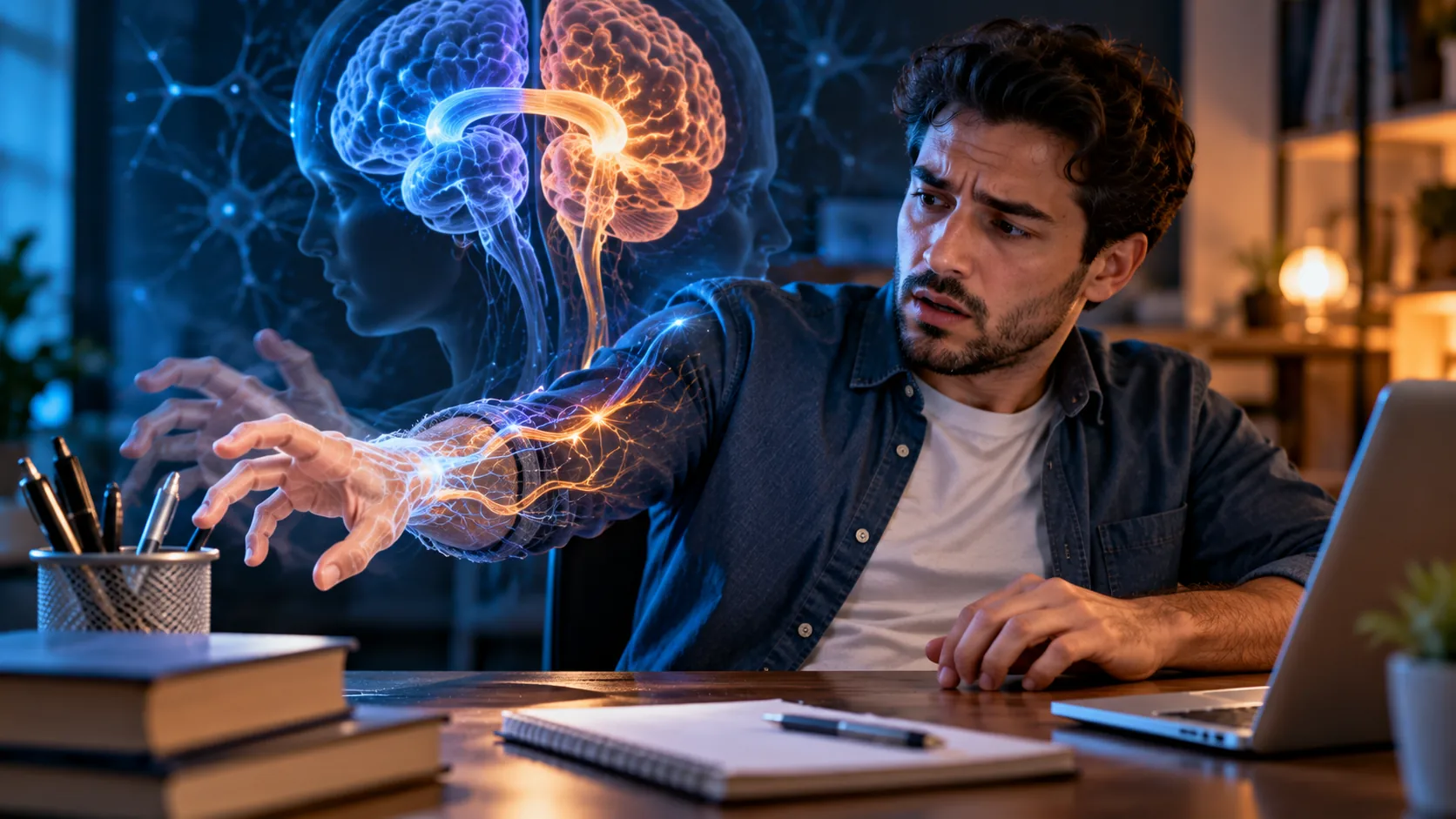
Imagine fastening a button with one hand while the other immediately unfastens it. This is not a supernatural story: similar conflicts have been documented in people with alien hand syndrome. The movements can be purposeful in appearance, yet they are not consciously intended. The experience raises questions about how the brain initiates action and creates a sense of agency. It also deserves serious medical attention, especially when symptoms start suddenly.
What Exactly Is Alien Hand Syndrome?
Alien hand syndrome (AHS) is a rare neurological phenomenon in which a limb, usually a hand, performs complex movements outside the person’s voluntary control. It may reach, grasp, manipulate objects, interfere with the other hand, or rise unexpectedly. Some patients feel that the limb does not belong to them, although altered ownership is not universal. Unlike an ordinary tremor, the movement may look organized or goal-directed. The syndrome describes a clinical pattern rather than a single disease with one cause.
The Symptoms: Grasping, Conflict, and Levitation
A hand might grab a door handle and refuse to release it, touch nearby objects repeatedly, or undo an action just completed by the unaffected hand. This intermanual conflict can make dressing or household tasks frustrating. Some people experience spontaneous arm elevation or a sense that the limb is foreign. Symptoms vary with the damaged brain networks; no single patient is expected to show every sign. Unexpected contact with hot surfaces or sharp tools can create practical safety risks.
How the Brain Normally Controls Voluntary Movement
Voluntary action requires coordinated networks that select goals, prepare movements, suppress competing impulses, monitor sensation, and generate the feeling that an action was self-initiated. Damage to these networks can disconnect movement execution from conscious intention. Researchers distinguish disruption of inhibitory control from altered body ownership and communication between hemispheres. AHS therefore offers a window into the neuroscience of agency, but it does not demonstrate that the hand contains an independent mind.
Three Broad Clinical Patterns
The frontal variant often features involuntary grasping and manipulation associated with medial frontal networks. The callosal variant is strongly linked to conflict between the hands after disruption of the corpus callosum, the major connection between the cerebral hemispheres. Posterior forms may involve limb levitation, unusual sensory experiences, or altered ownership related to parietal and neighboring networks. These categories overlap, and real patients may not fit neatly into one group.
What Causes Alien Hand Syndrome?
Published cases describe AHS after strokes, particular brain operations, traumatic injuries, tumors, and neurodegenerative conditions such as corticobasal syndrome. The location and nature of brain dysfunction matter more than the dramatic name of the syndrome. A person with an unusual hand movement does not automatically have AHS or any one of these conditions. Establishing the cause requires clinical history, examination, and investigations selected for the individual.
Is Alien Hand Syndrome a Psychiatric Disorder?
Patients sometimes describe the limb as alien or controlled by someone else. That language communicates a genuine disruption in the sense of agency, not evidence of possession or a second personality. Neurological lesions and network dysfunction provide the principal explanation for established AHS. Other movement and psychiatric conditions can occasionally resemble aspects of the syndrome, so clinicians must consider alternative explanations rather than relying on a striking description alone.
How Doctors Diagnose It
A clinician asks when the movements began, whether there was a stroke or brain surgery, which medications are used, and how the episodes affect everyday tasks. Examination may include observing grasping, two-handed tasks, sensation, strength, coordination, and language. MRI can help identify relevant structural lesions. Depending on the presentation, clinicians may evaluate seizures or other movement disorders. There is no single blood test that diagnoses AHS, and online videos are not a substitute for assessment.
What Real Case Reports Show
Medical literature includes patients with involuntary hand actions after corpus callosum infarction and other focal brain injuries. Reviews describe both intermanual conflict and independent grasping, alongside unusual sensations of limb ownership. Case reports help connect symptoms with anatomy and guide rehabilitation, but they do not establish a precise population prevalence or a universally predictable course. Because AHS is uncommon, controlled treatment studies are difficult to conduct.
Treatment: Managing the Cause and the Symptoms
There is no established universal cure. Management begins with treating the underlying neurological problem when possible. Occupational and physical therapy may help people adapt tasks and improve safety. Clinicians sometimes use visual guidance, structured activities, or a safe object to occupy the affected hand. Botulinum toxin and certain medications have appeared in individual reports, but evidence is limited and decisions must be individualized. Psychological support can help with distress and loss of confidence.
Practical Safety and Daily-Life Strategies
Keep sharp objects, hot pans, and other hazards out of reach during uncontrolled movements. An occupational therapist can suggest safer kitchen arrangements, dressing techniques, and tasks that give the affected hand a predictable role. Avoid forcefully restraining the limb without professional advice. Recording when episodes occur, what triggers them, and whether they interfere with sleep or work can make follow-up visits more informative. Family members should understand that the behavior is not deliberate.
Can People Recover?
Outcomes vary. Some individuals improve as an acute brain injury stabilizes or with rehabilitation; others have persistent symptoms, particularly when a progressive neurological condition is involved. Duration and severity cannot be inferred from a headline or a single dramatic case. Much of the literature consists of case descriptions rather than large comparative trials. Regular follow-up allows treatment and safety plans to be adjusted as abilities change.
When to Seek Emergency Help
Sudden unusual limb behavior accompanied by facial drooping, weakness on one side, speech difficulty, sudden visual changes, or an abrupt severe headache may indicate stroke. Seek emergency medical care immediately. Even without these warning signs, new or worsening involuntary hand movements warrant prompt professional assessment. A rare neurological syndrome should never be used as a self-diagnosis to explain away potentially urgent symptoms.
What Alien Hand Syndrome Teaches Us About Free Will
AHS reveals that initiating a movement and experiencing it as “my choice” depend on partly separable neural processes. An action can be complex while the person lacks the usual feeling of authorship. This observation is relevant to debates about consciousness and voluntary control, but it is not proof of two fully independent conscious beings in one brain. It is best understood as evidence that coordinated neural systems underpin ordinary agency.
Conclusion
Alien hand syndrome is a real but rare neurological phenomenon, not a paranormal event. It can cause purposeful-looking movements without normal voluntary control, and its clinical features depend on the networks affected. Diagnosis requires medical evaluation, treatment is individualized, and safety is essential. This article is educational and does not replace medical advice.
Sources and Further Reading
Cleveland Clinic — Alien Hand Syndrome
Pathophysiology and Treatment of Alien Hand Syndrome
Alien hand syndrome: pathophysiology and differential diagnosis
You may also like
 Science & Discoveries
 Robot Dog Runs a Full Marathon on One Charge: How RAIBO2 Made It Possible
RAIBO2 completed a 42.195 km marathon on one battery. Explore the engineering, energy-saving gait, power figures and what…
 Science & Discoveries
 Can AI Discover New Antibiotics? Breakthroughs, Evidence and Limits
How does AI find possible new antibiotics? Explore halicin, abaucin, generative models, laboratory validation, resistance and the path…
 Science & Discoveries
 Diamond Rain on Neptune and Uranus: What Experiments Really Show
Can diamonds form inside Neptune and Uranus? Examine extreme-pressure experiments, the role of oxygen, conflicting results and what…