
Warm Home Discount 2026–27: Who Gets the £150 Energy Bill Rebate and What to Do if It Is Missing
The £150 Warm Home Discount for 2026–27 has different eligibility routes in England, Wales and Scotland. Check dates, benefits, applications, missing letters and supplier issues.
Contents
- The £150 Warm Home Discount in one table
- What changed in 2026–27?
- The first decision: where do you live?
- England and Wales: four qualifying benefit routes
- Scotland: when the £150 is automatic
- Scotland: who needs to apply to the Broader Group?
- Key dates: what to do now and what to do later
- Step by step: how to check if you will receive the discount
- No Warm Home Discount letter? Use the right contact route
- A decision table for common missing-payment situations
- What if you changed your electricity supplier?
- Prepayment meters: vouchers are not a scam by default
- Park homes and people without a direct electricity account
- What the £150 actually saves: three worked examples
- Five mistakes that can cost time—or the rebate
- Avoid Warm Home Discount scams
- If you do not qualify: other support to check
- What Horus Valley checked, and what can still change
- Official sources and further reading

The Warm Home Discount for winter 2026–27 is a one-off £150 credit towards an eligible household’s energy bill, not £150 paid into a bank account. England and Wales mainly use automatic benefit-and-electricity-account matching. Scotland has an automatic Core Group and an additional supplier-run Broader Group that may require an application. Northern Ireland does not operate this scheme. The key date for determining household eligibility is 23 August 2026. If the government needs extra evidence, the helpline deadline is 26 February 2027; participating suppliers should provide the discount by 31 March 2027.
These details matter more than a generic “claim your £150 now” headline. A letter may tell you to do nothing; a second type may ask you to confirm details. Someone in Scotland might have to apply directly to their electricity company before its limited allocation is used. And changing supplier after the qualifying date can change which company you need to contact, even if you remain entitled.
The official starting points are GOV.UK’s Warm Home Discount overview, the England and Wales rules, the Scotland rules, and Ofgem’s scheme guidance. This guide was checked against those sources on 28 October 2026.
The £150 Warm Home Discount in one table
| Question | 2026–27 answer | Action that matters |
|---|---|---|
| How much? | One-off £150 reduction on an energy account | Do not expect a bank transfer |
| Where? | England, Wales and Scotland | Northern Ireland has different help |
| Qualifying date | 23 August 2026 | Check benefits, account name and supplier on that date |
| Letter window | Late October 2026 to early January 2027 | Some letters require a response |
| Information deadline | 26 February 2027 | Contact the official helpline before this date if needed |
| Rebate deadline | 31 March 2027 | Chase the relevant supplier if confirmed but unpaid |
| Prepayment meters | Eligible customers can still receive support | Check voucher/top-up instructions with the supplier |
| Scottish Broader Group | Application rules vary by participating supplier | Ask the supplier early; places can be limited |
The scheme has been extended through 2030–31, but the qualifying dates, benefit rules and application process discussed here are for 2026–27. Do not mistake the continuation of the programme for automatic entitlement to a payment every year. Your circumstances can change, and Scottish applications may need renewing.
What changed in 2026–27?
England and Wales now operate one consolidated Core Group rather than the older Core Group 1/Core Group 2 labels. The eligibility statement dated 7 August 2026 explains that the high-cost-to-heat threshold has been removed and the system relies on qualifying means-tested benefits and electricity account matching. This is a material change: advice focused on the old property-heating-cost score may be out of date.
Scotland’s system also changed, making automatic discounts available to more qualifying households. However, the Scottish rules are not simply a copy of England’s: the benefit conditions for the automatic group are more specific, and people outside that group may still qualify under a supplier’s Broader Group. Ofgem and suppliers publish the details, which can vary. An online checklist that says “Universal Credit means automatic payment everywhere in Britain” is too simplistic.
The first decision: where do you live?
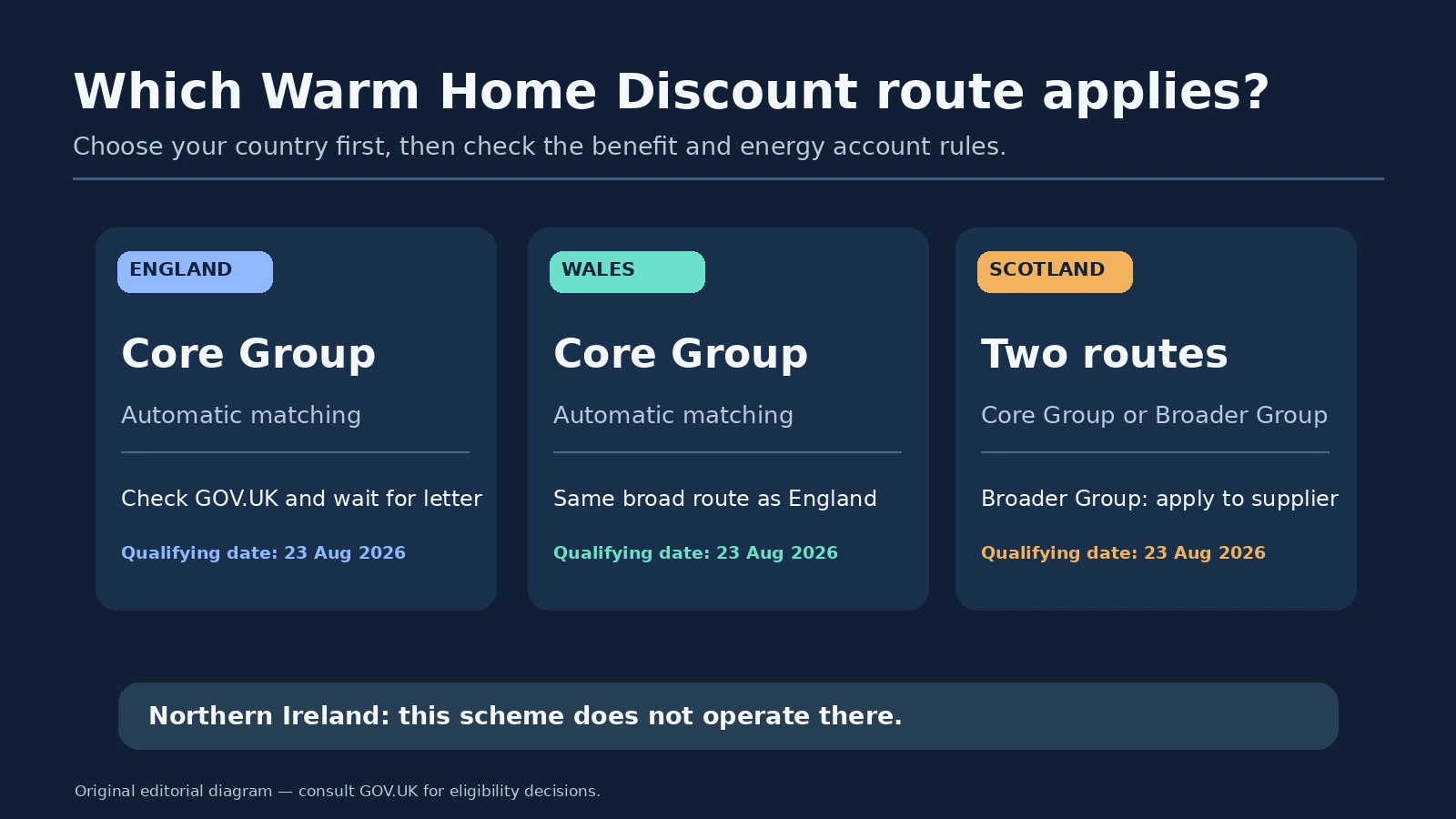
The right path depends on the country and your circumstances on 23 August, not just your current postcode. Use the location-based check below as an initial guide, not an official eligibility determination.
| Your location | Likely route | Who to speak to if something is wrong |
|---|---|---|
| England | Automatic Core Group if all tests are met | Government helpline for missing/uncertain letter; supplier for credited rebate |
| Wales | Same broad Core Group approach as England | Government helpline, then energy supplier as appropriate |
| Scotland, qualifying Core Group | Usually automatic | Government helpline if Core Group letter is missing; supplier for delivery |
| Scotland, Broader Group | Apply to participating electricity supplier | Your energy supplier; each has its own application process |
| Northern Ireland | Warm Home Discount does not apply | See Northern Ireland’s separate energy-efficiency and hardship schemes |
England and Wales: four qualifying benefit routes
For the 2026–27 scheme year, GOV.UK lists four benefit categories: Universal Credit, Housing Benefit, income-related Employment and Support Allowance (ESA), or Pension Credit, including Guarantee or Savings Credit. To qualify via the automatic Core Group, you also needed to be a customer of a participating supplier and have the recipient or their partner named on the electricity account on the qualifying date.
Those conditions must be checked together. Receiving a benefit today is not enough if you only became entitled after 23 August; receiving a qualifying benefit on 23 August does not by itself establish that your electricity account matched. Conversely, a household that did qualify on 23 August should not automatically assume it lost the rebate solely because its benefits changed subsequently. If the matching data is wrong or incomplete, the official helpline should assess the actual case.
Be careful when comparing sources. General Ofgem summaries may describe a wider range of historic or regulatory benefits, whereas the specific official England–Wales 2026–27 eligibility statement identifies the applicable criteria for this scheme year. Use the scheme-year statement rather than assuming an old blog’s benefit list is current.
Scotland: when the £150 is automatic
Some Scottish households qualify automatically, notably where the person or their partner gets Pension Credit or one of the other specified benefits with additional qualifying circumstances. These can include a disability-related Universal Credit element, relevant premiums, a Support for Mortgage Interest loan under qualifying conditions, or responsibility for a child under five combined with specified benefit and employment circumstances. See the official Scottish list to check the exact combinations.
Simply receiving Universal Credit in Scotland does not always put a household in the automatic Core Group. A claimant whose award and family circumstances do not meet the Core Group test should check the supplier’s Broader Group rather than wait for an automatic letter. The government says qualifying Core Group customers will receive a letter between late October 2026 and early January 2027, and may be asked to confirm information by 26 February 2027.
Scotland: who needs to apply to the Broader Group?
The Scottish Broader Group is designed for eligible low-income or vulnerable households who do not get the rebate automatically. Ofgem says suppliers must incorporate certain benefit categories, including Adult Disability Payment, Pension Age Disability Payment, Universal Credit, Housing Benefit, Income Support, income-based Jobseeker’s Allowance and income-related ESA, subject to their approved rules. Suppliers may have further criteria and limited numbers of rebates.
To apply, go to your energy supplier’s own website or contact its customer service team, ask specifically for the Warm Home Discount 2026–27 Scotland Broader Group, and check its opening and closing dates. Some suppliers, including OVO and British Gas, have already published details for this season. Do not assume there is a single government-wide Scottish online application form; there isn’t one for all suppliers. You should usually remain with the supplier until the Broader Group discount is delivered, according to GOV.UK.
Key dates: what to do now and what to do later
| Date or period | What happens | Recommended response |
|---|---|---|
| 7 August 2026 | England–Wales eligibility statement published | Confirm this season’s benefit rules |
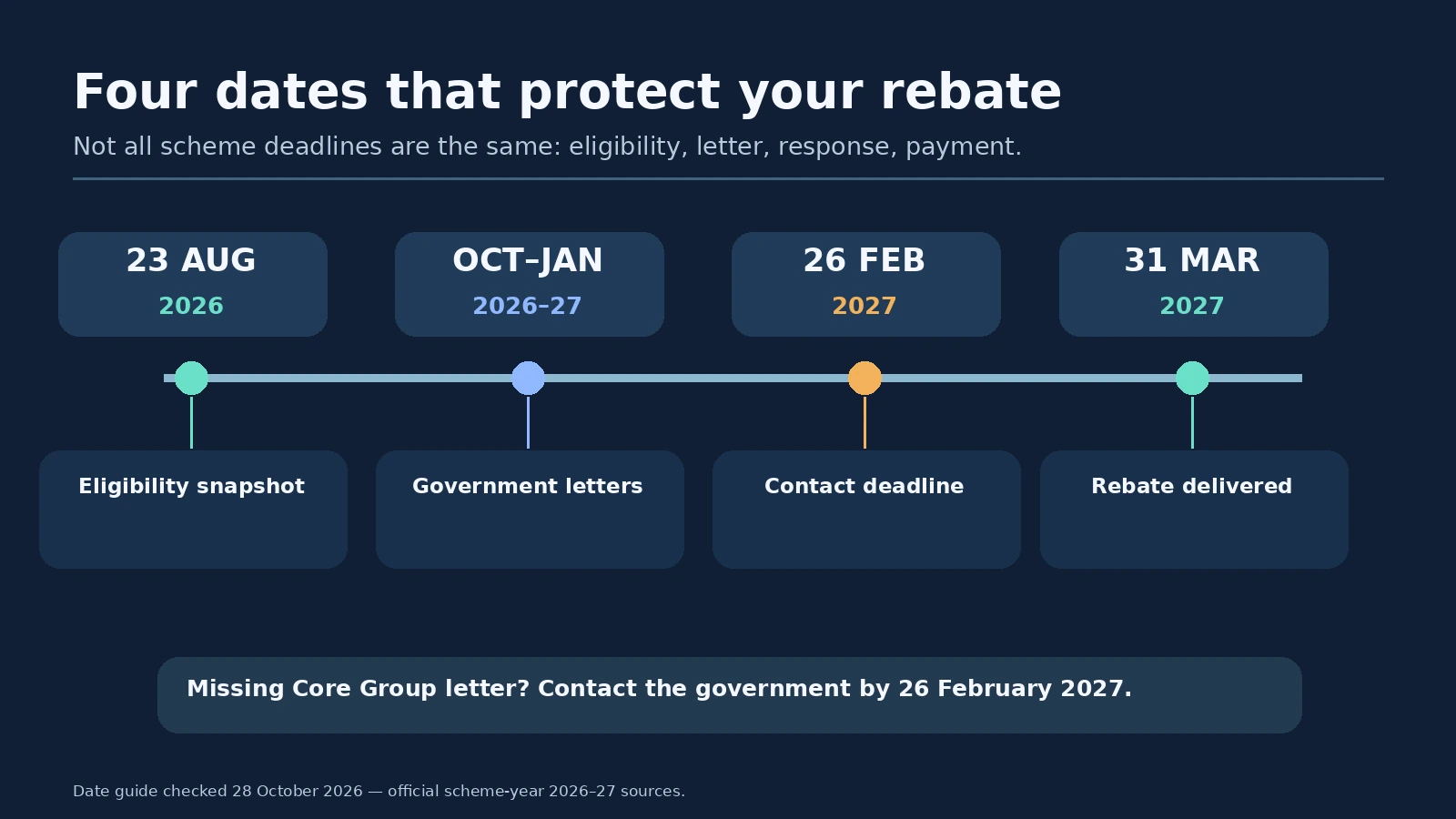
| 23 August 2026 | Main qualifying date | Review benefits and energy account records for that day |
| Late October 2026–early January 2027 | Government letters issued to Core Group households | Read carefully: no-action versus further-information letter |
| Now, autumn 2026 | Scottish supplier Broader Group windows | Apply promptly if potentially eligible; availability varies |
| Early January 2027 | Missing-letter follow-up period | Contact Warm Home Discount helpline if you expect Core Group eligibility |
| Before 26 February 2027 | Government contact cut-off | Confirm any missing details; do not leave this until March |
| By 31 March 2027 | Supplier rebate delivery deadline | Check statements or prepayment voucher status |
These dates are not all the same kind of deadline. 23 August is an eligibility snapshot; 26 February is the government information-contact cut-off; 31 March is the rebate-delivery target. A person who assumes “I have until March to start fixing my eligibility letter” could miss the earlier deadline.
Step by step: how to check if you will receive the discount
- Check your country: use the relevant GOV.UK page for England/Wales or Scotland; do not use a Northern Ireland route for this benefit.
- Check the 23 August snapshot: identify your benefit award and the electricity supplier for that date. If you have changed providers, keep details of the old one.
- Check the named billpayer: compare the benefit recipient’s name, their recognised partner or legal representative with the electricity bill. A spelling discrepancy can delay matching.
- Check the supplier: use the official list of participating suppliers. A similarly named intermediary or brand may use a licensed partner.
- Watch for official letters: a letter confirming eligibility may require no action; a letter asking for information must not be ignored.
- Choose the appropriate contact: government helpline for a Core Group missing letter; Scottish supplier for a Broader Group application; supplier for an already-awarded credit not appearing on your account.
- Record the result safely: note call dates and reference numbers privately, and check the bill or voucher before 31 March 2027.
This seven-step procedure is a practical checklist, not an independent benefit assessment. In unusual cases such as a recent move, bereavement, account-holder mismatch, intermediary electricity billing or a supplier that failed, ask the relevant official service to examine the records.
No Warm Home Discount letter? Use the right contact route
The government’s missing-letter page says that if you expect Core Group eligibility but have not received a letter by early January 2027, you should contact its helpline before 26 February 2027. The published number is 0800 030 9322, Monday to Friday, 8am to 6pm. You can verify that number directly on GOV.UK; always do so rather than using a number from a text message.
Before calling, put together the account name and address, supplier name, benefit type and relevant details of your circumstances on 23 August 2026. Have your current energy account details available, but do not share bank-card numbers, passwords or online banking codes. If you have a letter requesting more information, it may contain a reference specific to your case; check any unfamiliar contact instruction independently via GOV.UK before calling.
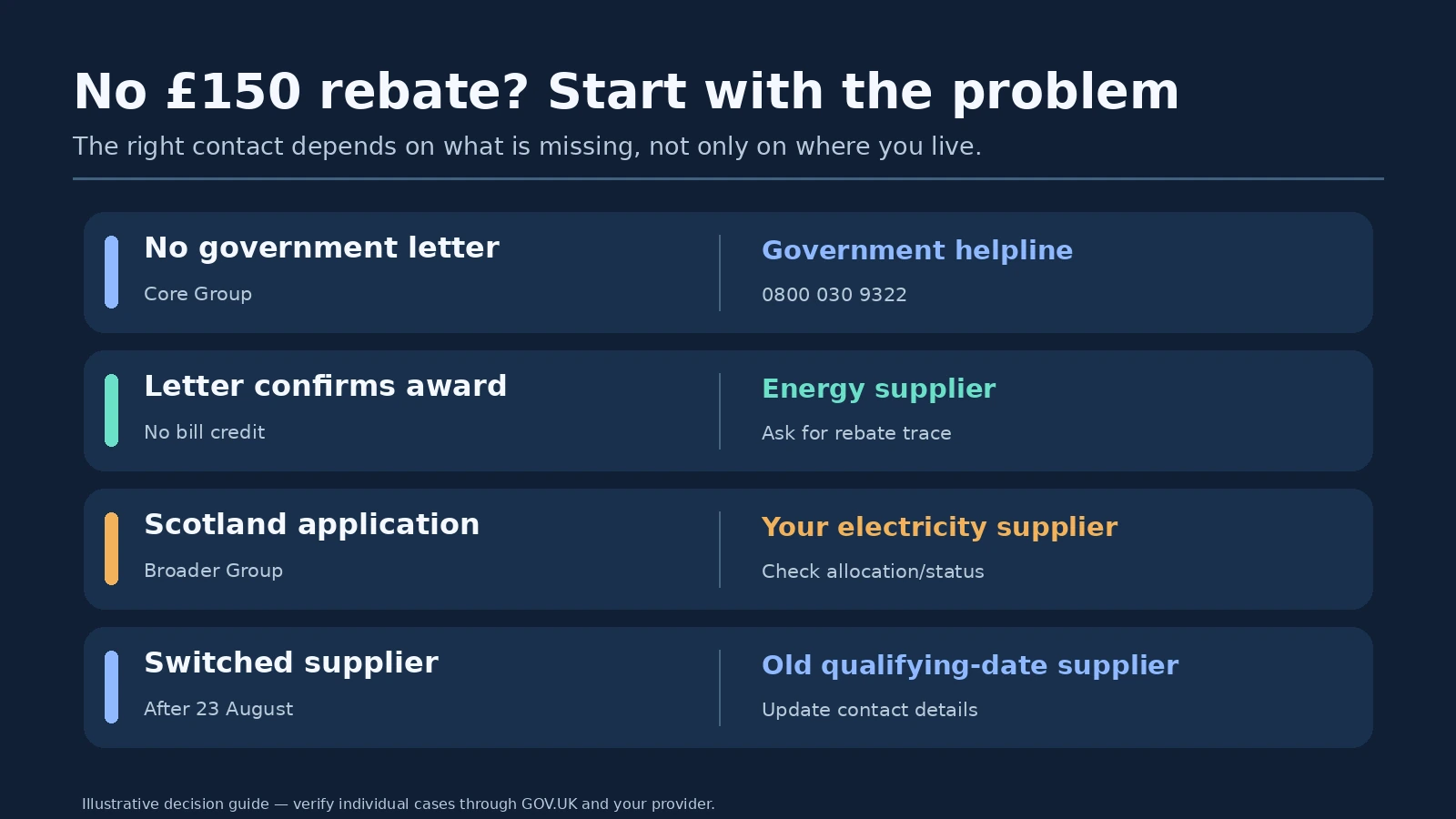
If you are in Scotland’s Broader Group, this is different: a government Core Group eligibility letter is not expected merely because you applied to your supplier. Contact the supplier for an application update. If you already received a confirmed award but no credit, ask your energy company to trace the rebate. A missing letter, missing confirmation and missing bill credit are three different problems with three different routes.
A decision table for common missing-payment situations
| Your situation | Who should act? | What to ask |
|---|---|---|
| England or Wales; qualifying benefits; no letter by January | Government helpline | Check eligibility matching and missing record before 26 February |
| Government says eligible; £150 not on bill in March | Electricity supplier | Confirm rebate processing date and delivery method |
| Scotland; not automatic; Broader Group application pending | Electricity supplier | Check application status, evidence requirements and allocation |
| You switched suppliers after 23 August | Supplier on qualifying date for Core Group | Ask about payment/voucher to former customers |
| Prepayment customer was told a voucher was sent | Supplier | Ask about issue date, expiry and replacement rules |
| Electricity supplied through park-home site owner | Park Homes scheme administrator | Check separate eligibility and current application window |
| You receive a suspicious link promising cash | Neither; do not click | Verify scheme on GOV.UK and report suspicious communications |
What if you changed your electricity supplier?
For automatic Core Group customers, Ofgem says the responsible supplier is generally the participating electricity company you used on the qualifying date. If you were eligible with Supplier A on 23 August, then switched to Supplier B, the correct first step is to contact Supplier A and make sure it has a current delivery address and contact information. A discount may be issued as a voucher or cheque rather than appearing on Supplier B’s bill. Do not assume Supplier B must pay because that is the provider whose app you currently use.
The reverse can be disappointing: if your electricity company on the qualifying date did not participate and you moved to a participating supplier afterwards, that switch does not automatically create entitlement to this season’s Core Group rebate. For Scotland’s Broader Group, GOV.UK advises that people need to stay with the supplier until the rebate is paid, so check before switching tariffs or companies.
If your old supplier went out of business, Ofgem says there may still be a route to the discount through the supplier appointed to take over. Ask the replacement supplier to assess your circumstances; do not assume the rebate vanished merely because the original company no longer trades.
Prepayment meters: vouchers are not a scam by default
Households using a prepaid or pay-as-you-go meter can still receive the discount. How it is delivered depends on the supplier. It could appear as an energy account credit, an electronic top-up or a voucher redeemable at an approved location. Government rules do not promise that every voucher works at the same shop, so ask your supplier where and how to redeem it. Check the expiry date and preserve any reference number privately.
Imagine someone with a £40 prepayment balance receiving a £150 credit. That does not mean their bank suddenly contains £190. Depending on the supplier’s method, the credit may increase their energy purchasing power by £150. Example for budgeting only: if a household spends about £30 a week on energy, £150 corresponds to around five weeks of that spending; winter usage, standing charges and tariff changes can make the actual number of days quite different.
If a prepayment voucher fails, take a record of the voucher date and redemption attempt and contact the supplier for replacement instructions. Never photograph and post a usable voucher barcode in a public Facebook group, since someone else might redeem it.
Park homes and people without a direct electricity account
The Warm Home Discount’s standard eligibility typically requires a direct account relationship with a participating supplier. In park homes, residents often pay the site owner for electricity, making ordinary supplier matching difficult. DESNZ’s 2026–27 eligibility statement identifies a separate Park Homes arrangement managed by Charis Grants. Funding is limited and applications may be open only for a period. Use the official government guide to find its current administrator route instead of a generic form offered on social media.
Living in a rented flat is not automatically an exclusion: what matters is whether the qualifying person (or recognised partner/legal representative) and the supplier-account information satisfy the rules. But if electricity is included in rent and the landlord has the direct account, you cannot safely assume eligibility. Ask the Warm Home Discount helpline to review the matching situation and whether another support scheme is more appropriate.
What the £150 actually saves: three worked examples
Example 1 — a straightforward bill credit. A household has an electricity bill of £228 and receives an eligible £150 Warm Home Discount. Its amount payable for that bill could fall to £78, before any other account adjustments. That is 150 ÷ 228 × 100 = 65.8% of this example bill. The percentage is not a scheme-wide subsidy rate; a £400 bill would experience a smaller proportionate reduction.
Example 2 — an annual budget. A household’s total annual energy spending is £1,800. A £150 rebate equals 8.3% of that illustrative annual cost. Divide £150 by 12 and it is £12.50 per month as a budgeting equivalent, but that is not how the rebate is paid. The actual credit arrives once, generally in the scheme year.
Example 3 — winter costs and other schemes. If an eligible older person receives a Winter Fuel Payment and separately meets the Warm Home Discount rules, those are different schemes with different eligibility dates, payment methods and geographic rules. It can be useful to enter each award on a household spreadsheet separately, but do not treat the Warm Home Discount as automatically £150 in addition to every other benefit for all pensioners. See Horus Valley’s Winter Fuel Payment 2026–27 guide for the distinct pension-age payment.
Five mistakes that can cost time—or the rebate
- Confusing Pension Credit with State Pension: the latter alone does not satisfy the England–Wales means-tested benefit requirement. Check the precise benefit, not just retirement age.
- Treating Scotland exactly like England: Scotland has a Core Group and a Broader Group. You may need to apply to your supplier rather than wait for DWP matching.
- Using today’s account as proof of the August snapshot: keep evidence of the supplier and billpayer on 23 August, especially if you recently moved or switched.
- Missing 26 February while waiting for 31 March: clarification of a missing Core Group letter belongs with the government helpline by the earlier date, not on the final supplier-payment day.
- Believing a £150 ‘instant cash transfer’ advert: this is ordinarily an energy-bill rebate. Do not enter bank details into links from unsolicited messages.
Avoid Warm Home Discount scams
Fraudsters may exploit a genuine benefit’s deadlines by sending texts such as “Your £150 energy grant expires today” or “Enter card details to release your discount.” The correct response is to type GOV.UK into your browser yourself and follow the Warm Home Discount pages, or call your supplier using the number printed on a genuine bill. The government helpline can verify letter-related information. Your bank password, PIN or one-time passcode is not a normal Warm Home Discount application requirement.
A genuine letter may ask for information, so never assume every message asking you to call is a scam. Instead verify the sender, published phone number and reason independently. MoneySavingExpert has also highlighted attempts to imitate official Warm Home Discount letters. Distinguish a request to prove benefit-and-account matching from a request to pay a processing fee.
If you do not qualify: other support to check
Not receiving this £150 discount does not prove there is no help with heating. Depending on your location and circumstances, explore eligibility for Cold Weather Payments, local council assistance, supplier hardship funds, fuel debt repayment plans and energy-efficiency support. England, Wales and Scotland have different combinations of programmes. Ofgem’s support information is a useful starting point, and local Citizens Advice services can help identify debt and benefits support.
If you can pay part of an energy bill but not all of it, contact the supplier early and ask about an affordable repayment plan, payment-method choices and available hardship support. You should not spend money on a “Warm Home Discount eligibility certificate” sold by an unofficial company; it does not replace the government or supplier assessment.
What Horus Valley checked, and what can still change
The specific 2026–27 qualifying date, government information deadline and rebate payment date come from GOV.UK and Ofgem. Scotland’s supplier-run Broader Group details can vary by company, including any allocation or application closing date, so the article intentionally does not invent one national deadline. The worked bill calculations are labelled illustrations, not benefit award predictions. Similarly, a genuine prepayment voucher is possible, but its issue method and redemption terms depend on the supplier.
Our review of current competing guides included MoneySavingExpert, Which? and Citizens Advice Scotland. Their explanations are useful, but the distinguishing feature here is a route-based troubleshooting table that separates missing letters, uncredited awards, switched suppliers, prepayment vouchers and Scottish applications. Always check the official service before giving anyone personal information.
Official sources and further reading
- GOV.UK — Warm Home Discount Scheme overview, definition, scheme coverage and payment format.
- GOV.UK — England and Wales eligibility, benefit list, 23 August qualifying date and deadlines.
- GOV.UK — Scotland eligibility and supplier applications, Core Group and Broader Group distinction.
- GOV.UK — If you do not get a letter, verified telephone number and 26 February contact deadline.
- GOV.UK — Participating energy suppliers, check your current and qualifying-date supplier.
- DESNZ — 2026–27 eligibility statement for England and Wales, statutory details and park-home exceptions.
- Ofgem — Warm Home Discount eligibility and supplier duties, rebate delivery, supplier switching, Scotland Broader Group.
- Citizens Advice Scotland — energy bill support, help applying for Scottish support.
Editorial review: 28 October 2026. This guide offers practical information, not a personalised benefits decision. Follow the official pages above if the rules or your situation changes.
You may also like
 Business & Economy
TG Jones Store Closures 2026–27: Confirmed Dates, Towns and Post Office Alternatives
TG Jones closures in the UK: check announced 2026–27 shop dates, where Post Office counters are affected, and…
 Business & Economy
Making Tax Digital 2027: £30,000 Threshold, Registration, Quarterly Deadlines and Penalties
MTD Income Tax expands on 6 April 2027 for UK sole traders and landlords above £30,000 qualifying income.…
 Business & Economy
Making Tax Digital for Income Tax 2026/27: Who Must Sign Up, Deadlines and Software
Making Tax Digital for Income Tax 2026/27 explained: check the £50,000 qualifying-income test, quarterly deadlines, software choices, exemptions,…