
SpaceX Space Jellyfish Explained: Why Rockets Create Glowing Clouds
What causes a SpaceX space jellyfish? Discover the science of glowing rocket exhaust, twilight launches, and how to verify viral sky videos.
Contents
- What Is a Space Jellyfish?
- The October 13, 2026 SpaceX Launch
- How the Rocket Jellyfish Effect Forms
- Why Sunrise and Sunset Matter
- Why the Plume Looks So Large
- Why the Cloud Can Look Blue, Orange, White, or Purple
- Space Jellyfish Versus Aircraft Contrails
- How It Differs From Auroras, Meteors, and Noctilucent Clouds
- Is a Space Jellyfish Dangerous?
- Why People in Different States May See It
- How to Verify a Viral Space Jellyfish Video
- Can You Predict the Next Rocket Jellyfish?
- How to Photograph One
- Why People Mistake It for a UFO
- What NASA Has Documented
- Why Does Altitude Change the Shape of Rocket Exhaust?
- Why Twilight Is the Ideal Time
- Why the Plume Can Appear Blue, Orange, White or Purple
- Is a Space Jellyfish the Same as an Aircraft Contrail?
- Space Jellyfish vs Aurora, Noctilucent Clouds and Meteors
- Are Rocket Jellyfish Dangerous?
- Why the Same Launch Looks Different From Different Places
- How to Verify a Viral Space Jellyfish Video
- Can You Predict and Photograph the Next One?
- Why These Clouds Are Sometimes Mistaken for UFOs
- What Is Confirmed About October 13, 2026?
- Conclusion
- Scientific Sources and Further Reading
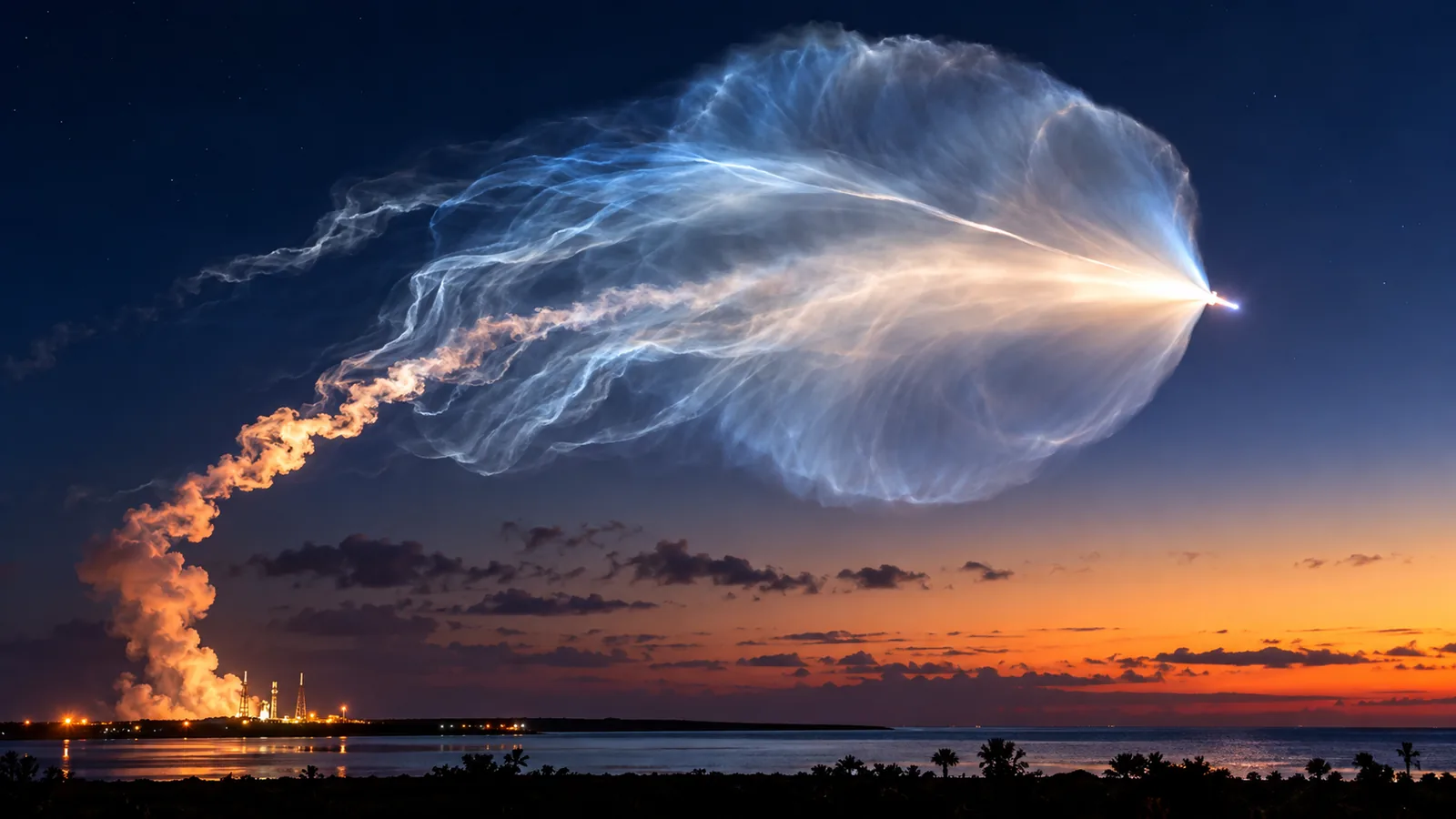
A huge luminous cloud stretches across the twilight sky, resembling a jellyfish floating above Earth. The dramatic sight has a scientific explanation: high-altitude rocket exhaust illuminated by sunlight while the sky below remains dark.
Following NASA’s confirmed SpaceX CRS-35 launch on October 13, 2026, the science behind the so-called space jellyfish is worth understanding. This guide explains how the effect forms, how to distinguish it from other phenomena, and how to verify dramatic online videos without assuming that a particular image depicts that mission.
What Is a Space Jellyfish?
A space jellyfish is a glowing, expanding rocket exhaust plume visible under special lighting conditions. It often appears when a rocket launches shortly before sunrise or after sunset. Observers on the ground can still be in darkness while the high-altitude exhaust catches direct sunlight. The resulting illuminated cloud may resemble a translucent jellyfish, comet, fan, or spiral. This is an informal visual description, not a separate astronomical object.
The October 13, 2026 SpaceX Launch
NASA confirmed that a SpaceX Falcon 9 launched a Dragon cargo spacecraft on the CRS-35 commercial resupply mission on October 13, 2026, at 6:33 a.m. Eastern Daylight Time from Space Launch Complex 40 at Cape Canaveral Space Force Station in Florida. The spacecraft carried more than 6,300 pounds of equipment, supplies, and scientific investigations for the International Space Station. The launch occurred near sunrise, which is consistent with conditions favorable for illuminated plumes. However, the timing alone does not verify that any particular viral jellyfish image shows CRS-35. Images require independent checks of time, location, and trajectory.
How the Rocket Jellyfish Effect Forms
A rocket engine produces thrust by expelling hot combustion gases at high speed. Falcon 9 Merlin engines use rocket-grade kerosene and liquid oxygen. As the vehicle climbs, surrounding atmospheric pressure decreases and exhaust can expand more freely. At high altitude the plume can spread far wider than the vehicle. If sunlight reaches the exhaust while the sky behind it remains dark, scattered light reveals the enormous cloud. Its shape depends on engine activity, exhaust properties, altitude, vehicle orientation, and viewing angle. Some visible features may involve condensed exhaust components; different stages and releases can produce different patterns.
Why Sunrise and Sunset Matter
Earth casts a shadow into space. Close to dawn or dusk, someone standing on the surface can be inside that shadow while a rocket high overhead remains sunlit. This altitude-dependent difference is a consequence of Earth’s curvature. During daylight the exhaust competes with a bright background; deep at night it may receive little direct sunlight. Twilight therefore offers particularly dramatic contrast, though it does not guarantee a display.
Why the Plume Looks So Large
A high-altitude plume expands as external pressure falls. The glowing cloud can occupy a much larger angle in the sky than the rocket itself. Apparent size is not a reliable measure of physical size: distance, camera focal length, and viewing geometry must be known before estimating dimensions. A photograph alone cannot establish that a plume measured a certain number of miles across.
Why the Cloud Can Look Blue, Orange, White, or Purple
Sunlight scattering, the composition and state of exhaust material, the path of sunlight through Earth’s atmosphere, and camera processing all influence the appearance. Low-angle sunlight may look warmer after atmospheric scattering, while some illuminated plume regions look pale white or bluish. Exposure, white balance, and editing can substantially change a photograph’s colors. A dramatic color is not evidence by itself of an exotic chemical or unexplained phenomenon.
Space Jellyfish Versus Aircraft Contrails
Aircraft contrails generally form when water vapor associated with engine exhaust freezes into ice crystals in cold, sufficiently humid air. Rocket plumes originate from high-speed combustion products exiting a nozzle and may expand greatly at low ambient pressure. Both can involve condensation and scattering, but their formation, geometry, and altitude profiles are not identical. The informal terms sometimes overlap; each event should be evaluated individually.
How It Differs From Auroras, Meteors, and Noctilucent Clouds
Auroras result from charged particles interacting with gases in the upper atmosphere and frequently form curtains or arcs. Meteors are rapidly moving luminous trails associated with objects entering the atmosphere. Noctilucent clouds are high-altitude ice-crystal clouds illuminated by the Sun after sunset or before sunrise. A space jellyfish, in contrast, is tied to rocket exhaust and its trajectory. A rocket stage venting gas while rotating may create a spiral rather than a jellyfish-shaped fan.
Is a Space Jellyfish Dangerous?
The glowing appearance is not itself evidence of immediate danger to people on the ground. A visible high-altitude exhaust plume should not be confused with material necessarily falling nearby. Nevertheless, rocket launches do have emissions and environmental effects that researchers study; these depend on fuel, altitude, frequency, and other factors. Those broader questions are distinct from the optical explanation of a sunlit plume.
Why People in Different States May See It
At sufficiently high altitude, an illuminated plume can be visible across a large geographical area, subject to weather, terrain, trajectory, and horizon geometry. Viewers in different locations may see dramatically different silhouettes because they observe the same three-dimensional structure from different directions. A wide fan from one viewpoint can look like a narrow streak from another.
How to Verify a Viral Space Jellyfish Video
First establish the original recording date rather than the repost date. Find the photographer’s location and any landmarks. Compare the time with official launch confirmations, not merely scheduled launch times. Check whether twilight lighting and the trajectory make sense for that location. Seek independent images from other observers. Preserve original metadata when possible. A visually convincing plume is not sufficient to attribute a video to a particular launch without corroboration.
Can You Predict the Next Rocket Jellyfish?
A launch near sunrise or sunset is a promising candidate. Check the official mission schedule, predicted trajectory, cloud cover, and whether the rocket will rise into sunlight while the observer remains in twilight. Favor an unobstructed, safe viewpoint. Not every twilight launch produces a visible jellyfish: weather, engine timing, geometry, and other factors can prevent the display.
How to Photograph One
Use a clear view of the launch direction and prepare before liftoff. On a smartphone, hold the device steady, use the main camera, and lower exposure if the brightest portion becomes washed out. A wide-angle lens can help fit a large plume into the frame; a tripod may improve stability. Video can preserve the plume’s changing shape. Keep the original files, timestamps, and location information for later verification. Never stop on unsafe roads or enter restricted areas to photograph a launch.
Why People Mistake It for a UFO
The plume can be huge, luminous, unfamiliar, and apparently disconnected from a visible aircraft. Perspective can also make a rocket appear to move in an unexpected direction. These observations explain the surprise but do not establish an extraordinary origin. Launch records, atmospheric physics, and multiple viewpoints often provide a testable explanation. If evidence is incomplete, describe an event as unidentified rather than assuming it is extraterrestrial.
What NASA Has Documented
NASA’s Astronomy Picture of the Day published a documented Falcon 9 jellyfish example from a March 4, 2026 launch. It describes the rocket launching 52 minutes before sunrise, with the high-altitude plume catching sunlight while the photographer remained in darkness. This is direct evidence for the phenomenon’s physical explanation, independent of any disputed October video.
Why Does Altitude Change the Shape of Rocket Exhaust?
At sea level, dense surrounding air restricts the outward expansion of hot exhaust gases. As atmospheric pressure falls with altitude, the exhaust jet becomes more underexpanded and can spread into a much broader plume. The exact outline depends on nozzle pressure, engine operating state, ambient pressure and the vehicle’s orientation. The glowing region seen from the ground can be vastly wider than the rocket itself, but photographs cannot reliably establish a physical width without knowing the distance and viewing geometry.
Why Twilight Is the Ideal Time
The essential geometry is that Earth casts a shadow. Before sunrise, the ground can still be in shadow while a high-altitude rocket has already risen into direct sunlight. After sunset, the opposite timing can create the same effect. Sunlight scattered by material in the plume makes it appear luminous against a relatively dark sky. Midday launches may produce visible plumes, but the contrast is typically less dramatic; night launches may lack the sunlight needed for this particular display.
Why the Plume Can Appear Blue, Orange, White or Purple
Color depends on sunlight angle, atmospheric scattering, the composition and physical state of the exhaust, and camera processing. Low-angle sunlight can produce warm orange or red tones, while other parts of the plume appear pale or bluish. White balance and exposure can strongly change the recorded colors. A blue or purple photograph alone is not evidence of unusual chemicals or an unexplained event.
Is a Space Jellyfish the Same as an Aircraft Contrail?
Not exactly. A familiar airplane contrail generally forms when exhaust water vapor condenses and freezes into ice crystals in sufficiently cold, humid air. A rocket plume begins as high-speed combustion products expanding from an engine and can involve multiple visible mechanisms, including sunlight scattering and condensation. The two can look similar from a distance but their origins and surrounding conditions differ.
Space Jellyfish vs Aurora, Noctilucent Clouds and Meteors
Auroras result from energetic charged particles interacting with the upper atmosphere and often appear as moving curtains. Noctilucent clouds consist of high-altitude ice crystals that remain sunlit in twilight and often look like thin ripples. Meteors usually create brief moving streaks as objects enter the atmosphere. A rocket jellyfish instead develops around the trajectory and exhaust of a launch. Shape alone is not proof: location, time, and launch records should be checked.
Are Rocket Jellyfish Dangerous?
The visual phenomenon itself does not imply an immediate threat to people on the ground: the illuminated exhaust may be very high overhead. This should not be confused with the separate environmental question of launch emissions. Scientists study how propulsion products and increasing launch activity affect different atmospheric layers. Risk depends on the specific propellant, emissions, altitude and exposure, rather than the mere presence of a glowing cloud.
Why the Same Launch Looks Different From Different Places
Observers in different locations see different two-dimensional projections of the same three-dimensional plume. One person may see a broad fan while another sees a narrow tail or spiral. At high altitude the rocket may be visible from far beyond the launch site, but cloud cover, terrain, the trajectory and sunlight geometry determine whether any observer can see it.
How to Verify a Viral Space Jellyfish Video
First, establish the original recording date rather than the repost date. Next identify the location and direction of the camera, and compare the timestamp against a confirmed launch—not merely a scheduled one. Check local sunrise or sunset and the launch trajectory. Finally, look for independent footage from other locations. A verified mission and favorable twilight timing are useful evidence, but neither alone proves a specific video depicts that launch.
Can You Predict and Photograph the Next One?
Look for a confirmed rocket launch close to local sunrise or sunset, then check weather and the expected trajectory. A clear view toward the flight path improves your chances, but a dramatic display is never guaranteed. For photography, use a stable position, avoid excessive digital zoom and preserve highlights around the brightest exhaust. Keep the original file and record your observation time and location to make the image easier to authenticate.
Why These Clouds Are Sometimes Mistaken for UFOs
The plume may seem enormous, oddly symmetrical or detached from its source. Perspective can also make the rocket’s motion appear counterintuitive. Those effects explain why observers may initially be uncertain about what they are seeing. An unexplained image is not evidence of extraterrestrial origin; careful comparisons with launch records and atmospheric conditions often reveal a straightforward physical explanation.
What Is Confirmed About October 13, 2026?
NASA confirmed a Falcon 9 launch carrying Dragon on the CRS-35 commercial resupply mission at 6:33 a.m. EDT from Cape Canaveral. The spacecraft carried more than 6,300 pounds of scientific equipment and supplies to support International Space Station research. The launch was close to dawn, a favorable time for illuminated exhaust. However, without independently verified imagery, it would be misleading to assert that any specific viral jellyfish image was recorded during CRS-35.
Conclusion
A space jellyfish is a striking interaction of rocket propulsion, expanding exhaust, sunlight, and Earth’s shadow. The October 13, 2026 CRS-35 launch is a verified event and a timely reason to learn the science, but a particular glowing-cloud photograph should only be attributed to that mission after verification. The central insight is simple: a rocket can be in sunlight even when its observers on the ground are still in darkness.
Scientific Sources and Further Reading
- NASA — CRS-35 launch confirmation
- NASA APOD — Launch Plume: SpaceX Jellyfish
- SpaceX — CRS-35 mission
- NASA — Dragon liftoff update
Last updated: October 14, 2026. Specific viral images should be independently verified before attribution to a mission.
You may also like
 Science & Space
Strange Cosmic Signal Leads Scientists to a Rare Triple-Star System
A puzzling timing change in millisecond pulsar PSR J0435+3233 led astronomers to uncover a rare triple-star system with…
 Science & Space
Brilliant Green Fireball Explodes Over Arizona — What Really Happened?
A vivid green fireball crossed the Arizona sky on October 6, flaring and fragmenting near the horizon. Here…