
Brilliant Green Fireball Explodes Over Arizona — What Really Happened?
A vivid green fireball crossed the Arizona sky on October 6, flaring and fragmenting near the horizon. Here is what scientists can tell from the footage.
Contents
- When and where was the Arizona fireball seen?
- Why did the meteor glow green?
- Why did it appear to explode?
- How big was the object?
- Was it part of a meteor shower?
- Could it have been a satellite reentry?
- Did any meteorites reach the ground?
- What is the difference between a meteoroid, meteor and meteorite?
- Why Arizona often produces spectacular meteor footage
- What scientists can learn from fireballs
- Frequently asked questions
- Was the green Arizona fireball dangerous?
- Why do some meteors look green?
- Can scientists tell where it landed from one video?
- Sources
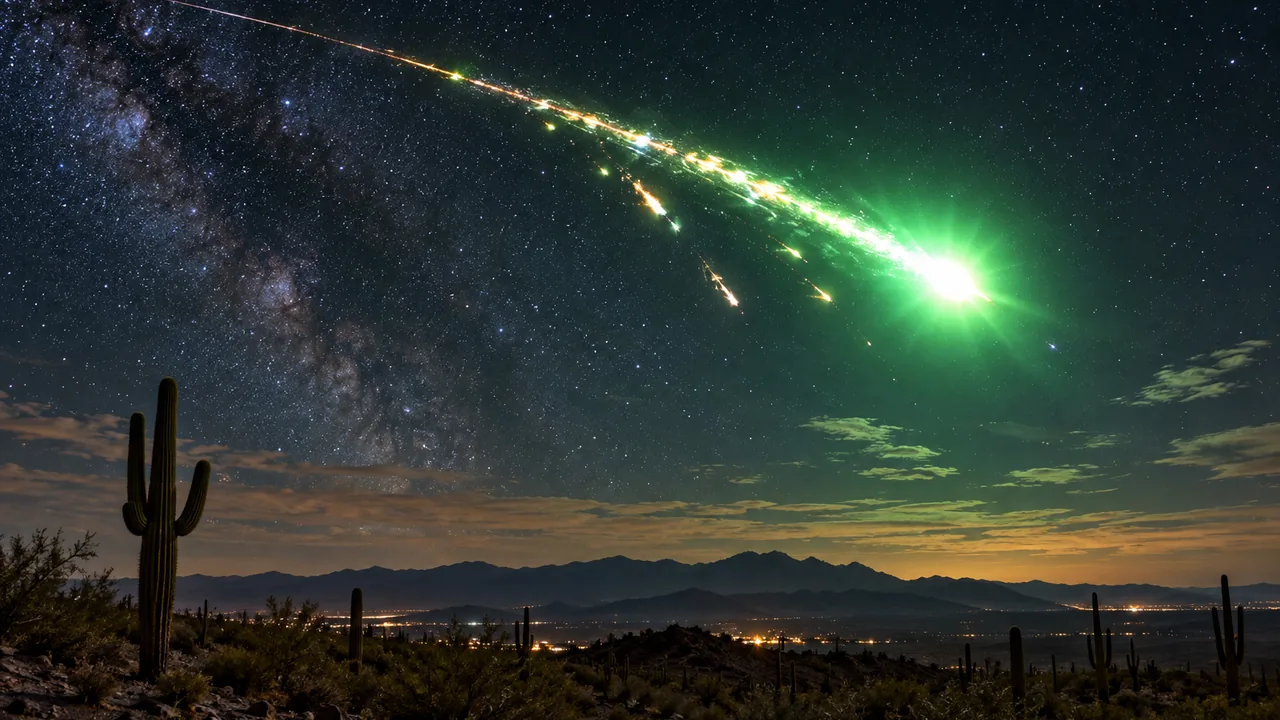
Last reviewed: October 11, 2026. A brilliant green fireball streaked across the Arizona sky in the early hours of October 6, producing repeated flashes before appearing to fragment near the horizon. The event was captured by cameras in the state, including a livestream in Dragoon southeast of Tucson.
The object was a meteor — the bright atmospheric streak produced when a meteoroid enters Earth’s atmosphere at high speed. Its vivid green or turquoise color and explosive-looking breakup made the event especially dramatic.
Despite some social-media speculation, there is no confirmed evidence that the object was a satellite reentry or that a large fragment reached the ground. The available footage mainly shows a fast natural meteoroid flaring and breaking apart.
When and where was the Arizona fireball seen?
Reports place the event shortly after 1 a.m. local time on October 6, 2026. A SouthWest RailCams livestream in Dragoon recorded the object as it crossed the night sky and flared repeatedly during its descent.
Other observers in Arizona also reported seeing the green flash, and local doorbell and outdoor cameras captured portions of the event.
Why did the meteor glow green?
Meteor colors are produced by a combination of the material inside the meteoroid and the hot, ionized air surrounding it. Different elements can emit characteristic colors when heated.
The strong green appearance has been linked in reports to magnesium, which can produce greenish light as a meteoroid vaporizes. Atmospheric oxygen can also contribute green emission under some conditions, so color alone cannot provide a complete chemical analysis.
Why did it appear to explode?
A meteoroid entering the atmosphere experiences enormous aerodynamic pressure and heating. If the body is cracked, porous or irregularly shaped, it can break apart as the stress rises.
Each fragmentation event exposes fresh material, often creating a sudden burst of brightness. A final bright flare is sometimes called a terminal burst.
That is what makes many fireballs look as if they explode in the sky even though there is no conventional explosive device involved.
How big was the object?
Public reports described the meteoroid as potentially comparable in size to a small car, but that estimate should be treated as approximate. Without a published trajectory and energy reconstruction, the exact diameter and mass cannot be stated with confidence.
A relatively small space rock can still create a spectacular fireball because atmospheric entry occurs at many kilometers per second, converting tremendous kinetic energy into heat and light.
Was it part of a meteor shower?
October has several active meteor showers, including the Orionids and Southern Taurids. However, an expert quoted by Space.com said the Arizona object was most likely a sporadic meteor rather than a member of a recognized shower.
Sporadic meteors are bits of interplanetary debris that enter the atmosphere from directions not associated with a specific annual shower.
Could it have been a satellite reentry?
The speed and short-lived appearance argued against a typical satellite or rocket-body reentry. Artificial objects usually move across the sky more slowly and may produce a train of multiple glowing fragments over a longer interval.
Astrophotographer Andrew McCarthy, cited in coverage of the event, also noted that the rapid motion looked more consistent with a natural meteor.
Did any meteorites reach the ground?
That remains unconfirmed. The fireball appeared to fragment low on the horizon from the camera’s viewpoint, but video alone cannot prove that surviving pieces reached the surface.
To identify a meteorite fall, researchers usually need a well-constrained atmospheric trajectory, a calculated dark-flight zone and then physical fragments that can be tested.
What is the difference between a meteoroid, meteor and meteorite?
- A meteoroid is the rocky or metallic object while it is still in space.
- A meteor is the streak of light produced as the object enters the atmosphere.
- A meteorite is any surviving piece that reaches the ground.
A fireball is simply an unusually bright meteor, bright enough to attract widespread attention and sometimes to cast visible light on the landscape.
Why Arizona often produces spectacular meteor footage
Arizona has large areas of dark, dry desert sky with relatively low humidity and many communities far from intense city lighting. That combination is excellent for stargazing, astrophotography and all-sky monitoring.
It does not necessarily mean more meteors fall over Arizona than elsewhere. It often means they are easier to see and more likely to be recorded clearly.
What scientists can learn from fireballs
Bright meteors can reveal the speed, direction and strength of incoming space rocks. If multiple cameras record the same event from different locations, astronomers can triangulate the path through the atmosphere.
In some cases they can reconstruct the object’s pre-impact orbit around the Sun and predict where surviving meteorites might land.
Recovered meteorites are scientifically valuable because they preserve material left over from the early solar system, often billions of years old.
Frequently asked questions
Was the green Arizona fireball dangerous?
There were no reports in the cited coverage of injuries or damage. Most meteoroids disintegrate high in the atmosphere, and spectacular brightness does not automatically mean the object is large enough to be hazardous on the ground.
Why do some meteors look green?
Green light can come from excited elements such as magnesium in the meteoroid and from emissions in the surrounding atmosphere. The exact color depends on composition, speed and atmospheric conditions.
Can scientists tell where it landed from one video?
Usually not. Reliable recovery predictions work best when several calibrated cameras view the same meteor from different locations.
Sources
You may also like
 Science & Space
 Strange Cosmic Signal Leads Scientists to a Rare Triple-Star System
A puzzling timing change in millisecond pulsar PSR J0435+3233 led astronomers to uncover a rare triple-star system with…