
Could Mars Dust Harm Astronauts? What Perseverance Found on Spacesuit Materials
Perseverance detected ultrafine dust clinging to spacesuit-like materials. Explore sizes, health evidence, habitat protection and NASA’s preliminary limits.
Contents
- What exactly did NASA discover?
- The numbers explained: how small is 100 nanometers?
- How did a geology rover study spacesuit materials?
- Why can the dust stay attached for years?
- Is Martian dust more dangerous than lunar dust?
- Why does chemical composition matter as much as size?
- Could particles reach the lungs, bloodstream or brain?
- NASA's 2026 preliminary limit: what does 0.1 mg/m³ mean?
- A worked example: why diameter alone cannot tell us the risk
- From the suit to the sleeping area: the possible contamination chain
- How might future suits and habitats control dust?
- What the 2026 study cannot tell us
- Three questions the next studies need to answer
- How to check the images and scientific numbers for yourself
- Conclusion: tiny grains and a big design challenge
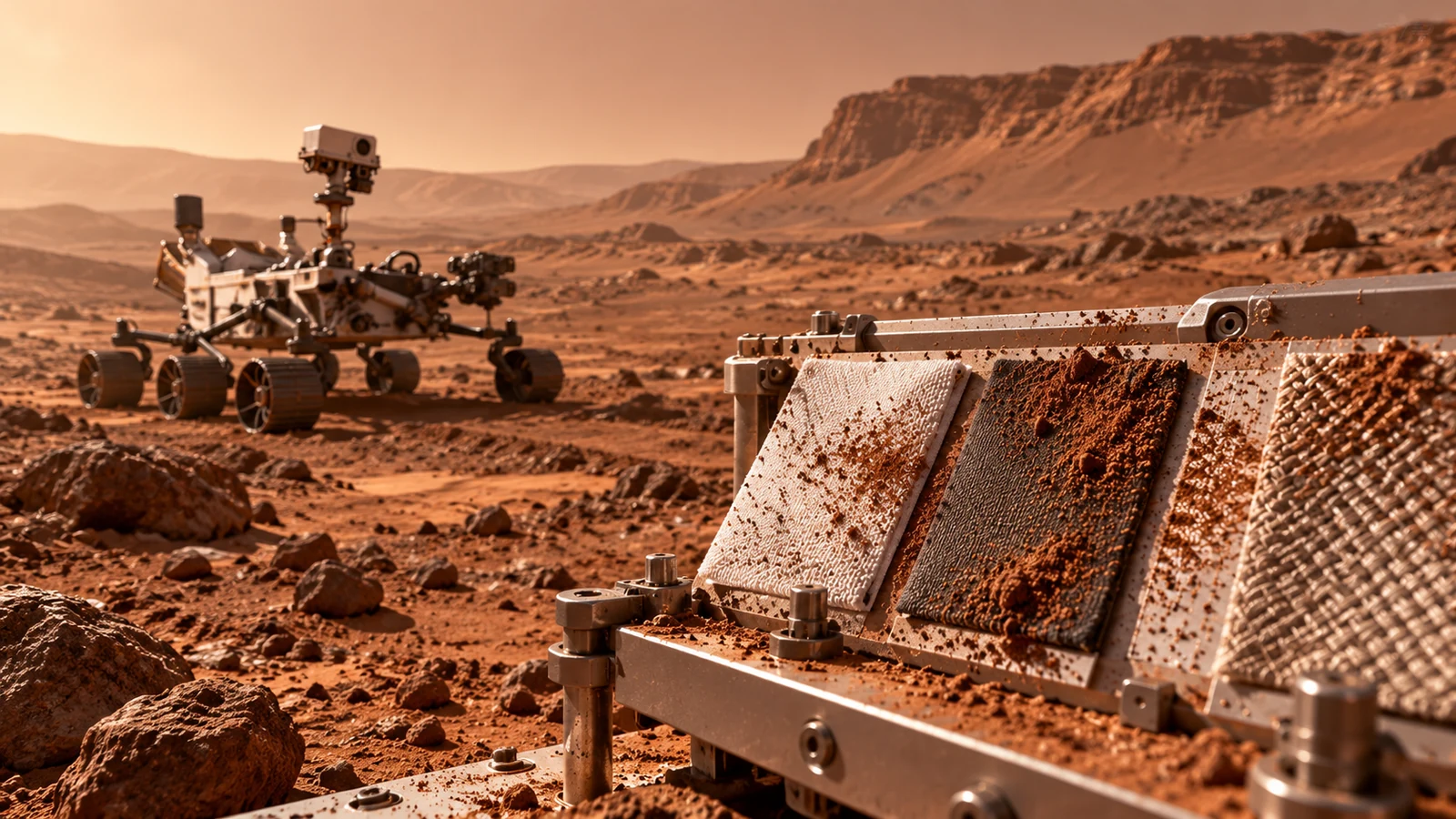
NASA’s Perseverance rover has detected Martian dust particles so small that some measure just 100–300 nanometers across, and the particles remained attached to surfaces resembling materials used in spacesuits. NASA’s Jet Propulsion Laboratory announced the results on October 26, 2026, alongside a peer-reviewed study in PNAS. This does not show that Martian dust has made an astronaut ill: no human has yet lived on the surface of Mars. It does, however, provide direct measurements that engineers and medical researchers have lacked when assessing how to keep a future crew safe.
The useful question is more precise than the headline "toxic dust": how do tiny particles attach to a suit, how might they enter a pressurized habitat, and what determines the danger if they are inhaled? This guide separates what Perseverance measured from what researchers infer and puts the numbers into context with links to the original NASA imagery. Its principal sources are NASA’s October 26 announcement and the PNAS research paper.
What exactly did NASA discover?
Perseverance did not examine human lungs or sample the atmosphere of a living compartment. Instead, the science team analyzed measurements by the rover’s X-ray instrument PIXL of dust deposited on test surfaces mounted on the spacecraft, including small patches of materials analogous to those considered for the outer layers of spacesuits. Observations extended across 1,645 Martian days, offering a rare view of what remains stuck to materials over years rather than after a short laboratory exposure.
The new finding is that the instrument could characterize particles smaller than 2.5 micrometers, with some in the 100–300-nanometer range—less than one-third of a micrometer. Previous in-situ Martian measurements had resolved particles down to roughly three micrometers. The new results therefore expand the direct observational record into a finer fraction of the dust that scientists had long expected to exist but struggled to measure on Mars itself.
The research reports particles averaging approximately two micrometers on a Teflon calibration surface and a Vectran swatch. Still smaller fractions appeared on basaltic glass and another Teflon surface. The choice of material is therefore not a side issue: different surfaces apparently collect different sizes of grains, with different implications for cleaning and the transfer of contamination.
The numbers explained: how small is 100 nanometers?
A micrometer is one-millionth of a meter, while a nanometer is one-billionth. A 100-nanometer particle is 0.1 micrometers across; 300 nanometers equals 0.3 micrometers. To communicate the scale, NASA uses the example of a human hair roughly 70 micrometers across. On that comparison, the hair’s diameter is approximately 700 times that of a 100-nanometer particle. This is a comparison of diameters, not particle masses or volumes, and it certainly does not establish that every tiny particle can pass straight into the blood.
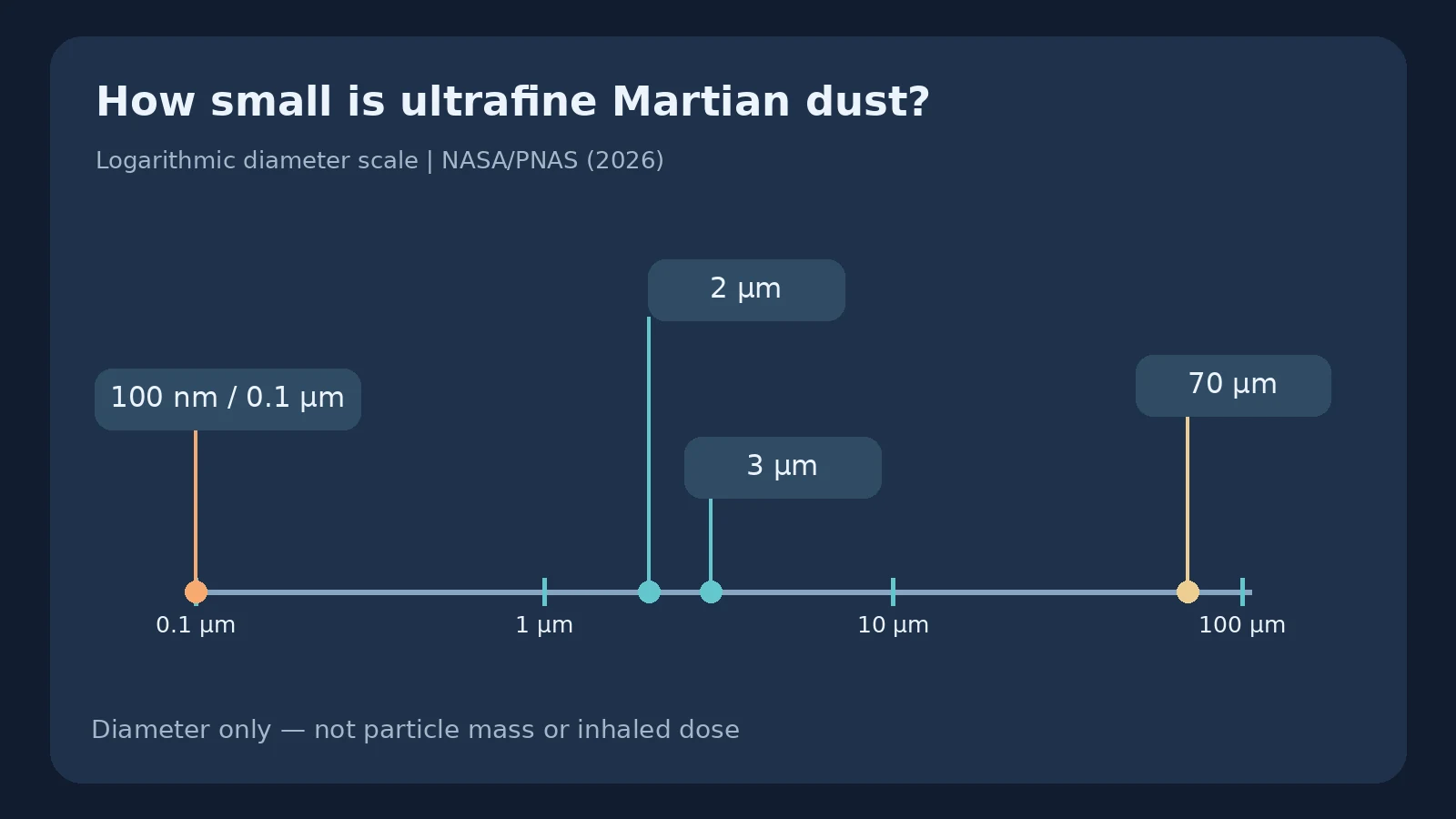
| Particle or reference | Approximate diameter | Why it matters |
|---|---|---|
| Typical human hair in NASA’s illustration | 70 micrometers | A familiar visual scale |
| Size reached by some previous Mars measurements | Around 3 micrometers | Finer grains were harder to resolve directly |
| Fine particulate category, PM2.5 | Smaller than 2.5 micrometers | A relevant category in terrestrial respiratory research |
| Mean on selected rover sampling surfaces | Around 2 micrometers | Does not represent an average for all Martian dust |
| Smallest particles discussed in the new study | 100–300 nanometers | A particularly difficult scale for contamination control |
A vital distinction: PM2.5 is a particle-size category widely used in Earth’s air-pollution science, not a direct measurement of astronaut exposure on Mars. The diameter of dust on a material swatch and the number or mass of particles suspended in a cubic meter of breathable air are different measurements.
How did a geology rover study spacesuit materials?
Perseverance carries calibration targets that let its instruments check measurements against known references. SHERLOC, mounted on the rover’s robotic arm, includes five small samples of spacesuit-related materials, each about 20 millimeters square. PIXL uses X-ray fluorescence to identify elements on a surface, a capability that proved useful for studying dust deposited on these test patches.
A Teflon reference target was particularly informative because its own material does not produce signals for the elements PIXL can detect. An elemental signal obtained on that surface could therefore be associated with deposited dust. By comparing surfaces and interpreting the instrument data with models, researchers could characterize particle size ranges and compositions. This was not simply a microscope photographing each grain at high magnification: it was a careful interpretation and modeling of instrument observations, with limits imposed by the technique and the materials tested.
Readers can examine NASA’s actual image locating the calibration swatches on Perseverance and the corresponding close-up in NASA’s Photojournal. These are documented spacecraft images, not imagined reconstructions. The featured artwork for this article is an illustration, not a photograph taken by the rover.
Why can the dust stay attached for years?
Electrostatic interactions offer a substantial part of the explanation. When particles move, collide and rub against one another, they can acquire electrical charge, and different surfaces may attract different sizes of grains. It resembles the everyday experience of dust sticking to a plastic screen, but the atmosphere, dryness and mineral composition on Mars make the physics more complex than this household analogy.
The research suggests that larger clumps may fall away as the rover moves or shakes, whereas the finest particles remain attached over long periods. Shaking visible dirt off a suit might therefore remove the most obvious contamination without addressing the most troublesome fractions for indoor-air protection.
For engineers, testing whether a fabric "looks clean" is inadequate. They must also consider how much material sticks, how easily it becomes airborne again as a suit is removed or handled, and whether cleaning systems work across particle sizes and chemical compositions. A result for Teflon or Vectran cannot simply be generalized to every suit fabric, seam, joint, zipper or electronic enclosure.
Is Martian dust more dangerous than lunar dust?
This study cannot provide a single ranking because "danger" combines several different problems: mechanical abrasion, failed seals, chemical effects and respiratory exposure. Apollo crews reported irritation similar to hay fever after contact with lunar dust, while its relatively sharp grains scratched visors and damaged exposed materials. Wind-driven particle collisions on Mars can round off grain edges, making them less abrasive than many lunar grains in that particular respect.
But being less abrasive does not mean being harmless. Martian dust has a different mineral and chemical composition, and some grains are too small to see individually. If dust enters a living area and is resuspended in its air, a mechanical cleaning problem can become an indoor-contamination problem. A responsible comparison therefore separates at least three categories of hazard—mechanical, chemical and respiratory—instead of claiming that one world’s dust is universally "more toxic."
| Comparison | Lunar dust | Martian dust |
|---|---|---|
| Grain edges | Often angular, without Earth-like wind weathering | Wind can round some grain edges |
| Direct astronaut experience | Apollo crews provide firsthand observations | No human surface residency yet |
| Demonstrated engineering concern | Abrasion, adhesion, material and mechanism wear | Adhesion, very fine grains and possible habitat transfer |
| Human dose knowledge | Informed by lunar studies and simulants | Actual inhabited-Mars doses remain unknown |
Why does chemical composition matter as much as size?
The rover observations point toward dust enriched in elements including iron, sulfur and phosphorus, alongside evidence of calcium sulfate. That sits within a wider picture of silicate-rich Martian materials. Composition informs engineering assumptions about reactions and surface treatments, but identifying elements does not directly determine the toxic dose in a human body.
The Martian environment also contains compounds such as perchlorates, which can interfere with thyroid function under relevant exposure conditions, and reactive iron species that may contribute to cellular damage. Yet finding a compound is not equivalent to forecasting disease. Toxicity depends on its exact chemical form, solubility, amount reaching the respiratory system, duration and individual biological factors.
Four evidence levels must be kept apart: detecting grains on Mars, determining what they contain, estimating a future habitat exposure, and measuring the effects of a dose in a human. The new paper contributes most directly to the first two. It does not replace toxicology studies or examinations of astronauts who have yet to visit Mars.
Could particles reach the lungs, bloodstream or brain?
On Earth, exposure to fine particulate matter is associated with a range of adverse health outcomes. Certain particles can reach deep into the lung, and some particle components or biological effects can extend beyond the lungs. Experimental research also indicates that some ultrafine particles may move along pathways linked to the nasal cavity and olfactory nerve. These observations make protection a high priority, but they are not proof that every kind of Martian grain would behave identically at every dose.
Penetration depends on size, shape, density, charge, clumping, moisture, breathing conditions and exposure time. A diameter of 100 nanometers is not a guaranteed passport to an organ: it is one variable among many. And measuring dust on an exposed swatch does not determine how much would become suspended in the regulated air inside a pressurized dwelling.
The scientifically defensible wording is that particles of these sizes raise plausible respiratory concerns and justify testing and containment, not that NASA has discovered dust that definitively destroys astronauts’ brains. The study reports no injury sustained by a human on Mars.
NASA’s 2026 preliminary limit: what does 0.1 mg/m³ mean?
On July 21, 2026, NASA described a preliminary standard for keeping Martian particulate concentrations in an inhabited atmosphere under control. The published requirement calls for a 24-hour time-weighted concentration below 0.1 milligrams per cubic meter for particles smaller than 10 micrometers, in exposure scenarios lasting up to 30 days. This is a risk-informed engineering and verification target, not a declaration that every person can safely withstand any duration below the number.
The mass conversion is straightforward: 0.1 milligrams equals 100 micrograms. But it would be misleading to compare that figure directly with everyday Earth-air thresholds without considering differences in particle chemistry, exposure duration and the enclosed environment. It would also be wrong to confuse suspended-air concentration with the amount of dirt covering a spacesuit: those require different observations and instruments.
NASA explicitly describes the limit as an initial foundation based on imperfect evidence. Authentic airborne Martian dust has not yet been returned for comprehensive Earth-based health studies. The original explanation is NASA’s July 21, 2026 dust-exposure standard article.
A worked example: why diameter alone cannot tell us the risk
Consider a teaching example, not a measured Mars environment: a sealed room with 60 cubic meters of air, containing a hypothetical concentration of 0.05 milligrams of airborne dust per cubic meter at one moment. Multiplication gives three milligrams suspended in that assumed air volume, if the concentration is uniform. At 0.2 milligrams per cubic meter, the corresponding mass would be 12 milligrams.
Neither number describes what an astronaut actually inhales. Estimating an inhaled dose additionally needs the breathing rate, duration, mask efficiency, filtration, how particles settle and whether they enter the lungs. NASA’s preliminary exposure requirement is time-weighted over 24 hours; a single instant or hypothetical classroom calculation cannot establish compliance. This example illustrates the difference between diameter, concentration and airborne mass—not a medical recommendation or an operating procedure for a Mars mission.
From the suit to the sleeping area: the possible contamination chain
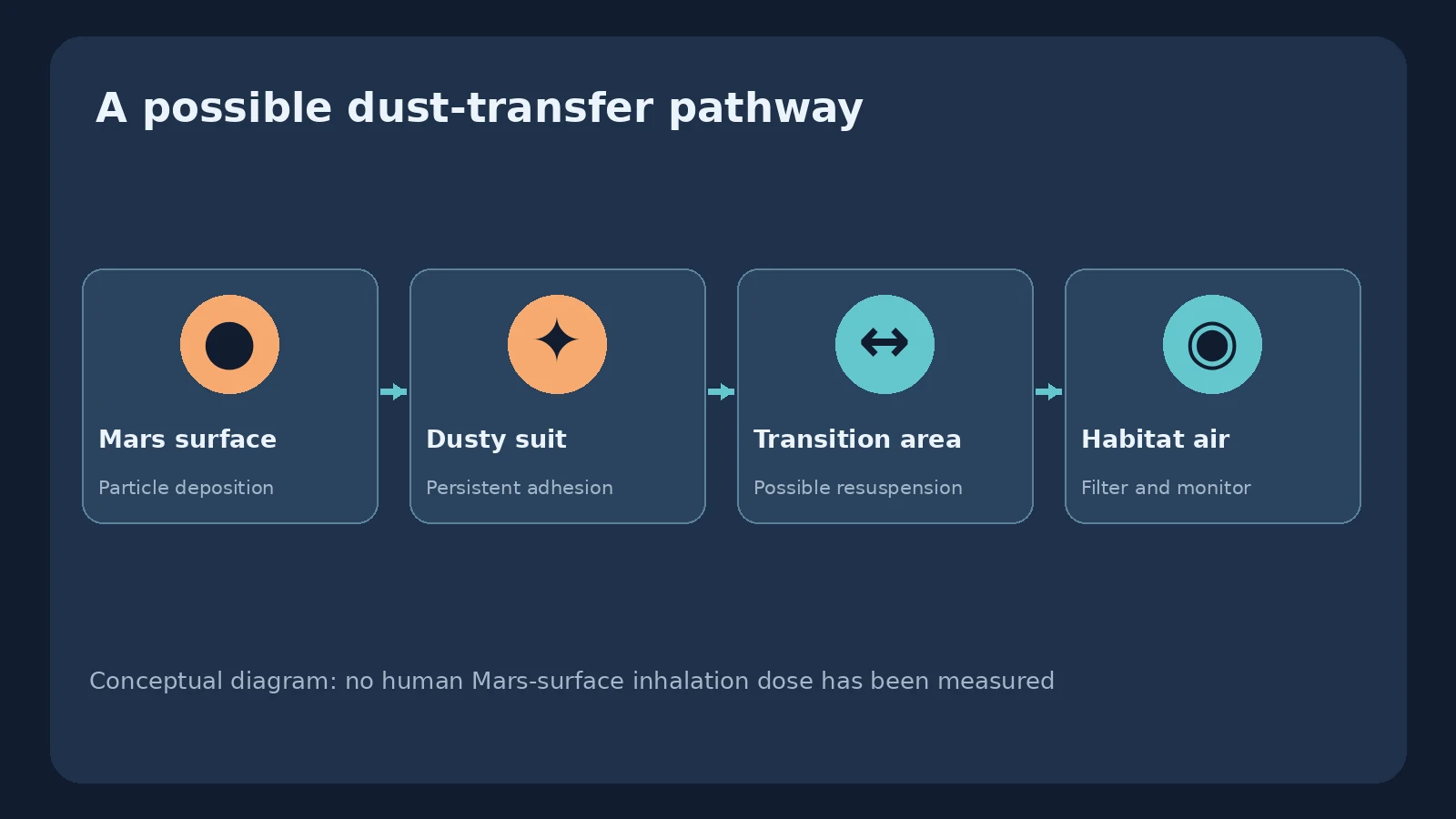
An astronaut conducting work outside a habitat may accumulate fine dust on boots, joints, gloves, back panels and connections. During re-entry, equipment handling, suit removal or maintenance might transfer a portion of that material into the transition area. If it becomes airborne inside an occupied compartment, some fraction could be breathed before a filtration system captures it or it settles again.
This is an analytical pathway, not a human experiment that has already followed a particular Martian particle into a living space. Designers can interrupt it at multiple points: discourage adhesion, isolate the suit, clean it outside inhabited air, monitor suspended dust, and filter what does enter. A high-consequence environment calls for layered protection rather than reliance on one supposedly perfect method.
How might future suits and habitats control dust?
One promising approach is the "suitport," which allows a suit to dock outside a habitat and lets the wearer enter it without bringing most of its exterior indoors. Other options include dual-chamber airlocks, controlled transition zones, dust-resistant coatings, materials that clean more easily, and indoor instruments sensitive to different particle sizes.
Mentioning a design is not the same as saying it is a proven final solution for Mars. Engineers face trade-offs: a surface that holds less dust might be less durable or more costly, while aggressive cleaning might damage seals or send more particles into the air. Candidate systems must be tested with appropriate Mars simulants, repeated operations, realistic maintenance loads, power limits and emergency scenarios.
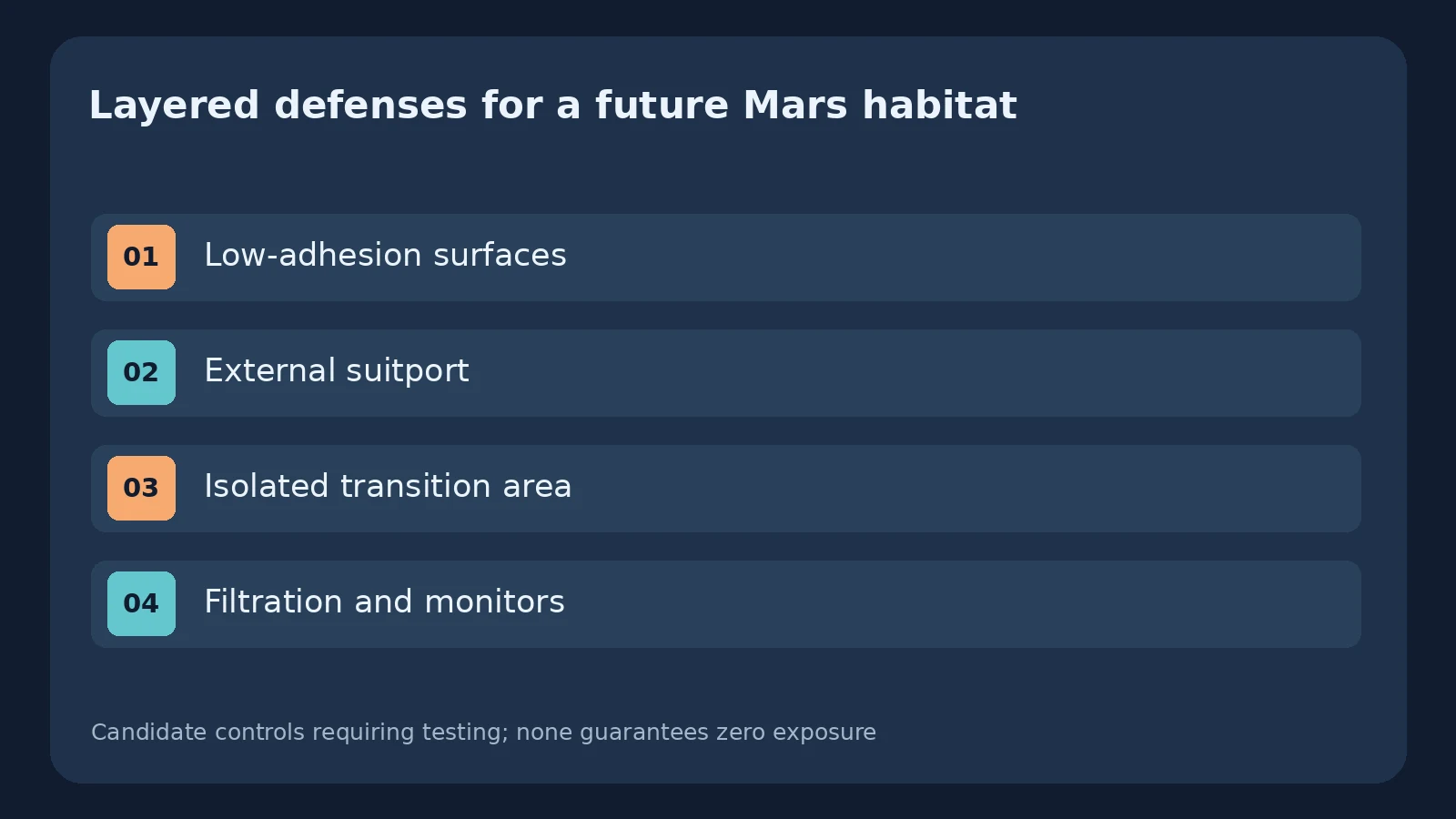
| Possible engineering defense | Problem addressed | What must still be tested |
|---|---|---|
| Low-adhesion outer coatings | Fine particles sticking to exposed surfaces | Performance after repeated dust and abrasion cycles |
| External suitports | Suits bringing dust into living areas | Seal integrity and emergency procedures |
| Multistage transition zone | Contamination transferred with people and equipment | Cleaning effectiveness without resuspension |
| Filtration and particle monitoring | Dust that reaches breathable air | Efficiency across roughly 0.1–10 micrometers and maintenance requirements |
| Segregated work equipment | Dust reintroduced during repair or storage | Crew usability and reliability during stressful operations |
What the 2026 study cannot tell us
First, it cannot give a numerical chance of an astronaut becoming ill from grains on a calibration target. Second, a few small surfaces do not establish the airborne concentration everywhere on Mars or during every season. Third, finding extremely tiny particles does not prove they contribute most of the total dust mass or health risk. Fourth, no human dose has been measured inside a real inhabited Martian habitat, and Earth exposure rules cannot simply be pasted onto this setting.
None of those limitations diminishes the discovery. The researchers have extended direct on-planet observations into a previously under-characterized size range and connected those grains with materials relevant to realistic future designs. The productive response is to recognize the value of that measurement without adding dramatic outcomes unsupported by the data.
Three questions the next studies need to answer
- How much dust becomes airborne indoors? Researchers need size-resolved concentration measurements over time in an environment resembling a habitat after a contaminated suit is brought near or through its entry system.
- What is the toxicity of authentic Martian dust? Future tests should separate mineral types, perchlorate chemistry and ultrafine-particle behavior from the effects of Earth-made dust simulants.
- Which protection systems remain reliable after months? A filter performing well in one experiment must still work through repeated cleaning cycles, emergency use, maintenance and opening and closing of isolation areas.
How to check the images and scientific numbers for yourself
Read the original NASA announcement for the rover measurements, examine the actual SHERLOC calibration-target photograph to locate the material swatches, and consult the research paper via its DOI for methods and interpretation. For the preliminary exposure requirement, refer to NASA’s Mars dust limits explanation. NASA’s image-use guidelines explain attribution requirements and the importance of avoiding any suggestion that NASA endorses a commercial article or product.
When reusing imagery, check original captions, instrument names and image-capture dates. A historical spacecraft photograph can illustrate a newly released study without having been photographed on its publication date. The graphics in this article are original educational diagrams derived from the published values, not real rover photographs or new experimental measurements.
Conclusion: tiny grains and a big design challenge
Perseverance has given researchers direct observations of ultrafine and fine Martian grains persisting on surfaces that matter to future spacesuits and habitats. The engineering opportunity is twofold: choose materials based partly on their ability to resist particle accumulation and create layers of defense to prevent dust passing from the Martian environment into the air a crew breathes.
Yet very small does not mean automatically poisonous. Real risk will depend on chemistry, the amount transported indoors, airborne concentration and length of exposure. In that sense, the study does not announce a human health disaster on Mars. It provides information that could help prevent one before the first crew ever settles there.
You may also like
 Science & Space
2026 ED138: Rubin’s New Dwarf Planet Candidate Explained
Explore 2026 ED138, Rubin’s dwarf planet candidate: the discovery, uncertain size, orbital measurements and observations needed for confirmation.
 Science & Space
TOI-561 b: Why a Lava Planet Reflects 75% of Starlight
Webb observations suggest a scorching lava world may reflect 75% of starlight, but the proposed silicate clouds remain…
 Science & Space
SpaceX Space Jellyfish Explained: Why Rockets Create Glowing Clouds
What causes a SpaceX space jellyfish? Discover the science of glowing rocket exhaust, twilight launches, and how to…