
Missed a Connecting Flight in Europe? Single Booking vs Separate Tickets
Missed a connection in Europe? Check single bookings vs separate tickets, rebooking, bags, care and claims, with official EU and UK guidance.
Contents
- What to do in the first 15 minutes
- How to establish whether your connection is protected
- If you have one booking: ask for a usable onward route
- If you have separate tickets: act before the next flight closes
- Ask for care without confusing it with compensation
- Which rules cover a US or UK traveller in Europe?
- US rules may also matter, but ask the right question
- When can a missed connection lead to cash compensation?
- Three worked situations that change the next step
- A 40-minute inbound delay produces a five-hour final delay
- Separate tickets turn a 90-minute delay into an expensive afternoon
- The airline offers tomorrow, while you see another option today
- A short message for the transfer desk
- Do not accept a refund before deciding whether you still need transport
- After arrival: build one clear evidence file
- A date-sensitive EU change to keep separate
- Sources and image credits
If a delayed flight makes you miss a connection in Europe, check whether the flights form one protected journey or separate tickets. On a through booking, ask the airline to arrange the continuation of your journey. On separate tickets, contact the next airline immediately: it may treat you as a passenger who missed that flight, even though the previous delay was outside your control.
Open the airline app, find the transfer desk and save your original itinerary before accepting a change. Rebooking, meals or accommodation, refunds and cash compensation are different questions. Your immediate priority is a confirmed onward plan; a compensation claim can follow once the facts are clear.
This guide focuses on missed connections and self-transfer decisions. For payment bands and the wider claim process, see our Europe flight-delay and cancellation claim guide.
What to do in the first 15 minutes
- Check the flight status and gate. Do not assume a connection has departed just because your original boarding time has passed. Use the airline’s live information or airport staff.
- Check the app and messages for a replacement. Record the new route, departure time and whether you have a confirmed seat or only standby.
- Find the right help channel. Use the airline transfer desk, its official app or its published phone number. If an agent issued the ticket, ask whether that agent must make the change.
- Explain the booking type. Say whether this was sold as one connected journey or advertised as self-transfer. Have the ticket and itinerary ready.
- Ask about your checked bag and next check-in deadline. Find out where you must go before leaving the transfer area.
- Save the evidence. Keep the original schedule, disruption message and any written reason for the delay.
Some airlines automate disruption handling. For example, Lufthansa’s disruption page describes flight-change notifications and automatic rebooking where required. That is a reason to check the app, not a promise that every airline will instantly rebook every missed connection.
How to establish whether your connection is protected
Read the ticket documents and ask a specific question: “Are these flights covered by one through journey, or are they separate transport contracts?” The UK Civil Aviation Authority’s planning guidance distinguishes flights booked together as one journey from self-transfer bookings, where individual-flight rights remain separate.
A shared payment receipt or a travel website displaying one itinerary is not enough on its own. Equally, do not treat the number of airline reference codes as a complete legal test. Ask the issuer to explain the actual ticketing arrangement and keep the answer.
Different operating airlines do not automatically make a connection unprotected. In Court of Justice case C-436/21, the Court addressed flights combined by a travel agency for an overall price with a single ticket, including carriers without a specific legal relationship. That is why “same airline” and “same protected journey” are not interchangeable tests.
| Question | One connected booking | Separate tickets / self-transfer |
|---|---|---|
| Who handles the missed onward flight? | Ask the airline to arrange continuation under the ticket and applicable rules. | Contact the onward airline or ticket issuer; a free replacement is not automatic. |
| Which arrival delay matters? | The final destination of the covered connected journey can be relevant. | Assess each flight separately; a late arrival after your replacement journey is not automatically the first airline’s delay. |
| Meals, hotel or cash payment? | May be due when the relevant rules and conditions apply. | No automatic end-to-end entitlement simply because the separate connection was missed; individual-flight rights still matter. |
| Any extra protection? | Check airline obligations and any package or insurance cover. | Read insurance or a booking service’s connection guarantee and its conditions. |
If you have one booking: ask for a usable onward route
Give the agent your original final destination and explain that the inbound disruption broke the connection. Ask for the earliest appropriate confirmed routing. If the offered itinerary leaves much later, ask whether another flight or permitted alternative can get you there sooner.
Before accepting it, check:
- The actual airport and terminal, especially if an airport change is involved.
- Whether the seat is confirmed and the new boarding pass has been issued.
- Whether the reroute requires immigration, a new transit permission or entry to a country you cannot enter.
- Where your bag will travel and whether you must collect it.
- Whether remaining flights on the booking, including the return, remain intact.
A seat offered to someone else, a search result or an unconfirmed standby listing is not your completed rebooking. Avoid arranging conflicting changes through several agents simultaneously; once one channel issues the new ticket, tell the others what has happened.
Lufthansa’s Lufthansa/ANA travel FAQ advises contacting the airline that caused the missed connection when help or a notification is missing. This is an airline-specific practical example. Follow your actual carrier’s process rather than assuming every partner arrangement works identically.
If you have separate tickets: act before the next flight closes
Call the onward airline or issuer promptly, even if the first airline is still dealing with its delay. Ask whether you can move to a later flight, retain unused ticket value, or avoid being recorded as a no-show. Request the change cost and fare difference before agreeing.
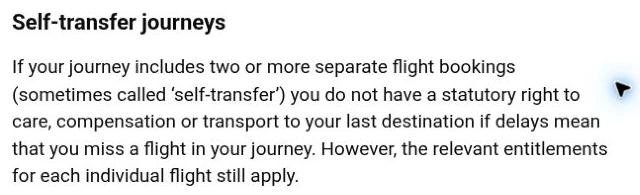
The CAA explains that self-transfer passengers do not have an automatic statutory right to care, compensation or transport to their last destination just because a delay causes a separate flight to be missed. Rights for the disrupted flight itself can still apply. The distinction is visible in its official delay guidance.
If the booking company sold a connection guarantee, open its terms before buying a replacement. Find the reporting deadline, required contact channel, covered causes and whether prior approval is needed. Insurance and agency protection are contractual layers; neither should be assumed to cover every missed connection.
Also protect the rest of your itinerary. British Airways’ published customer commitment includes a ticket-sequence/no-show policy and tells passengers to contact it about changes affecting remaining travel. Other airlines have their own terms. Do not quietly abandon one segment and assume the next or return flight is unaffected.
Ask for care without confusing it with compensation
When applicable UK delay rules require care, that can include reasonable food and drink, communications, overnight accommodation and transport. The relevant wait thresholds vary with distance. These needs should be discussed while you are stranded, not postponed until a cash claim is decided.
A severe-weather defence to fixed compensation does not automatically remove an otherwise applicable care obligation. For cancellations covered by UK rules, the CAA’s cancellation guidance expressly separates care from the cause of the disruption. For a missed connection, establish the covered journey and applicable waiting conditions rather than assuming every overnight stop creates the same entitlement.
Ask the airline to arrange the essentials first. If it cannot, keep a record of your request, follow any reasonable spending instructions and retain itemised receipts. Before booking an airport hotel, establish whether you can legally reach it from the terminal. A hotel outside the airport’s secure area may require entry formalities.
Keep a simple expense note: date, item, amount, currency, why it was necessary, and the receipt. Separate hotel and meal reimbursement from a fixed compensation request. Do not describe a reimbursement as guaranteed before the airline or relevant dispute body has assessed the facts.
Which rules cover a US or UK traveller in Europe?
Your passport nationality is not the main route-coverage test. For EU passenger rights, the departure point and operating carrier are central: departures from the EU are generally covered on any carrier; arrivals from outside the EU generally require an EU carrier. Connecting itineraries and benefits already received under another country’s law can complicate the assessment. A European hub alone does not settle the whole journey’s status.
For UK coverage, the CAA lists UK departures on any airline, UK arrivals on a UK or EU airline, and EU arrivals on a UK airline. Identify the operating carrier, not just the brand printed at the top of the booking email. Where regimes overlap, ask which legal basis the airline has applied rather than assuming you can collect the same compensation twice.
US rules may also matter, but ask the right question
For relevant travel to, from or within the US, the US Department of Transportation’s refund guidance describes refund rights when a flight is cancelled or significantly changed and you decline the offered alternatives. This does not mean you can take the replacement journey and also automatically recover the whole airfare.
The DOT airline customer-service dashboard separately describes carrier commitments for disruptions within their control. Check the particular airline’s published commitments for rebooking, meals and accommodation. Do not substitute US refund thresholds for the EU or UK fixed-compensation test; they address different remedies.
When can a missed connection lead to cash compensation?
For a covered EU connected journey, the relevant arrival is normally the final destination on that reservation. A comparatively short first-leg delay can create a much longer final delay when you miss the next flight. A final-arrival delay of at least three hours can qualify for fixed compensation, but coverage, the reason for the disruption and the other conditions must also be satisfied. Extraordinary circumstances can exclude that payment. The official Your Europe missed-connection section sets out these checks.
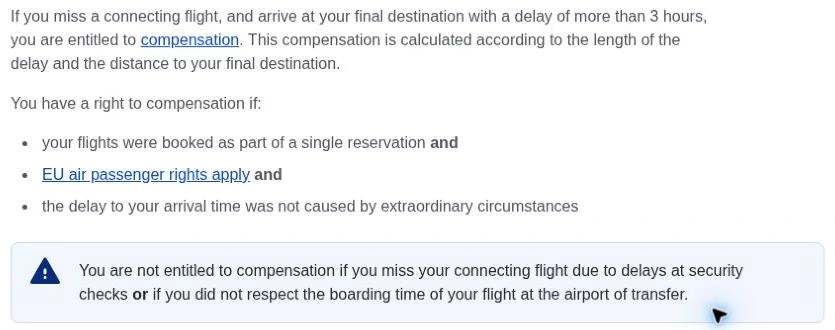
Do not assume that a missed connection caused by a security queue qualifies in the same way as a delayed inbound flight. The CAA’s missed-flight guidance says airlines are unlikely to consider themselves obliged to provide compensation or a free alternative when a passenger misses a flight because of long security queues, even after reaching the airport on time. Contact the airline and insurer about the actual circumstances.
A broken journey can therefore produce a valid request for rebooking or care without a successful fixed-payment claim. Keep those requests distinct, and ask for the factual reason behind any refusal.
Three worked situations that change the next step
These are illustrative scenarios, not passenger case reports. They show how to organise the facts; they do not guarantee a legal outcome.
A 40-minute inbound delay produces a five-hour final delay
You hold one connected Amsterdam–Frankfurt–Chicago booking. The first flight is 40 minutes late, you miss the Chicago connection and arrive five hours after the original final arrival time. Record that five-hour difference and ask the airline to assess the connected journey, its cause and the applicable rules. Looking only at the first flight’s 40 minutes would miss the important consequence.
Separate tickets turn a 90-minute delay into an expensive afternoon
You booked Manchester–Paris separately from Paris–Rome. The first flight arrives 90 minutes late, and after buying a replacement you reach Rome six hours later than planned. That six-hour difference does not automatically turn the separate Manchester–Paris flight into a six-hour arrival delay. Assess its own rights and pursue the onward ticket, insurance or guarantee through the appropriate channel.
The airline offers tomorrow, while you see another option today
Write down the flight number and ask whether it can be used for rerouting. Check airport changes, entry requirements and baggage before agreeing. If you buy the alternative yourself without giving the responsible party a chance to assist, reimbursement may become disputed. Record unsuccessful requests if urgent circumstances force you to act.
A short message for the transfer desk
Use this wording for a connected ticket, changing the details to match your itinerary:
My inbound flight was disrupted and I missed the onward connection on this ticket. Please confirm the earliest appropriate route to my original final destination, whether the seat is confirmed, where my checked bag will go, and what care is available while I wait. Please also record the reason for the disruption and confirm the remaining flights on my booking.
For separate tickets, say so explicitly and ask the onward carrier for its available change options. Do not tell an agent that the flights were protected unless the documents support that description.
Do not accept a refund before deciding whether you still need transport
A refund and a replacement journey are not interchangeable. If you still need to reach your destination, ask what accepting the refund would do to the airline’s onward obligations before you choose. The CAA warns passengers not to select the delay-refund option if they still wish to travel.
For a covered long delay, refund arrangements may include unused flights and, where appropriate, return transport to the starting point. The exact remedy depends on the disruption and itinerary. Do not assume every missed connection automatically gives a full refund plus a new ticket plus fixed compensation.
After arrival: build one clear evidence file
- The original ticket and complete route, including how it was sold.
- Operating airline and flight number for every affected leg.
- Scheduled final arrival and actual final arrival, with the relevant date and time zone.
- Disruption messages and the airline’s stated cause.
- Replacement itinerary, receipts and records of assistance requests.
- Any insurer or booking-guarantee terms and reports you made.
Start with the airline’s official claim channel and distinguish expense reimbursement from compensation. The CAA complaint guidance then explains ADR and CAA escalation for relevant UK disputes. PACT cannot impose a decision in the way a CAA-approved ADR provider can. EU enforcement and court time limits vary; do not assume a universal Europe-wide deadline.
A date-sensitive EU change to keep separate
Reviewed on 31 October 2026. Regulation (EU) 2026/2202 has been published, but Article 3 states that it applies from 23 October 2027. Do not apply its new procedures to an October 2026 disruption simply because the regulation has been adopted. This guide uses current passenger guidance and flags that future application date; UK rules must be checked separately.
Sources and image credits
- Your Europe: air passenger rights
- CAA: delays, connecting bookings and self-transfer
- CAA: planning your trip
- CAA: cancellations and UK scope
- CAA: missed flights and security queues
- CAA: how to make a complaint
- Court of Justice: C-436/21, single reservation and different carriers
- Lufthansa: disruption handling
- Lufthansa/ANA: travel FAQ
- British Airways: customer commitment and ticket sequence
- US DOT: refunds
- US DOT: airline customer-service dashboard
- Regulation (EU) 2026/2202, Article 3
Featured photograph: CK Chen on Unsplash, used under the Unsplash License. It illustrates an airport terminal, not a particular missed flight. Inline screenshots are actual public guidance pages captured on 31 October 2026 and cropped for readability: © UK Civil Aviation Authority and © European Union. The EU excerpt is reused under CC BY 4.0 in accordance with the Commission reuse notice. Screenshots were converted to WebP; no wording was altered.
You may also like
 Travel & Consumer Rights
Flight Delayed or Cancelled in Europe? How to Claim Compensation
A complete practical guide to EU261 and UK261 flight delay and cancellation compensation, refunds, airline rerouting, necessary expenses…