
Flight Delayed or Cancelled in Europe? How to Claim Compensation
A complete practical guide to EU261 and UK261 flight delay and cancellation compensation, refunds, airline rerouting, necessary expenses and rejected claims, updated for October 2026.
Contents
- Step 1: Check whether EU261 or UK261 covers your flight
- When EU air-passenger rights apply
- What changed for UK flights after Brexit?
- Step 2: Work out whether a delay actually qualifies
- The actual arrival time is not touchdown
- EU flight-delay compensation amounts
- UK fixed payments are in pounds
- Step 3: Know the extra rules for cancelled flights
- The 14-day cancellation rule and its exceptions
- Step 4: Ask for food, hotels and transport while stranded
- When does assistance usually start?
- If you pay for essentials yourself
- Step 5: Understand the five-hour delay and refund option
- Step 6: Determine whether the airline has a valid defence
- What to ask when the airline says 'extraordinary circumstances'
- Step 7: Claim compensation directly from the operating airline
- Evidence that helps a claim survive rejection
- A short claim message you can adapt
- Step 8: Escalate a rejected or ignored claim
- EU claims: airline first, then the competent national body
- UK claims: airline, ADR or the CAA
- Time limits are not uniform across Europe
- Connecting flights, missed connections and separate tickets
- A few realistic scenarios
- Scenario A: A three-hour-20-minute delay from Madrid to Paris
- Scenario B: Paris to New York arrives three hours and 35 minutes late
- Scenario C: A Manchester-to-Rome cancellation after a severe storm
- Scenario D: London to New York arrives three hours and 30 minutes late
- Scenario E: A cheaper refund leaves a traveller stranded
- What about travel agents, packaged holidays and credit cards?
- Ten mistakes that delay or weaken claims
- Important 2026 update: new EU law does not apply yet
- Your 10-minute claim checklist
- Conclusion: claim the right remedy, not just the biggest number
- Official sources and further reading
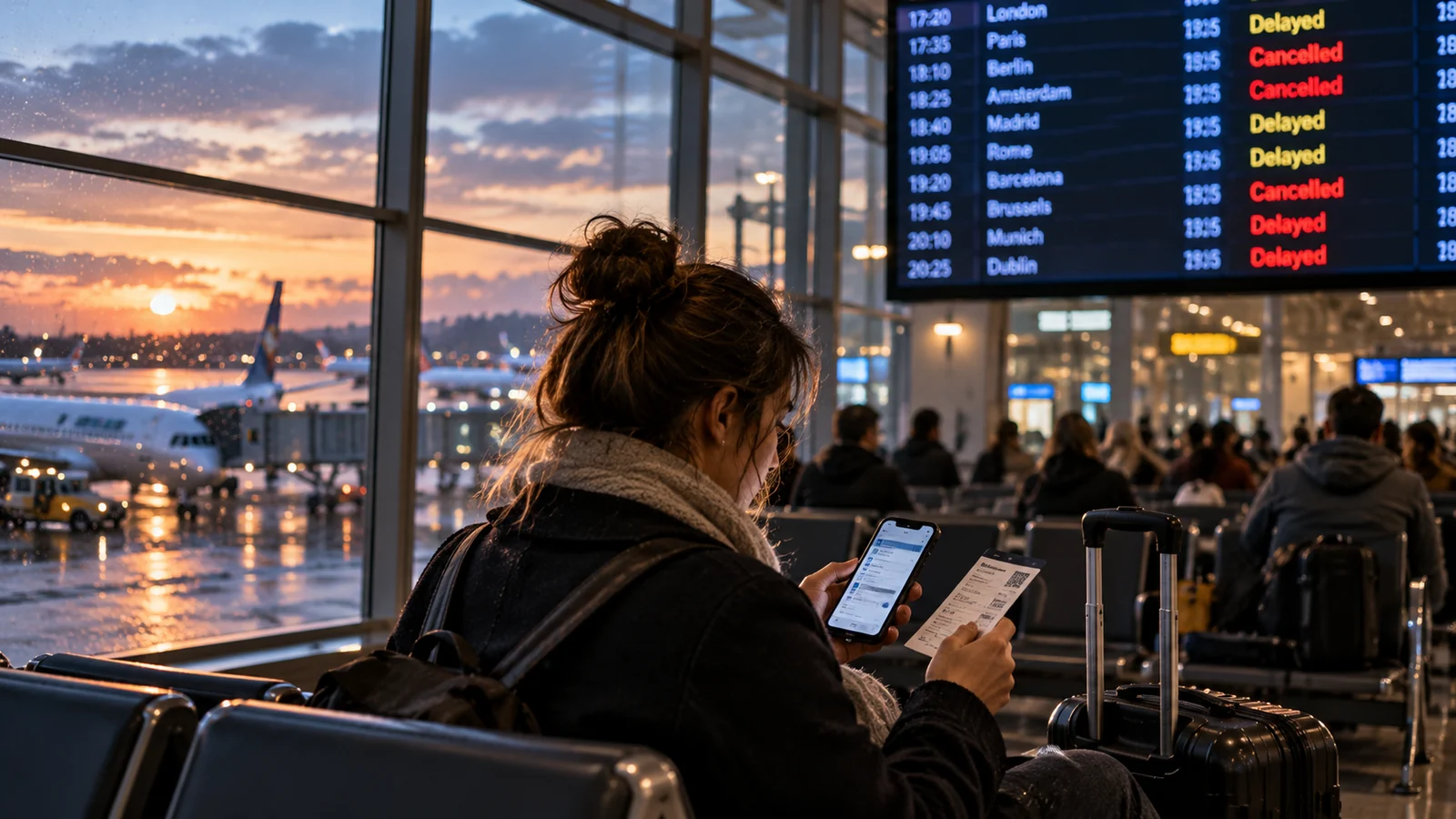
A delayed flight can mean a missed wedding, an unexpected hotel bill or a lost day of a long-awaited holiday. A cancellation can be worse: you may find yourself stuck at an unfamiliar airport with an airline offering a voucher instead of the replacement journey you actually need. European passenger-rights rules can help, but the right answer depends on your route, the operating airline, the reason for the disruption and when you arrive.
For many eligible journeys, fixed compensation ranges from €250 to €600 under EU rules or £220 to £520 under UK rules. That money is distinct from a ticket refund, a replacement flight and reimbursement of reasonable food or hotel costs. Some claims fail because the disruption resulted from genuinely extraordinary circumstances; others fail because the passenger never asked the operating airline or did not keep the necessary evidence.
This step-by-step guide explains which rules apply, how to work out what to request, how to submit a claim without paying a third party, and where to escalate a rejection. The information reflects rules in force as of 18 October 2026. A new EU regulation was published in October 2026 but its substantive amendments will not apply until 23 October 2027.
Quick answer: If a covered flight gets you to your final destination at least three hours late, you may qualify for fixed compensation when the cause was within the airline’s responsibility. If your flight is cancelled, you generally have a choice of refund or rerouting even where extraordinary circumstances remove the separate right to fixed compensation. While waiting, an airline may still owe meals, communication assistance and a hotel.
Step 1: Check whether EU261 or UK261 covers your flight
Your nationality does not decide eligibility. Where the flight starts, where it ends and which airline actually operates it are far more important. A traveller from the United States, Canada, Australia or elsewhere can be covered on a qualifying European flight just like an EU resident.
When EU air-passenger rights apply
EU Regulation (EC) No 261/2004 (often called EU261) generally covers flights departing from an EU airport, regardless of airline nationality. It also covers flights arriving in the EU from a non-EU country when operated by an EU airline, subject to rules preventing duplicate benefits under another country’s law. The European Commission also explains that comparable protections extend to Iceland, Norway and Switzerland.
Consider these examples:
- Paris to New York on a US airline: ordinarily EU261 applies because the flight departs the EU.
- New York to Paris on a French airline: EU261 generally applies because an EU carrier operates the inbound service.
- New York to Paris on a US airline: EU261 generally does not apply to that inbound flight solely because the destination is in France.
- Rome to Madrid on any airline: EU261 generally applies because the flight is within the EU.
For complex connections, code-shares, return itineraries or journeys partly covered by other legislation, the precise ticket and operating-carrier arrangement matters. The EU’s official passenger-rights guide is the starting point.
What changed for UK flights after Brexit?
The United Kingdom maintains a separate regime commonly called UK261, described by the Civil Aviation Authority (CAA). It generally applies to flights departing the UK on any airline; flights arriving in the UK on a UK or EU airline; and some flights arriving in the EU on a UK airline. A flight may touch both legal systems, but you should not expect to collect two sets of fixed compensation for the same disruption.
| Example route | Common starting point | Why |
|---|---|---|
| London to Rome on any airline | UK261; EU relevance may also arise | Departure from a UK airport |
| Rome to London on an EU airline | EU261; UK261 may also apply | Departure from the EU and UK arrival on EU airline |
| Istanbul to London on a UK airline | UK261 | UK airline arriving in the UK |
| New York to London on a US airline | Usually neither EU261 nor UK261 for that flight | Non-UK/non-EU carrier arriving from outside Europe |
| Berlin to Lisbon on any airline | EU261 | Departure from an EU airport |
Do not rely on the logo on your booking confirmation. A ticket may be sold by one airline and operated by another. Look for the words operated by and submit the claim to the operating airline. For UK routes see the CAA’s cancellation and coverage guidance.
Step 2: Work out whether a delay actually qualifies
For fixed compensation under current EU rules, the crucial measure is usually how late you arrive at the final destination, not how late the plane leaves the gate. The general qualifying threshold is three hours or more, assuming EU261 covers the flight and no proven extraordinary-circumstances exemption applies. The CAA describes the corresponding UK threshold as arrival more than three hours late.
Imagine your plane was scheduled to depart at 10:00 but departed at 13:20. If the aircraft made up time and passengers could leave it only two hours and 45 minutes after the scheduled arrival time, fixed long-delay compensation normally would not be triggered solely by the departure delay. However, care and assistance rights may still apply while you wait.
The actual arrival time is not touchdown
For EU compensation calculations, the Court of Justice of the European Union has established that actual arrival is when at least one aircraft door opens and passengers may disembark, not simply when the wheels touch the runway. This distinction can be decisive if a delay is close to three hours. Record the time shown by the airline, keep any messages and ask for a written explanation if necessary.
EU flight-delay compensation amounts
| Flight distance and category | Delay on arrival | Potential EU261 fixed payment |
|---|---|---|
| 1,500 km or less | At least 3 hours | €250 per passenger |
| More than 1,500 km within the EU; other flights 1,500–3,500 km | At least 3 hours | €400 per passenger |
| More than 3,500 km, eligible long-haul to/from a non-EU country | At least 3 but under 4 hours | €300 per passenger |
| More than 3,500 km, eligible long-haul to/from a non-EU country | 4 hours or more | €600 per passenger |
These are potential payments, not automatic guarantees. Extraordinary circumstances, route coverage and other conditions matter. The EU’s official guide gives the 50% long-haul reduction when the applicable delay is between three and four hours. Distances refer to the legal route calculation, not necessarily the actual distance flown after a diversion.
UK fixed payments are in pounds
| Flight distance | Qualifying arrival delay | Potential UK261 fixed payment |
|---|---|---|
| Under 1,500 km | More than 3 hours | £220 per passenger |
| 1,500–3,500 km | More than 3 hours | £350 per passenger |
| Over 3,500 km | More than 3 but under 4 hours | £260 per passenger |
| Over 3,500 km | More than 4 hours | £520 per passenger |
The CAA uses these amounts in its official delayed-flight guidance. At precise boundary times, follow the regulator’s wording and the relevant legal interpretation instead of assuming a few seconds cannot matter.
Step 3: Know the extra rules for cancelled flights
Cancellation is not the same thing as a long delay. If an airline abandons the original service and places you on another flight, this is usually a cancellation. An earlier departure by more than an hour can also count as a cancellation under EU guidance, rather than merely a rescheduling inconvenience.
If your protected flight is cancelled, the airline must generally give you a choice between:
- Reimbursement: a refund of the unused part of your ticket and, where relevant, a return to the starting airport if a connecting journey no longer serves its purpose.
- Rerouting at the earliest opportunity: an alternative journey to your destination under comparable travel conditions.
- Rerouting at a later date of your choice: subject to seat availability and comparable conditions.
Choose deliberately. Taking a refund usually ends your right to insist that the airline also transport you on the same cancelled journey, although qualifying fixed compensation may still be payable separately. If you urgently need to reach the destination, ask about rerouting before accepting an airline credit or voucher.
The 14-day cancellation rule and its exceptions
Where the airline tells you of a cancellation at least 14 days before departure, fixed cancellation compensation usually is not due. With shorter notice, fixed compensation may be due unless there are extraordinary circumstances or the replacement itinerary fits one of the statutory exceptions.
| When you were told | Alternative-flight timing that may remove fixed cancellation compensation |
|---|---|
| At least 14 days before departure | Ordinarily no fixed cancellation payment |
| 7–13 days before departure | Offered rerouting departing no more than 2 hours early and arriving less than 4 hours late |
| Fewer than 7 days before departure | Offered rerouting departing no more than 1 hour early and arriving less than 2 hours late |
These are conditional tests, not a promise that every short-notice cancellation pays €600. The amount can also be halved for eligible rerouting outcomes. Save the original and proposed departure/arrival times, the cancellation notification with its date, and the final itinerary. UK cancellation cases have corresponding rules; see the CAA’s detailed examples.
Step 4: Ask for food, hotels and transport while stranded
Even when severe weather or air-traffic restrictions mean fixed compensation is not payable, the airline generally still has a duty of care for passengers covered by the relevant EU/UK rules. These are different legal rights and should be claimed separately when needed.
When does assistance usually start?
For departure delays, general thresholds under the current regime are approximately:
- 2 hours for shorter flights of 1,500 km or less.
- 3 hours for medium-distance flights and certain longer intra-EU routes.
- 4 hours for other long-distance flights.
Depending on the circumstances, appropriate assistance includes refreshments and meals proportionate to the wait, communication facilities, and hotel accommodation plus necessary airport transfers when an overnight stay becomes necessary. The exact classification of some longer intra-EU flights differs from an oversimplified three-row distance chart, so check the official route guidance for your itinerary.
If you pay for essentials yourself
First ask the airline’s desk or support team to arrange care. If the airline does not supply it, make necessary, reasonable and appropriate purchases: ordinary food and drink, a reasonably priced room, and travel between the airport and hotel. Keep itemised receipts, dates and the reason each expense was necessary.
A luxury resort, alcohol, non-essential shopping or an extravagant taxi can be challenged. If accessible accommodation or disability-related assistance is needed, explain the requirement and document the response. Reimbursement of reasonable expenses is not the same as fixed-sum compensation; one does not automatically replace the other.
Step 5: Understand the five-hour delay and refund option
If departure is delayed at least five hours and EU/UK rules apply, you may choose to abandon the journey and seek reimbursement for the unused flight or relevant itinerary. For a journey with connections already partly completed, a return flight to the original point of departure may be due when the onward trip no longer serves its purpose.
If you choose to keep travelling, the airline’s duty of care remains relevant while you wait. Do not assume that five hours of waiting automatically creates a right to both a ticket refund and a completed journey on the same reservation. Similarly, a refund is not always the best choice if you must travel to an event and buying a last-minute replacement ticket would be much more expensive.
Step 6: Determine whether the airline has a valid defence
A compensation claim can be refused when a disruption was caused by extraordinary circumstances that the airline could not have avoided even after taking all reasonable measures. The airline is expected to substantiate the cause and the link to your particular disruption. A one-line response saying operational reasons or weather is not, by itself, a thorough explanation.
| Reported disruption | How to evaluate it |
|---|---|
| Severe storms, unsafe weather, airport closure | May be extraordinary where the conditions actually caused the disruption |
| Air-traffic-control restrictions | Can be extraordinary; check whether the restriction affected this flight |
| Security threats or political instability | May be extraordinary, depending on facts |
| Ordinary technical fault during maintenance | Generally not extraordinary merely because it was unexpected |
| Internal strike by the airline’s own staff | Generally not treated as extraordinary under EU case law |
| External strike affecting services | May qualify, depending on the nature of the event and reasonable measures |
| Airline rostering, scheduling or crew availability | Often within airline operations; ask for a precise explanation |
Do not conclude that all bad-weather delays are automatically exempt or all technical failures automatically qualify for money. A disruption might begin with weather and worsen due to the airline’s later choices. The key questions are what happened, what caused your arrival delay, and whether reasonable steps could have reduced it.
What to ask when the airline says 'extraordinary circumstances'
Ask for the specific cause, its timing, the route or airport affected, and why it could not be prevented or mitigated through reasonable operational measures. The EU’s consumer guidance states that the carrier must be able to support the claimed exemption. You do not need to prove how to operate an airline; you can ask for the facts supporting its rejection.
Step 7: Claim compensation directly from the operating airline
You can normally submit the initial claim without paying a claims company. Most airlines have an online form specifically for EU261 or UK261 compensation, distinct from their general customer-service inbox and their receipt-reimbursement forms.
- Find the airline that operated the disrupted flight; check your itinerary rather than only the booking agent’s name.
- Go to the airline’s official website and look for flight disruption, passenger rights, EU261 compensation or UK261 claims.
- Enter the booking reference, affected flight number, date, origin, destination and the names of all affected passengers covered by the form.
- Include the scheduled and actual final-arrival times, or the original and rerouted schedule if cancelled.
- State separately whether you request fixed compensation, ticket reimbursement, care expenses or more than one category.
- Upload available evidence and itemised receipts; avoid emailing full payment-card information or passport scans unless a verified, necessary secure process requires them.
- Save the claim reference, full submission, acknowledgments and follow-up correspondence.
Evidence that helps a claim survive rejection
| Evidence | Why it matters |
|---|---|
| E-ticket and original itinerary | Confirms booking, route and scheduled times |
| Boarding pass or airline booking record | Helps connect a passenger to the flight |
| Cancellation notice or airline email/SMS | Shows when you were informed and what changed |
| Screenshots of flight status | Helps support the departure or arrival timeline |
| Updated itinerary | Establishes rerouting and final destination |
| Itemised hotel, meal and transfer receipts | Supports necessary care-expense reimbursement |
| Written airline explanation and claim number | Useful if escalating a refusal |
Some airlines may verify travel without a boarding pass. If a document is missing, provide the strongest other evidence available rather than assuming a claim is impossible.
A short claim message you can adapt
Subject: EU261/UK261 compensation claim — flight [NUMBER], [DATE]I was booked on flight [NUMBER] from [ORIGIN] to [DESTINATION] on [DATE], booking reference [REFERENCE]. My scheduled arrival was [TIME]; my actual arrival at the final destination was [TIME], a delay of [HOURS/MINUTES]. Alternatively, my flight was cancelled and I was notified on [DATE], with the following rerouting: [DETAILS].Please assess my eligibility for fixed compensation under the applicable EU261 or UK261 passenger-rights rules and confirm the specific cause of the disruption. I also request reimbursement of the attached reasonable care expenses of [AMOUNT], where applicable. Please respond in writing with the claim reference and a reasoned decision.
Use this as a factual template. Change or remove passages that do not fit your case; do not claim a precise amount until the appropriate route and legal thresholds have been checked.
Step 8: Escalate a rejected or ignored claim
EU claims: airline first, then the competent national body
Start with the operating airline. Under the present EU passenger-rights guidance, if you receive no reply within two months, or if the answer is unsatisfactory, you can contact the national enforcement body in the country where the incident occurred. It can advise or take relevant enforcement steps, although its intervention may not itself secure a binding personal money award. Consumer support or court procedures may be needed to settle an individual payment dispute.
A resident of an EU country may also be able to seek assistance from the European Consumer Centres Network or an alternative dispute-resolution body. Eligibility for out-of-court procedures, deadlines and individual claim handling vary by country. Start at the EU Your Europe rights portal, which links to national contacts and redress options.
UK claims: airline, ADR or the CAA
Under the CAA’s current published process, if the airline gives an unsatisfactory final response or has not responded after eight weeks, you can escalate to an approved Alternative Dispute Resolution (ADR) provider where the airline is a member. Otherwise, you can seek help from the CAA’s Passenger Advice and Complaints Team (PACT). Check the CAA claims guide for the route relevant to your airline.
Time limits are not uniform across Europe
Do not believe claims that every European flight always has a two-year or six-year deadline. Court limitation periods vary among countries. Airlines may also operate separate administrative claim windows, which do not necessarily change statutory rights. Submit early, keep dated copies and check the applicable national limitation period if you are considering legal action.
Connecting flights, missed connections and separate tickets
A protected single reservation with a connecting itinerary is generally assessed by the delay at its final destination. For instance, if an earlier flight is delayed only 50 minutes but causes you to miss a connection and arrive five hours late, the journey may qualify for compensation under the applicable rules even though the first leg’s delay was less than three hours.
Separate-ticket self-transfers are different. When two journeys are booked independently, missing the second flight because the first is late does not automatically make the first airline responsible for the replacement ticket and missed connection. Travel-insurance terms or individual bookings may offer other remedies. Save your confirmation to show whether all legs formed one booking.
If you miss a connection because you arrived late at security or ignored the boarding deadline, EU flight-delay compensation is generally not available for that missed connection on those facts.
A few realistic scenarios
Scenario A: A three-hour-20-minute delay from Madrid to Paris
An eligible short-haul flight arrives 3 hours and 20 minutes late because of an ordinary aircraft maintenance issue, with no proven extraordinary circumstances. Depending on the exact distance and evidence, fixed compensation is likely to fall within the €250 short-distance category. A £220 payment does not apply simply because the traveller lives in London; EU departure rules and the specific itinerary control the analysis.
Scenario B: Paris to New York arrives three hours and 35 minutes late
The journey is covered because it departs the EU. For an eligible route longer than 3,500 km, a delay of at least three but under four hours normally points to €300, not an automatic €600. At four hours or more, the standard long-haul figure may be €600, provided no exemption applies.
Scenario C: A Manchester-to-Rome cancellation after a severe storm
If extraordinary weather actually made the flight impossible despite reasonable measures, fixed compensation may not be owed. Yet the traveller can generally still request the appropriate refund or rerouting, and care while waiting for a replacement journey. These rights should not be bundled together or refused as one package simply by saying ‘bad weather’.
Scenario D: London to New York arrives three hours and 30 minutes late
For an eligible UK261 long-haul delay, the CAA schedule indicates £260 when arrival delay is more than three but less than four hours. It is not automatically £520. The cause, route coverage and precise recorded arrival time must be checked.
Scenario E: A cheaper refund leaves a traveller stranded
An airline cancels a flight and offers a refund, but buying the only available replacement journey personally would cost substantially more. If the traveller still needs to go, they should ask the airline for rerouting under comparable conditions before electing the refund. Rerouting and reimbursement are alternative choices, not two unrelated benefits that can always be stacked.
What about travel agents, packaged holidays and credit cards?
The ticket may have been purchased through a travel agency or booking platform, but claims for fixed EU261/UK261 compensation normally go to the operating airline, not necessarily the website that sold the ticket. You can separately raise contractual booking, package-travel or insurance issues with the relevant provider where applicable.
A package holiday might offer additional protections under package-travel law, and travel insurance may cover certain accommodation, missed connections or other losses subject to its policy wording. Neither guarantees the EU261/UK261 payment, and receiving one category of reimbursement may affect duplicate recovery under another scheme.
Claim firms can be helpful in a disputed case, but many charge a percentage or an additional litigation fee. Ask for the total cost and terms before signing. A direct claim is an appropriate first step for many passengers and avoids unnecessary commission.
Ten mistakes that delay or weaken claims
- Claiming from the ticket seller rather than the operating airline. Confirm which company actually flew—or was due to fly—the aircraft.
- Using departure delay rather than final arrival time. Fixed long-delay compensation usually hinges on reaching the final destination late.
- Assuming every three-hour delay pays €600. Distance and special three-to-four-hour long-haul reductions affect the calculation.
- Treating weather as a blanket reason to refuse every right. Fixed compensation and care or rerouting rights are not interchangeable.
- Accepting a voucher without understanding the choice. Ask whether cash reimbursement or rerouting is available before agreeing.
- Losing original emails, receipts or rerouting details. These establish notice times, expenses and what the airline offered.
- Assuming a cheap ticket means only a tiny fixed payment. Where payable, standard fixed compensation is not normally proportional to the fare.
- Expecting both a full cancelled-journey refund and a replacement flight. The normal choice is one or the other, with separate fixed compensation potentially still payable.
- Forgetting that UK and EU regimes differ. Identify the relevant legal route and currency rather than adding both tables together.
- Quoting future reforms as law in force today. A new EU regulation was published in October 2026, but its substantive rules apply from October 2027.
Important 2026 update: new EU law does not apply yet
On 2 October 2026, the EU published Regulation (EU) 2026/2202, which amends the existing air-passenger-rights framework. Its Article 3 says it enters into force on the twentieth day after publication, but applies from 23 October 2027. As of the date of this article, the detailed new procedures should not be presented as rights passengers can already demand for an October 2026 flight.
The forthcoming changes include clearer information and claims obligations, rules requiring airlines to acknowledge and respond to qualifying compensation requests within prescribed periods, more explicit assistance and rerouting arrangements, and additional passenger protections. They keep the familiar basic €250 / €400 / €600 compensation structure in broad terms. The updated text also specifies the circumstances in which a passenger can arrange alternative travel after an airline fails to offer compliant rerouting. Those future detailed remedies should not be applied backwards to a 2026 dispute.
For the authoritative dates and new text see Regulation (EU) 2026/2202 on EUR-Lex and the Council’s formal-adoption notice.
Your 10-minute claim checklist
Before submitting, answer these seven questions on paper or in a note on your phone:
- Is my flight covered by EU261, UK261 or another regime?
- Which airline operated it, and what is the booking reference?
- What were the scheduled and actual arrival times at the final destination?
- If cancelled, when did I receive the notice and which rerouting options were offered?
- What specific cause does the airline give? Has it supplied supporting details?
- Am I requesting fixed compensation, a refund, rerouting expenses or care expenses, and have I separated those requests?
- Have I saved my receipts, original itinerary, flight messages and claim number?
If the claim is declined, request a reasoned written answer before escalating. If the flight is still disrupted and you are stranded, request help from the airline immediately rather than postponing assistance until the compensation claim is resolved.
Conclusion: claim the right remedy, not just the biggest number
A disrupted flight does not automatically qualify for cash compensation, but it also does not mean the airline can ignore every obligation. The strongest claims distinguish fixed compensation for qualifying delays or cancellations, refunds or rerouting when a service is cancelled or a long wait makes travel impractical, and reasonable care expenses while stranded.
Check the route and operating carrier, record the final arrival time, keep receipts, and submit a factual claim directly to the airline. Use the official EU or UK escalation routes if it cannot justify a rejection. That approach is more reliable than a blanket promise that every cancelled flight pays €600.
Official sources and further reading
- European Union — Your Europe: Air passenger rights. Scope of EU261, refunds, rerouting, care, compensation and complaint steps.
- UK Civil Aviation Authority — Flight delays. UK261 delay rights, rates and care thresholds.
- UK Civil Aviation Authority — Flight cancellations. UK rules on cancellation notice, compensation and refund/rerouting.
- UK Civil Aviation Authority — Making a claim. Claim process, rejected claims and escalation.
- EUR-Lex — Germanwings, Case C-452/13. Court of Justice definition of actual arrival time.
- EUR-Lex — Regulation (EU) 2026/2202. 2026 revision; application from 23 October 2027.
- Council of the EU — Final clearance for stronger air passenger rights, 13 July 2026. Regulatory background and timetable.
- European Commission — Know your EU passenger rights, 28 July 2026. Official overview of complaint pathways.
Editorial note: This is general travel-rights information, not legal advice tailored to an individual claim. If a trip spans multiple jurisdictions or involves unusual circumstances, consult the relevant regulator or an appropriately qualified adviser.
You may also like
 Travel & Consumer Rights
Missed a Connecting Flight in Europe? Single Booking vs Separate Tickets
Missed a connection in Europe? Check single bookings vs separate tickets, rebooking, bags, care and claims, with official…