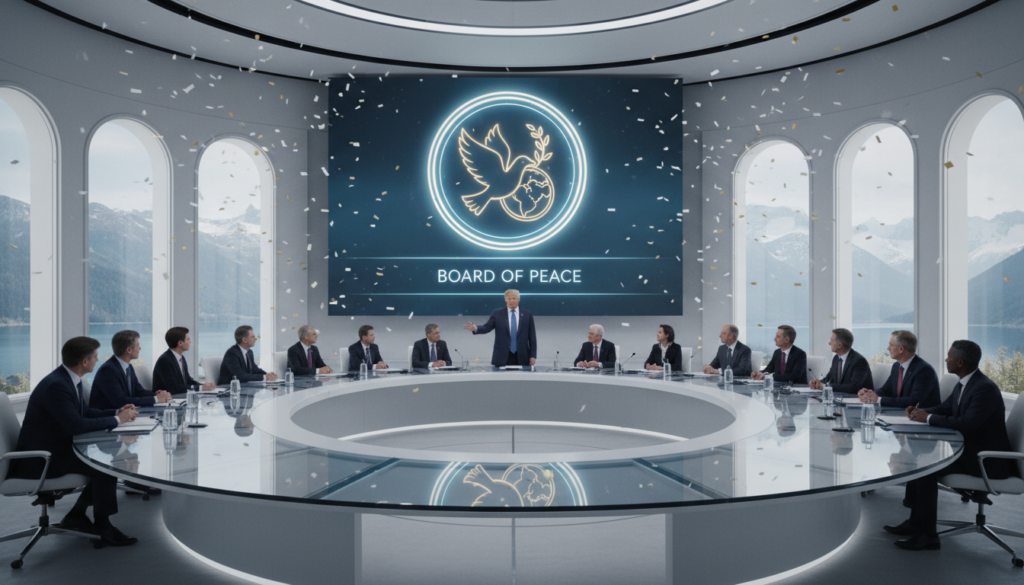
Trump Launches ‘Board of Peace’ at Davos: A New Global Initiative
Slug: trump-launches-board-of-peace-davos
In a major diplomatic development at the World Economic Forum (WEF) in Davos, Switzerland, President Donald Trump has unveiled a new international body designed to tackle escalating geopolitical tensions. Dubbed the “Board of Peace,” the initiative represents a significant shift in the U.S. approach to foreign policy, emphasizing direct engagement and alternative coalitions over traditional multilateral institutions.
A New Charter for Global Stability
President Trump officially signed the charter for the Board of Peace during a high-profile ceremony at the annual Davos gathering. The administration has positioned this new body not merely as a forum for discussion, but as an action-oriented council aimed at resolving global conflicts that have stalled in other international venues such as the United Nations.
Speaking to the assembled world leaders and business tycoons, President Trump highlighted the necessity of a fresh approach to global stability. He argued that existing frameworks have become too bureaucratic and slow to react to the rapid pace of modern warfare and political instability. The “Board of Peace” is intended to operate with greater agility, focusing on transaction-based diplomacy and direct negotiation.
Argentina and Azerbaijan Join as Founding Members
The launch was accompanied by the announcement of the Board’s first strategic partners. In a move that underscores the administration’s specific foreign policy interests, Argentina and Azerbaijan were introduced as initial members.
Why These Members?
- Argentina: Under the leadership of President Javier Milei, Argentina has aligned itself closely with U.S. economic and political ideologies. Their inclusion signals a strengthening of ties between Washington and Buenos Aires, creating a stronger foothold for the initiative in South America.
- Azerbaijan: Situated at a critical geopolitical crossroads between Eastern Europe and Western Asia, Azerbaijan’s participation highlights the Board’s focus on energy security and regional stability in the Caucasus.
Redefining International Diplomacy
The creation of the Board of Peace raises questions about the future of traditional diplomatic channels. By circumventing established bodies, the Trump administration appears to be doubling down on a strictly sovereignty-first model of international relations.
Critics question whether a smaller, exclusive group can effectively manage complex global conflicts without the broad consensus required by the UN. However, supporters argue that a streamlined group of like-minded nations can achieve results faster, unburdened by the veto power of geopolitical adversaries.
Key Objectives of the Board
While the full charter has yet to be released to the public, the initial goals outlined at Davos include:
- Rapid Conflict De-escalation: Creating a hotline for immediate dialogue during emerging crises.
- Economic Peacekeeping: Leveraging trade agreements and economic incentives as primary tools for conflict resolution.
- Energy Security: Ensuring stable energy supply chains among member nations to prevent resource-driven conflicts.
Conclusion
The launch of the Board of Peace at Davos marks a pivotal moment in President Trump’s foreign policy agenda. By establishing a new diplomatic architecture with partners like Argentina and Azerbaijan, the U.S. is signaling a move away from universal multilateralism toward strategic, interest-based alliances. As the Board begins its operations, the world will be watching closely to see if this new model can succeed where traditional institutions have struggled.