
Why Some People Cannot Visualize Images in Their Mind: Understanding Aphantasia
Why can some people not picture an apple or a familiar face? Explore aphantasia, the science of mental imagery, practical strategies and warning signs.
Contents
- What is aphantasia?
- Mental imagery exists on a spectrum
- Why can some people not visualize images?
- What does research actually show?
- How might aphantasia affect everyday life?
- Aphantasia versus face blindness, memory disorders and ordinary distraction
- Can you check your own mental imagery?
- What if your ability to visualize suddenly disappears?
- Practical strategies for studying, memory and creative work
- Can you train yourself to visualize?
- What scientists still do not know
- A simple seven-day observation exercise
- Key takeaways
- Research and further reading
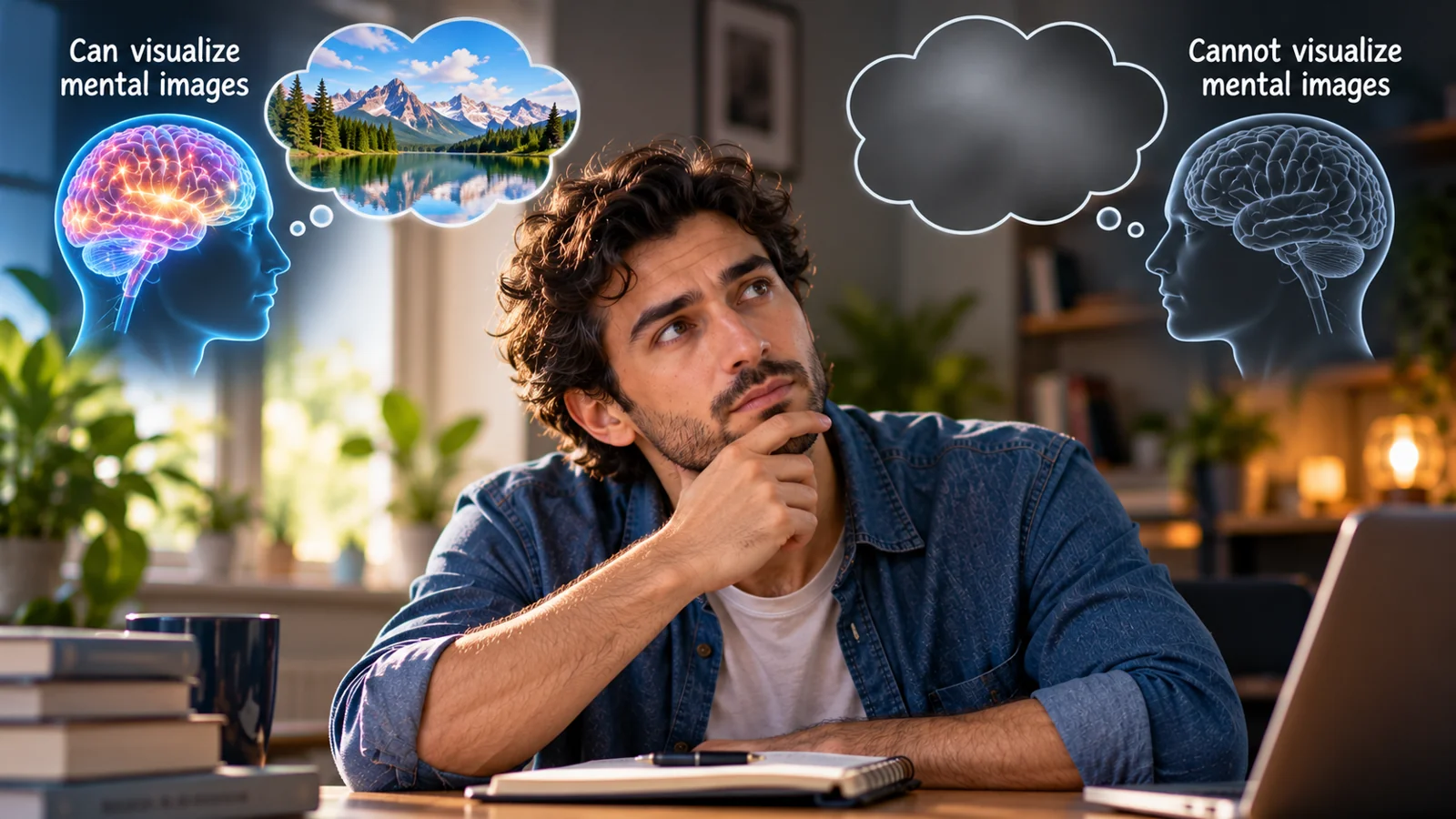
Close your eyes and picture a red apple on a wooden table. Some people see a vivid image; others experience only a faint impression, and some see no image at all—even though they know exactly what an apple looks like. That last experience is often called aphantasia: a reduced or absent ability to voluntarily generate visual mental imagery. It is not the same as blindness, a lack of imagination, or low intelligence.
Aphantasia is a description of how someone experiences mental imagery, not a diagnosis of a disease in itself. Researchers increasingly distinguish lifelong aphantasia from a newly acquired change in imagery. This guide explains what scientists know, what remains uncertain, and practical ways to study, work and remember information without relying on a “mind’s eye.”
What is aphantasia?
The term was introduced in modern scientific discussion by neurologist Adam Zeman and colleagues in 2015, after earlier research on a person who lost visual imagery following a medical procedure. People with aphantasia typically recognize faces, navigate familiar places and describe objects, but report that they cannot deliberately “see” those things internally. Experiences vary: some people can imagine sounds or touch vividly despite little visual imagery; others report reduced imagery across multiple senses.
The defining issue is voluntary visual imagery. Dream imagery, involuntary flashes, visual memory, recognition, and the ability to draw are separate processes that may or may not be affected. An individual who says “I know what my mother looks like but I cannot see her face in my head” is describing a plausible aphantasic experience—not proving an inability to remember faces.
Mental imagery exists on a spectrum
| Experience | What it may feel like | Important qualification |
|---|---|---|
| Hyperphantasia | Exceptionally vivid, picture-like imagery | Vividness is subjective and varies by task |
| Typical range | Images of varying clarity and detail | Not everyone visualizes the same way |
| Hypophantasia | Dim, vague or inconsistent images | May overlap with ordinary low imagery |
| Aphantasia | Little or no voluntary visual image | Other senses and skills may be unaffected |
The commonly used Vividness of Visual Imagery Questionnaire (VVIQ) asks people to rate imagined scenes. It can help describe a personal experience, but a single online score is not a medical test. Scores are self-reported and should not be treated as proof of a specific brain condition.
Why can some people not visualize images?
There is no single established cause for all lifelong aphantasia. Scientists investigate differences in how visual, attention and memory systems interact when people attempt to generate images. Brain-imaging studies show that imagery involves distributed networks rather than a single “imagination center.” Researchers have found group-level differences in some neural and physiological measures, but these findings cannot diagnose an individual or show that a brain region is missing or damaged.
Some evidence suggests that the strength of top-down signals—from higher-level representations toward sensory systems—may matter. This remains a research model, not a confirmed explanation for every case. Genes and development may contribute to lifelong differences, but there is currently no simple genetic test for aphantasia.
What does research actually show?
One notable experiment found that imagining bright or dark objects changed pupil size in typical visualizers, while participants reporting aphantasia showed little imagery-linked pupil response despite normal responses to real light. The finding offers a physiological clue beyond questionnaires, but it does not make a home pupil test a valid diagnosis. Read the 2022 eLife study on the pupillary light response.
Other studies have reported differences in binocular rivalry priming, autobiographical memory and the subjective vividness of dreams. Results differ across samples and tasks, and researchers continue debating whether aphantasia is one phenomenon or several related profiles. A small or highly selected sample should not be generalized to everyone who has low imagery.
How might aphantasia affect everyday life?
| Area | What some people report | What not to assume |
|---|---|---|
| Reading fiction | Following ideas without seeing a movie-like scene | They cannot enjoy novels |
| Remembering events | Recalling facts or narratives more easily than pictures | They have no memories |
| Recognizing faces | Recognizing someone in person despite no internal portrait | They necessarily have face blindness |
| Navigation | Using landmarks, routes or verbal directions | They cannot navigate |
| Creative work | Planning with sketches, language, models or references | They cannot be artists or designers |
| Dreams | Vivid, faint or absent visual dreams | Everyone with aphantasia dreams the same way |
Aphantasia does not automatically imply poor academic performance, low creativity or an inability to learn visually presented information. Many people compensate with external visual aids or nonvisual strategies, and some may not feel they need to compensate at all.
Aphantasia versus face blindness, memory disorders and ordinary distraction
Prosopagnosia (face blindness) is difficulty recognizing faces, including faces that are physically in view; aphantasia concerns voluntarily picturing a face when it is absent. The two may co-occur in some people but are not interchangeable. Memory disorders can affect forming or retrieving information; aphantasia is not, by itself, evidence of dementia or brain injury. ADHD and attention problems can disrupt focus but do not define visual imagery ability.
Someone may have vivid dreams but no voluntary mental pictures while awake. That apparent contradiction is not necessarily a problem: dreaming and deliberate imagery involve overlapping but nonidentical processes. Similarly, “I think in words” is a useful personal description, not proof that all people with aphantasia use one cognitive style.
Can you check your own mental imagery?
Try a gentle, non-diagnostic reflection. Sit comfortably and imagine a familiar object, such as a lemon. Ask whether you experience visual color and shape, a faint impression, or simply knowledge that the object is yellow and oval. Repeat with a familiar room or person, then consider whether images arrive spontaneously rather than on command.
- Use the same familiar object each time; avoid judging yourself by someone else’s descriptions.
- Separate “I know its features” from “I experience a picture of it.”
- Notice whether sounds, movement or other sensory impressions are easier to imagine.
- If useful, complete a research-oriented questionnaire such as the VVIQ and keep the result as a description, not a diagnosis.
- Do not attempt to test yourself by staring at bright lights or recording pupil changes; those experiments require controlled methods.
The apple exercise is only an illustration: there is no universal threshold for what counts as “seeing” internally, and language can make two similar experiences sound different. If you have always experienced little imagery and function well, this is not automatically a medical problem.
What if your ability to visualize suddenly disappears?
A new or sudden loss of imagery is different from lifelong aphantasia. If it follows a head injury, occurs alongside a new severe headache, confusion, speech difficulty, weakness, visual loss or other neurological symptoms, seek urgent medical assessment. In the US call 911; in the UK call 999 for emergency stroke-like symptoms. For a persistent but non-emergency change, arrange a clinician’s evaluation rather than assuming it is a harmless lifelong trait.
This distinction matters because researchers use “acquired aphantasia” for imagery loss that develops after previously normal imagery. Causes may vary and require individual clinical investigation; online exercises cannot determine the cause.
Practical strategies for studying, memory and creative work
| Task | Imagery-heavy advice | Accessible alternative |
|---|---|---|
| Remember a shopping list | Picture every item in a room | Group by aisle; use a checklist |
| Study anatomy | Visualize the diagram later | Label a real diagram and practice retrieval |
| Plan a design | See the finished result mentally | Use mood boards, sketches and prototypes |
| Recall a route | Replay the route as a movie | Write turn-by-turn landmarks |
| Relaxation | Imagine a beach in detail | Focus on breathing, sounds or muscle relaxation |
Externalizing an idea can be especially helpful: use diagrams, photographs, written outlines, maps, physical models or quick sketches. Retrieval practice and spaced repetition can work without vivid imagery. For creative projects, iterative prototypes let you discover a design through feedback rather than requiring a fully formed mental picture before starting.
Can you train yourself to visualize?
There is no well-established treatment proven to restore voluntary visual imagery in lifelong aphantasia. Anecdotal claims about “image streaming,” visualization courses or guaranteed brain rewiring are not strong evidence. Some people report changes after practice, but such reports do not demonstrate that a method works reliably or safely for everyone.
If the goal is better memory, relaxation or creativity, choose techniques with benefits that do not depend on acquiring visual imagery. Someone with aphantasia can still practice drawing from observation, learn spatial skills, use mindfulness approaches that emphasize sensation, or create detailed art through reference-based workflows.
What scientists still do not know
- How many distinct forms of aphantasia exist and where boundaries with low imagery should be drawn.
- Why visual dreams are vivid for some people without voluntary imagery but absent for others.
- Which neural measures generalize across populations and tasks.
- How imagery differences interact with memory, emotion, navigation and other senses over a lifetime.
- Whether any intervention can reliably increase imagery vividness in people with lifelong aphantasia.
Prevalence estimates depend on the survey, scoring threshold and population studied; a single definitive percentage would be misleading. Aphantasia research is growing, but many conclusions are still based on relatively small groups and subjective reports.
A simple seven-day observation exercise
Rather than trying to “fix” your imagination, you can learn which thinking tools work best for you. Over seven days, compare tasks that rely on a mental picture with versions that provide an external picture or written structure. This is a personal reflection, not a scientific experiment or diagnostic tool.
- Day 1: Describe your imagery experience in your own words.
- Day 2: Read a short story; note whether you follow plot, emotion and setting without images.
- Day 3: Memorize a short list using categories instead of imagined scenes.
- Day 4: Follow a new route using written landmarks or a map.
- Day 5: Plan a small creative project using a sketch or reference images.
- Day 6: Try a nonvisual relaxation exercise using breathing or sounds.
- Day 7: Review which tools made tasks easier and keep those that helped.
Record outcomes such as task completion, comfort and recall rather than rating yourself as a “good” or “bad” thinker. The useful result is a personal strategy, not a label.
Key takeaways
Aphantasia means little or no voluntary visual mental imagery. It does not mean a person cannot think, remember, dream, recognize objects or create art. Research supports meaningful differences in imagery experience, but mechanisms, prevalence and interventions remain unsettled. Lifelong low imagery is often simply part of cognitive diversity; a sudden new loss, especially with other neurological symptoms, warrants medical assessment.
Research and further reading
- Zeman and colleagues (2015): Lives without imagery—congenital aphantasia.
- eLife (2022): The pupillary light response as a physiological index of aphantasia.
- Vividness of Visual Imagery Questionnaire (VVIQ): descriptive self-report resource.
- NHS: Stroke symptoms and emergency warning signs.
- CDC: Signs and symptoms of stroke.