
Remembrance Day vs Remembrance Sunday: Dates and Meaning
Remembrance Day is 11 November; Remembrance Sunday is the second Sunday in November. Compare the dates, silence times, poppies and historical meaning.
Contents
- The dates and differences at a glance
- Why is Remembrance Day on 11 November?
- Why is there a separate Remembrance Sunday?
- What time is the two-minute silence?
- What does the Cenotaph represent?
- Why do people wear red poppies?
- Which side should you wear a poppy on?
- How to check a remembrance event before attending
- Sources and image credit
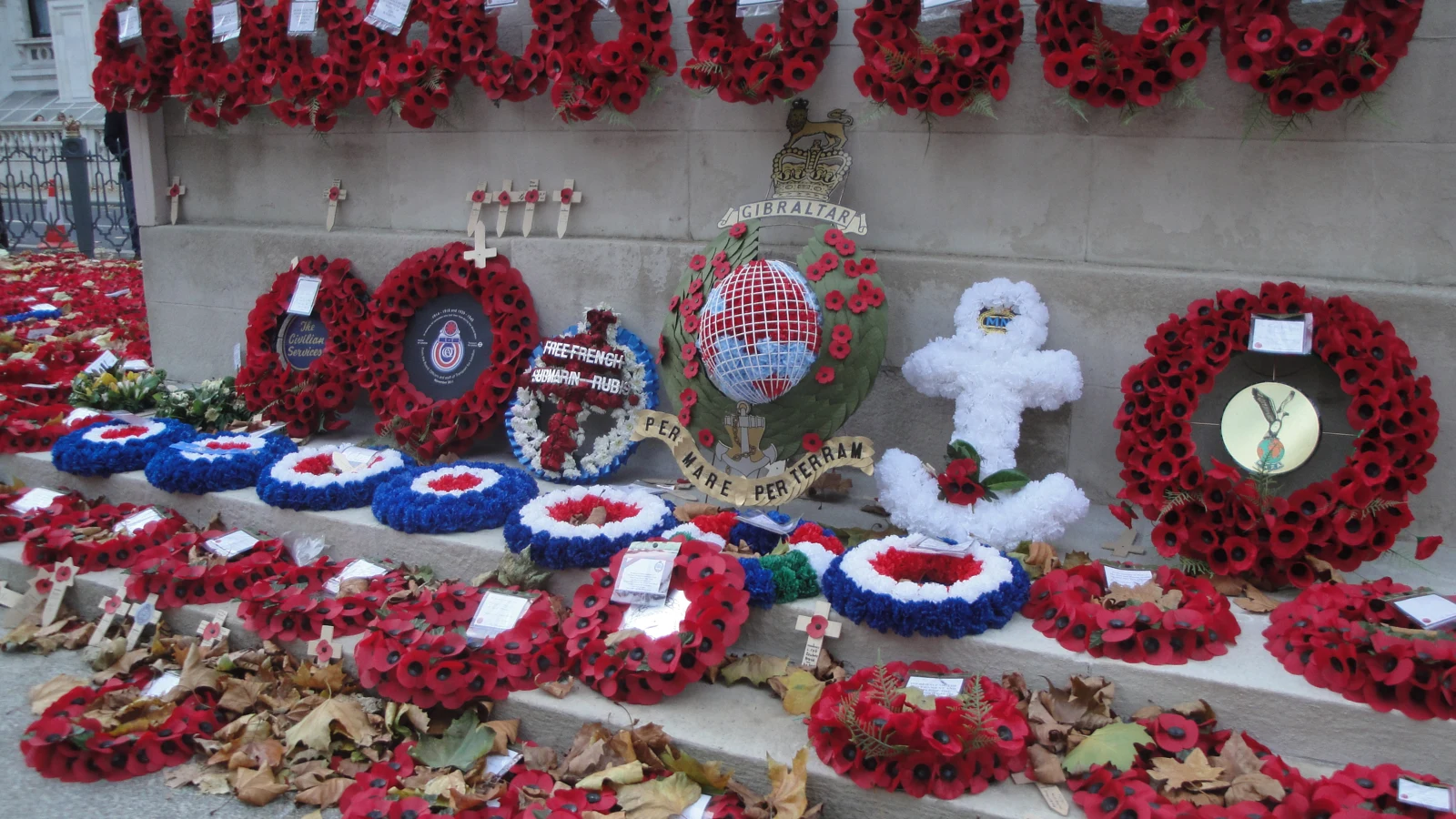
Remembrance Day is on 11 November every year. Remembrance Sunday is the second Sunday in November. In the UK in 2026, that means Sunday 8 November for Remembrance Sunday and Wednesday 11 November for Remembrance Day, also called Armistice Day.
The dates belong to the same period of remembrance, but they serve different purposes: one preserves the anniversary of the 1918 armistice, while the other brings together the main national Sunday ceremonies. The House of Commons Library’s explanation, published on 3 November 2026, confirms the distinction.
The dates and differences at a glance
| Name | How the UK date is determined | Date in 2026 |
|---|---|---|
| Remembrance Day | Fixed anniversary on 11 November | Wednesday 11 November |
| Armistice Day | Another name used for the 11 November observance | Wednesday 11 November |
| Remembrance Sunday | Second Sunday in November | Sunday 8 November |
The Sunday ceremony does not move the anniversary itself. A calendar can therefore correctly list both 8 and 11 November as remembrance dates in 2026.
For a future year, find the second Sunday in November rather than reuse this year’s date. It always falls between 8 and 14 November; if 11 November is a Sunday, the observances fall on the same day.
Why is Remembrance Day on 11 November?
The date marks the armistice with Germany that took effect at 11am on 11 November 1918. The National Archives preserves the British War Cabinet’s minutes from that morning, including the decision to announce that hostilities would cease at 11am.
This is the origin of the familiar association with the eleventh hour, day and month. The anniversary remembers a decisive moment in the First World War and became the basis for an annual act of commemoration.
There is an important historical qualification: an armistice is a ceasefire, not the same thing as a final peace treaty. The government’s historical account, “The war that did not end at 11am on 11 November”, explains that fighting continued in some places after the appointed hour.
The later Treaty of Versailles was signed on 28 June 1919. The National Archives’ treaty record helps distinguish that peace settlement from the armistice commemorated in November. Remembering the anniversary does not require treating the end of a global war as a single, simultaneous event everywhere.
Why is there a separate Remembrance Sunday?
The Sunday observance developed around the main national ceremonies. English Heritage’s history of the Cenotaph explains that the principal service moved to a Sunday during the Second World War to avoid disrupting industry. A Sunday observance was formally adopted in 1946, embracing remembrance of both world wars and subsequent conflicts.
Today, the second Sunday in November provides the recurring date for the National Service of Remembrance at the Cenotaph in Whitehall, London. It is a public act of commemoration, alongside local services and individual remembrance.
The distinction is practical as well as historical. Someone attending a Sunday parade and someone pausing at work on 11 November may both be participating in remembrance, on different dates.
What time is the two-minute silence?
The two-minute silence is observed at 11am on both Armistice Day and Remembrance Sunday. The Royal British Legion’s guidance confirms both observances and dates the annual Armistice Day silence to 1919.
For UK ceremonies, read 11am as UK local time. If you are watching from another country, check the time difference rather than assuming a UK broadcast follows your local clock. A separate event outside the UK should be checked against its own organiser’s instructions.
Observing silence on the Sunday does not mean the 11 November observance has been cancelled. They are two opportunities to remember within the same commemorative period.
What does the Cenotaph represent?
The name means “empty tomb”. No one is buried inside the Whitehall monument. It provides a shared focus for remembrance, including for families whose relatives were buried overseas or had no known grave.
English Heritage records that Sir Edwin Lutyens designed the memorial. The permanent Portland-stone version was unveiled on 11 November 1920, following the temporary monument of 1919. Its dedication commemorates the fallen collectively rather than listing individual names.
For the 2026 observance, the official government event page lists the National Service on 8 November, beginning at 11am. It also provides the official viewing link and order of service. The national ceremony and the veterans’ march past are related parts of the day; a general calendar entry is not a substitute for the organiser’s arrangements.
Why do people wear red poppies?
The red poppy became a symbol of remembrance after the First World War. The Royal British Legion traces its adoption of the symbol in 1921 to the influence of In Flanders Fields, written by Canadian doctor and soldier John McCrae.
The symbol links remembrance of those who died with support for the Armed Forces community. It is not simply a decoration indicating which ceremony someone will attend.
Which side should you wear a poppy on?
The Royal British Legion states that there is no single correct way for members of the public to wear a poppy. People commonly pin one to either side of their chest. The choice is personal; service personnel may have separate uniform regulations.
Nor is there one compulsory start or removal date. Many people wear a poppy during the period from the Poppy Appeal in late October through the November commemorations, but it can also be worn at other remembrance events during the year.
How to check a remembrance event before attending
Use the commemorative calendar to identify the day, then consult the actual organiser. A local service may ask participants to assemble earlier so that the silence can begin at 11am.
- Check the year and full date. An old event page may still appear in search results.
- Separate arrival time from silence time. A parade’s assembly time is not necessarily the start of the service.
- Confirm the location and access arrangements. Look for information from the council, venue or organising branch.
- Check whether a viewing link is live or recorded. A recording of a previous ceremony is useful historical material, but is not a current livestream.
This approach also works for other commemorative calendars. For a separate November observance with its own history and context, see our guide to Native American Heritage Month and reliable learning resources.
Sources and image credit
Dates and guidance checked on 8 November 2026. The historical explanation remains useful beyond this year; event links and annual dates should be checked again before making plans.
The linked sources include the House of Commons Library, Royal British Legion, National Archives, English Heritage and the UK government’s event guidance. Their roles differ: historical records explain the origins, while current organiser pages establish practical arrangements.
Featured photograph: Editor5807, Remembrance poppies at the Cenotaph in November 2011, photographed on 26 November 2011, CC BY 3.0. Cropped to 16:9 and converted to WebP. This historical image shows wreaths after the commemorations, not the 2026 service.
You may also like
 History & Culture
Native American Heritage Month: History and Ways to Learn
Learn when Native American Heritage Month takes place, how it began, and where to find reliable Smithsonian, Library…