
Persimmon Soap for 2-Nonenal: Does It Really Work?
Contents
- What Is 2-Nonenal?
- Does Everyone Over 40 Produce 2-Nonenal?
- Why Is Persimmon Soap Supposed to Help?
- Is There Any Human Study on Soap and 2-Nonenal?
- What Was Actually in the Soap?
- Does Persimmon Soap Really Work?
- Why Has Persimmon Soap Become So Popular?
- Is “Old Person Smell” Actually Real?
- Why Doesn't Regular Soap Always Solve the Problem?
- Can You Smell 2-Nonenal on Yourself?
- Is 2-Nonenal Connected to Menopause?
- What Should You Look for in Persimmon Soap?
- Look for Ingredients Such As
- Is More Persimmon Always Better?
- Can Persimmon Soap Irritate Your Skin?
- Is Persimmon Soap a Medical Treatment?
- Can 2-Nonenal Stay in Clothing and Bedding?
- Why the Persimmon Soap Trend Is Scientifically Interesting
- The Bottom Line
- Frequently Asked Questions
- What Is Persimmon Soap?
- What Is 2-Nonenal?
- Does Persimmon Soap Remove 2-Nonenal?
- At What Age Does 2-Nonenal Begin?
- Is Persimmon Soap Better Than Regular Soap?
- Can Women Use Persimmon Soap?
- Is Age-Related Body Odor Caused by Poor Hygiene?
- Sources
- Journal of Investigative Dermatology / PubMed
- Original Scientific Paper
- Journal of Japan Association on Odor Environment
- Japanese Journal of Conservative Dentistry
- PMC
- PLOS ONE
- Rising Trends
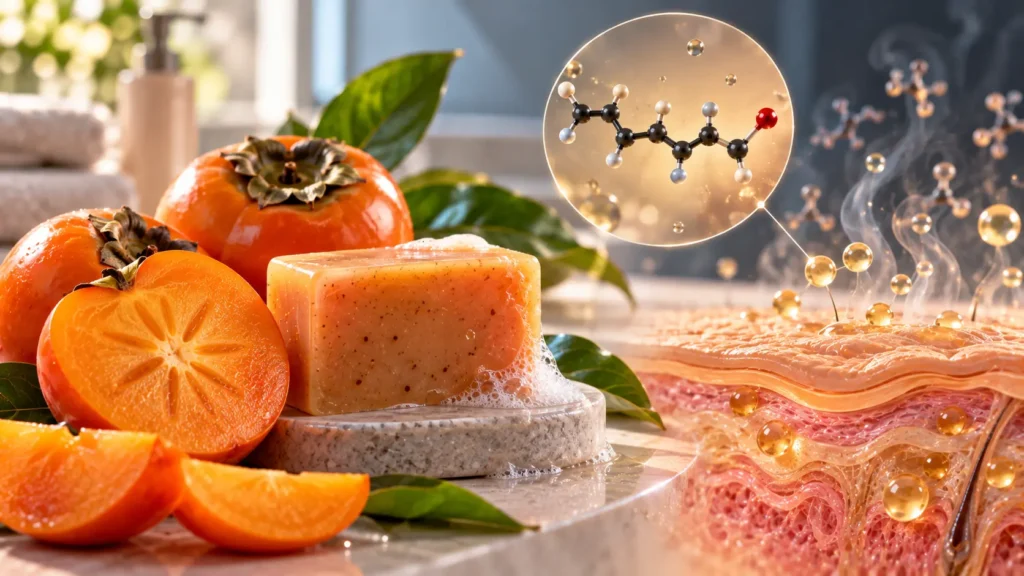
Does Persimmon Soap Really Work for “Old Person Smell”? The Science Behind 2-Nonenal
Persimmon soap has become one of the most talked-about body-care products online.
Across social media, forums, and shopping platforms, people are recommending Japanese persimmon soap for a distinctive type of body odor that may become more noticeable with age.
The phrase often used online is “old person smell.”
While that description can sound insensitive, there is real scientific evidence showing that human body odor changes as we get older.
One molecule in particular has received enormous attention:
2-Nonenal.
A landmark study found that 2-nonenal appeared in body odor samples from adults aged 40 and older and linked its production to age-related changes in fatty acids on the skin.
That finding eventually helped create a market for soaps and body washes containing Japanese persimmon extracts and tannins.
But there is an important question:
Does persimmon soap really remove 2-nonenal, or has online marketing gone further than the scientific evidence?
The answer is more complicated than many product advertisements suggest.
You can read the original study here:
2-Nonenal newly found in human body odor tends to increase with aging
What Is 2-Nonenal?
2-Nonenal is an unsaturated aldehyde, a type of volatile organic compound that can contribute to body odor.
In a 2001 study published in the Journal of Investigative Dermatology, researchers analyzed body odor samples from people between the ages of 26 and 75.
The researchers reported that 2-nonenal was detected in participants aged 40 and older but not in the younger participants included in the study.
They described its odor as having a somewhat greasy and grassy character.
The researchers also found that levels of omega-7 unsaturated fatty acids and lipid peroxides on the skin increased with age.
When some of these fatty acids undergo oxidative breakdown, 2-nonenal can be produced.
In simplified form:
Skin oils + oxidation → 2-nonenal → changes in body odor
Read the original scientific paper
Does Everyone Over 40 Produce 2-Nonenal?
Not necessarily.
This is one of the most important details often missing from discussions about persimmon soap.
Although the original Japanese study strongly associated 2-nonenal with aging, later research examining volatile compounds released from human skin did not always detect it.
One study comparing compounds emitted from the skin of younger and older adults found several substances that changed with age, including:
Nonanal
Dimethyl sulfone
Benzothiazole
However, researchers did not detect 2-nonenal in their samples.
They suggested that differences in population, diet, environment, or other factors might partly explain why their results differed from the earlier Japanese study.
Read the study on volatile compounds released from human skin
So it would be too simplistic to say:
“Everyone over 40 smells different because of 2-nonenal.”
Human body odor is produced by a complicated combination of skin oils, sweat, bacteria, hormones, diet, medications, genetics, and environmental factors.
2-Nonenal may be an important part of age-related odor in some people, but it is unlikely to explain everything.
Why Is Persimmon Soap Supposed to Help?
Japanese persimmon, scientifically known as Diospyros kaki, contains plant compounds called tannins.
Tannins belong to a larger group of compounds known as polyphenols.
They can interact with proteins and other organic molecules, which is one reason persimmon tannins have been investigated for deodorizing applications.
Researchers in Japan have studied purified persimmon tannin preparations for reducing odor-producing compounds.
One clinical study involving 100 participants found that a persimmon tannin preparation reduced measured levels of oral malodor after use.
However, that study examined bad breath, not age-related body odor.
So it cannot prove that persimmon soap removes 2-nonenal from human skin.
Still, it does provide evidence that persimmon tannins can interact with certain odor-producing compounds.
Read the persimmon tannin study
Is There Any Human Study on Soap and 2-Nonenal?
Yes, but there is an important limitation.
A small Japanese study published in 2012 tested a soap designed to reduce age-related body odor.
The study involved 20 men between the ages of 43 and 75.
Participants used the soap daily for four weeks.
Researchers reported that the amount of 2-nonenal detected from the participants’ bodies decreased significantly and that odor intensity also improved.
At first glance, this sounds like strong evidence for persimmon soap.
However, the soap did not contain persimmon alone.
What Was Actually in the Soap?
The tested product contained an anti-nonenal polyphenol complex made from:
Astringent persimmon
Oolong tea
Tencha tea
Green tea
Therefore, the study suggests that a polyphenol-containing soap may reduce 2-nonenal, but it does not prove that persimmon alone was responsible for the effect.
The study also included only 20 men, so larger and independent clinical trials would be needed before making strong claims.
Does Persimmon Soap Really Work?
The most accurate answer is:
It may help, but the scientific evidence is more limited than many advertisements suggest.
Several findings support the idea:
2-Nonenal has been linked to age-related changes in body odor.
Persimmon contains tannins with deodorizing properties.
Persimmon tannin preparations can reduce certain odor compounds.
A small human study found that a soap containing persimmon and several tea extracts reduced measured 2-nonenal.
However, we do not currently have large, independent clinical trials proving that ordinary commercial persimmon soap reliably removes age-related body odor in everyone.
The chemistry is plausible.
The early evidence is interesting.
But the claim is not yet scientifically settled.
Why Has Persimmon Soap Become So Popular?
Interest in persimmon soap has increased sharply as discussions about 2-nonenal, aging, menopause, and body odor have spread across social media and online communities.
Trend-tracking data has shown a substantial increase in searches for persimmon soap compared with previous years.
Read the Persimmon Soap Trend Report
One reason for the product’s popularity is that it gives people a simple explanation for a change they may have noticed but never had a name for.
Instead of searching only for general terms such as “body odor remedies,” users increasingly search for phrases such as:
Persimmon soap
2-nonenal soap
Persimmon soap for body odor
Persimmon soap for old person smell
Does persimmon soap work?
This growing search interest has turned a relatively obscure Japanese personal-care product into an increasingly popular skincare and body-care trend.
Is “Old Person Smell” Actually Real?
Age-related changes in body odor are real.
But the phrase “old person smell” can be misleading.
Human skin releases hundreds of volatile organic compounds, and their relative levels can change with age.
A study published in PLOS ONE found that people were able to distinguish the body odor of older adults from that of younger age groups.
Interestingly, older adults were not necessarily judged to smell worse.
Participants actually rated odor samples from the oldest group as less intense and less unpleasant than some samples from younger participants.
Read the PLOS ONE study on the smell of age
So there may be a recognizable age-related scent without it being inherently unpleasant.
Cultural stereotypes may be harsher than what controlled sensory experiments actually show.
Why Doesn’t Regular Soap Always Solve the Problem?
Ordinary soap is effective at removing skin oils, sweat, dirt, bacteria, and many odor-producing compounds.
However, body odor is constantly being produced.
Even after bathing, skin oils return and chemical reactions begin again.
If 2-nonenal forms through oxidation of fatty acids on the skin, washing can remove some of the molecules already present, but it cannot permanently prevent the skin from producing more.
Some advertisements claim ordinary soap cannot remove 2-nonenal at all.
That statement is too strong.
Regular cleansing can reduce many odor-causing substances.
The more scientifically interesting question is whether persimmon tannins provide an additional deodorizing effect beyond ordinary cleansing.
That question still needs better comparative clinical research.
Can You Smell 2-Nonenal on Yourself?
Possibly, but judging your own body odor is difficult.
Humans experience a phenomenon known as olfactory adaptation.
When your brain is exposed continuously to the same odor, it becomes less sensitive to it.
This is why you may stop noticing:
Your own perfume
The smell of your house
Your clothing
Your own body odor
A visitor may notice the same smell immediately.
This does not mean that everyone who cannot smell themselves is producing 2-nonenal.
It simply means that self-assessing body odor is unreliable.
Is 2-Nonenal Connected to Menopause?
Persimmon soap has become particularly popular in online menopause and perimenopause communities.
Hormonal changes can alter:
Sweating
Skin oil production
Body temperature
Skin microbiome
Overall body odor
However, the scientific evidence linking 2-nonenal specifically to menopause is much weaker than some social-media claims suggest.
A change in body odor during menopause does not automatically mean 2-nonenal is responsible.
Hot flashes, sweating, medications, diet, and changes in skin physiology may also contribute.
What Should You Look for in Persimmon Soap?
If you want to try persimmon soap, read the ingredient list rather than relying only on the front label.
Different products marketed as persimmon soap can contain very different formulas.
Look for Ingredients Such As
Diospyros kaki fruit extract
Persimmon extract
Persimmon tannin
Kakishibu
Do not assume that an orange-colored bar contains a high amount of persimmon.
Color may come from dyes or other ingredients.
Likewise, fragrance can make a product smell pleasant without proving that it neutralizes 2-nonenal.
Is More Persimmon Always Better?
Not necessarily.
There is currently no universally established clinical concentration of persimmon tannin proven to eliminate 2-nonenal from human skin.
Claims that a certain percentage is guaranteed to work should therefore be treated cautiously unless the manufacturer provides credible independent testing.
The entire soap formulation also matters.
Ingredients such as surfactants, oils, fragrances, and pH can affect how a product behaves on the skin.
A persimmon extract that works in a laboratory solution does not automatically perform the same way inside a commercial soap bar.
Can Persimmon Soap Irritate Your Skin?
Yes.
Persimmon soap, like any cleanser, can irritate some people.
Traditional bar soaps may have a relatively high pH and can strip natural oils from the skin.
Possible effects include:
Dryness
Tightness
Redness
Itching
Irritation
People with eczema, very dry skin, or sensitive skin should be particularly cautious with fragranced or strongly cleansing products.
If you try a new soap, consider testing it on a small area first and stop using it if irritation develops.
Is Persimmon Soap a Medical Treatment?
No.
Body odor is usually a normal biological phenomenon.
But a sudden or dramatic unexplained change in body odor can sometimes accompany:
Medication changes
Hormonal changes
Infection
Metabolic conditions
Other health problems
Soap can help manage odor, but it should not be used to diagnose or treat an underlying medical condition.
If your body odor changes suddenly or is accompanied by other symptoms, consider speaking with a healthcare professional.
Can 2-Nonenal Stay in Clothing and Bedding?
Body odor compounds do not remain only on the skin.
Oil-based substances can accumulate in:
Shirts
Pillowcases
Sheets
Towels
Mattresses
Upholstery
This means someone may shower regularly and still notice an odor because fabrics continue releasing compounds that have accumulated over time.
Regular washing of clothing and bedding, allowing fabrics to dry thoroughly, and improving ventilation may sometimes be just as important as changing body wash.
Why the Persimmon Soap Trend Is Scientifically Interesting
The persimmon soap trend is a good example of how health and skincare trends develop online.
First, scientists identify a molecule.
Then researchers discover that a traditional ingredient has chemistry that may interact with odor-producing compounds.
A few small studies produce encouraging results.
Social media then simplifies the story into:
“This molecule causes the smell, and this soap removes it.”
But real science is usually more complicated.
2-Nonenal appears to be a genuine component of age-related body odor in at least some people.
Persimmon tannins have genuine deodorizing properties.
But there is still a large gap between those facts and the claim that every persimmon soap sold online is clinically proven to eliminate age-related body odor.
The Bottom Line
So, does persimmon soap really work for age-related body odor?
There is enough scientific evidence to say that the idea is plausible and worth studying, but not enough evidence to say that persimmon soap has been definitively proven to eliminate 2-nonenal in everyone.
The strongest evidence currently includes:
A study linking 2-nonenal to age-related body odor.
Research showing deodorizing activity from persimmon tannins.
A small human study in which a polyphenol soap containing persimmon and several tea extracts reduced measured 2-nonenal.
What is still missing is a large, randomized, independent clinical trial directly comparing a clearly defined persimmon soap with ordinary soap and an appropriate control.
Until then, the fairest conclusion is:
Persimmon soap may help some people manage age-related body odor, but the science is more limited than many viral claims suggest.
Frequently Asked Questions
What Is Persimmon Soap?
Persimmon soap is a cleanser containing extract or tannins from Japanese persimmon, Diospyros kaki. It has become popular for its claimed ability to reduce age-related body odor.
What Is 2-Nonenal?
2-Nonenal is a volatile aldehyde produced partly through oxidation of certain fatty acids on the skin. A 2001 study associated it with age-related changes in body odor.
Does Persimmon Soap Remove 2-Nonenal?
There is limited evidence suggesting that a soap containing persimmon and other polyphenol extracts may reduce 2-nonenal, but strong independent clinical evidence for persimmon soap alone is still lacking.
At What Age Does 2-Nonenal Begin?
The original study detected 2-nonenal in participants aged 40 and older, but this does not mean everyone begins producing the same odor at exactly age 40.
Is Persimmon Soap Better Than Regular Soap?
There is not enough high-quality comparative research to conclude that persimmon soap is universally better than ordinary soap.
Some formulations may provide additional deodorizing effects, but stronger studies are still needed.
Can Women Use Persimmon Soap?
Yes.
Persimmon soap is not gender-specific.
However, people with sensitive or dry skin should examine the full ingredient list and stop using the product if irritation develops.
Is Age-Related Body Odor Caused by Poor Hygiene?
No.
Normal chemical changes in skin oils can alter body odor with age even in people who maintain excellent personal hygiene.
Sources
Journal of Investigative Dermatology / PubMed
2-Nonenal newly found in human body odor tends to increase with aging
Original Scientific Paper
2-Nonenal newly found in human body odor tends to increase with aging
Journal of Japan Association on Odor Environment
Preventive effect against the aged men’s body odor by the soap containing polyphenol
Japanese Journal of Conservative Dentistry
Deodorizing Effect of Persimmon Tannin against Oral Malodor
PMC
Analyses of volatile organic compounds from human skin
PLOS ONE
The Smell of Age: Perception and Discrimination of Body Odors of Different Ages