
Lifelong Learning Entitlement 2027: Applications Open and How to Apply
LLE applications are open for January–July 2027 starts. Check eligibility, tuition funding, deadlines, the new account requirement and official application links.
Contents
- LLE 2027 at a glance: the five facts that matter
- What is the Lifelong Learning Entitlement and what actually changes?
- Application dates: January starts and autumn 2027 starts are different
- What is the actual deadline for your application?
- Who qualifies for LLE funding? A practical six-part check
- 1. Is the course a funded qualification or designated module?
- 2. Are you studying enough credits, but not too many?
- 3. Is your institution properly registered?
- 4. Does your nationality and residence meet the rules?
- 5. What is your age on the first day of the course?
- 6. How much prior government-funded tuition has been used?
- How much money can you get from LLE in 2027?
- Why four years of entitlement does not mean four free years
- Previous study: calculate your remaining LLE balance carefully
- What if you already have a degree?
- Can you fund an individual short course or module?
- How to verify a module in five checks
- Maintenance Loans, Disabled Students’ Allowance and other help
- Step by step: applying for LLE funding in England
- GOV.UK One Login and your new LLE account
- What to have ready before applying
- Common problems with LLE applications and what to do
- Special case: returning from a break
- How LLE repayments work: a worked wage example
- Is an LLE-funded course worthwhile? Compare three real-world situations
- Before you apply: a checklist to keep
- Official sources and update notes

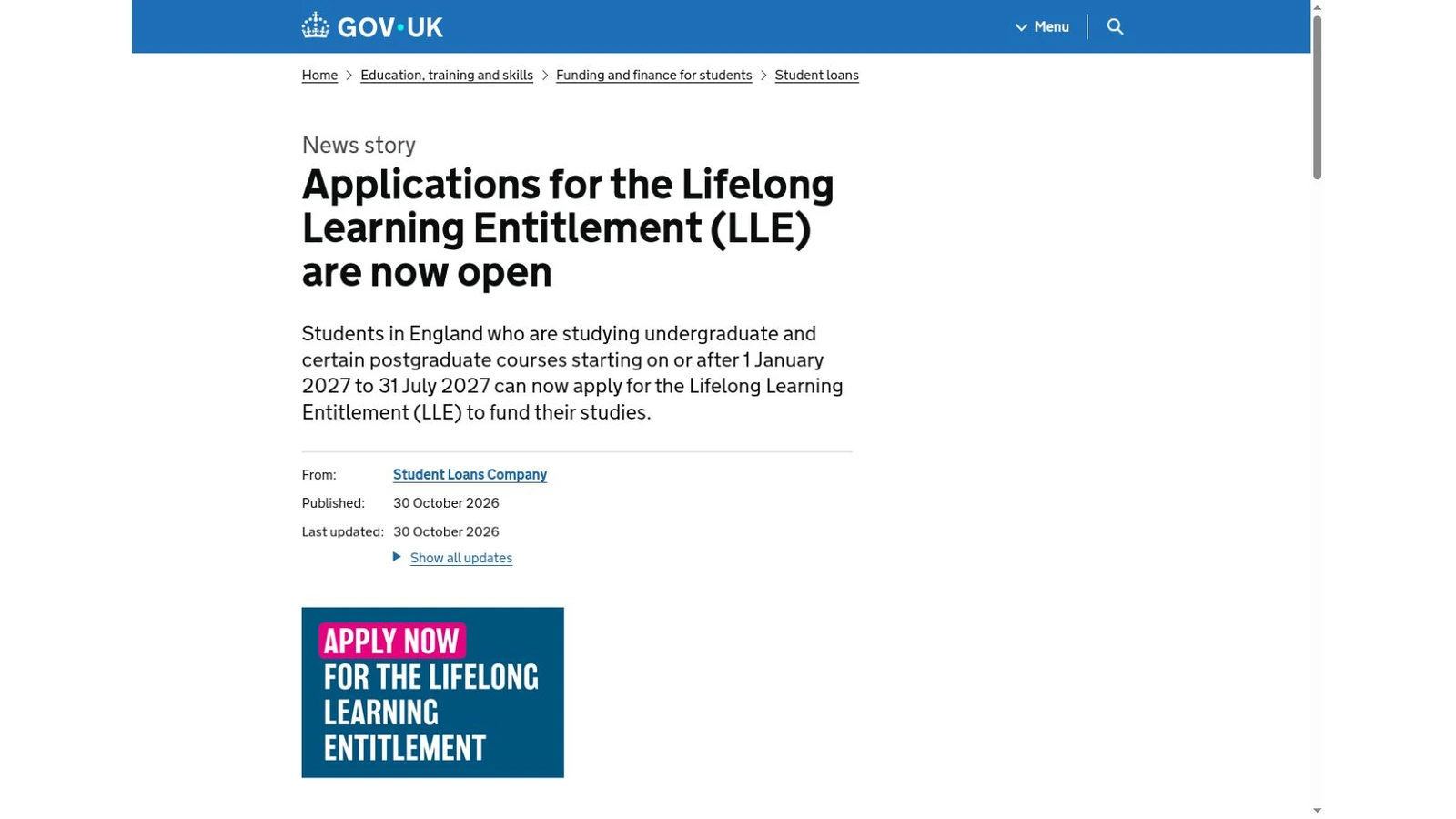
The Lifelong Learning Entitlement (LLE) is England’s new student-finance route for most eligible higher-education courses beginning on or after 1 January 2027. Students can apply for tuition-fee funding of up to £39,160 in total at the 2026–27 rate, but this is a repayable loan, not a grant or a £39,160 cash payment, and previous government-funded study can reduce the balance. Applications for January-to-July 2027 starts opened on 30 October 2026, as confirmed in the official opening announcement; applications for courses beginning on or after 1 August 2027 open in spring 2027, according to the current Student Finance England application timetable.
This guide is for people whose home is normally in England: first-time applicants, adults retraining, graduates thinking about a second qualification, part-time students, and applicants considering short higher-technical modules. It combines the official eligibility checks, a route selector, realistic money examples, and deadlines that depend on your actual course. Guidance reviewed: 31 October 2026. As the scheme is launching, always confirm your personalised award through Student Finance England (SFE) before committing to a course.
LLE 2027 at a glance: the five facts that matter
| Question | The practical answer |
|---|---|
| When does it apply? | Most qualifying new courses and modules beginning 1 January 2027 or later use LLE funding. |
| When do applications open? | Open now for January–July 2027 starts; spring 2027 for starts from August 2027. |
| How much can a new learner borrow for tuition? | Usually up to £39,160 in total, subject to study history, provider fees and course-specific rules. |
| What study qualifies? | Most Level 4–6 courses, selected Level 7 courses, and designated modular study at approved providers. |
| Is it free? | No. Tuition and maintenance support are income-contingent student loans. Grants or bursaries, where awarded separately, are different. |
The official starting points are GOV.UK’s student finance overview and how to apply.
What is the Lifelong Learning Entitlement and what actually changes?
The LLE brings most higher-education tuition lending and certain Advanced Learner Loans for Level 4–6 study into a single credit-based finance system. Instead of treating a traditional degree as the only typical path, it can support approved shorter chunks of higher-level learning. A person may study a full qualification now, come back for an eligible module later, and use remaining tuition entitlement, if available.
There are three important changes. First, some smaller modules can be funded without enrolling immediately on an entire degree. Second, tuition entitlement becomes visible as a running total that prior government-funded study can reduce. Third, people who already hold a qualification may be eligible to fund an equivalent- or lower-level qualification with whatever entitlement remains, replacing many of the previous equivalent or lower qualification restrictions. This is not a promise that every short online course, professional certificate or second degree qualifies.
For a different student-finance system, see our FAFSA 2027–28 application guide for US federal aid. The US process does not replace England’s LLE service.
The launch of modular funding is deliberately limited to designated subjects and institutions; wider availability is an ambition rather than a guaranteed nationwide catalogue from day one. The Department for Education’s LLE overview sets out the scope and funding model, while the official approved modular provider and subject list is the best route to check what is initially available.
Application dates: January starts and autumn 2027 starts are different
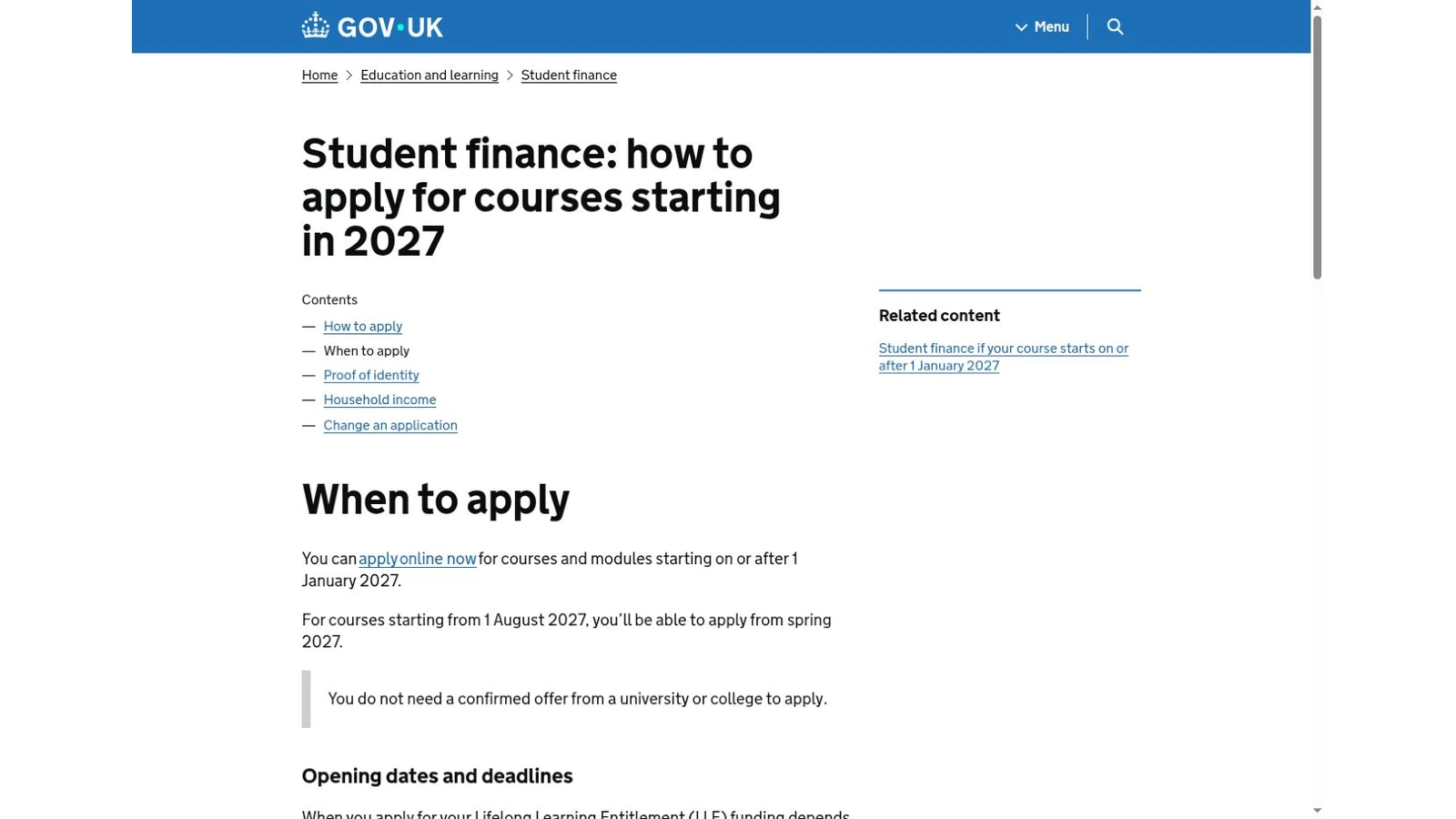
The two opening periods should not be confused. For a course or module starting from 1 January to 31 July 2027, LLE applications are now open, following the 30 October 2026 launch. For courses starting from 1 August 2027, applications open in spring 2027. Neither statement is a guarantee that your particular university has published every module by that date.
| Your situation | Funding application route | What to do |
|---|---|---|
| New undergraduate course began in September 2026 | Existing student finance | Continue under the earlier system in future course years. |
| New eligible course begins 15 January 2027 | LLE | Apply now through the official LLE service; a confirmed course offer is not required. |
| New eligible module begins April 2027 | LLE | Confirm the module is approved; apply now using the service for courses starting January–July 2027. |
| New course starts September 2027 | LLE | Check the spring 2027 opening; do not assume the January-intake application is available. |
| Standard standalone postgraduate master’s or doctorate | Separate postgraduate application route | Check the GOV.UK postgraduate service rather than selecting LLE automatically. |
Do not rely on older articles saying applications opened in September 2026. The government’s September date was amended to late October 2026 in its 24 September policy update. Do not mistake a marketing expression-of-interest form on a college website for an application to Student Finance England.
What is the actual deadline for your application?
You may still apply after study has begun, but GOV.UK says the final deadline is the earlier of (a) the last day of the ninth month of the 12-month course or module year, and (b) the course or module end date. Course years are measured from the first day of the month in which the study starts, not the calendar year.
Take a course beginning 15 January 2027: its course year starts 1 January, so month nine is September. If the course runs through November, the deadline is 30 September 2027. If your module ends 31 May 2027, you must apply by 31 May, because the course end date comes first. These examples are based on the government’s deadline rule; they are not an excuse to wait until the final day if you need support before classes begin. Check the official rule.
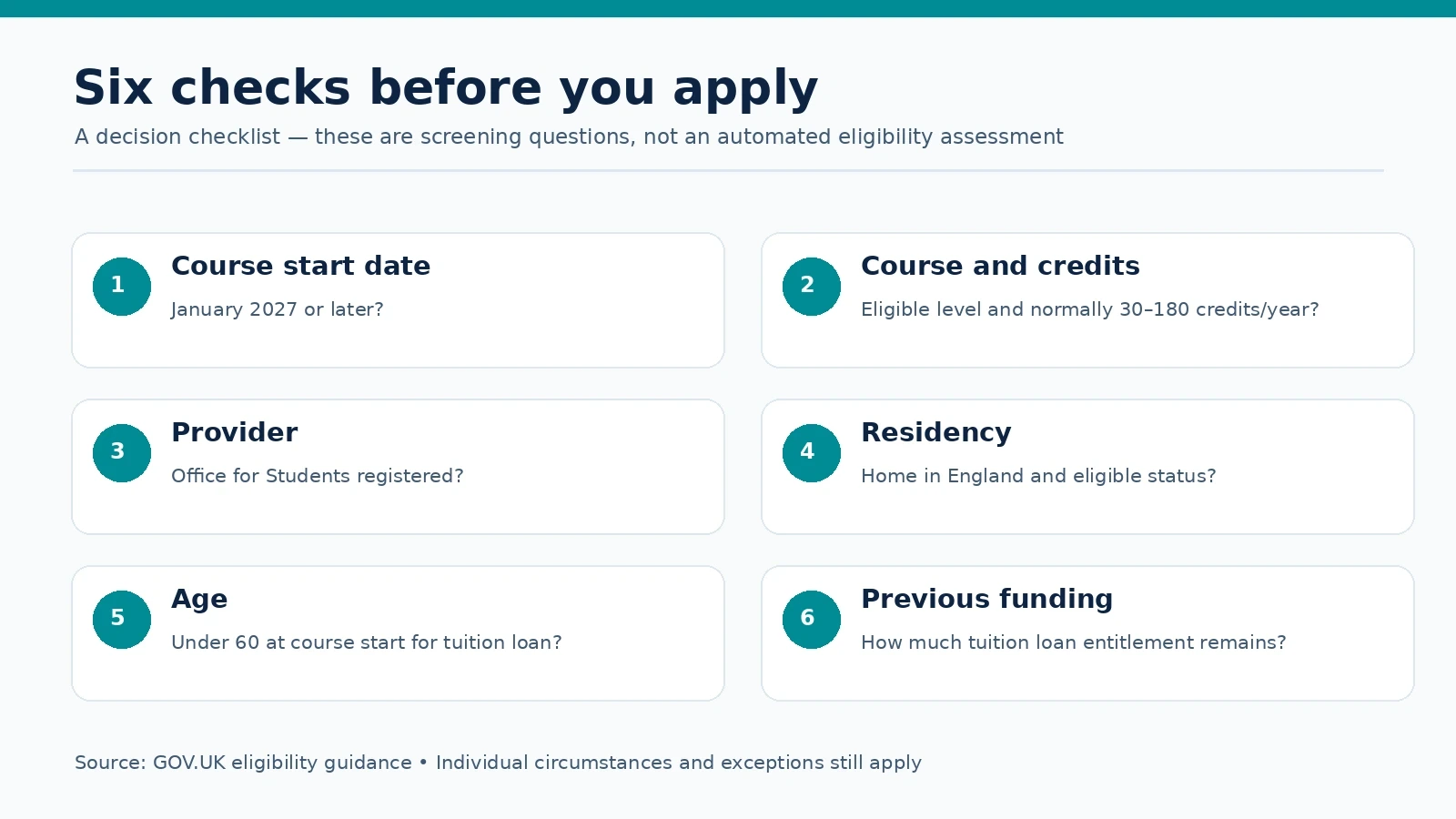
Who qualifies for LLE funding? A practical six-part check
1. Is the course a funded qualification or designated module?
Most qualifying courses are at Levels 4, 5 or 6. Examples include bachelor’s degrees, foundation degrees, designated Higher Technical Qualifications (HTQs), and foundation years that form part of a bachelor’s programme. Certain Level 7 qualifications, such as PGCEs, integrated master’s degrees and specified postgraduate healthcare programmes, may also fall within the system. A standalone master’s degree or doctorate is not automatically an LLE course. Check the precise course record with the provider before applying. Official course eligibility guidance.
2. Are you studying enough credits, but not too many?
Most applicants need to take between 30 and 180 credits per course year. A UK credit represents approximately 10 hours of expected learning time, including lectures, study and assignments, so a 30-credit block suggests around 300 hours of total work rather than 300 hours of classroom teaching. A conventional full-time year of a bachelor’s degree is normally 120 credits.
Study on several LLE courses or modules in the same course year is subject to a combined 180-credit limit. For instance, a 120-credit programme plus an eligible 30-credit module totals 150 credits; adding a further 60 credits would take the total to 210 and breach the cap. GOV.UK warns that a course which takes you over the limit does not receive partial funding for the excess. Multiple-course rules.
3. Is your institution properly registered?
The university, college or training provider generally needs to be registered with the Office for Students (OfS). Modular approval is a further check: appearing on a government list of approved institutions does not mean every subject or every 10-credit short course at that institution can automatically attract an LLE loan. Verify the parent course, subject and particular module, then check the published approved-provider list. Approved modular providers and subjects.
4. Does your nationality and residence meet the rules?
The route discussed here is for applicants whose home is normally in England, not everyone studying at an English university. Under the standard full-support rule, UK nationals, Irish citizens and people with settled status can qualify when they meet other conditions, including ordinarily living in England and having lived in the UK, Channel Islands or Isle of Man for three years before the first day of the month their course begins, aside from temporary absences.
There are important other categories. Some applicants with pre-settled status, qualifying family relationships, long UK residence, or different immigration histories may qualify for tuition-only or other support. Do not assume that a UK visa or attending an English college by itself guarantees a Maintenance Loan; equally, do not reject yourself based solely on nationality without using GOV.UK’s detailed residency check.
5. What is your age on the first day of the course?
For an LLE Tuition Fee Loan, the applicant must be under 60 on the first day of the course under current government guidance. Applicants aged 60 or over may be eligible for a different, limited loan towards living costs; they should not assume the normal tuition loan will be available. This differs from the older undergraduate student-finance guidance, which commonly refers to no maximum age for its tuition loan. Always follow the rules for the course’s actual start date. Official age rule.
6. How much prior government-funded tuition has been used?
The full £39,160 is generally for someone with no prior applicable publicly funded tuition support. Returning graduates and students who left a previous course may have a reduced residual entitlement. A student who has already used the full standard allowance normally will not get further ordinary tuition support, though extra entitlement can apply to certain longer degrees and priority subjects, such as specified healthcare or social work courses. How previous study affects funding.
How much money can you get from LLE in 2027?
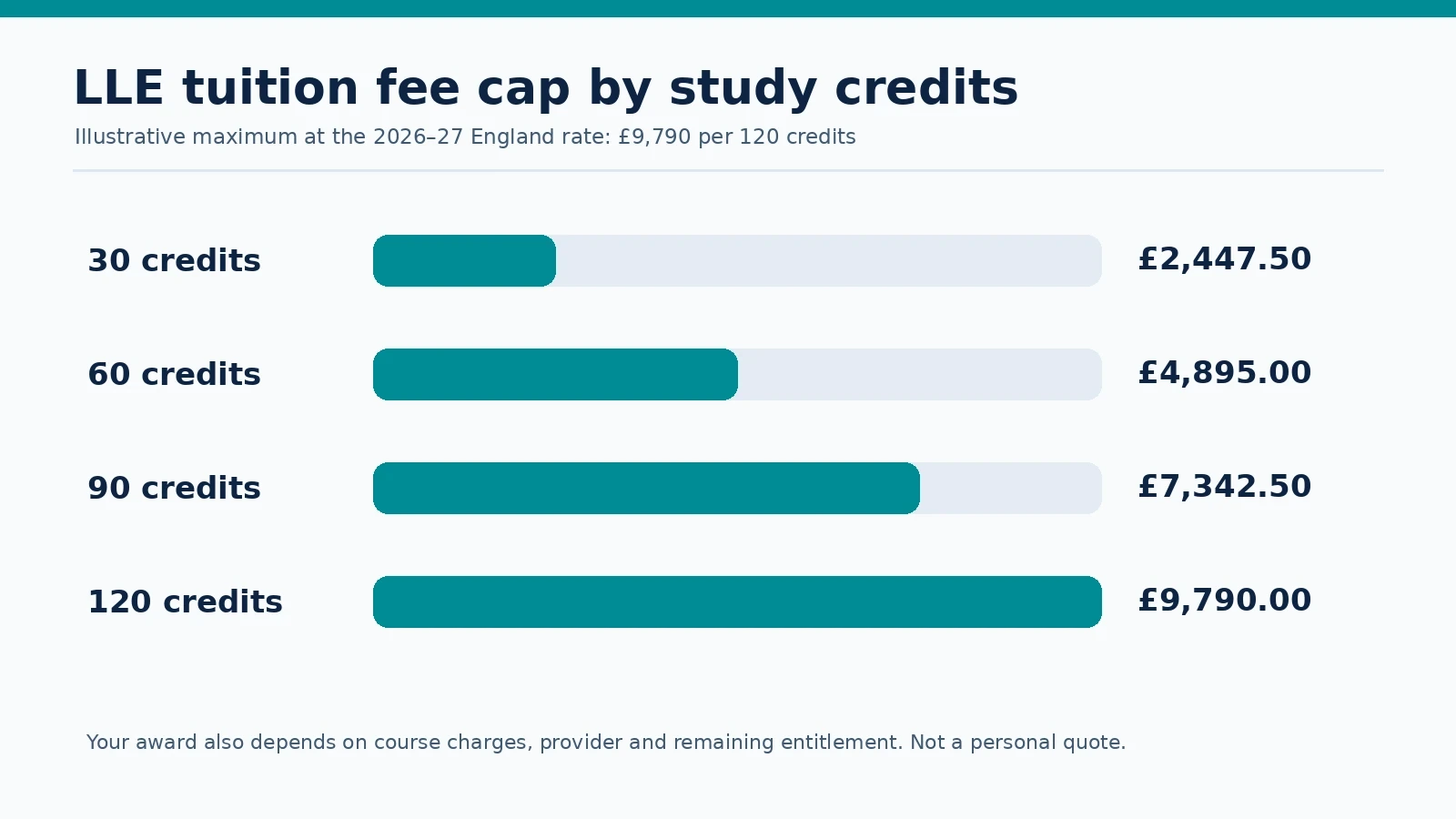
For 2026–27 the headline full tuition entitlement is £39,160. The standard maximum tuition-loan rate used by the government’s examples is £9,790 per 120 credits. An eligible 30-credit module therefore corresponds to one quarter of that rate, £2,447.50, if the full standard rate is applicable. Your actual loan cannot simply be calculated by multiplying credits in isolation: the institution’s charge, registration arrangements, programme type, study country and your remaining personal balance all matter. Some courses have lower applicable fee limits.
| Credits in one eligible course year | Illustration at standard £9,790 per 120-credit rate | Key caution |
|---|---|---|
| 30 | £2,447.50 | A module needs to be approved; not every 30-credit subject is. |
| 60 | £4,895.00 | Often represents half a normal full-time credit load. |
| 90 | £7,342.50 | Check both fee cap and what the provider charges. |
| 120 | £9,790.00 | Standard illustrative maximum for a 120-credit year. |
These are examples of the tuition calculation, not quotations or guaranteed awards, and the £39,160 overall figure is subject to policy and future annual fee adjustments. If a provider charges less, the student does not get to pocket the difference. Tuition loans are usually paid directly to the education provider, not deposited into the student’s bank account.
Why four years of entitlement does not mean four free years
Imagine a new student taking a two-year 240-credit course funded at £9,000 per 120 credits. They could use £18,000 in tuition-fee lending and still have £21,160 of their headline £39,160 entitlement, assuming no prior support and no other deductions. The remaining balance may be put towards future eligible study. Equally, an eligible series of lower-cost courses can stretch the entitlement beyond four calendar years. The four-year phrase is a funding-value comparison, not a four-year expiry date.
Another student takes a 60-credit part-time year at a provider that can charge £4,500 and is eligible for that amount of loan. Their tuition balance would fall by £4,500, not by £9,790. Even when the maximum permitted fee rate is higher, a tuition-loan award follows the funding rules and actual charge. If your total planned fees exceed your assessed loan, make an explicit self-funding plan for the gap before enrolling.
Previous study: calculate your remaining LLE balance carefully
The government does not simply subtract the amount showing as today’s outstanding student-loan debt. It calculates how much eligible tuition support you previously received, translated where required into current fee-equivalent values. Maintenance Loans are not normally deducted when determining your tuition entitlement. The treatment differs by when the course began, even if you have since repaid part of the debt.
| Previous-study situation | General treatment | What the learner should check |
|---|---|---|
| No applicable government-funded tuition study | Usually start from £39,160 at 2026–27 rates | Other age, course and residence checks still apply. |
| Tuition-funded study began on/after 1 September 2012 | Deduction based on tuition loans/grants received, uprated to current fee equivalents | Do not simply deduct original nominal loan; use SFE’s assessment. |
| Tuition-funded study began before September 2012 | Deduction generally based on eligible years of previous study | Clarify full-time/part-time years and any public tuition support. |
| Government-funded course abandoned mid-way | Earlier tuition study may count | Document the actual years and any accepted compelling personal reasons. |
| Previous course affected by serious illness or bereavement | Accepted compelling personal reasons may change deductions | Ask how to submit evidence and seek reassessment. |
| Eligible priority degree after ordinary entitlement exhausted | Special additional entitlement may apply | Ask whether the specific qualification is designated for it. |
Worked example — straightforward self-funded returner: A learner has no applicable tuition support from previous publicly financed study and is offered an eligible module costing £3,200. If SFE confirms full entitlement and the module is designated, a tuition loan of £3,200 would hypothetically leave £35,960. The example assumes the entire fee is permitted under the applicable module cap; check that assumption with SFE.
Worked example — prior study is not the outstanding debt: A student originally borrowed £27,750 for tuition on an older degree and now owes less after repayments. It would be misleading to say their remaining LLE is automatically £39,160 minus £27,750. SFE adjusts past funded tuition to the current equivalent, and the result may differ. A previous SFE balance statement is not a substitute for the new entitlement estimate. Government residual entitlement methodology.
What if you already have a degree?
A degree does not automatically rule out a second funded course. An applicant with residual entitlement may qualify for another degree, an eligible lower-level technical qualification or an approved module. On the other hand, a graduate who has used almost all the usual tuition allowance should not assume that removing the old equivalent-or-lower-qualification restriction creates a fresh £39,160 fund. The sensible order is to obtain the SFE residual entitlement estimate, then compare it with the course fees and ask about any additional eligibility linked to the subject.
Can you fund an individual short course or module?
Sometimes — and this is the part most likely to be misunderstood. The launch does not finance every microcredential, short online certificate or commercial bootcamp. Modules normally must be part of a qualifying parent programme at an eligible institution, worth at least 30 credits individually or as an eligible bundle, assessed and supported by a standardised transcript. Launch subjects include computing, engineering, architecture and building, mathematics, nursing and midwifery, allied health, physics, chemistry, economics and health/social care. Modules of approved HTQs have a different subject-scope provision. Official course and subject rules.
An institution may bundle a 10-credit module and a 20-credit module into 30 credits or offer two 20-credit modules worth 40 credits. This makes a credit-sized bundle potentially eligible only when all remaining approval requirements are satisfied. Having 30 credits printed on a course brochure is not evidence of approval.
A standardised module transcript records what you studied and achieved; completing one module does not by itself guarantee a full qualification, an automatic transfer to another university, or acceptance by an employer. Ask the provider whether these credits can be counted toward a named qualification, which institutions accept them, whether there is a time limit for credit transfer, and whether the exact pathway is written down.
How to verify a module in five checks
- Locate a named university or college on the official approved provider list.
- Find the specific course and its parent qualification, not just a marketing slogan about flexible learning.
- Confirm the exact module title, qualification level, credits, course start date and fees with the provider.
- Ask in writing whether that exact offering is designated for LLE tuition-fee finance and whether it is delivered by the registered institution rather than an ineligible franchise arrangement.
- Ask for the credit transcript and recognition policy if you plan to collect modules towards a degree later.
Maintenance Loans, Disabled Students’ Allowance and other help
Tuition Fee Loans cover tuition charged by your institution. A Maintenance Loan is separate and is paid to you to help with living expenses; the amount depends on income, where you live, course credits and weeks of study. GOV.UK says an eligible student normally needs at least £1,587.50 remaining in their Tuition Fee Loan entitlement and must attend in person to apply for a Maintenance Loan, subject to exceptions for certain longer degrees and disabled learners or those with long-term illness who cannot attend in person.
For course years lasting up to 30 weeks, GOV.UK gives a maximum Maintenance Loan illustration of £15,415, but that is not a universal award. Students studying fewer than 120 credits generally have the amount scaled to their credits; residence and household income matter. Distance learners normally do not qualify for Maintenance Loans solely because tuition study is eligible. Official loan details.
Other possible support includes Disabled Students’ Allowance (normally from 30 credits/year), Childcare Grant, Parents’ Learning Allowance, Adult Dependants’ Grant, travel grants, university bursaries and NHS or social-work assistance for particular courses. Several family-related grants generally need 120 credits/year, unlike the 30-credit minimum for DSA. These are assessed under their own conditions and must not be automatically included in a person’s expected budget. Extra financial help.
| Type of support | Normally paid to | Repayable? | Most important catch |
|---|---|---|---|
| Tuition Fee Loan | Provider | Yes, according to student-loan terms | Reduces tuition entitlement and must match funded charges. |
| Maintenance Loan | Student bank account | Yes | Living-cost eligibility and amount have separate rules. |
| Disabled Students’ Allowance | Usually used for approved needs/support | Usually no | Specific disability and course evidence is required. |
| University bursary / hardship support | Varies | Often no, under scheme rules | Provider-specific availability and restrictions. |
Your first Maintenance Loan payment follows confirmation of course registration by your provider; approval of the application alone does not mean payment arrives before the start date. How payments work.
Step by step: applying for LLE funding in England
- Confirm the correct service. Read GOV.UK’s LLE application guide and check your course start date. Undergraduate courses that began in 2026 generally stay on the old route; standalone postgraduate master’s and doctoral courses may need a different service.
- Confirm course designation and provider. Ask the provider for its OfS registration status, qualification level, credits, precise start date, fee amount, and whether it offers the course through the LLE route.
- Check your tuition entitlement. If you studied before, use the new SFE account entitlement estimate rather than deducting old debt balances yourself. Keep previous course dates and evidence of any exceptional circumstances.
- Create a new LLE student finance account. Applications are open for January–July 2027 starts. You will need a GOV.UK One Login to access the new service. The government says this is necessary even if you already hold a Student Finance England account for the old system. Use links reached from GOV.UK rather than unverified third-party portals.
- Complete identity checks. Digital photo-ID verification may use a valid passport or driving licence. Alternative evidence routes exist for people without a current passport; do not send original identity documents. Official proof of identity guidance.
- Enter your course and income details accurately. You can apply even without a confirmed university offer. For applications relating to courses starting January–July 2027, the government’s income guide uses the 2024–25 tax year for household-income assessment where required. Household income guide.
- Choose the support you genuinely need. Distinguish tuition finance, means-tested living-cost finance and support requiring its own evidence; do not rely on the maximum advertised amounts as a budget.
- Submit, retain the reference and monitor requests. Save the application confirmation, respond to evidence requests, and ask SFE to correct any incorrect prior-study or course information.
- Repeat for each additional course or module. The LLE service handles multiple applications; for a course longer than one year, government guidance says to reapply for each year of funding, not to open a new application for the entire course every few weeks.
- Confirm enrolment and payment. The provider must confirm registration for maintenance payments. Track the offer, funding award and actual bank instalments separately.
GOV.UK One Login and your new LLE account
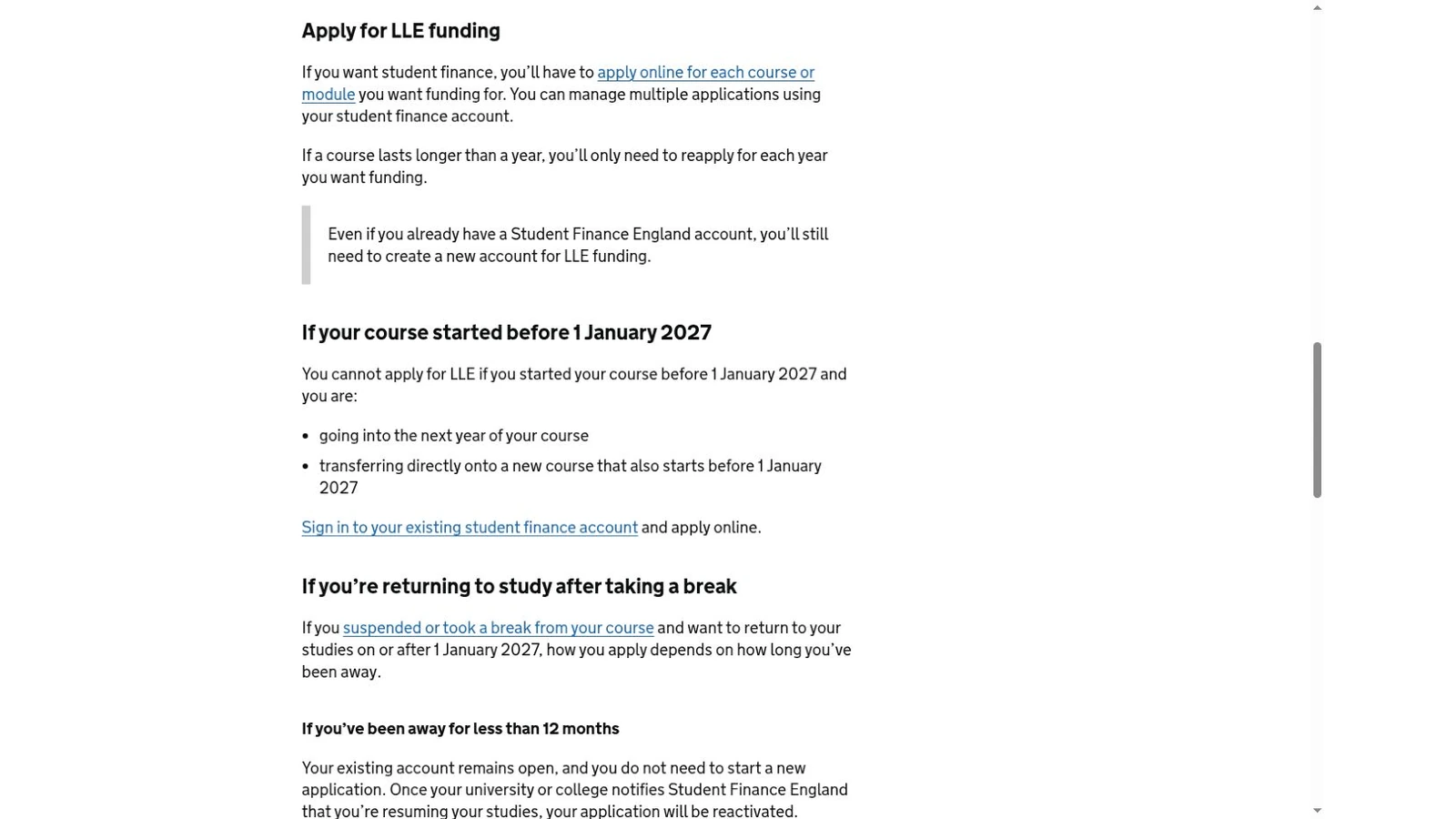
Start from the official LLE application guide and follow its online application link. The launch announcement says a GOV.UK One Login is needed. Signing in is one part of accessing the service; it does not remove the separate requirement to create a new LLE student finance account, even if you already used SFE for an earlier course. Do not expect the old SFE application record to become an LLE application automatically.
What to have ready before applying
You do not need a confirmed course offer to apply. Have the provider, course or module title, exact start date, fee and credit information ready, along with details of previous government-funded study. Confirm the course with the provider if the listing is missing or ambiguous; an advertised short course is not proof that LLE funding is available.
For identity checks, GOV.UK says digital verification can use a valid passport or driving licence. If you cannot complete that check while setting up the account, the guidance allows you to skip it and enter a valid UK passport later in the application. Other circumstances have different evidence routes: follow the official identity instructions for your nationality and documents. Do not send original documents.
For January–July 2027 starts, the household-income guidance uses the 2024–25 tax year. Household-income information is needed for more than the minimum Maintenance Loan and certain family-related grants. It is not required merely to apply for a Tuition Fee Loan or the minimum Maintenance Loan. Check which support you are requesting before asking family members for evidence.
The screenshots in this guide show public GOV.UK guidance captured on 31 October 2026. They do not show a completed application or a private student account. The eligibility and fee charts are explanatory graphics, rather than application screens.
Common problems with LLE applications and what to do
| Problem | Likely reason | Practical next action |
|---|---|---|
| Cannot find a January 2027 course | Provider has not uploaded eligible course details, or wrong service selected | Confirm programme/credits with provider, then check the LLE route. |
| Old SFE account login does not start an LLE application | New LLE account is required | Follow GOV.UK’s LLE route, use GOV.UK One Login and create the new LLE account even if you have an older SFE account. |
| A short course is not listed | It may not be among approved modules or may have insufficient credits | Ask provider for parent qualification and LLE module designation. |
| Funding estimate below £39,160 | Previous publicly funded tuition or course rules may reduce entitlement | Review official residual-entitlement estimate, not remaining loan debt. |
| Tuition loan is available but maintenance is not | Online-only study, too little entitlement, or other eligibility limit | Check attendance, residual entitlement and residence before budgeting. |
| Identity verification fails | Passport, driving-licence or identity information cannot be matched | Follow the alternative document process on the official identity guidance. |
| Enrolment confirmed but money has not arrived | Provider confirmation or banking processing may be outstanding | Check SFE status, enrolment confirmation and bank details. |
| Applicant starts an eligible course after having previously withdrawn | Existing record or return-to-study rules need attention | Verify whether the break was under 12 months or 12 months or more. |
| Cannot apply for an August or September 2027 start yet | The current opening covers January–July 2027 course starts | Use the official timetable: applications for starts from 1 August open in spring 2027. |
Special case: returning from a break
Someone returning after a break of less than 12 months from an existing course normally has their existing application reactivated when the institution informs SFE. Someone away for 12 months or longer may need a different process: continuing a pre-2027 course is not treated the same as starting a fresh post-January-2027 qualification. Read GOV.UK’s returning-student section rather than opening multiple accounts in the hope that one produces an award.
How LLE repayments work: a worked wage example
LLE tuition and maintenance borrowing follows the Plan 5 student-loan repayment structure. Under the published threshold, repayments are normally based on 9% of earnings above £25,000 a year, not 9% of the entire salary. The repayment obligation depends on income, not the size of the original tuition loan.
For a simple illustration, suppose earnings are £31,000 gross annually, the threshold remains £25,000, and the applicable 9% rate applies without other repayment complications. The difference is £6,000. Nine per cent of that is £540 per year, or approximately £45 monthly. This shows the method, not a payroll quote: actual deductions use pay periods, rounding, changing threshold rules and any interaction with other student loans. Under currently published LLE rules, any unpaid balance is normally written off 40 years after the April you first become due to repay, rather than 40 years from signing the course form. Overview and repayment terms.
Interest applies from the point the first loan payment is made and the rate can change. Do not assume that the repayment illustration predicts how much you will repay in total, or that obtaining a degree guarantees a salary rise. Consider completion, course outcomes, potential career benefits and your likely income trajectory alongside the initial loan figure.
Is an LLE-funded course worthwhile? Compare three real-world situations
First-time undergraduate, aged 19. A full-time student starting a designated three-year bachelor’s degree in January 2027 expects 120 credits each year. If otherwise eligible, the LLE is the usual application route; the financing resembles a conventional student loan, though applications and entitlement tracking differ. The headline £39,160 is a lifetime-style tuition pot, not one lump sum paid to the student. The student should check living-cost support separately.
Working graduate, aged 42. The learner already completed a previous government-funded degree but wants an approved technical module to update their computing skills. Their best first step is to obtain an SFE residual-entitlement estimate and verify that the specific module, not just the university, is listed for LLE funding. A course promising ‘stackable credits’ is worth more if the relevant qualification programme actually accepts the module. They also need to check time off work and whether the lessons require on-campus attendance.
Self-employed learner seeking a short online certificate. A 12-week online certificate advertised as ‘credit-bearing’ may still be outside the LLE scheme if it has too few credits, is not part of a funded parent course, or is offered by a provider without the necessary status. Even if the tuition loan is available for a designated distance-learning qualification, a Maintenance Loan is not automatically available for living costs. Ask the provider for written confirmation and compare alternatives before taking on loan obligations.
Before you apply: a checklist to keep
- Save your course title, provider, precise start date, level, total credits and tuition fee in one note.
- Check your opening period: apply now for January–July 2027 starts; applications for August 2027 onward open in spring 2027.
- Check OfS registration, and the approved modular list if you plan a module rather than a whole course.
- Record previous government-funded study, including abandoned courses and relevant compassionate circumstances.
- Make separate estimates for tuition borrowing, maintenance borrowing and any non-repayable support.
- Check your age on the first day of the course, residence category and evidence documents.
- Ask your provider about credit transfer and qualification recognition before committing to a modular pathway.
- Use the official SFE portal, protect personal information, and keep confirmation emails and reference numbers.
Official sources and update notes
Originally published on 27 October 2026; application guidance reviewed and updated on 31 October 2026. The update reflects the 30 October opening announcement and current operational application pages. A live GOV.UK notice takes precedence over dated examples in this article.
- Student Loans Company: applications opened on 30 October 2026 — launch confirmation and GOV.UK One Login requirement.
- Student Finance England: LLE application route — correct form and cases requiring a different service.
- When to apply and deadline rule — applications open for January–July starts, spring 2027 opening for August onward, and the earlier-of-two-dates deadline.
- LLE eligibility and age/residence conditions — level, credits, provider, previous study, age, nationality.
- Loans, credit fee examples and maintenance eligibility — £39,160, £9,790/120 credits and £1,587.50 maintenance threshold.
- Residual entitlement methodology — prior study deductions and illustrative calculations.
- Approved modular institutions and subjects — not every module at an approved institution is funded.
- Identification requirements and household-income evidence — documents and 2024–25 income year for early-2027 starters.
- Student loan repayment thresholds — Plan 5 threshold and income-based calculation.
If you normally live in England and plan an eligible new course from January 2027, start with the correct application window and course-level eligibility, then verify your individual tuition entitlement before comparing study options. A well-targeted module can offer a genuine route back to education, but an LLE loan is still borrowing and a transcript alone does not guarantee an accepted degree pathway.
You may also like
 Education & Careers
FAFSA 2027–28: How to Apply for Federal Student Aid and Avoid Costly Mistakes
Apply for FAFSA 2027–28 with a step-by-step guide to 2025 tax data, parent contributors, deadlines, SAI, corrections and…